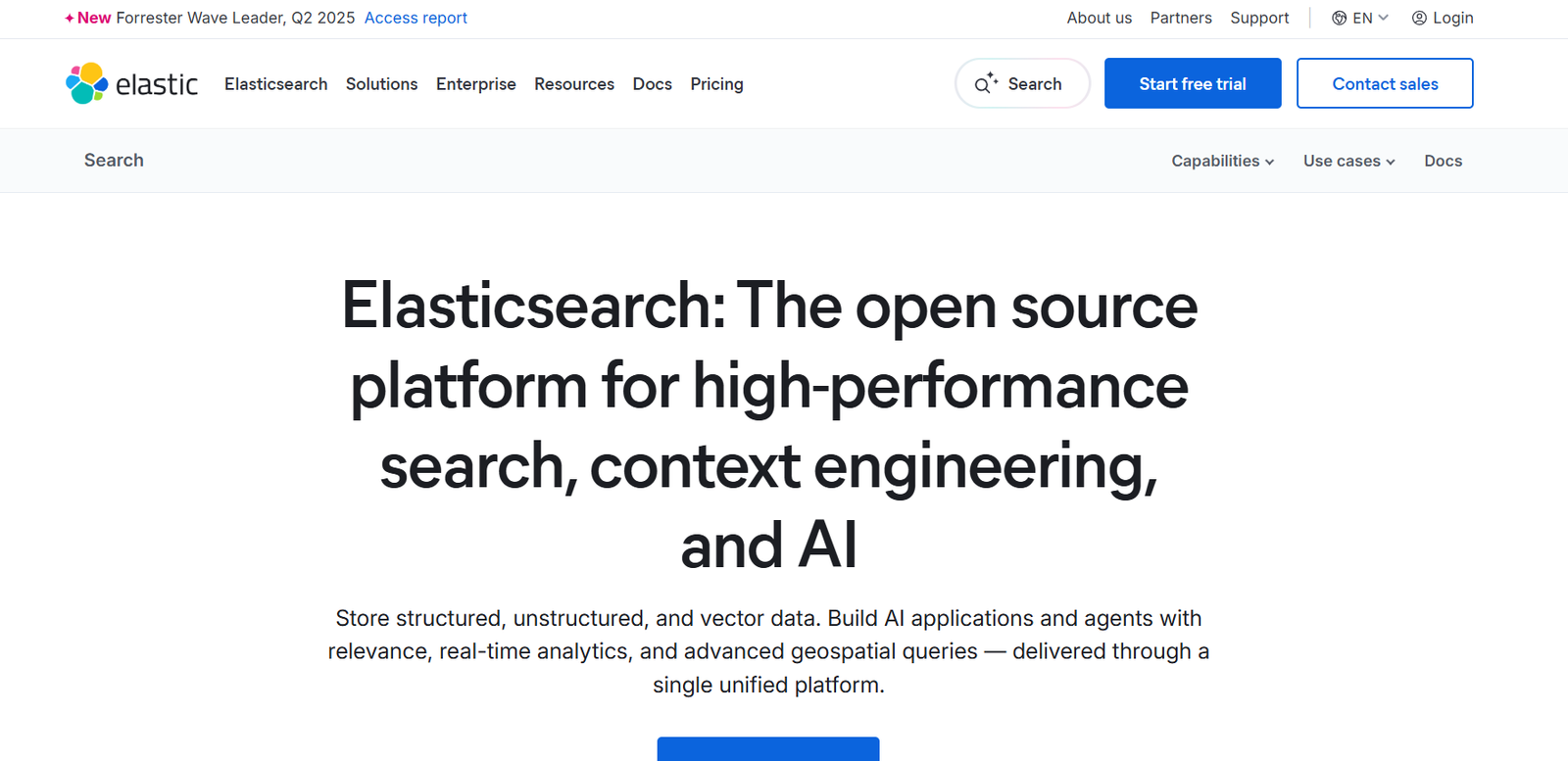
Elastic is a powerful AI-powered search platform that enables organizations to find, analyze, and secure data across all systems in real time. Best known for Elasticsearch, its open-source distributed search and analytics engine, Elastic powers solutions in enterprise search, application performance monitoring (APM), log and metric analytics, and cybersecurity.
Elastic helps organizations gain actionable insights from structured and unstructured data. The platform is widely used across industries for its speed, scalability, and flexibility. It is deployed in cloud, on-premises, and hybrid environments, with robust capabilities in full-text search, machine learning, anomaly detection, observability, and threat detection.
Elastic is part of the Elastic Stack (also known as the ELK Stack), which includes Elasticsearch, Logstash, Kibana, and Beats. Together, these tools allow developers and analysts to collect, process, visualize, and analyze large volumes of data in real time. Elastic is used by thousands of companies around the world to power search engines, monitor infrastructure, secure systems, and drive digital transformation.
Elastic: Features
Elastic offers a broad range of features that support search, observability, and security use cases.
Elasticsearch – A distributed, RESTful search engine that indexes and searches data with near real-time performance.
Kibana – A visualization interface to explore data and build dashboards using queries, filters, and machine learning models.
Logstash – A server-side data processing pipeline that ingests, transforms, and sends data to Elasticsearch.
Beats – Lightweight data shippers that send logs, metrics, and other operational data to Elasticsearch.
Semantic Search – Integrates vector search and hybrid search for improved semantic retrieval using machine learning models.
Generative AI Integration – Connects with large language models (LLMs) to enable RAG (retrieval-augmented generation) applications.
Observability – Unified monitoring of applications, infrastructure, logs, metrics, and traces from a single interface.
APM – Application Performance Monitoring tools to trace transactions and identify performance bottlenecks.
Security Information and Event Management (SIEM) – Real-time security analytics, detection, and automated response.
Anomaly Detection – Built-in machine learning to detect unusual patterns in logs, metrics, and user behavior.
Data Ingestion – Scalable ingestion from cloud services, APIs, databases, and streaming platforms like Kafka.
Enterprise Search – Customizable search for websites, applications, and workplaces with relevance tuning and analytics.
Role-Based Access Control – Secure user access with fine-grained permissions and audit logging.
Elastic: How It Works
Elastic works by indexing data into Elasticsearch, where it can be searched, filtered, and analyzed in real time. Users can collect data from multiple sources using Beats and Logstash, then visualize and interact with that data through Kibana.
Elasticsearch stores data as JSON documents and indexes them for fast retrieval. When a user sends a search query, Elasticsearch uses inverted indexes, scoring algorithms, and optional vector similarity to return relevant results quickly. The data can be structured (e.g., metrics) or unstructured (e.g., text, logs).
For observability, data is collected from applications, infrastructure, and cloud platforms. It is then analyzed for performance monitoring and root-cause analysis. Elastic APM instruments applications to provide detailed trace data, helping developers monitor latency and detect issues.
In security use cases, Elastic SIEM ingests logs and event data from systems, applies detection rules and ML-based anomaly detection, and triggers alerts for suspicious activity.
For AI and semantic search applications, Elastic supports dense vector indexing and retrieval, allowing hybrid and semantic search using sentence embeddings. It also integrates with LLMs to support retrieval-augmented generation, where search results are fed to a language model to generate accurate answers or summaries.
Elastic: Use Cases
Elastic supports a wide range of enterprise use cases across industries and technical domains.
Enterprise Search – Build intelligent, custom search for websites, ecommerce, help centers, and intranet platforms.
Observability – Monitor infrastructure, cloud services, and applications with unified visibility and automated anomaly detection.
Security Operations – Detect, investigate, and respond to threats using Elastic SIEM and endpoint security capabilities.
Log Analytics – Centralize logs from across services and systems for troubleshooting, compliance, and monitoring.
Business Intelligence – Use real-time data analytics and visualization to inform decisions and track performance.
AI and ML-Powered Search – Enable semantic and hybrid search by integrating vector search with traditional keyword matching.
Chatbots and RAG Systems – Feed search results to LLMs to generate responses using retrieval-augmented generation for accurate, data-backed answers.
Incident Management – Monitor service health and performance to reduce mean time to resolution (MTTR) during incidents.
E-commerce Optimization – Analyze search behavior, recommend products, and improve conversions through relevance tuning.
Compliance and Audit – Retain and query system logs and user actions for compliance and audit requirements.
Elastic: Pricing
Elastic offers both open-source and commercial offerings. Pricing is available for Elastic Cloud as well as self-managed deployments.
Elastic Cloud Free Tier – Includes limited ingestion and storage for development and testing. Comes with basic features and is suitable for evaluation.
Standard Plan – Offers core features including Elasticsearch, Kibana, and basic observability. Pricing is based on resource usage (RAM, storage, ingest).
Gold Plan – Adds machine learning, role-based access, alerting, and more advanced security features.
Platinum Plan – Includes all Gold features plus Elastic SIEM, endpoint security, and enhanced machine learning capabilities.
Enterprise Plan – Custom pricing for large organizations requiring advanced security, support SLAs, and deployment flexibility.
Elastic’s pricing is primarily resource-based and measured in Elastic Consumption Units (ECUs). Billing is monthly and transparent via the Elastic Cloud console. Users can choose their cloud provider (AWS, GCP, Azure) and region for deployment.
For self-managed deployments, licensing costs apply only when using commercial features not available in the open-source Basic license.
Elastic: Strengths
Elastic offers several core advantages that make it a market leader in search and observability.
Open Source Core – Provides transparency, extensibility, and a strong developer community.
Unified Platform – Combines search, observability, and security into a single stack with a shared data layer.
Real-Time Performance – Delivers low-latency data ingestion and search across massive datasets.
Scalable Architecture – Handles petabytes of data with horizontal scalability across distributed environments.
AI and LLM Integration – Supports hybrid search and retrieval-augmented generation workflows.
Powerful Query Language – DSL (domain-specific language) allows complex filtering, scoring, and aggregations.
Cross-Platform Support – Works across cloud providers, hybrid environments, and on-premise data centers.
Enterprise-Ready – Offers security, access controls, audit logs, and 24/7 support for mission-critical applications.
Extensive Ecosystem – Integrates with cloud services, databases, data lakes, Kafka, and other enterprise tools.
Elastic: Drawbacks
While Elastic is a powerful and mature platform, it comes with certain limitations.
Learning Curve – Requires time to understand indexing strategies, queries, and Kibana dashboards.
Resource Intensive – Performance and reliability depend on correct infrastructure sizing and tuning.
Cost at Scale – In high-ingest or storage-heavy environments, cloud costs may grow quickly.
Complex Configuration – Advanced features such as vector search, ML models, and SIEM require deeper configuration knowledge.
Feature Gating – Some advanced features like machine learning and SIEM are only available in paid tiers.
Upgrades and Maintenance – Self-managed clusters require careful upgrades, especially when scaling.
Elastic: Comparison with Other Tools
Elastic is often compared to OpenSearch, Splunk, Datadog, and newer vector databases like Pinecone or Weaviate.
Compared to OpenSearch, Elastic provides more advanced features, stronger commercial support, and richer observability and security tools. OpenSearch is a community-driven fork of older versions of Elasticsearch.
Against Splunk, Elastic is more developer-friendly and open-source at its core, while Splunk emphasizes ease of use for non-technical teams and provides a managed interface.
Compared to Datadog, Elastic is more customizable and cost-effective at scale, but Datadog offers a more opinionated SaaS experience with tighter integrations for metrics and logs.
Versus Pinecone or Weaviate, Elastic offers hybrid search with both vector and keyword search, whereas those platforms specialize exclusively in vector data. Elastic’s strength is in its integration of traditional search, observability, and security with growing AI capabilities.
Elastic: Customer Reviews and Testimonials
Elastic is used by thousands of organizations worldwide, including Netflix, Cisco, Adobe, and the US Department of Defense.
Customers praise its scalability, speed, and flexibility. One enterprise user noted, “Elastic helps us centralize all our logs and metrics, giving us real-time observability we couldn’t achieve otherwise.”
Developers appreciate the open-source foundation and the ability to deploy Elastic in any environment. Security teams highlight Elastic’s SIEM as a robust tool for threat detection and compliance.
The Elastic community is active and global, with frequent contributions, meetups, and forums that support continuous learning and adoption.
Conclusion
Elastic is a comprehensive, AI-powered platform for search, observability, and security, built on the strength of Elasticsearch and the wider Elastic Stack. Whether you are building semantic search applications, monitoring cloud infrastructure, or defending against cybersecurity threats, Elastic provides a flexible and scalable solution.
With integrations for LLMs, support for hybrid and vector search, and deep capabilities in real-time analytics, Elastic is a forward-looking platform ready for the demands of AI and data-driven innovation. Its open-source core, combined with enterprise-grade features and cloud-native deployment options, makes it a powerful tool for developers and enterprises alike.