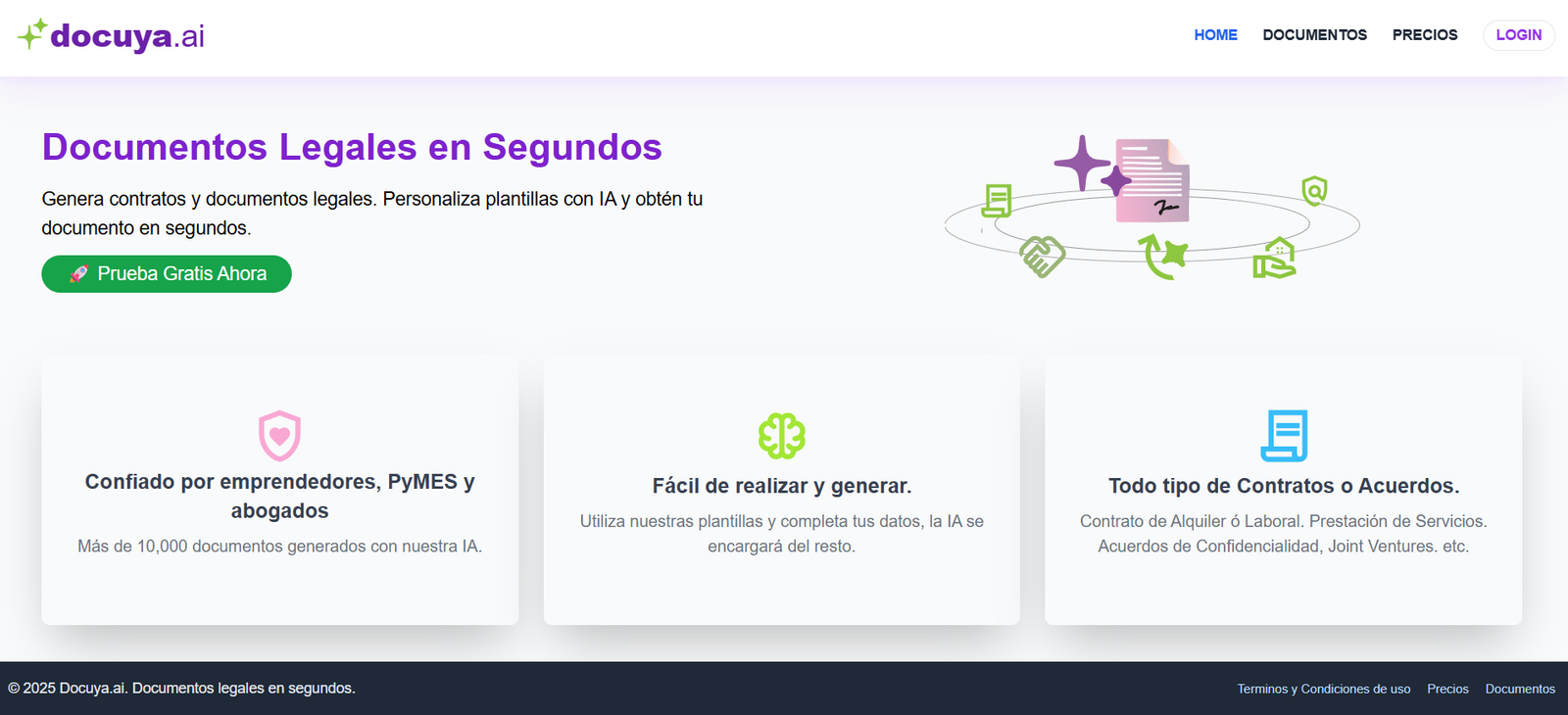
DocuYA is an AI-powered platform designed to automate the creation of legal documents for lawyers, law firms, in-house counsel, and legal teams. With a focus on speed, accuracy, and customization, DocuYA transforms traditional contract drafting workflows by leveraging machine learning and natural language processing to generate legal documents based on user input.
The platform eliminates the need to manually draft repetitive agreements and templates, providing a reliable, intelligent document automation solution that enhances legal productivity. Built specifically for the legal industry, DocuYA ensures that legal teams can produce compliant, error-free documents at scale while maintaining full control over content and structure.
DocuYA’s mission is to help legal professionals focus on higher-value work by reducing the time spent on routine drafting.
Features
DocuYA provides a range of powerful features tailored for modern legal workflows.
AI Document Drafting: Automatically generates legal documents including contracts, agreements, and letters based on user prompts and predefined templates.
Custom Template Creation: Allows law firms to build and reuse their own legal templates, which can be modified by AI for different scenarios.
Clause-Level Editing: Users can edit specific clauses, insert variables, and apply conditional logic for highly personalized outputs.
Collaborative Drafting: Enables teams to collaborate on document creation in real time, with version control and role-based access.
Language Precision: Built with legal-specific language models to ensure clarity, consistency, and enforceability.
Data Input Forms: Collects necessary information through guided forms to eliminate drafting errors and inconsistencies.
Document Export: Generated documents can be exported in formats like Word or PDF, ready for review or signature.
Security and Compliance: Ensures all data is encrypted and stored according to enterprise-grade privacy standards.
Integration Friendly: Supports integration with legal CRMs, contract management systems, and cloud storage platforms.
How It Works
DocuYA is a cloud-based platform accessible through a secure web portal. Users begin by selecting a document type or uploading their own template. The platform prompts users to fill in required information through a smart form or by interacting with a conversational AI assistant.
Once the necessary inputs are provided, DocuYA’s AI processes the data and generates a draft that includes appropriate clauses, formatting, and terminology. Users can then edit the document directly within the platform or collaborate with colleagues before exporting the final version.
Advanced users can create dynamic templates with variables and conditions, allowing for fully customized document generation at scale. The system continuously learns from user interactions to improve accuracy and relevance over time.
Use Cases
DocuYA is suitable for a wide range of legal and business applications where document consistency and speed are critical.
Law Firms: Generate client contracts, engagement letters, and legal opinions faster and with fewer resources.
In-House Legal Teams: Automate routine agreements such as NDAs, service contracts, and compliance letters across departments.
Contract Managers: Manage large volumes of contracts with automated generation and version tracking.
Legal Process Outsourcing: Standardize document workflows for legal service providers supporting multiple clients.
HR and Operations Teams: Create employment agreements, policy documents, and internal compliance materials with minimal legal overhead.
Corporate Legal Departments: Streamline internal legal documentation, including procurement, vendor agreements, and partnership contracts.
Pricing
As of the latest available information, DocuYA does not list public pricing on its website. The platform appears to offer customized pricing based on firm size, number of users, and volume of document generation.
Custom Quotes: Law firms and corporate teams can request a tailored demo and pricing proposal directly through the website.
Free Demo: A demo is available upon request to evaluate features and platform usability.
Subscription Model: Pricing likely follows a monthly or annual subscription structure with tiered access based on usage and team size.
Enterprise Licensing: For large organizations, DocuYA provides bulk licensing and additional customization options, including API access and support.
Strengths
DocuYA offers several key advantages that make it a valuable asset for legal professionals.
Time Savings: Reduces hours spent on manual drafting by generating documents in minutes.
Customization: Offers fully editable templates and supports dynamic clause insertion for various legal scenarios.
Accuracy: Minimizes drafting errors with structured input forms and AI language validation.
Collaboration: Enables real-time editing and review across teams with access controls.
Consistency: Ensures brand and legal tone consistency across all firm-generated documents.
Scalability: Suitable for both solo lawyers and enterprise legal teams handling high document volume.
Data Security: Meets modern security standards, making it safe for sensitive legal information.
Integration Capabilities: Compatible with external systems, improving workflow continuity.
Drawbacks
While DocuYA is a powerful legal automation platform, there are some limitations to consider.
No Public Pricing: Lack of upfront pricing may delay evaluation for budget-conscious users.
Requires Onboarding: Custom template creation and system setup may require initial training or support.
Limited Legal Advice: The platform assists with drafting but does not replace legal review or judgment.
AI Dependency: Generated documents should still be reviewed by legal professionals to ensure accuracy and appropriateness.
Internet Required: As a cloud-based tool, it requires a stable internet connection for full functionality.
Not a Full CLM: DocuYA is focused on document generation and does not replace full contract lifecycle management platforms.
Comparison with Other Tools
Compared to tools like Lawyaw or Woodpecker, DocuYA offers more AI-based drafting capabilities, whereas competitors often rely solely on template automation. Lawyaw integrates with Clio and focuses on court forms, while DocuYA supports broader contract types and firm-specific templates.
Against AI platforms like Spellbook or Harvey AI, which provide clause suggestions during contract negotiation or legal research capabilities, DocuYA emphasizes rapid, complete document generation over AI-assisted legal argumentation.
DocuYA also compares favorably with HotDocs and Contract Express, known for enterprise-level document automation but requiring complex setup. DocuYA offers a more user-friendly and modern UI with AI support for faster template adaptation.
Customer Reviews and Testimonials
Customer feedback for DocuYA highlights its ease of use, time-saving benefits, and the ability to maintain high legal standards across automated documents.
A managing partner at a midsize law firm stated, “DocuYA cut our contract drafting time by over 60 percent. It’s like having a junior associate ready to go 24/7.”
An in-house counsel for a tech company commented, “We use DocuYA for vendor agreements and NDAs. The platform ensures consistency across departments and reduces back-and-forth with legal.”
Users appreciate the intuitive interface, the ability to collaborate with team members, and the platform’s flexible template management options.
Conclusion
DocuYA is a next-generation legal document automation platform that empowers legal teams to draft faster, with greater consistency and less manual effort. Whether you’re a solo attorney looking to scale your drafting capabilities or a corporate legal department managing hundreds of contracts, DocuYA offers a secure, customizable, and AI-enhanced solution that streamlines legal document workflows.
By eliminating repetitive drafting tasks, reducing errors, and enabling team collaboration, DocuYA frees up time for legal professionals to focus on strategic, high-impact work. It represents a practical step toward digital transformation in legal practice.