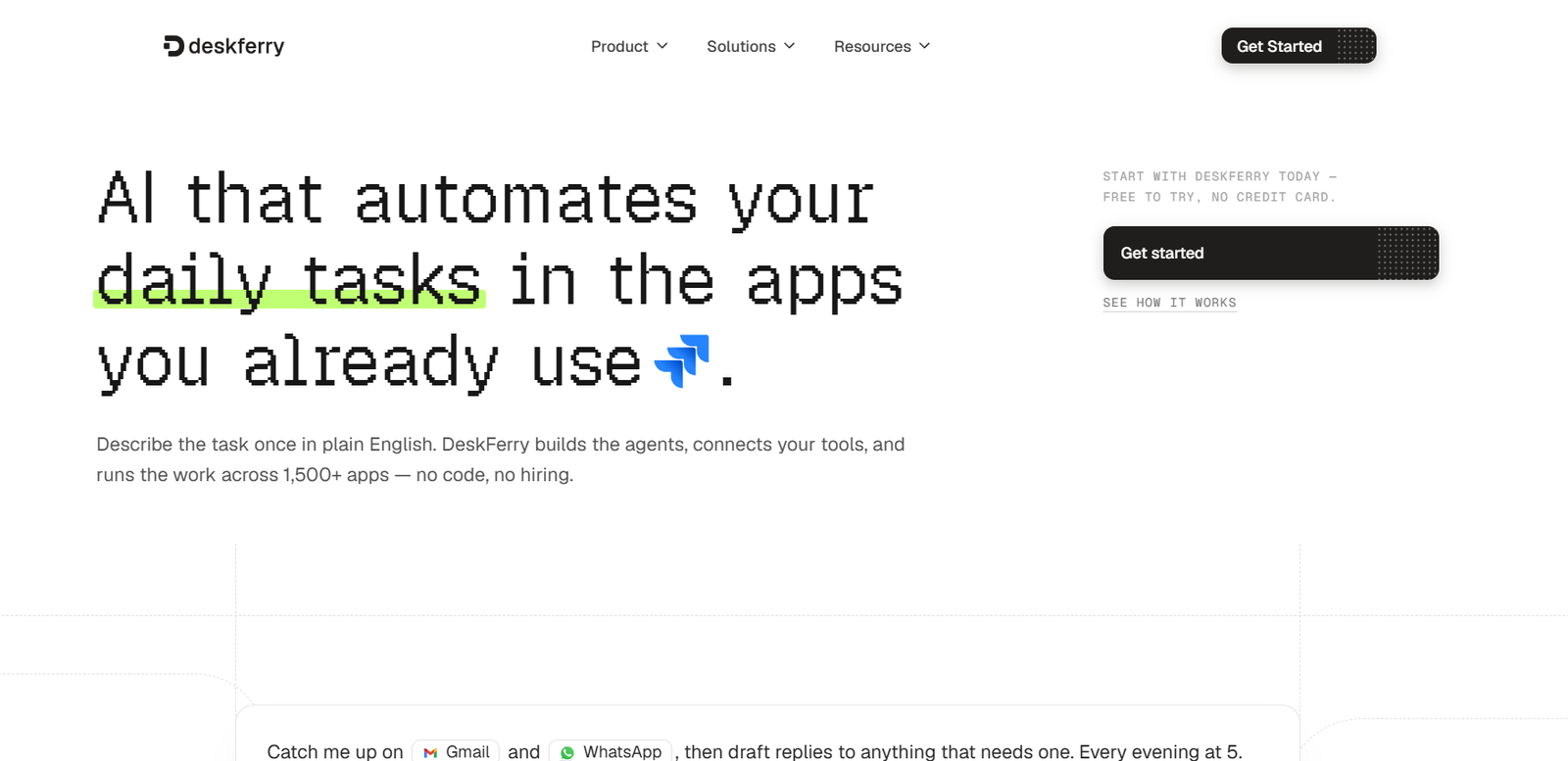
DeskFerry is an AI automation platform designed to help businesses create AI agents that can perform recurring tasks across the applications they already use. Instead of manually building complex workflows, users can describe what they want automated in plain language, connect their business tools and allow DeskFerry to build and run the required AI agents.
The platform is particularly suited to founders, small businesses, operations teams, sales teams, customer support departments and growing companies that want to reduce repetitive manual work. DeskFerry agents can work with more than 1,500 applications, including Gmail, Slack, Notion, HubSpot, Salesforce, Stripe, Jira, Asana and other commonly used business platforms.
DeskFerry also supports multiple AI models from providers such as OpenAI, Anthropic, Google, xAI and others. Users can create agents for tasks such as lead qualification, customer support, reporting, data entry, email follow-ups and other business processes.
Features
No-Code AI Agent Builder
DeskFerry allows users to describe a job or workflow in everyday language. The platform can then create an AI agent to carry out the required tasks, reducing the need for programming or complex automation setup.
1,500+ App Integrations
The platform connects with more than 1,500 applications. These integrations allow AI agents to access information and perform actions across CRM systems, communication platforms, productivity tools, databases and other business software.
Multiple AI Models
Users can work with models from providers including OpenAI, Anthropic, Google, xAI, Mistral and others. This provides flexibility when different AI capabilities are required for different tasks.
Scheduling and Event Triggers
AI agents can operate according to predefined schedules or respond when specific events occur in connected applications. For example, an agent could process new leads when they enter a CRM or prepare a report every week.
Human Approval Controls
DeskFerry includes human-in-the-loop functionality. Businesses can require approval before an AI agent performs sensitive actions such as sending an email or modifying an important business record.
Knowledge Integration
Users can provide documents, databases and URLs as knowledge sources. AI agents can use this information as additional context while performing assigned tasks.
Agent Memory
DeskFerry includes memory capabilities that allow automations to retain useful context from previous interactions and user preferences. This can reduce the need to repeatedly provide the same instructions.
Custom Skills
Businesses can teach agents specific working methods, such as following a particular brand voice, preparing standardized reports or saving information in a required format.
API and Embedded Chat
DeskFerry automations can be accessed through an API, embedded chat interfaces, Slack and email, allowing companies to use their agents in different environments.
Ready-Made Agent Marketplace
The platform provides an agent marketplace where users can explore ready-to-deploy agents for areas such as sales, customer support, operations and back-office activities.
How It Works
Step 1: Create an account
Users start by creating a DeskFerry account and accessing its AI agent platform.
Step 2: Describe the task
The user explains in plain language what they want the AI agent to accomplish. This could include qualifying leads, managing support requests, preparing reports or handling routine administrative work.
Step 3: Connect applications
Users connect the applications required for the workflow, such as Gmail, Slack, Salesforce, HubSpot, Notion or other supported platforms.
Step 4: Configure the AI agent
The agent can be provided with instructions, knowledge sources, custom skills and the appropriate AI model for the task.
Step 5: Add triggers or schedules
Users determine when the automation should operate. Tasks can run on a schedule or begin automatically when an event occurs in a connected application.
Step 6: Add approval requirements
For important actions, businesses can configure the workflow so that human approval is required before the agent proceeds.
Step 7: Test and deploy
The workflow can be tested before deployment. Once active, the agent can perform the assigned tasks automatically.
Use Cases
Sales Teams
Sales teams can use DeskFerry for lead qualification, CRM updates, prospect research and follow-up activities. Agents can collect information from connected systems and route promising leads to sales representatives.
Customer Support
Businesses can create agents to classify incoming support requests, answer routine questions and direct more complicated issues to appropriate team members.
Operations
Operations teams can automate repetitive activities such as data entry, invoice follow-ups, information processing and recurring reports.
Marketing
Marketing teams can use agents to move information between marketing applications, prepare content-related workflows and automate repetitive campaign processes.
Founders and Small Businesses
Solo founders and smaller teams can use DeskFerry as an AI assistant for recurring administrative and operational work that would otherwise consume significant working time.
Agencies
Agencies managing several clients can use AI agents to automate recurring workflows and organize work across separate processes or workspaces.
Internal Business Processes
Organizations can create customized agents for finance, back-office administration, reporting, research and other repetitive internal processes.
Pricing
DeskFerry currently displays three main paid plans on its official website, with a free trial available and no credit card required to begin.
Starter: $19 per month
Designed for users who want to automate an initial workflow. The plan includes unlimited agents, while usage is governed by the amount of work performed through the platform.
Growth: $49 per month
Designed for businesses that want to operate several AI workflows across areas such as sales, customer support and operations.
Pro: $99 per month
Designed for organizations running multiple workflows and AI agents across teams.
DeskFerry states that unlimited agents are available across its plans, while plans primarily differ according to the amount of work and platform capacity provided. Paid subscriptions renew automatically until cancelled.
Pricing and plan features may change, so users should check the official pricing page before subscribing.
Strengths
Simple agent creation: Users can describe tasks in natural language rather than relying entirely on technical workflow configuration.
Large integration ecosystem: Support for more than 1,500 applications makes DeskFerry suitable for businesses already using multiple cloud tools.
No-code approach: Non-technical users can create business automations without needing to develop their own AI infrastructure.
Multiple AI models: Access to models from several major AI providers gives businesses more flexibility for different workflows.
Human approval: Approval controls can help businesses maintain oversight when automations perform important actions.
Knowledge and memory: Agents can use connected information and retain useful context, making them more suitable for ongoing workflows.
Wide range of business applications: The platform can support sales, customer service, marketing, operations and administrative processes.
Drawbacks
DeskFerry may require some initial configuration to connect applications, define instructions and test workflows before they can be trusted with important business processes.
The credit or usage system may also require businesses to monitor consumption, particularly when several agents are operating frequently.
Although the platform reduces the technical knowledge required for automation, complicated business processes may still require careful workflow design and human supervision.
Businesses dealing with sensitive or regulated information should independently evaluate the platform’s security, privacy and compliance features before connecting critical systems.
Comparison with Other Platforms
DeskFerry operates in the broader AI agent and workflow automation market alongside platforms such as Zapier, Make, Lindy and developer-focused agent frameworks.
Traditional automation platforms commonly focus on predefined triggers and actions between applications. DeskFerry places greater emphasis on AI agents that can interpret instructions, make decisions and perform multi-step tasks across connected tools.
Compared with developer-oriented AI agent frameworks, DeskFerry provides a more accessible no-code approach. This may make it attractive to businesses that want AI automation without building and maintaining their own agent infrastructure.
The best choice will depend on whether a business primarily needs traditional workflow automation, advanced developer customization or autonomous AI agents capable of handling recurring business tasks.
Customer Reviews and Testimonials
The DeskFerry website displays customer testimonials describing the use of its AI agents for lead management, customer support and operational tasks.
One example describes using a DeskFerry agent to automate manual lead sorting, qualification, CRM updates and routing prospects to sales. Another testimonial describes using an AI agent to handle initial customer support queries and escalate more complicated requests.
The website also presents a testimonial from an operations professional describing the use of DeskFerry for invoice follow-ups, data entry and weekly reporting.
These testimonials are presented by DeskFerry on its own website and should be viewed as company-published customer feedback rather than independent third-party reviews.
Conclusion
DeskFerry is a practical AI agent platform for businesses that want to move beyond simple chatbots and automate recurring work across their existing applications. Its combination of natural-language agent creation, more than 1,500 integrations, multiple AI models, scheduling, memory, knowledge sources and human approval controls makes it suitable for a wide range of business workflows.
It may be particularly useful for founders, small and growing businesses, agencies, sales teams, customer support departments and operations teams that spend significant time on repetitive digital tasks. Organizations looking for no-code AI agents that can work across multiple business applications may find DeskFerry worth exploring.