DesiVocal was an AI powered text to speech and voice generation platform designed with a strong focus on Indian languages and voices. It allowed users to convert written text into natural sounding speech and was aimed at content creators, businesses, educators, developers and professionals who needed voiceovers without recording audio manually.
The platform supported languages including Hindi, English, Indian English, Tamil, Telugu, Punjabi, Bengali, Marathi, Malayalam, Assamese, Kannada, Urdu and Arabic. This made it particularly relevant for creators and organizations producing multilingual content for Indian audiences.
Apart from text to speech generation, DesiVocal also offered speech to speech voice transformation. Users could upload recorded audio and transform the original voice into another AI voice while retaining natural speech characteristics.
DesiVocal also provided API access and enterprise oriented voice AI capabilities for developers and organizations that wanted to integrate speech generation into their applications or workflows.
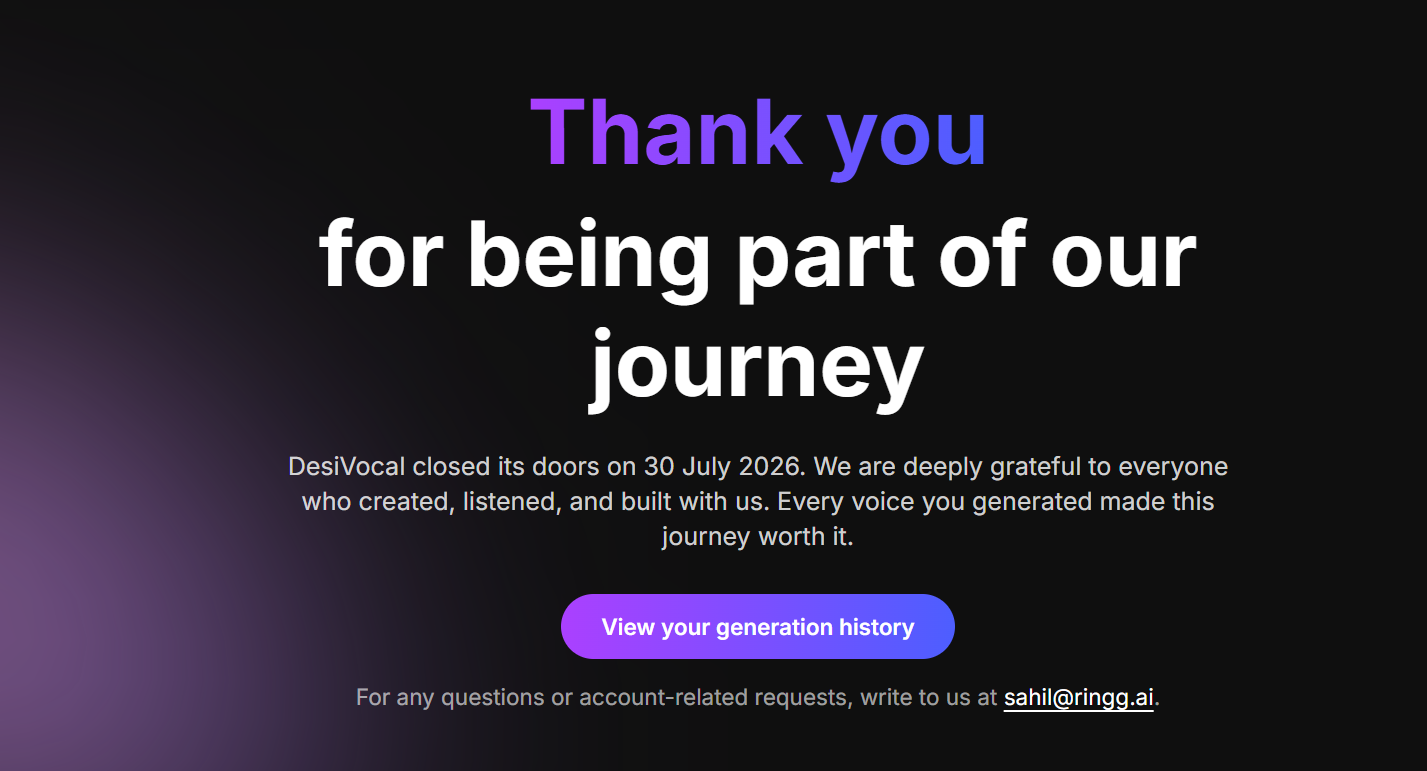
Important: DesiVocal has now discontinued its regular service. Its official website states that the platform closed on July 30, 2026. Therefore, it should be considered a discontinued AI tool rather than an actively available voice generation service.
Features
AI Text to Speech
DesiVocal converted written text into AI generated speech. Users could enter their scripts and select an appropriate voice to produce audio for videos, presentations, educational material and other content.
Indian Language Support
One of the platform’s main strengths was its focus on Indian languages. It provided text to speech options for Hindi, Indian English, Tamil, Telugu, Punjabi, Bengali, Marathi, Malayalam, Assamese, Kannada and Urdu, along with languages such as English and Arabic.
AI Voice Changer
DesiVocal offered speech to speech technology that could transform an uploaded voice recording into another AI generated voice. The system analyzed characteristics such as tone and pitch before generating the transformed audio.
Multiple AI Voices
The voice changer provided more than 20 voice options. This gave users flexibility when choosing a voice suited to narration, entertainment, educational material or professional content.
Multilingual Voice Transformation
Users could work with multiple languages when generating or transforming voices. This capability was useful for creators producing localized content for audiences speaking different languages.
Voice Customization
The platform was designed to provide control over voice characteristics and presentation, helping users select voices that better matched the intended style of their project.
API Access
DesiVocal provided an API for developers. Applications could send text and a selected voice ID to the API to generate text to speech audio programmatically.
Enterprise and On Premise Deployment
DesiVocal also offered an on premise option for organizations requiring greater control over their voice AI infrastructure. The solution emphasized keeping data within an organization’s infrastructure, customizable inference and integration flexibility.
Low Latency Enterprise Processing
Its on premise offering advertised latency below 400 milliseconds, making the technology potentially useful for applications requiring relatively fast voice responses.
How It Works
Users would first create or log in to a DesiVocal account and access the Vocal Studio.
For text to speech, the user could select the required language and AI voice, enter or paste the written script and generate the corresponding audio.
For speech to speech transformation, users could upload an audio recording, select a target AI voice and allow the system to analyze and transform the original speech.
Developers could use DesiVocal’s API by obtaining an API key from their workspace and connecting their application to the text to speech API. A voice ID and text input were then supplied when requesting generated speech.
Organizations requiring private infrastructure could previously contact DesiVocal about its on premise voice AI deployment.
However, new users can no longer follow the normal generation process because DesiVocal officially closed its service in July 2026.
Use Cases
YouTube and Video Creators
Creators could generate narration for YouTube videos, Shorts, explainers and other video content without recording every voiceover manually.
Podcasters
Written scripts and articles could be converted into spoken audio, making the platform useful for experimenting with podcast style content.
Businesses
Companies could use generated voices for presentations, promotional material, product explanations and multilingual customer communication.
Developers
API access allowed developers to integrate text to speech generation into applications, websites and automated workflows.
Education
Teachers and educational content creators could turn written learning material into audio and create multilingual learning resources.
Audiobooks
Long form written material could be transformed into narrated audio, although the quality and suitability would depend on the selected voice and source text.
Dubbing and Localization
Its support for multiple Indian languages made DesiVocal useful for producing localized audio and experimenting with multilingual dubbing.
Customer Service
Voice AI technology could also support automated telephone and customer interaction applications, including conversational voice based systems.
Pricing
DesiVocal previously offered paid character packs and other voice generation options. Its enterprise on premise solution mentioned a minimum commitment of $2,500 for custom hosting.
However, these prices should no longer be treated as current purchasing options. DesiVocal announced the discontinuation of the service, disabled new purchases during its shutdown period and officially closed on July 30, 2026.
Therefore, there is currently no active standard pricing plan available for new DesiVocal users.
Strengths
DesiVocal’s biggest strength was its strong focus on Indian languages and voices. This made the platform particularly useful for creators who needed Hindi and regional Indian language voiceovers.
Its combination of text to speech, speech to speech transformation, multiple voices and developer API access made it suitable for both individual creators and technical users.
The availability of an on premise deployment option was another advantage for organizations concerned about data control, privacy and integration with their own infrastructure.
The platform also addressed a practical need for multilingual content production, particularly for India’s diverse linguistic audience.
Drawbacks
The most significant drawback is that DesiVocal is no longer operational as an active AI voice generation platform. The official website confirms that the service closed on July 30, 2026.
This means new users cannot rely on it for ongoing text to speech projects, subscriptions or regular production workflows.
As with most AI generated speech systems, output quality could also vary depending on the selected voice, language, pronunciation and complexity of the supplied text.
Users looking for a currently supported AI voice platform will need to consider active alternatives.
Comparison with Other Platforms
DesiVocal competed in the same general category as AI voice and text to speech platforms that convert written content into realistic speech.
Its notable difference was its emphasis on Indian voices and regional languages. This made it particularly relevant for users producing Hindi and multilingual Indian content rather than focusing primarily on international English voices.
The combination of text to speech, voice transformation, API access and on premise deployment also gave DesiVocal applications beyond basic online voiceover generation.
However, this comparison has fundamentally changed because DesiVocal has discontinued its service. Active AI voice platforms now have an important advantage in ongoing product development, customer access and availability.
Customer Reviews and Testimonials
Customer reviews and testimonials are not clearly available on the official website in a form that can be reliably presented as current verified customer feedback.
Conclusion
DesiVocal was an interesting AI voice generation platform with a particularly useful focus on Indian languages, regional voices and multilingual content production. Its text to speech capabilities, AI voice changer, API and enterprise deployment options made it suitable for creators, developers, educators and businesses.
Its support for Hindi and numerous regional Indian languages was especially valuable for users creating content for India’s diverse audience.
However, anyone discovering DesiVocal today should be aware of one critical fact: the platform officially closed on July 30, 2026. It should therefore be listed as a discontinued AI tool rather than recommended as an active service.
For an AI tools directory, DesiVocal can still be useful as a reference to an Indian focused AI voice platform, but visitors looking to generate new voiceovers should consider currently active alternatives.