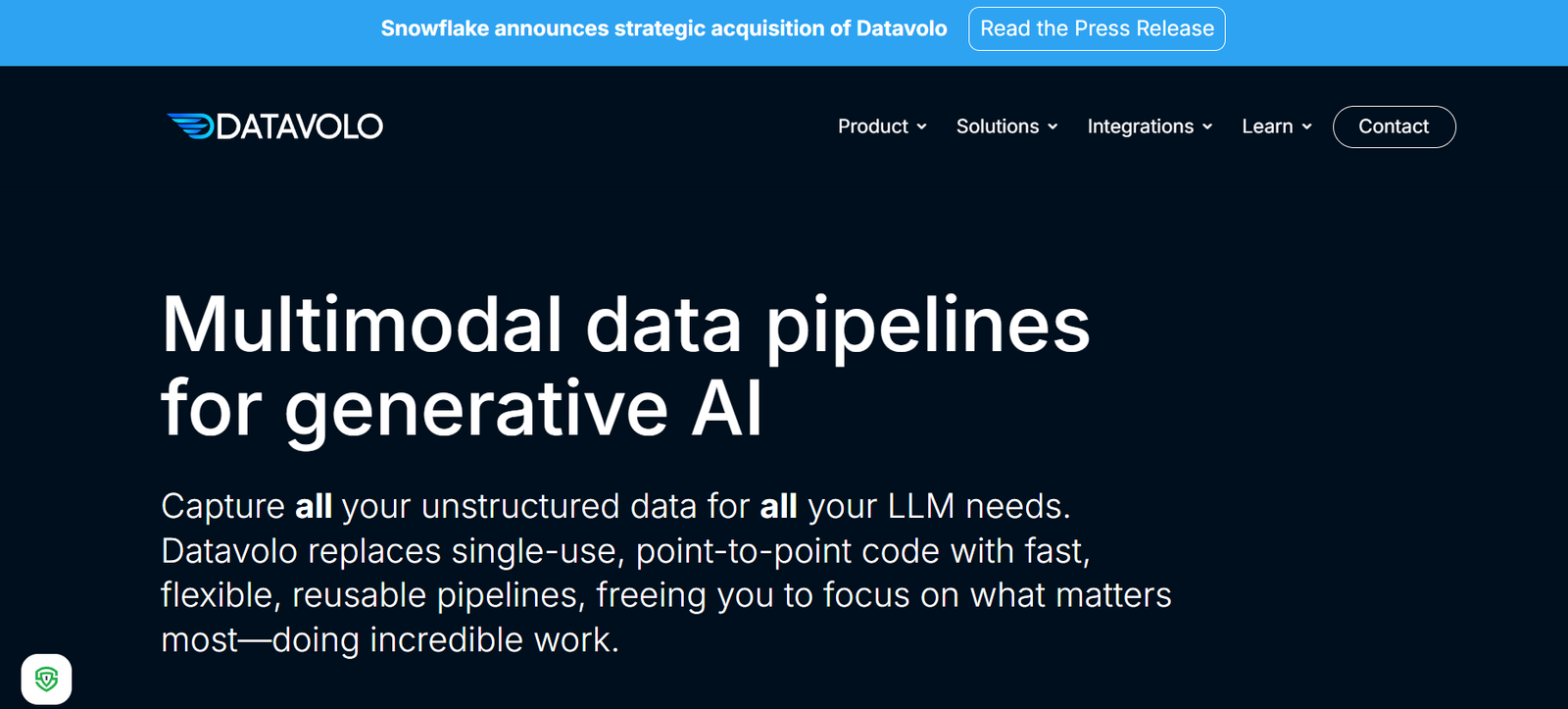
Datavolo is a next-generation data ingestion and streaming platform built from the ground up to handle the scale and complexity of modern cloud-native architectures. Unlike traditional data ingestion tools that were designed for static environments, Datavolo is optimized for real-time data pipelines, event streaming, and cloud-scale deployments, offering enterprises a powerful way to move, transform, and operationalize data across systems.
Created by a team of engineers with deep experience in large-scale distributed systems, Datavolo provides a unified platform for ingesting structured and unstructured data from various sources and streaming it to destinations like data lakes, warehouses, and analytics platforms—all while ensuring performance, observability, and scalability.
Features
Datavolo delivers a robust set of features focused on cloud-native, real-time data ingestion and orchestration:
Scalable Data Ingestion
Designed to handle high-throughput ingestion from databases, APIs, files, IoT devices, and message queues with low latency.Streaming First Architecture
Native support for streaming pipelines using Apache Pulsar under the hood, ensuring real-time processing and delivery.Schema Registry & Validation
Automatically manages schemas to ensure consistency and prevent data corruption across the pipeline.Change Data Capture (CDC)
Supports CDC from popular databases like PostgreSQL, MySQL, and MongoDB to enable near-instant replication and analytics.Flexible Connectors
Ingest and export data to and from Kafka, S3, Snowflake, Redshift, BigQuery, and other cloud-native tools.Pipeline Observability
Real-time metrics, logs, and dashboards to monitor pipeline health and data flow.Cloud-Native Deployment
Runs seamlessly on Kubernetes and integrates with cloud-native services like AWS, GCP, and Azure.Secure by Design
Built-in support for role-based access control (RBAC), audit logging, TLS encryption, and API security.
How It Works
Datavolo simplifies complex data movement through a modular, stream-based ingestion model:
Connect to Sources
Easily configure data sources (e.g., relational databases, NoSQL, APIs, files, IoT endpoints) using prebuilt connectors.Define Pipelines
Create data pipelines that can ingest, filter, transform, and stream data to multiple destinations.Stream & Transform in Real-Time
Data is streamed through a Pulsar-based pipeline, where it can be enriched, reshaped, or routed based on defined rules.Deliver to Destinations
Final outputs can be sent to cloud data warehouses, real-time analytics systems, or storage platforms for further processing.Monitor & Scale
Use the built-in observability stack to monitor throughput, latency, errors, and bottlenecks, and scale pipelines dynamically based on load.
This architecture allows data teams to build resilient and responsive data systems without managing complex infrastructure.
Use Cases
Datavolo is ideal for modern enterprises looking to ingest and stream data at scale across various domains:
Real-Time Analytics
Enable up-to-the-second dashboards and alerts by streaming data directly into analytical systems like BigQuery or Snowflake.ETL/ELT Automation
Automate the ingestion and transformation of structured and semi-structured data with flexible pipeline orchestration.IoT Data Ingestion
Stream telemetry and sensor data from millions of devices with high throughput and low latency.Data Lake Ingestion
Continuously ingest data into object storage (like S3 or GCS) to power data lakes and ML pipelines.Cloud Migration Projects
Move data from on-prem systems to cloud-native destinations with minimal downtime using CDC and streaming tools.Operational Monitoring
Use the observability layer to detect anomalies and ensure pipeline uptime in mission-critical systems.
Pricing
As of June 2025, Datavolo follows a usage-based pricing model tailored to enterprise needs. While specific pricing tiers are not publicly disclosed, cost generally depends on:
Volume of data processed (GB/month)
Number of pipelines and data connectors used
Deployment mode (self-hosted vs. managed cloud)
Feature tiers (e.g., standard vs. enterprise security & observability)
Support and SLA levels
To receive a custom quote, you can request a demo or contact the Datavolo team through the website.
Strengths
Datavolo stands out in the cloud-native data ingestion space due to several core strengths:
Streaming-Native Architecture
Built for real-time use cases from the ground up using Apache Pulsar.Enterprise-Grade Scalability
Capable of handling petabyte-scale data movement across hybrid and multi-cloud environments.Observability Built-In
Full pipeline monitoring, logs, and metrics to support operational excellence.High Flexibility
Compatible with both batch and streaming use cases via a unified pipeline model.Secure and Compliant
RBAC, encryption, and logging support ensure data security and auditability.Open Core & Developer Friendly
Emphasis on APIs, CLI tools, and integrations make it ideal for engineering-driven data teams.
Drawbacks
Despite its strengths, Datavolo may not suit all organizations:
Geared Toward Mid-to-Large Enterprises
Smaller teams with basic data movement needs might find it too advanced or resource-intensive.Learning Curve
Real-time streaming and schema evolution require experienced data engineering practices.No Freemium Tier
Currently no publicly available free tier or self-serve product for testing.Newer to Market
As a modern entrant, it lacks the large community or marketplace of older platforms like Kafka or Fivetran.
Comparison with Other Tools
Datavolo vs. Kafka
Kafka is a message broker; Datavolo is a full data pipeline platform built on Pulsar with schema management, connectors, and observability layers included.
Datavolo vs. Fivetran
Fivetran offers managed ELT pipelines focused on SaaS integrations. Datavolo offers real-time, streaming-first ingestion with more flexibility and control.
Datavolo vs. Airbyte
Airbyte is strong in batch ELT for SaaS apps. Datavolo excels in high-volume, multi-modal, cloud-native streaming use cases.
Datavolo vs. Confluent Cloud
Confluent is a managed Kafka platform; Datavolo offers simplified pipeline configuration and streaming orchestration on top of Pulsar.
Customer Reviews and Testimonials
As of now, Datavolo is focused on enterprise deployments, and public customer reviews are limited. However, early adopters and beta users have praised:
“Blazing-fast ingestion for our real-time analytics stack.”
“Reduced our pipeline deployment time by 70% with Datavolo’s prebuilt connectors.”
“Finally, a streaming platform that doesn’t require a PhD in Kafka.”
Datavolo is also gaining recognition among cloud-native data teams and DevOps professionals for its simplicity and performance.
Conclusion
Datavolo is a powerful, cloud-native data ingestion and streaming platform designed for the demands of modern, real-time data systems. With a streaming-first architecture, built-in observability, and flexible connectors, it gives data teams the tools they need to build reliable, high-throughput pipelines across cloud and hybrid environments.
If your organization is ready to modernize data pipelines, reduce complexity, and move faster with real-time analytics, Datavolo offers an enterprise-ready solution that meets today’s data infrastructure challenges.