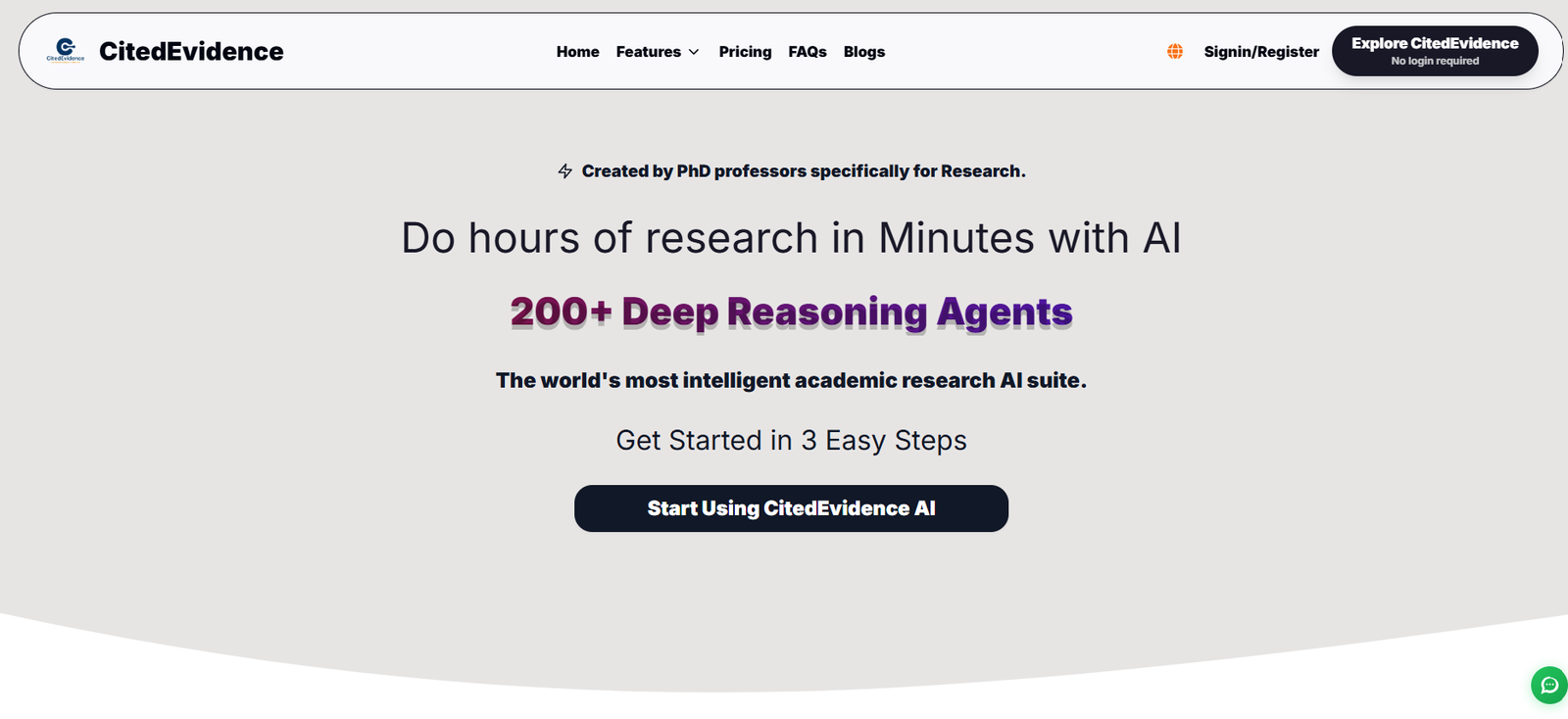
CitedEvidence is an AI-powered academic research and writing platform designed for researchers, students, professors and academic teams. It brings several stages of the research process into one environment, including scholarly search, literature reviews, PDF analysis, academic writing, citation generation, manuscript review and data analysis.
The platform provides access to a large scholarly search environment covering papers, authors, journals, institutions, funders, publishers and research topics. Users can search with natural-language research questions or construct more advanced search strings.
One of CitedEvidence’s distinguishing features is its Deep Reasoning system. According to the platform, this uses more than 200 AI agents for source-aware academic research. Researchers can also work directly with PDFs, organize papers in a library and use AI tools for proposals, theses and manuscripts.
CitedEvidence is designed as a broader academic workflow platform rather than only an AI writing assistant. It combines research discovery, evidence organization, writing and analysis tools within the same ecosystem.
Features
Deep Reasoning
CitedEvidence provides a multi-agent research system using more than 200 AI agents. It is designed to perform deeper, source-aware academic research and help users investigate complex research questions.
Scholarly Article Search
Users can search a large academic database covering hundreds of millions of research articles and other scholarly records. Searches can include papers, authors, journals, institutions, funders, publishers and research topics.
Multiple Academic Sources
The public research interface supports scholarly sources including OpenAlex, Semantic Scholar and PubMed. This gives researchers different avenues for discovering relevant academic literature.
Natural-Language Research Search
Researchers can enter a question in ordinary language rather than relying entirely on complicated database queries.
Research Search String Builder
The platform can also help users create structured search strings. This can be valuable when preparing literature searches and systematic reviews.
PDF Chat
Researchers can upload and interact with academic PDFs. They can ask questions about papers and use AI to turn lengthy documents into more manageable evidence and insights.
AI Editor
CitedEvidence provides an academic editor for rewriting, refining and improving research text. It also includes tools intended to make AI-assisted writing sound more natural.
Research Library
Users can organize papers, PDFs, citations, notes and other research materials in a centralized library.
Proposal & Literature Studio
The Proposal & Literature Studio uses AI to support research proposal and literature-writing workflows. It is designed to help researchers move from a research idea toward a more structured academic document.
AI Thesis
The AI Thesis tool assists with generating research proposals, thesis sections and longer academic documents.
Thesis to Manuscript Converter
Researchers can use CitedEvidence to transform thesis material into a manuscript intended for journal submission. The platform is designed to preserve important elements such as tables, figures and references during the process.
Citation Generator
CitedEvidence provides tools for generating citations and managing academic references. This can reduce the manual work involved in formatting sources for research papers.
Systematic Review
The platform includes a systematic review workflow covering activities such as evidence searching, screening, extraction and synthesis.
Manuscript Reviewer
Researchers can submit manuscripts for AI-assisted review. The tool evaluates areas such as structure, writing clarity, journal suitability and overall manuscript readiness.
Data Analysis
CitedEvidence provides research-oriented data analysis capabilities. Users can analyze datasets, compare groups and create summaries suitable for further academic interpretation.
AI Humanizer
The AI Humanizer is intended to make AI-assisted academic writing sound more natural while retaining an appropriate scholarly style.
AI Detector
The platform includes an AI detection tool for examining text for AI-writing signals and other writing-quality indicators.
Paraphrasing Tool
Researchers and students can rewrite passages while maintaining the original meaning and an academic tone.
Data Collection
CitedEvidence includes tools for creating forms and collecting structured research data, bringing another stage of the research workflow into the platform.
Research Directories
Users can separately explore directories for papers, researchers, institutions, journals, funders, publishers and topics. These directories can help researchers investigate relationships across the academic ecosystem.
CitedEvidence Scholar
CitedEvidence also operates a dedicated scholarly search service. It supports natural-language searches for scientific literature, researchers, journals and topics.
The Scholar platform reports access to more than 230 million papers, 100 million authors, 100,000 institutions and 250,000 academic sources.
Scholar API
Developers can access scholarly information programmatically through the CitedEvidence Scholar API. Authenticated access provides higher request limits for applications requiring large-scale academic data.
How It Works
Step 1: Visit CitedEvidence
Users can begin through the public research playground or create an account to access the wider research platform.
Step 2: Enter a Research Question
Type a research question, topic, author, DOI or other academic search term.
Step 3: Search Scholarly Sources
CitedEvidence searches its scholarly graph and supported research sources to identify relevant academic material.
Step 4: Refine the Research
Users can apply search options, construct Boolean-style searches and explore related papers, authors, journals and institutions.
Step 5: Add Research Material
Relevant papers and PDFs can be organized in the research library or used with PDF Chat.
Step 6: Analyze the Evidence
Researchers can ask questions about papers, generate summaries and use Deep Reasoning for more complex research tasks.
Step 7: Create Academic Content
Depending on the project, users can work with the AI Editor, Proposal Studio, AI Thesis or other writing tools.
Step 8: Manage Citations
The Citation Generator helps users organize and format references for academic writing.
Step 9: Analyze Research Data
Researchers working with datasets can use the data analysis tools to compare information and produce research-oriented summaries.
Step 10: Review the Manuscript
The Manuscript Reviewer can provide AI-assisted feedback on structure, clarity, journal fit and publication readiness before submission.
Use Cases
University Students
Students can use CitedEvidence to discover academic sources, understand papers, organize citations and receive assistance with research-based assignments.
PhD Scholars
Doctoral researchers can use the platform for literature searches, research proposals, thesis development, PDF analysis, citation management and manuscript preparation.
Academic Researchers
Researchers can investigate scholarly literature, organize evidence, analyze research material and prepare papers using a connected research workflow.
Professors and Supervisors
Academic supervisors can use the research and manuscript tools when evaluating scholarly material and helping students improve research quality.
Systematic Review Researchers
Researchers conducting systematic or structured literature reviews can use CitedEvidence for searching, screening, extraction and synthesis.
Research Teams
Teams can centralize research materials and use AI-assisted tools to manage evidence, citations and academic documents.
Healthcare Researchers
The availability of PubMed search can make the platform relevant to medical, healthcare and life-science researchers searching for published evidence.
Thesis Writers
Students preparing dissertations and theses can use the platform across multiple stages, from literature discovery and proposal preparation to writing and citation management.
Journal Authors
Researchers preparing articles for publication can use manuscript review and thesis-to-manuscript capabilities to improve and restructure their work.
Developers
Developers can use the Scholar API to incorporate academic search and scholarly metadata into research applications and other software.
Pricing
CitedEvidence currently displays three main monthly subscription plans.
Basic: $10 per Month
The Basic plan is designed for testing and basic research. It includes 500 credits per month, full Research Notes access, limited AI Proposal Generator and AI Thesis usage, and data collection for up to 100 responses.
Premium: $25 per Month
The Premium plan is designed for general research and provides 1,200 credits per month. It includes full Research Notes access, broader AI Proposal Generator and AI Thesis usage, unlimited responses for data collection and expanded data-analysis access.
Advanced: $85 per Month
The Advanced plan is intended for more demanding research projects and provides 10,000 credits per month. It includes Premium features along with advanced proposal generation, larger document-generation capabilities and higher data-collection limits.
The platform also displays monthly and yearly billing options. Because subscription details and credit allowances can change, users should confirm current limits before subscribing.
Strengths
One of CitedEvidence’s main advantages is the breadth of its academic workflow. Researchers can search literature, analyze PDFs, organize sources, generate citations, work on proposals and theses, analyze data and review manuscripts without moving between many separate applications.
Its scholarly search goes beyond simple paper discovery by allowing users to explore authors, institutions, journals, funders, publishers and research topics.
The public research playground is useful because visitors can experiment with scholarly searches before creating an account.
Deep Reasoning provides a more research-focused approach than a conventional AI writing assistant by emphasizing source-aware multi-agent investigation.
The Thesis to Manuscript tool can be valuable for researchers who have completed substantial thesis work and want to prepare part of it for journal publication.
Its combination of PDF Chat, systematic review tools and citation management also makes it useful for evidence-heavy academic projects.
Drawbacks
CitedEvidence includes a large number of research tools, which may feel more complex than necessary for users who only need a simple citation generator or PDF summarizer.
The platform uses credits for parts of its service, so researchers carrying out intensive AI-assisted work should understand the usage limits of each subscription.
AI-generated academic writing and research synthesis still require careful human verification. Researchers should check citations, interpretations, statistical results and generated claims against original sources.
Students also need to follow their university’s academic integrity and AI-use policies when using AI-assisted writing features.
Some information presented across the official website and pricing pages may vary as the platform evolves, so users should confirm current plan limits before purchasing.
Comparison with Other Platforms
CitedEvidence operates in the same broad academic AI market as research discovery, literature review, citation management and academic writing platforms.
Some academic tools specialize mainly in finding research papers. Others focus on citation management, PDF conversations, literature reviews or AI writing. CitedEvidence attempts to combine these activities into a more complete research environment.
Compared with conventional citation managers, CitedEvidence provides substantially more AI-assisted research and writing functionality. Compared with general-purpose AI writing tools, it is more specifically structured around academic evidence, scholarly sources and research workflows.
Its combination of scholarly search, Deep Reasoning, PDF Chat, AI Thesis, systematic reviews, data analysis and manuscript review may make it particularly attractive to researchers who prefer a single integrated environment.
However, researchers should compare platforms according to the depth of scholarly coverage, citation reliability, institutional requirements, collaboration needs and subscription costs.
Customer Reviews and Testimonials
CitedEvidence displays testimonials from researchers and academic users on its official website.
A public health researcher describes the platform as reducing the time needed for literature searching and proposal preparation. A graduate supervisor highlights the usefulness of PDF Chat and citation tools for helping students support claims with evidence.
A PhD candidate also comments positively on the way the research agent connects different parts of the research workflow.
The website additionally displays examples of researchers discussing CitedEvidence through platforms such as YouTube, X, LinkedIn and TikTok.
These testimonials are presented by CitedEvidence itself and should therefore be considered company-published user feedback rather than independent ratings.
Conclusion
CitedEvidence is a comprehensive AI research platform aimed at students, PhD scholars, professors and professional researchers who want to bring multiple academic tasks into one environment.
Its biggest advantage is the combination of scholarly discovery and research production. Users can search academic literature, analyze PDFs, organize evidence, prepare literature reviews, generate citations, work on proposals and theses, analyze datasets and review manuscripts.
The platform may be especially useful for researchers handling complex or long-term academic projects where managing papers, evidence, citations and writing across separate tools becomes time-consuming.
For researchers who want an AI assistant focused specifically on evidence-based academic work rather than general content generation, CitedEvidence provides a broad collection of research-oriented tools worth exploring.