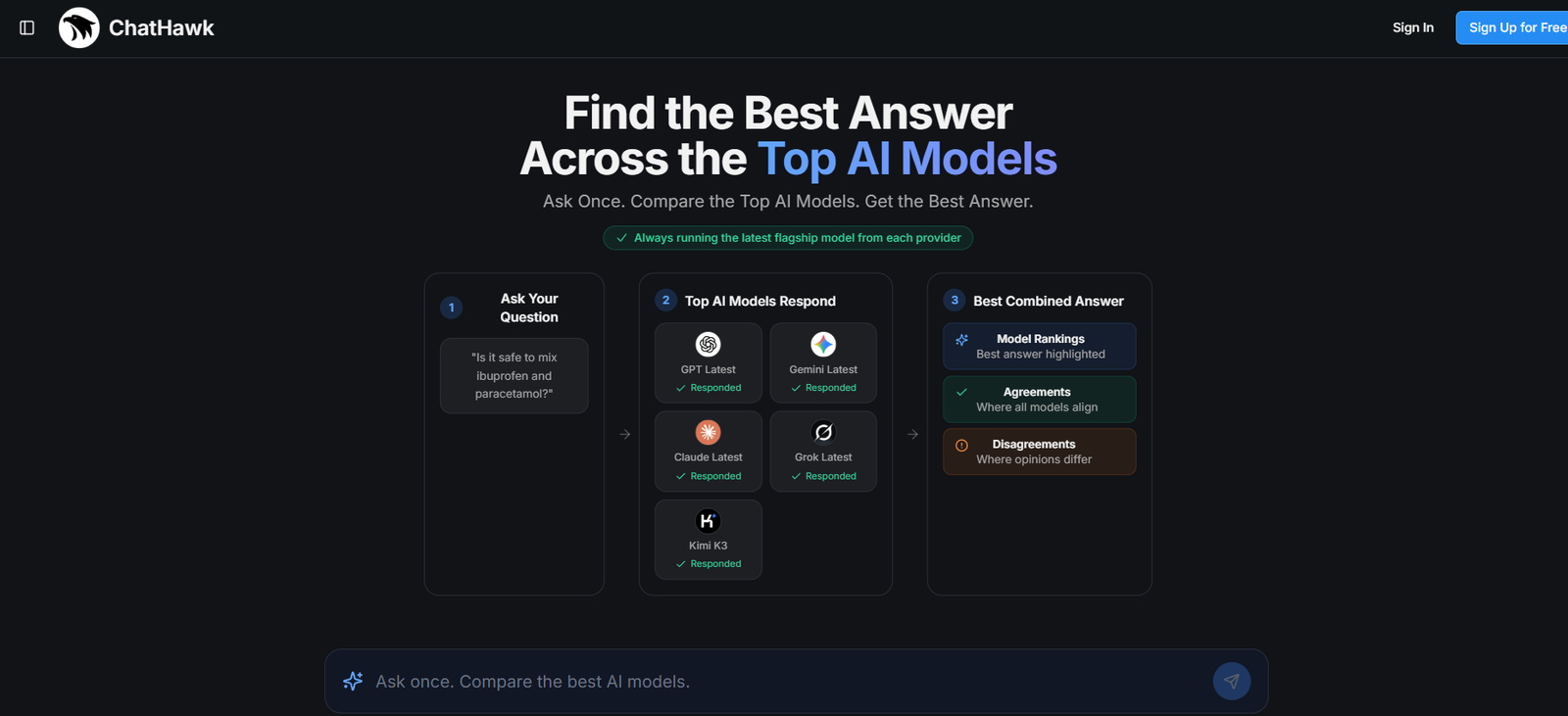
ChatHawk is a multi-model AI chat and comparison platform designed for users who want to consult several leading AI models without opening multiple websites and repeating the same prompt.
Instead of asking one AI model a question, users can enter a prompt once and receive responses from several flagship models simultaneously.
ChatHawk currently highlights access to leading model families from OpenAI, Google, Anthropic, and xAI. Its current platform promotes models including GPT-5.5, Gemini 3.1 Pro, Claude Opus 4.6, and Grok 4.3.
The responses are presented together so users can compare how different AI systems approach the same question.
ChatHawk goes beyond simple side-by-side comparison by generating consensus insights. It can identify where the models broadly agree and where their answers differ.
This makes the platform useful for research, brainstorming, decision support, content development, technical questions, and situations where relying on a single AI response may not provide enough perspective.
Features
Ask Multiple AI Models at Once
ChatHawk’s central feature is simultaneous multi-model querying.
Users write a question once and ChatHawk sends it to multiple supported AI models.
This eliminates the need to copy the same prompt manually between different AI services.
Flagship AI Models
ChatHawk focuses on major AI model families rather than providing only one underlying model.
The current platform highlights models including GPT-5.5, Gemini 3.1 Pro, Claude Opus 4.6, and Grok 4.3.
The exact model versions may change as providers release newer models.
Side-by-Side AI Comparison
Responses from different models can be compared in one interface.
This makes it easier to identify differences in reasoning, explanation, writing style, recommendations, and conclusions.
Consensus Insights
ChatHawk analyzes the responses and identifies areas where multiple AI models reach similar conclusions.
This provides users with a quick overview of common ground between the models.
Disagreement Detection
The platform can also highlight areas where models disagree.
This is particularly useful when a question is ambiguous, subjective, uncertain, or dependent on different assumptions.
Synthesized Answer
Instead of requiring users to manually combine several long responses, ChatHawk can produce a synthesized answer based on the collective outputs.
This provides a more convenient summary of the different perspectives.
AI Advisory Board Approach
ChatHawk can effectively be used as a small AI advisory board.
One question is presented to several AI systems, allowing users to examine multiple perspectives before reaching their own conclusion.
Unified AI Interface
Users do not need to constantly move between separate AI websites.
The supported models can be accessed through one ChatHawk workspace.
Conversation History
Signed-in users can retain conversations so they can return to previous questions and comparisons.
Incognito Chat
ChatHawk also provides an Incognito Chat option.
This is useful when users do not want a conversation included in their normal saved chat history.
Users handling confidential information should still review the current privacy terms before submitting sensitive material.
Web-Based Access
ChatHawk works through a browser and does not require users to install separate desktop software for its basic multi-model chat workflow.
How It Works
Step 1: Open ChatHawk
Visit the ChatHawk web application.
Step 2: Start a Conversation
Create a new standard or Incognito Chat depending on your preference.
Step 3: Enter a Question
Write the prompt that you want the AI models to answer.
Step 4: Submit Once
Instead of repeating the prompt across several AI websites, submit it through ChatHawk.
Step 5: Receive Multiple Responses
The supported flagship models respond to the same question.
Step 6: Compare the Answers
Review how each model approaches the prompt.
Look for differences in facts, reasoning, recommendations, tone, and conclusions.
Step 7: Check Consensus
Use ChatHawk’s consensus functionality to identify conclusions shared across the model responses.
Step 8: Examine Disagreements
Pay attention to areas where the models provide conflicting answers.
These areas may require additional verification.
Step 9: Review the Synthesized Response
Use the combined answer to get an overview of the different model perspectives.
Step 10: Continue the Conversation
Ask follow-up questions to investigate the subject further.
Use Cases
Research
Researchers can compare how several leading AI systems explain or interpret the same topic.
Fact Checking
Users can identify situations where one model gives a substantially different answer from the others.
Agreement between AI models should not be treated as proof that a claim is correct, so important facts should still be checked against reliable primary sources.
Decision Support
Professionals can obtain several AI perspectives before making a decision.
Content Research
Writers can compare explanations, arguments, examples, and content ideas generated by different models.
Brainstorming
Multiple models can provide a broader collection of ideas than relying on one response.
Technical Questions
Developers can compare proposed explanations or solutions from different AI systems.
AI Model Evaluation
Users considering different AI platforms can see how the models respond to their own real-world prompts.
Writing
Different models can suggest alternative approaches to articles, reports, emails, scripts, and other content.
Business Analysis
Teams can use several AI perspectives to explore strategies, opportunities, risks, and possible decisions.
Education
Students and educators can compare different explanations of the same concept.
AI responses should still be verified when academic accuracy matters.
Complex Questions
Questions without one obvious answer can particularly benefit from exposure to several AI perspectives.
Pricing
ChatHawk is a paid AI platform.
The official pricing page currently advertises plans starting at approximately $9.50 per month.
However, complete details about every plan, model-specific usage allowance, message limit, and other subscription restrictions are not consistently exposed in the publicly accessible pricing information.
For this reason, users should check the live ChatHawk pricing and checkout page before subscribing.
Pricing and included model versions can change as the underlying AI providers update their models and costs.
Strengths
One Prompt, Multiple Models
Users do not need to repeat the same question manually across several AI services.
Flagship Model Access
ChatHawk brings major AI model families into one interface.
Easy Comparison
Side-by-side responses make differences between models easier to identify.
Consensus Analysis
The platform helps summarize areas where several models reach similar conclusions.
Highlights Disagreement
Users can quickly identify topics where the AI systems do not agree.
Synthesized Answers
ChatHawk can combine multiple responses into a more manageable overview.
Time Saving
Users who regularly consult several AI platforms can reduce repetitive prompting and tab switching.
Useful for AI Evaluation
Users can test different models using their own questions rather than relying only on benchmark scores.
Incognito Option
A separate Incognito Chat workflow provides an alternative to ordinary saved conversations.
Drawbacks
ChatHawk requires a paid subscription for its main ongoing usage.
The official public pricing information does not clearly expose every usage allowance and restriction.
Supported models can change when AI providers release new versions or alter API availability.
Sending a prompt to several advanced models simultaneously can consume more underlying AI resources than querying only one model.
Consensus does not guarantee factual accuracy.
Several AI models can repeat the same incorrect information, especially when they rely on similar public knowledge or assumptions.
Users should therefore verify important medical, financial, legal, scientific, or other high-stakes information against authoritative sources.
A synthesized response can also hide useful differences between individual models if users read only the final combined answer.
For simple everyday questions, consulting four flagship AI models may be unnecessary.
Comparison with Other Platforms
ChatHawk competes with multi-model AI chat platforms and model-comparison services.
Its main advantage over using individual AI services separately is convenience.
A user who wants perspectives from GPT, Claude, Gemini, and Grok would normally need to open several applications, enter the same prompt repeatedly, and manually compare the results.
ChatHawk brings this process into one interface.
Its consensus functionality also distinguishes it from basic multi-model interfaces that simply display several responses without analyzing their similarities and differences.
Compared with subscribing to individual AI platforms, ChatHawk can be attractive to users whose main requirement is cross-model comparison.
However, the original AI platforms may provide specialized capabilities, tools, integrations, memory, advanced modes, or newly released features that are not available through a third-party multi-model interface.
ChatHawk is therefore best viewed as a model-comparison and multi-perspective workspace rather than a complete replacement for every native AI platform.
Customer Reviews and Testimonials
A substantial collection of independently verified customer reviews is not clearly available on ChatHawk’s official website at this time.
Third-party AI directories have begun listing the platform and generally describe its core functionality as simultaneous access to multiple flagship AI models with side-by-side comparison and consensus synthesis.
However, directory descriptions should not be treated as verified customer testimonials.
Prospective users should evaluate ChatHawk using their own typical prompts and compare its convenience, model access, response quality, and subscription cost with accessing individual AI services directly.
Conclusion
ChatHawk is a multi-model AI platform built around a simple idea: important questions can benefit from more than one AI perspective.
Instead of asking GPT, Claude, Gemini, and Grok separately, users can submit one prompt and receive responses from multiple flagship models in a unified interface.
The platform then helps users identify where the models agree, where they differ, and what a synthesized answer based on their collective responses might look like.
This makes ChatHawk particularly useful for researchers, writers, analysts, developers, professionals, students, and AI enthusiasts who frequently compare outputs from different models.
Its main strengths are convenience, simultaneous model access, side-by-side comparison, consensus analysis, and synthesized responses.
Its main limitations are paid access, incomplete public detail about usage limits, dependence on third-party AI providers, and the fact that agreement between several AI models should never be mistaken for guaranteed factual accuracy.
With official pricing currently starting at approximately $9.50 per month, ChatHawk is best suited to users who consult multiple flagship AI models frequently enough to benefit from having them together in one comparison-focused workspace.