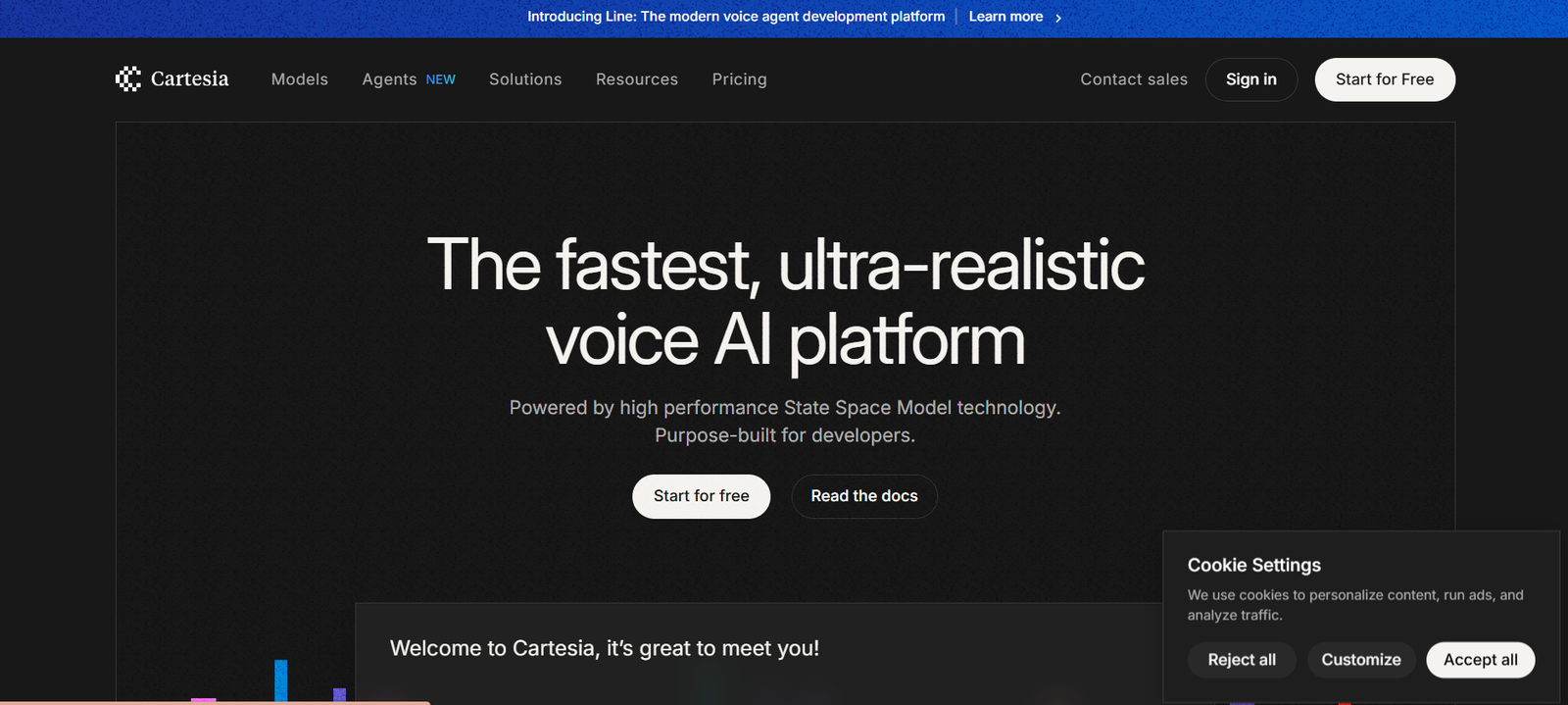
Cartesia AI is a cutting-edge artificial intelligence platform designed to enable spatial reasoning and memory in autonomous agents. Built for advanced developers, researchers, and teams building autonomous systems, Cartesia equips AI agents with the capability to reason about and operate within complex environments over time.
Unlike traditional large language models that focus on static text generation or task completion, Cartesia adds a critical layer of spatial and temporal understanding, empowering AI to perform long-horizon tasks, remember dynamic changes, and reason across virtual or physical spaces.
This makes Cartesia particularly valuable in fields like robotics, gaming, virtual agents, and advanced simulations—where agents must interact, navigate, and make decisions in dynamic environments.
Features
Cartesia AI offers a range of powerful features that make it distinct from standard AI development frameworks.
At the core is its spatial memory engine, which allows agents to construct and maintain an internal map of the environment they operate in. This memory persists over time and helps agents understand their position, surroundings, and context.
Cartesia also provides a temporal reasoning framework. Agents can reason about sequences of events, plan for the future, and act based on memory of past states—critical for long-horizon planning and decision-making.
The platform includes multi-agent coordination, enabling the creation of multiple agents that interact within the same environment while sharing spatial understanding and collaborative goals.
Cartesia supports integration with existing AI systems, including LLMs, reinforcement learning agents, and custom logic engines. This makes it flexible and composable with broader AI workflows.
Additionally, Cartesia includes developer tools for debugging, simulation, and visualization, allowing teams to test, refine, and optimize agent behavior in spatial environments.
How It Works
Cartesia AI enhances standard AI models by embedding spatial and temporal reasoning into their operating frameworks. Developers begin by defining an environment—whether it’s a simulated space, game world, or robotic application.
Within this environment, Cartesia-powered agents build a spatial map as they move, interact, and observe. This map evolves dynamically and includes representations of objects, obstacles, goals, and other agents.
As the agent acts, Cartesia captures and stores event sequences, enabling episodic memory and temporal logic. The agent can then reason: “What changed since I was last here?” or “Where did I leave that object?”
Agents powered by Cartesia can make informed decisions based not only on immediate inputs but on accumulated environmental context, memory of actions, and forward-planning algorithms.
This significantly increases the agent’s ability to operate autonomously in dynamic, unpredictable environments.
Use Cases
Cartesia AI serves a wide range of use cases where spatial reasoning and memory are essential.
In robotics, Cartesia enables agents to navigate and manipulate physical environments, remember object positions, and plan tasks like cleaning, delivery, or inspection over long periods.
In gaming and virtual environments, Cartesia supports non-player characters (NPCs) with persistent memory and spatial awareness, making them smarter and more realistic in their behavior.
In AI research, the platform is useful for studying cognitive architectures, testing long-term memory models, and exploring agent planning in dynamic simulations.
In industrial simulations, agents can be trained to operate machinery, inspect facilities, or coordinate with other systems in a virtual replica of a real-world environment.
For multi-agent systems, Cartesia provides coordination protocols that allow teams of agents to share space, memory, and goals—ideal for swarm robotics, collaborative automation, or game AI teams.
Pricing
Cartesia AI currently operates as an early-access platform. As of now, pricing is not publicly listed on the website. Interested developers, companies, or research teams are encouraged to apply for early access by contacting Cartesia directly via the website.
The platform appears to offer custom solutions depending on the use case, with potential support for enterprise deployment, research collaboration, or custom integration.
To request access or inquire about pricing, visit https://cartesia.ai and submit the contact form.
Strengths
One of Cartesia AI’s key strengths is its novel architecture, which introduces spatial and temporal reasoning to AI systems that previously relied on narrow inputs or context-free generation.
Its long-term memory capabilities allow agents to perform multi-step tasks that unfold over time—something most LLMs and narrow AI systems struggle with.
The platform is also highly modular and integrable, making it a powerful complement to existing AI models, rather than a replacement. This enables researchers and developers to expand existing capabilities without starting from scratch.
Cartesia’s support for multi-agent collaboration opens new doors in simulation and robotics, where agents must share space, knowledge, and intent.
The platform’s focus on high-level cognition makes it ideal for experimentation in advanced AI tasks that mimic human reasoning more closely than standard tools.
Drawbacks
One limitation of Cartesia AI is its current availability, as the platform is in early-access mode. This restricts immediate adoption by general developers or teams without direct contact.
There is no public documentation or developer portal available as of now, which may slow onboarding or evaluation for technical teams.
Cartesia’s complexity may also pose a steep learning curve for those unfamiliar with spatial AI concepts, agent-based systems, or simulation environments.
Additionally, real-world hardware integration, such as with physical robots, is not clearly outlined, meaning teams building robotic systems may need custom support or development assistance.
As with many new AI platforms, third-party reviews and community case studies are currently limited.
Comparison with Other Tools
Cartesia AI can be compared to cognitive architectures like OpenCog, LEGO Mindstorms AI, or even simulation platforms like Unity ML-Agents.
Compared to Unity ML-Agents, which focuses on reinforcement learning in game-like environments, Cartesia provides a more general-purpose spatial reasoning layer that is not tied to a specific training paradigm.
Unlike OpenAI’s Gym, which is more focused on environment benchmarks, Cartesia is designed for production-ready agent memory and reasoning, not just training.
While some robotics frameworks support basic mapping and pathfinding, Cartesia adds an intelligent memory layer, making its agents capable of learning from and adapting to long-term changes in the environment.
Cartesia stands out in the growing ecosystem of agent intelligence platforms by prioritizing spatial memory, collaboration, and temporal reasoning as first-class design goals.
Customer Reviews and Testimonials
As of the latest version of the website, Cartesia AI does not publish formal customer reviews or testimonials. The platform is currently in early access, with access granted selectively to developers, researchers, or partners.
However, the concept and positioning of Cartesia have begun attracting attention in AI research and robotics circles, especially for its innovative focus on cognitive-like spatial reasoning.
As the platform expands and opens up to broader usage, detailed case studies and testimonials are expected to follow from early adopters.
Conclusion
Cartesia AI is redefining how AI agents interact with the world by introducing spatial and temporal reasoning as core capabilities. By giving agents memory, awareness, and the ability to navigate dynamic environments intelligently, Cartesia unlocks new levels of autonomy and usefulness for AI systems.
Whether you’re building smart robots, advanced NPCs, or cognitive simulations, Cartesia offers a forward-looking architecture that bridges the gap between reactive AI and long-term, goal-oriented intelligence.
While still in its early-access phase, Cartesia represents a major advancement in agent intelligence and spatial computing. For researchers, developers, and innovators exploring the frontier of AI, Cartesia is a platform worth watching—and building with.