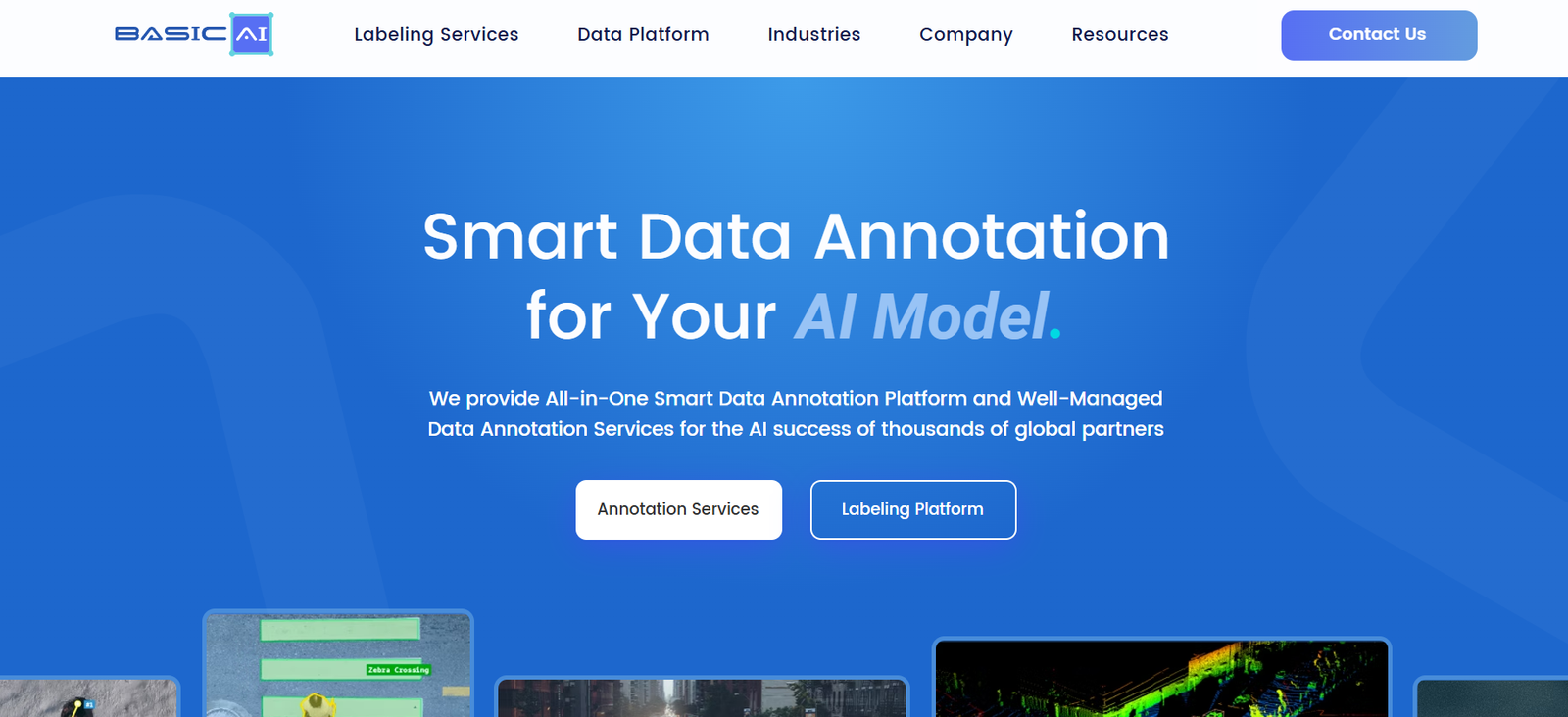
Basic.ai is an AI data lifecycle platform that provides advanced tools and infrastructure for data labeling, processing, and workflow automation. It supports a wide range of data types and annotation tasks, including 2D and 3D visual data, video, LiDAR, radar, audio, and natural language.
The platform is tailored for teams building complex machine learning systems that require accurate and large-scale data annotation. It also integrates collaboration tools, quality assurance pipelines, workforce management, and APIs—making it suitable for both startups and large enterprises.
From raw data ingestion to final dataset export, Basic.ai supports the entire pipeline in one unified interface.
Features
✅ Multi-Modal Annotation Tools
Supports 2D images, video, LiDAR point clouds, radar, audio, and NLP datasets. Offers bounding boxes, polygons, segmentation, keypoints, cuboids, 3D boxes, and more.
✅ Integrated QA System
Annotation tasks include built-in quality control mechanisms such as consensus review, audit trails, accuracy scoring, and annotator performance tracking.
✅ Task and Workflow Management
Advanced task assignment, progress monitoring, and custom workflow creation allow teams to efficiently manage multiple projects and teams.
✅ AI-Assisted Labeling
Leverages machine learning to pre-label data and speed up annotation. Supports active learning, auto-segmentation, and model-in-the-loop feedback.
✅ Team and Workforce Management
Manage internal teams or external labeling vendors with role-based access control, productivity reports, and incentive tracking.
✅ Secure and Scalable Infrastructure
SOC 2-ready infrastructure with flexible deployment options: public cloud, private cloud, or on-premise.
✅ API and SDK Support
Full-featured APIs and SDKs for integrating with custom ML pipelines and automating data operations.
✅ Custom Ontology Builder
Design and manage your data taxonomy or label schema using an intuitive interface with hierarchical structures.
✅ Dataset Management
Organize, version, and track datasets with metadata tagging, search tools, and data lineage logs.
How It Works
Basic.ai simplifies the complex process of data annotation and project management into a streamlined, five-step workflow:
Data Upload and Ingestion
Users can upload datasets from local storage or cloud buckets (e.g., AWS S3, GCP). Data is indexed and previewed automatically.Project Configuration and Ontology Design
Set up your labeling project with a defined label schema and ontology. Choose annotation tools based on data type and use case.Task Assignment and Annotation
Assign tasks to internal annotators or outsourced teams. Use AI-assisted tools to annotate faster and improve efficiency.Quality Control and Review
Implement QA processes including cross-review, automated checks, and feedback loops to maintain accuracy.Export and Integration
Export the labeled datasets in custom formats compatible with training pipelines, or access data directly via API.
Basic.ai also supports continuous data labeling with active learning to retrain models and feed back into the annotation loop.
Use Cases
Autonomous Vehicles
Label LiDAR, radar, and multi-camera video data for perception, object detection, and sensor fusion tasks.
Medical Imaging
Segment anatomical structures or diagnose pathologies in 2D/3D scans like CT, MRI, and X-rays.
Retail and E-commerce
Tag product images, categorize user reviews, and annotate conversational data for AI-driven recommendations.
Agriculture and Remote Sensing
Use satellite or drone images for crop health monitoring, weed detection, and soil analysis.
Robotics and Manufacturing
Train robots using labeled visual data for object recognition, navigation, and quality inspection.
Natural Language Processing (NLP)
Label text for intent classification, entity recognition, sentiment analysis, and chatbot training.
Audio and Speech
Annotate sound clips for voice recognition, speaker diarization, and audio classification tasks.
Pricing
Basic.ai follows a customized pricing model based on data volume, project complexity, team size, and required deployment method.
Although exact pricing is not listed publicly, here’s a general overview:
Starter / Pilot Plan
For small teams or MVPs
Limited data volume
Access to basic annotation tools
Email support
Professional Plan
Supports larger datasets and teams
Includes advanced QA and automation features
Role-based access and reporting
Enterprise Plan
Full platform access with API/SDK
On-premise or VPC deployment
Dedicated support and success manager
Compliance (SOC 2, GDPR, HIPAA readiness)
You can request a demo or quote at https://www.basic.ai.
Strengths
End-to-End Platform
Covers the full AI data pipeline from annotation to export with integrated project management.Multi-Modal and Industry-Agnostic
Supports diverse data types and is applicable across AI sectors—vision, language, and audio.Quality Assurance Built-In
Robust QA processes ensure high labeling accuracy even at scale.Scalable for Enterprises
Designed to support large annotation teams, enterprise-grade security, and high-volume projects.Custom Workflows and Integrations
Flexible APIs and SDKs allow users to tailor the platform to specific ML operations.Deployment Flexibility
Cloud, hybrid, and on-premise options make it suitable for privacy-sensitive industries.
Drawbacks
No Transparent Public Pricing
Users must request a demo or quote to determine actual costs, which may delay decision-making for smaller teams.Learning Curve for New Users
While powerful, the platform’s extensive features require onboarding and training.Primarily Targeted at Enterprises
May be too feature-heavy or cost-prohibitive for hobbyists or early-stage AI startups.Limited Open-Source Offerings
Basic.ai is proprietary; there is no open-source version or community edition for public use.
Comparison with Other Tools
Basic.ai vs. Labelbox
Labelbox is a direct competitor offering similar annotation and management tools. Basic.ai offers stronger enterprise customization and workflow management.
Basic.ai vs. Scale AI
Scale provides managed data labeling with its workforce. Basic.ai is more focused on platform flexibility and internal team control.
Basic.ai vs. Supervisely
Supervisely excels in visual tasks like 3D and image segmentation. Basic.ai supports a broader range of data types and complex project management tools.
Basic.ai vs. CVAT
CVAT is open-source and customizable, but lacks built-in QA, scalability, and support features that Basic.ai provides out-of-the-box.
Customer Reviews and Testimonials
Basic.ai is trusted by AI teams across industries, particularly in autonomous driving, healthcare, and robotics. While formal reviews are limited, early adopters report:
“We transitioned from spreadsheets and manual uploads to an integrated system with Basic.ai. Our annotation speed and consistency improved significantly.”
— Lead Data Scientist, Autonomous Vehicle Startup
“The ability to manage 3D, 2D, and video annotation within a single interface was a game-changer.”
— ML Project Manager, Robotics Company
“Excellent support and enterprise readiness. The private cloud deployment aligned with our data compliance requirements.”
— Head of AI Ops, Healthcare Enterprise
For more insights or a live demo, visit www.basic.ai.
Conclusion
Basic.ai is a powerful and scalable platform purpose-built for AI teams that require precision, speed, and flexibility in their data annotation pipelines. With support for complex data types, AI-assisted labeling, integrated QA, and enterprise-grade infrastructure, it’s ideal for organizations training machine learning models at scale.
If your business depends on large volumes of high-quality training data and you need a reliable platform to manage the entire lifecycle—from labeling to QA to export—Basic.ai is a strong contender worth evaluating.