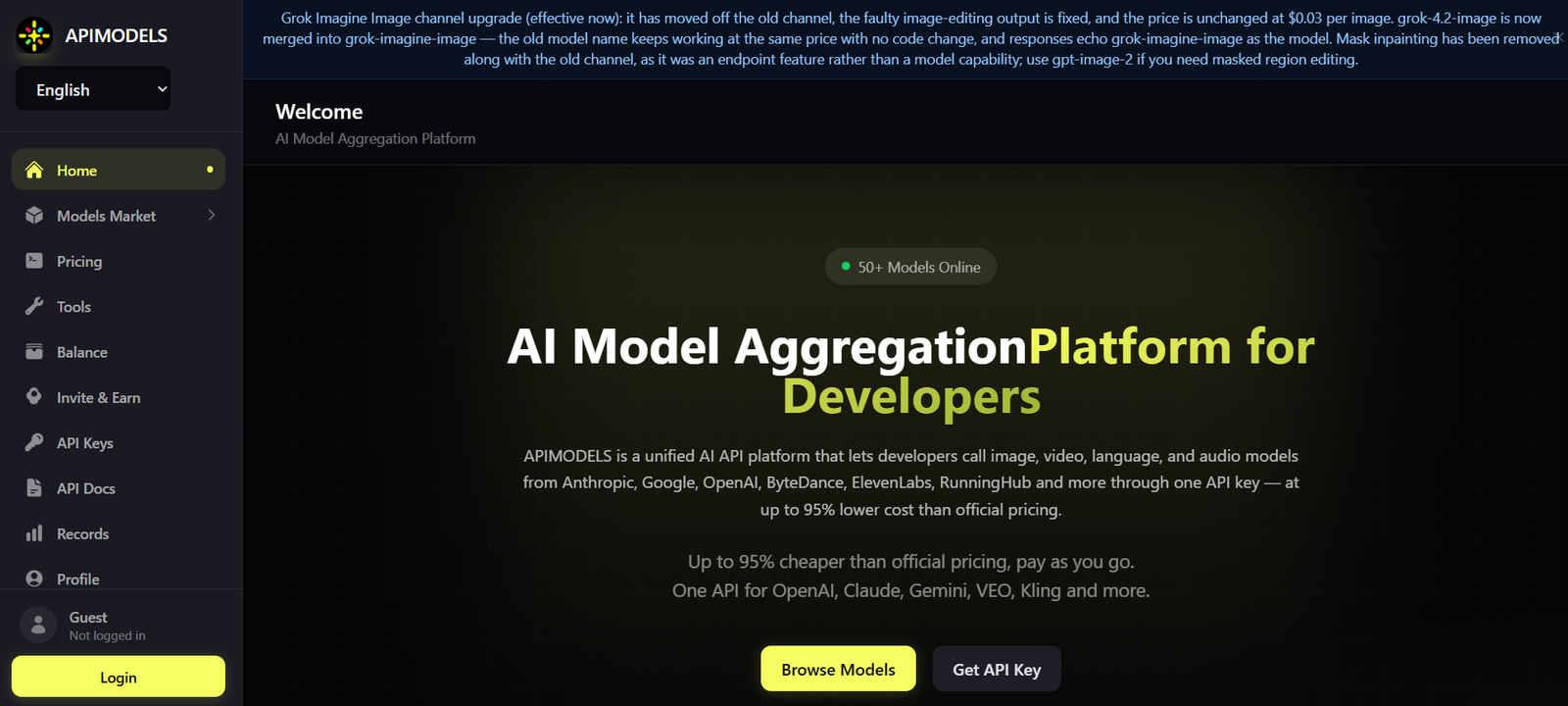
APIMODELS is a unified AI API platform designed to give developers access to a large collection of artificial intelligence models through a single API key and standardized interface.
Instead of opening separate accounts and integrating APIs individually with different AI providers, developers can use APIMODELS as one gateway for language, image, video and audio models. The platform currently lists more than 100 available models across its marketplace.
Its catalog includes model families from providers such as OpenAI, Anthropic, Google, ByteDance, ElevenLabs, Kling and others. Available options cover large language models, image generation, video generation, text-to-speech, dubbing and other generative AI capabilities.
APIMODELS uses a pay-as-you-go billing system without a mandatory monthly subscription. Pricing varies by model, and users are charged according to token consumption, generated images, video duration or other model-specific units.
The platform is primarily intended for developers, startups, independent creators and software teams that want to experiment with or deploy several AI models without maintaining separate integrations and billing accounts.
Features
Unified AI API
APIMODELS brings different categories of AI models behind a common API infrastructure. Developers can use one account and API key instead of separately managing credentials for every provider.
100+ AI Models
The marketplace currently provides access to more than 100 models. The selection covers large language models, image generation, video generation and audio applications.
Large Language Models
Developers can access various GPT, Claude, Gemini, Grok, DeepSeek and other language models for conversational applications, content creation, reasoning, coding and data processing.
AI Image Generation
APIMODELS provides APIs for multiple image generation families, including GPT Image, Nano Banana, Seedream, Kling Image and Grok Imagine models.
AI Video Generation
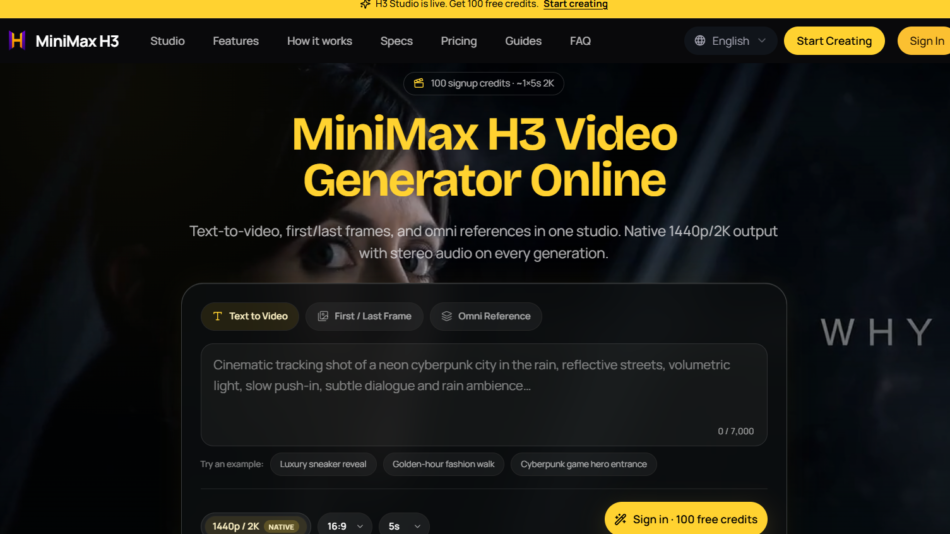
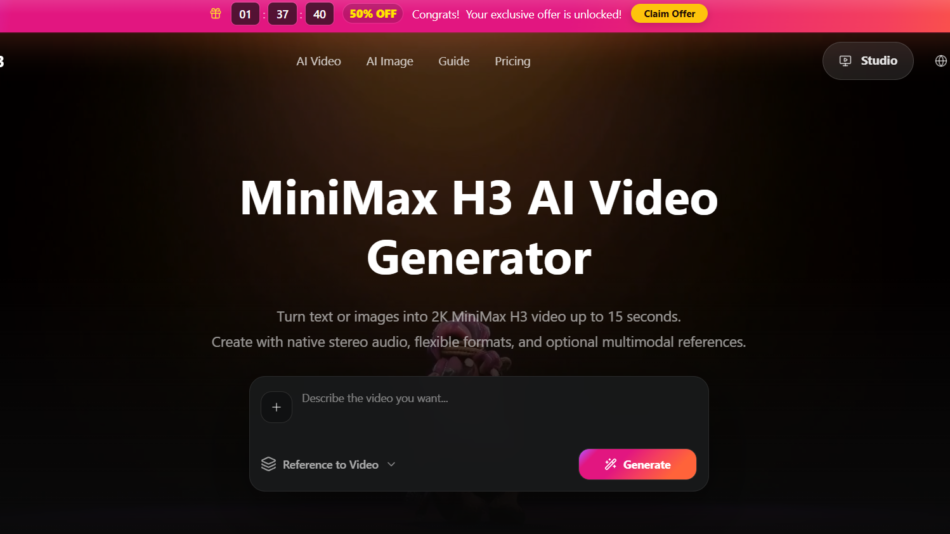
The platform includes video generation options such as Seedance, Kling and VEO models, allowing developers to integrate generative video capabilities into their applications.
AI Audio Tools
Audio APIs include text-to-speech, dialogue generation, dubbing, voice isolation, lip synchronization and music-related capabilities depending on the selected model.
One API Key
A single APIMODELS API key can be used across supported model categories, simplifying credential management for developers working with multiple AI services.
OpenAI-Compatible Interface
The platform provides an OpenAI-compatible interface. Existing applications built around compatible SDKs can point to the APIMODELS base endpoint and use an APIMODELS key.
Anthropic SDK Compatibility
APIMODELS also provides Anthropic-compatible API functionality, making it easier to integrate supported Claude models into existing development workflows.
Pay-As-You-Go Billing
There is no mandatory monthly subscription. Developers add account credit and pay according to actual model usage.
Success-Only Billing
According to the platform, unsuccessful generation requests are not charged. This can reduce wasted credits when upstream generation fails.
Transparent Model Pricing
Individual model pages show their current usage rates, allowing developers to estimate costs before choosing a model.
Low Minimum Top-Up
Users can begin adding paid credit from $10, making the service more accessible to independent developers and small projects.
Multiple Payment Methods
The platform supports international card payments through Stripe as well as Alipay. Its website also indicates PayPal support for USD payments.
API Documentation
APIMODELS provides technical documentation and integration examples to help developers understand endpoints, parameters, authentication and model usage.
Code Examples
Developers can find examples for common environments such as cURL, Python and Node.js, reducing the amount of work required to make an initial API request.
Worldwide Accessibility
The platform is designed to make supported models accessible across different regions, including mainland China, without requiring developers to independently handle every upstream provider’s regional access requirements.
How It Works
Create an APIMODELS account using email or a supported sign-in option.
Access the developer console.
Create a new API key.
Add account credit when paid model usage is required.
Browse the model marketplace and choose an AI model for your project.
Use the appropriate API endpoint for language, image, video or audio generation.
Pass your API key as authentication with the request.
Specify the required model and parameters.
Send the request through the unified APIMODELS API.
The platform forwards the request to the relevant upstream AI service.
Monitor usage and account balance as your application makes additional requests.
Use Cases
Software developers can add generative AI functionality to websites, mobile apps and SaaS products without maintaining many separate API integrations.
AI startups can experiment with different model providers before deciding which models work best for their products.
Independent developers can access several premium AI models through one account while keeping infrastructure relatively simple.
SaaS businesses can offer text, image, video and audio generation capabilities from a unified backend.
Content platforms can integrate AI writing, image generation and multimedia creation into their products.
AI agents can use different language models according to the reasoning, speed or cost requirements of individual tasks.
Creative applications can combine image, video, speech and language generation in a single workflow.
Developers in regions with access restrictions may use the unified platform to simplify connectivity to supported upstream AI services.
Research teams can compare outputs from multiple models without maintaining a separate API integration for every provider.
Pricing
APIMODELS uses pay-as-you-go pricing rather than a fixed monthly subscription.
Users can top up their account starting from $10. Each AI model has its own published rate.
Large language models are generally charged according to input and output token usage.
Image models may charge according to each generated image, resolution or generation configuration.
Video models can be charged per clip or according to requested video duration, depending on the specific model.
Audio services may be charged according to characters, duration or another model-specific usage unit.
The platform states that users are charged only for successful requests and that failed generation requests are not billed.
APIMODELS advertises pricing that can be 60% to 95% below official provider rates for selected models. The company states that these savings are made possible by aggregating enterprise-level quotas and passing volume pricing to smaller developers.
Since individual model prices can change, users should check the relevant model page before integrating a service into a production application.
Strengths
Provides one API key for more than 100 AI models.
Combines language, image, video and audio APIs.
Reduces the need to maintain separate provider accounts.
Provides an OpenAI-compatible interface.
Supports Anthropic-compatible integrations.
Uses flexible pay-as-you-go billing.
Does not require a monthly subscription.
Starts with a relatively low minimum account top-up.
Does not charge for failed generation requests according to the platform.
Publishes model-specific pricing.
Supports cURL, Python and Node.js examples.
Provides access to several major AI model families.
Can simplify experimentation across competing AI models.
Supports international payment options.
Designed for independent developers, startups and small teams.
Drawbacks
APIMODELS acts as an intermediary between developers and upstream AI providers.
Model availability and performance can therefore depend on third-party providers.
Rate limits and some model capabilities may inherit restrictions from the original upstream services.
Prices vary considerably between models and can change over time.
Developers still need API and programming knowledge to use the platform effectively.
Using an aggregation platform introduces an additional service layer compared with integrating directly with an AI provider.
Users building sensitive or regulated applications should carefully review privacy, security and data-processing terms before sending confidential information.
Uploaded images are limited to 10 MB per file, according to the current website information.
Video uploads are limited to 100 MB.
Generated images and videos are retained for seven days, so developers need to download or transfer important generated assets to permanent storage.
Comparison with Other Platforms
APIMODELS differs from direct AI provider APIs because its main purpose is aggregation. Instead of choosing one provider and building a dedicated integration, developers can access models from several providers through one API infrastructure.
This approach can be particularly useful when an application needs different models for different jobs. For example, a developer could use one language model for reasoning, another model for image generation and a separate model for video or speech without maintaining completely independent provider accounts.
Compared with other AI API aggregators, APIMODELS places considerable emphasis on lower usage costs, pay-as-you-go billing, regional accessibility and support for multimedia generation alongside large language models.
Direct provider APIs may still be preferable when a business requires the closest possible relationship with the original model provider, provider-specific enterprise agreements or specialized features that are not available through an aggregation layer.
Customer Reviews and Testimonials
Customer reviews and testimonials are not clearly available on the official website.
The website does display platform usage statistics and information about its developer community, but these should not be treated as independent customer reviews.
Conclusion
APIMODELS is a unified AI API platform aimed at developers who want convenient access to a broad selection of modern AI models without integrating with every provider separately.
Its single API key can cover language, image, video and audio generation, making the platform particularly useful for AI startups, SaaS developers, independent programmers and multimedia applications that need several types of generative AI.
The combination of OpenAI-compatible integration, more than 100 available models, pay-as-you-go billing and success-only charging can make AI experimentation and deployment easier to manage.
For developers who value model choice and centralized billing over maintaining direct relationships with individual AI providers, APIMODELS offers a practical way to bring multiple generative AI services into one development workflow.