
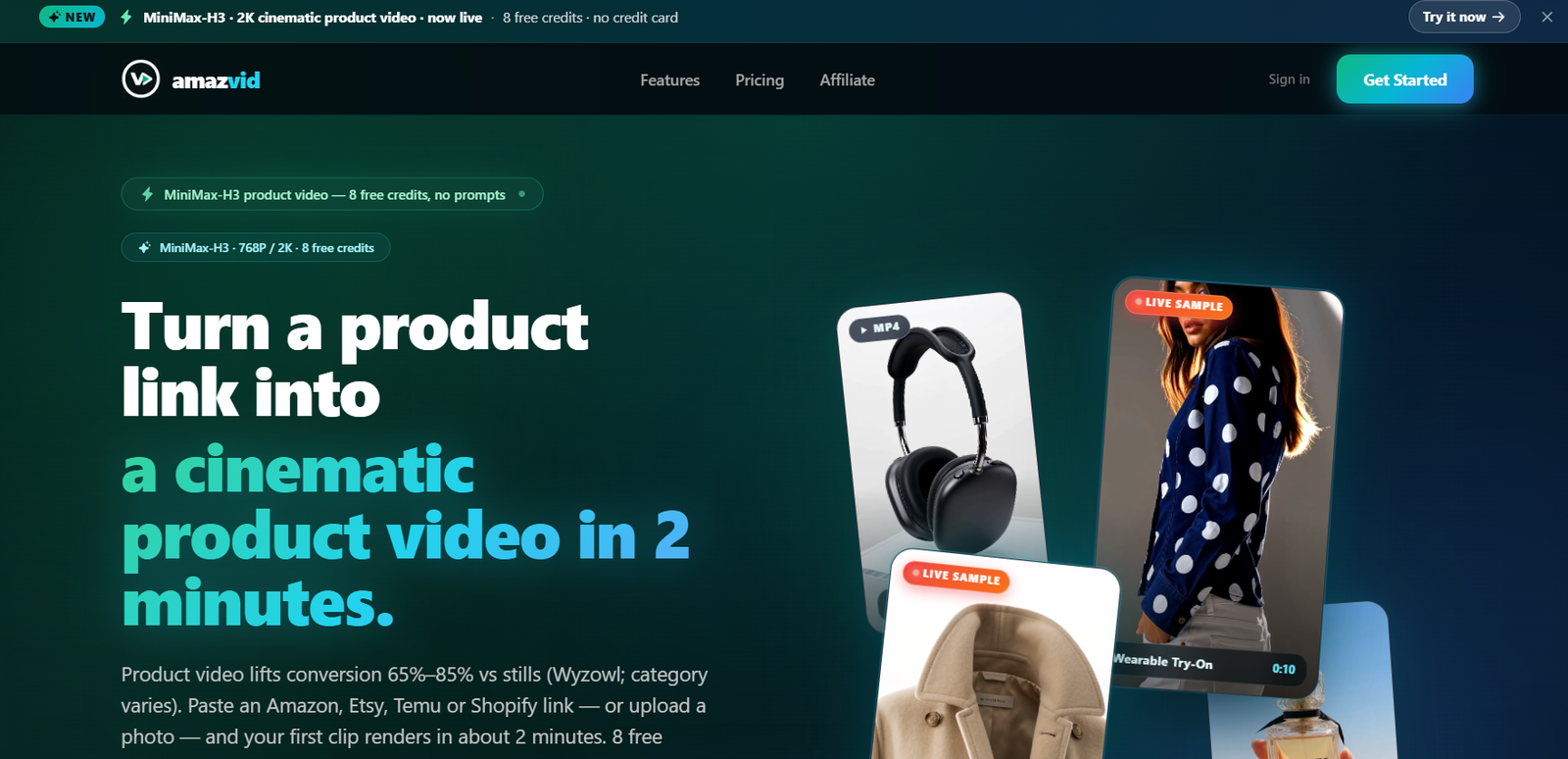
AmazVid is an AI-powered product video and advertising creative generator designed specifically for ecommerce sellers, DTC brands, agencies, and performance marketing teams.
Users can paste a product listing URL, upload a product photograph, or start from a text prompt. AmazVid then uses AI to transform the product information into polished product videos and advertising creatives.
The platform supports product links from major ecommerce platforms such as Amazon, Shopify, Etsy, Temu, and AliExpress.
Instead of requiring sellers to arrange a studio shoot for every product, AmazVid can animate existing product photography into short promotional clips with camera movements, lighting effects, lifestyle settings, and other visual treatments.
Its main creation modes include Product Shot, Ad Creative, Wearable Try-On, and Ad Image.
Product Shot is designed for catalogue and product-detail-page content. Ad Creative creates more promotional videos for platforms such as Meta and TikTok. Wearable Try-On can place supported fashion products on AI-generated models, while Ad Image converts ordinary product photography into more polished campaign imagery.
AmazVid uses AI models including MiniMax H3 in its current product-video pipeline.
The platform is especially useful for Amazon sellers, Shopify brands, Etsy sellers, TikTok Shop merchants, ecommerce agencies, and businesses that need to create visual content for many SKUs without organizing repeated photography and video shoots.
Features
Product URL to Video
Users can paste a supported ecommerce product URL and allow AmazVid to extract relevant listing information.
The platform currently supports product links from Amazon, Shopify, Etsy, Temu, and AliExpress.
Photo to Product Video
Users do not need a live ecommerce listing.
A product photograph can be uploaded directly and transformed into a short AI-generated video.
Prompt-to-Video
AmazVid also supports prompt-only creation.
Users can describe a product concept or advertising scene in text without providing a listing URL or existing SKU photograph.
This can be useful for agencies developing concepts, pre-launch brands, and early creative experimentation.
Product Shot
Product Shot creates short catalogue-style videos designed to showcase the actual product.
Users can generate 5-second or 10-second clips.
First-Frame Lock
AmazVid uses the original product photograph as the first frame and attempts to preserve important characteristics such as product shape, color, materials, logos, and packaging.
This is intended to reduce the product drift that can occur with general-purpose AI video generators.
Ad Creative
Ad Creative creates more cinematic promotional videos from existing product imagery.
This mode is designed particularly for paid social platforms such as Meta, TikTok, and Instagram.
AI-Written Shot Brief
Ad Creative can automatically prepare the visual direction for the promotional clip rather than requiring users to write a detailed video prompt.
Wearable Try-On
Wearable mode is designed for products that benefit from being shown on a person.
Potential applications include clothing, footwear, eyewear, and accessories.
This allows ecommerce sellers to experiment with model-based promotional imagery without arranging a conventional model shoot.
Ad Image
AmazVid can also generate advertising still images.
A standard packshot or product photograph can be transformed into a more polished lifestyle or campaign visual.
38 Preset Styles
The platform currently advertises 38 preset visual styles for different ecommerce and advertising requirements.
These help users create content without writing complex prompts.
Multiple Aspect Ratios
AmazVid supports common ecommerce and social-media formats, including:
9:16 for Reels, TikTok, and Shorts
1:1 for social feeds
16:9 for landscape video and supported marketplace use
Other layouts such as 4:5 are also represented in its template library.
768P, 1080p and 2K Options
Resolution availability depends on the selected plan and generation mode.
Higher-quality options are available for sellers who need cleaner product-page or advertising assets.
MiniMax H3
AmazVid currently uses MiniMax H3 technology in its AI product-video workflow.
Batch Product Generation
Paid users can process multiple products more efficiently.
Product Shot currently supports batches of up to five product links or photographs with shared camera settings.
Product Identity Preservation
The platform is designed to preserve the identity of the original SKU rather than freely reinventing the product.
However, users should still inspect generated output carefully because AI can alter packaging, text, logos, proportions, and fine details.
AI Advertising Images
Product photographs can be transformed into campaign-style images without requiring a separate photoshoot.
Silent Video Output
Current Product Shot videos are generated as silent clips.
Voiceovers and burned-in captions are not automatically added to these videos.
Users can add music, narration, captions, and additional editing using their preferred video editor.
Fast Rendering
AmazVid states that many product clips can be generated within a few minutes, depending on queue load and selected settings.
Clean MP4 Export
Paid plans allow users to download videos without the AmazVid watermark.
API Access
The Agency plan includes API access for businesses that want to integrate AmazVid into larger ecommerce or creative-production workflows.
White-Label Delivery
Agency users receive white-label delivery capabilities for client work.
How It Works
Step 1: Choose Your Input
Start with a product URL, product photograph, or text prompt.
Step 2: Import the Product
Paste a supported Amazon, Shopify, Etsy, Temu, or AliExpress link.
Alternatively, upload your own product image.
Step 3: Choose a Creation Mode
Select Product Shot, Ad Creative, Wearable Try-On, or Ad Image depending on the intended output.
Step 4: Select a Style
Choose from the available visual templates and styles.
Step 5: Configure the Output
Select available options such as duration, aspect ratio, camera direction, and resolution.
Step 6: Generate
Submit the project for AI processing.
Step 7: Review Product Accuracy
Check the result carefully for product shape, packaging, logos, text, colors, materials, and proportions.
Step 8: Retry if Necessary
If a generation fails because of a platform-side problem, AmazVid states that failed renders can be retried without being charged again.
Step 9: Download
Export the completed product video or advertising creative.
Step 10: Publish
Use the content on ecommerce product pages, social media, or advertising campaigns as appropriate.
Use Cases
Amazon Product Videos
Amazon sellers can turn existing listing photographs into short product videos.
Shopify Product Pages
DTC brands can create motion content for Shopify product-detail pages.
Etsy Product Videos
Etsy sellers can animate existing handmade or product photography.
TikTok Shop
Sellers can create vertical product content for TikTok Shop and related promotional campaigns.
Meta Advertising
Ad Creative mode can turn product photographs into short advertising videos for Facebook and Instagram.
TikTok Ads
Vertical AI product videos can be used as creative material for TikTok advertising campaigns.
Instagram Reels
Brands can convert static product photography into motion content suitable for Reels.
Fashion Marketing
Wearable Try-On can help fashion sellers visualize clothing and accessories on AI-generated models.
Jewelry Marketing
Jewelry photographs can be converted into cinematic product videos with controlled camera movement.
Beauty Products
Cosmetics and skincare brands can transform packshots into lifestyle and promotional visuals.
Product Launch Concepts
Prompt-only generation allows brands to explore advertising ideas before final product photography is available.
Creative Agencies
Agencies can generate product videos and advertising concepts for multiple ecommerce clients.
Large Product Catalogues
Batch generation can reduce the time required to create video content across multiple SKUs.
Pricing
AmazVid currently offers Free, Seller, Growth, Studio, and Agency plans.
Free: $0
The Free plan is available without a credit card.
It currently includes 8 starting credits.
Free exports contain an AmazVid watermark.
Users can purchase a clean individual MP4 export for $3.
Higher resolutions, batch capabilities, and priority processing require a paid plan.
Seller: $29 per month
Seller includes 40 credits per month.
Annual billing currently reduces the effective price to $23 per month.
It includes:
5-second and 10-second Product Shots
No watermark on exports
Batch processing for up to five products
Image advertising creatives
Growth: $49 per month
Growth includes 70 credits per month.
Annual billing currently reduces the effective price to $39 per month.
It includes everything in Seller along with additional credits and priority email support.
Users can purchase extra credit packs when required.
Studio: $79 per month
Studio includes 120 credits per month.
Annual billing currently reduces the effective price to $63 per month.
It includes everything in Growth along with:
Priority render queue
1080p shots
Priority support
Agency: $199 per month
Agency includes 350 credits per month.
Annual billing currently reduces the effective price to $159 per month.
It includes everything in Studio along with:
API access
White-label delivery
Dedicated account manager
Enterprise
Custom enterprise arrangements are available for larger teams.
Enterprise options can include custom integrations, volume discounts, dedicated support, and SLA arrangements.
Credit Costs
Credit usage varies according to the generation mode.
Current standard costs include:
Product Shot – 5 seconds: 2 credits
Product Shot – 10 seconds: approximately 3 credits under the current main pricing page
Ad Creative: 5 credits
Wearable Try-On: 6 credits
2K Resolution: generally adds 1 additional credit
Users should check the displayed cost immediately before generation because AmazVid’s newer product documentation shows some variation in credit requirements as features are updated.
Additional Credit Packs
Users who need additional generations can purchase one-time credit packs without changing their subscription.
Current packs include:
10 credits: $9.90
50 credits: $49.50
100 credits: $99
Purchased pay-as-you-go credits do not expire while the account remains open.
Monthly subscription credits reset at the beginning of each billing period and do not roll over.
Refund Policy
New paid subscriptions currently include a 14-day money-back guarantee, subject to the platform’s refund terms and exceptions.
Subscriptions renew automatically until cancelled.
Commercial Use
AmazVid’s terms state that users own the shots generated for them while their account remains in good standing.
Generated output can be used commercially for marketplace listings, advertising, social media, and other business purposes, subject to the platform’s terms.
Users must have the necessary rights to the photographs and other source material they submit.
AmazVid specifically states that its license does not authorize users to paste a competitor’s product listing and generate content from photography they do not have permission to use.
Users should also review generated content carefully to ensure that AI has not invented or misrepresented product characteristics.
Strengths
Built Specifically for Ecommerce
AmazVid is focused on product marketing rather than general-purpose AI filmmaking.
URL-to-Video Workflow
Sellers can begin directly from an existing product listing.
No Prompt Engineering Required
Templates and automatic creative direction reduce the need to write detailed AI prompts.
Product Fidelity Focus
First-frame locking is intended to keep generated content closer to the real SKU.
Multiple Ecommerce Platforms
Amazon, Shopify, Etsy, Temu, and AliExpress listings are supported.
Product Video and Ad Creative
The same platform can create catalogue content and more promotional advertising assets.
Wearable Try-On
Fashion sellers can experiment with model-based content without arranging a conventional shoot.
Batch Processing
Multiple products can be processed more efficiently on paid plans.
Free Starting Credits
New users can test the platform before purchasing a subscription.
Commercial Usage
Eligible generated output can be used commercially under the platform’s terms.
Agency Features
API access and white-label delivery make the higher plan useful for agencies and larger production workflows.
Drawbacks
AmazVid is specialized for ecommerce product content and is not intended to replace a full general-purpose video editor.
Current Product Shot videos are silent. Users who require narration, music, captions, or complex audio production will need to add these separately.
Video duration is relatively short, with core Product Shot workflows centered around 5-second and 10-second clips.
AI-generated product videos can still alter packaging text, labels, logos, fine details, colors, or proportions.
This is especially important for ecommerce because the generated advertisement should accurately represent the product customers will receive.
Monthly subscription credits do not roll over.
Advanced modes such as Wearable Try-On and Ad Creative consume more credits than standard Product Shots.
API access and white-label delivery require the considerably more expensive Agency plan.
Comparison with Other Platforms
AmazVid differs from general AI video generators because it is built specifically around ecommerce products.
General text-to-video platforms usually begin with a creative prompt. This provides greater artistic freedom but can also result in an AI model inventing or changing the product.
AmazVid instead emphasizes existing SKU information. Users can begin with a product listing or real product photograph, and its first-frame approach attempts to preserve the product’s visual identity.
It also combines several ecommerce-specific workflows within the same platform, including catalogue Product Shots, advertising creatives, wearable try-ons, advertising images, batch generation, and marketplace-oriented aspect ratios.
Compared with traditional photography and video production, AmazVid can substantially reduce production time and upfront costs. However, traditional photography still provides greater certainty that every visible detail accurately represents the physical product.
AmazVid is therefore best considered a fast AI creative-production option rather than a complete replacement for professional photography in every ecommerce situation.
Customer Reviews and Testimonials
AmazVid publishes several customer testimonials on its official website.
These include comments attributed to Amazon catalogue sellers, Shopify DTC brands, ecommerce agency producers, eyewear brands, Etsy sellers, and multi-SKU FBA operators.
The testimonials describe using AmazVid to reduce reshoots, refresh advertising creative, maintain packaging consistency, create wearable content, and process multiple products.
These testimonials are selected and published by AmazVid itself. They should therefore be treated as company-presented customer feedback rather than independent evidence of typical results.
The website also presents conversion and revenue improvement statistics associated with product video. These figures are based on external industry studies and illustrative calculations rather than AmazVid’s own controlled customer panel, and the company explicitly states that they are not sales guarantees.
Conclusion
AmazVid is an AI product-video platform designed to help ecommerce sellers transform existing product information into advertising and marketplace-ready visual content.
Users can paste an Amazon, Shopify, Etsy, Temu, or AliExpress product link, upload a SKU photograph, or begin from a text prompt.
The platform can then create Product Shots, Ad Creatives, Wearable Try-On content, and advertising images without requiring a conventional photography or video-production workflow.
Its first-frame locking approach is particularly relevant for ecommerce because it attempts to preserve product identity rather than freely reinventing the item.
Batch generation, multiple aspect ratios, 2K options, API access, white-label delivery, and commercial-use rights extend the platform from individual sellers to agencies and larger ecommerce teams.
The main limitations are short video durations, silent Product Shot output, credit-based usage, and the possibility that generative AI may still alter important product details.
For Amazon sellers, Shopify and DTC brands, Etsy merchants, TikTok Shop sellers, and ecommerce agencies that already have product photographs but need more video and advertising creative, AmazVid provides a focused way to turn static catalogue assets into motion content.


