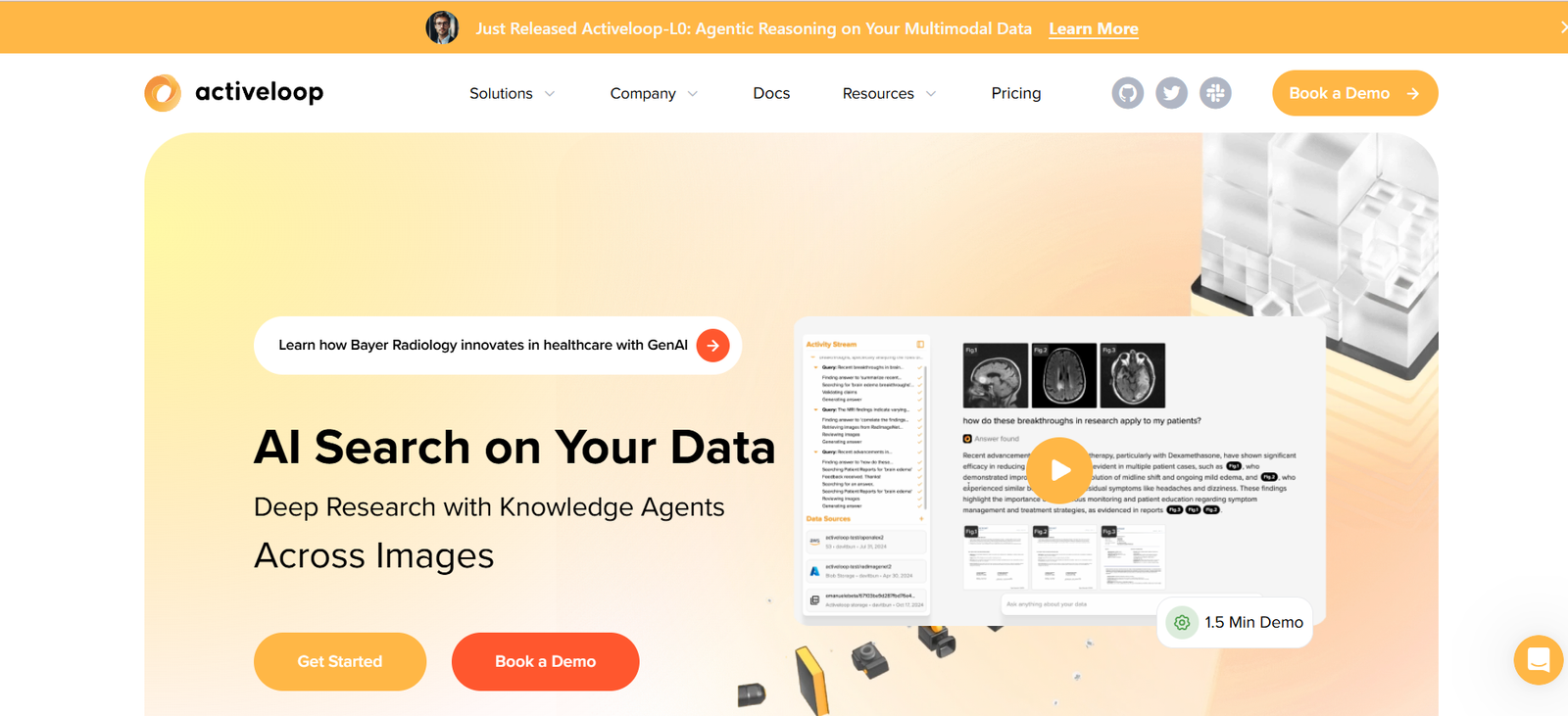
Activeloop is the company behind Deep Lake, an advanced AI-native data lake and vector database designed to power machine learning and deep learning workflows. Built for developers and data scientists, Deep Lake allows users to store, stream, label, and version large-scale datasets efficiently—without the need to move data around repeatedly.
Whether you’re building foundation models, computer vision pipelines, or embedding-based retrieval systems, Activeloop’s platform is optimized for scalable, real-time data access directly from cloud storage like S3, GCS, or Activeloop’s managed backend. Deep Lake is fully compatible with frameworks such as PyTorch and TensorFlow, making it a powerful backend for AI infrastructure.
Features
Deep Lake Vector Database
Activeloop’s Deep Lake functions as a vector database with support for storing embeddings, metadata, and versioned datasets—ideal for retrieval-augmented generation (RAG) workflows.
Streaming Datasets
Enables training directly on cloud-hosted datasets (e.g., images, video, audio, or embeddings) without downloading to local memory.
Dataset Version Control
Git-like versioning for datasets, allowing reproducibility and collaborative data science workflows.
Real-Time Data Sync
Ingest data from live sources and sync changes in real time across cloud and local environments.
Built-in Annotation Tool
Label images, video frames, and objects with bounding boxes or segmentation masks through an integrated labeling interface.
Scalable Cloud Storage
Supports direct integration with AWS S3, Google Cloud Storage, and Activeloop’s own managed storage.
Open-Source Python SDK
Interact programmatically using Deep Lake’s open-source SDK for loading, querying, and transforming datasets.
How It Works
Create a Deep Lake Dataset
Use the SDK or UI to create a dataset linked to cloud storage (your bucket or managed by Activeloop).Stream Data for Training
Load large datasets or specific samples directly into PyTorch or TensorFlow training pipelines.Store and Query Vectors
Add embeddings (e.g., from CLIP, BERT, or custom models) into the vector database for similarity search.Label and Version Data
Use the visual tool to annotate images or video, then commit changes using dataset versioning commands.Integrate with Models
Build custom data loaders, RAG systems, or analytics using standard ML frameworks and Deep Lake’s querying features.
Use Cases
Machine Learning Model Training
Train vision, NLP, or audio models on large datasets streamed directly from the cloud with minimal latency.
Vector Search and RAG
Store and query embedding vectors to support LLM workflows that require contextual retrieval or similarity-based input.
Dataset Collaboration and Governance
Use version control to manage datasets across teams and environments with auditability and reproducibility.
Annotation and Active Learning
Label samples efficiently and build active learning loops where model uncertainty drives labeling priorities.
AI Infrastructure Scaling
Eliminate storage duplication and bottlenecks by unifying data sources in a single, cloud-optimized backend.
Pricing
As of June 2025, Activeloop offers multiple pricing tiers based on feature access and usage volume. The plans include:
Free Tier
Up to 3 datasets
500MB managed storage
Open-source SDK access
Community support
Pro – Starts at $15/month
10+ datasets
Up to 50GB managed storage
Dataset versioning
Priority support
Team – Custom Pricing
Unlimited datasets
1TB+ managed storage
RBAC, API rate limits
SLAs and team collaboration
Enterprise
Advanced security and compliance (SOC 2, SSO, etc.)
Dedicated infrastructure
Custom integrations and support
On-prem or VPC deployment options
Learn more or request a custom quote at activeloop.ai/pricing.
Strengths
Streaming-First Architecture: Enables real-time training on massive datasets without moving data locally.
Unified Vector + Dataset Store: Combines vector search with traditional dataset storage in a single API.
ML Framework Compatible: Integrates natively with PyTorch and TensorFlow for ease of adoption.
Open Source SDK: Offers flexibility and transparency with a growing developer ecosystem.
Built for AI at Scale: Ideal for foundation model training, RAG systems, and large annotation workflows.
Drawbacks
Primarily for Technical Users: Requires Python proficiency and familiarity with ML pipelines.
Cloud Dependence: Performance benefits are optimized for users working in cloud-native environments.
Labeling Features Still Evolving: While functional, the built-in annotation tools are basic compared to dedicated labeling platforms.
No Built-In Model Training: Not a full ML platform—focused on data handling rather than model training orchestration.
Comparison with Other Tools
Activeloop vs. Weaviate / Pinecone
Weaviate and Pinecone are vector databases only. Activeloop combines vector storage and raw data (images, videos) into a full ML data stack.
Activeloop vs. DVC (Data Version Control)
DVC supports dataset versioning but lacks real-time streaming or deep learning dataset structure. Deep Lake is purpose-built for modern ML workflows.
Activeloop vs. FiftyOne
FiftyOne offers powerful data visualization. Activeloop focuses on streaming, versioning, and scalable storage, often used alongside FiftyOne.
Customer Reviews and Testimonials
“Deep Lake helped us reduce training times by 40% by removing the bottleneck of dataset copying.”
– ML Engineer, VisionTech Labs
“It’s like Git for data, but built for GPUs and deep learning workloads.”
– Founder, AI Research Startup
“We combined our image and text embeddings in Deep Lake and built a fully custom RAG pipeline in a week.”
– Data Scientist, Healthcare AI Platform
Conclusion
Activeloop, through its Deep Lake platform, offers one of the most forward-thinking infrastructures for modern AI data pipelines. By enabling real-time streaming, embedding storage, and dataset versioning, it empowers ML teams to scale model training and retrieval systems more efficiently and collaboratively.
If you’re building computer vision models, LLM pipelines, or scalable AI systems that demand fast, efficient, and cloud-native data access, Activeloop is a platform to seriously consider.
Get started or explore the docs at www.activeloop.ai.