
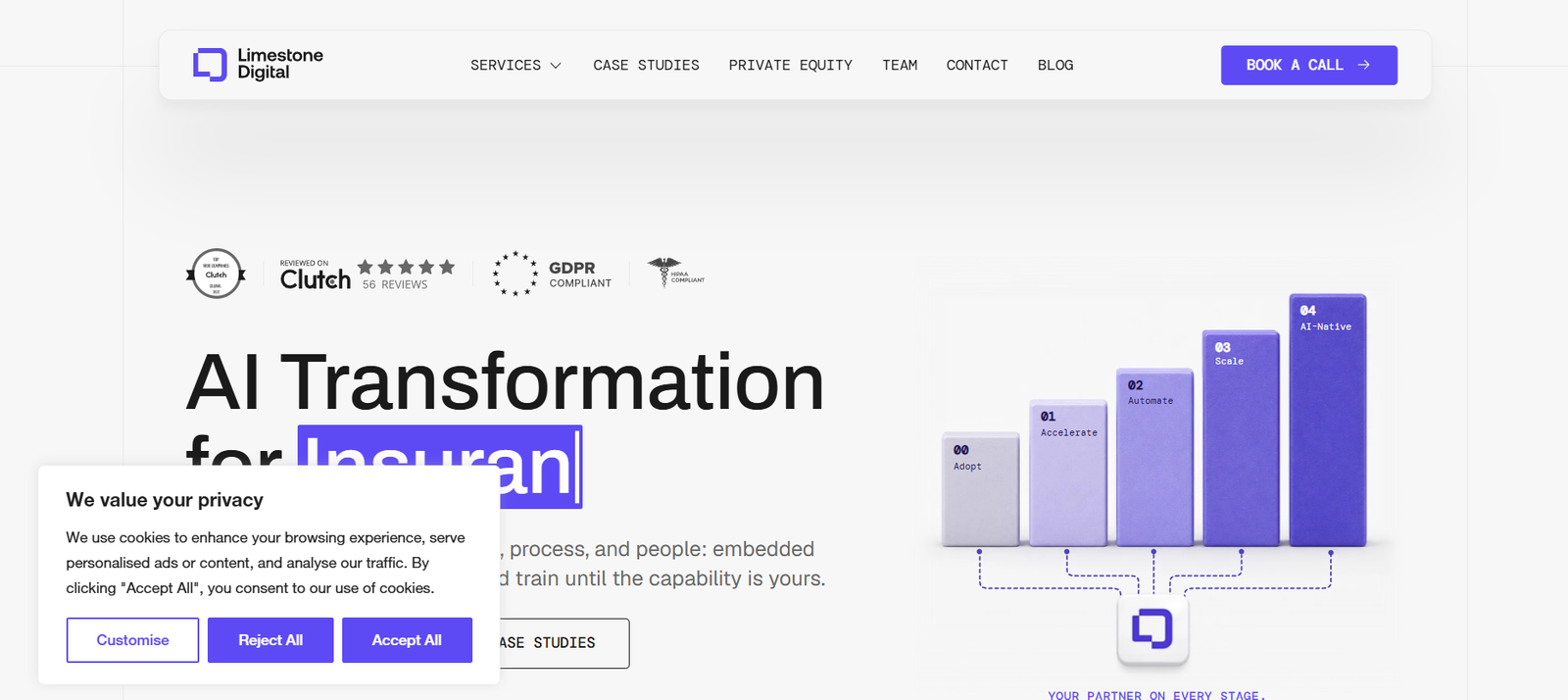
Limestone Digital is an AI transformation and software engineering company that helps businesses integrate artificial intelligence into existing products, development processes, and organizational workflows.
Unlike a typical self-service AI tool, Limestone Digital provides engineering teams and professional services. Its specialists work within a client’s existing codebase, technology environment, and development processes to implement AI capabilities while continuing to develop and improve the existing product.
The company’s AI services cover three major areas: AI training and enablement, custom AI agent development, and AI-native software delivery. This allows organizations to approach AI adoption from both a technology and people perspective.
Limestone Digital also works with established and legacy software systems. Instead of requiring businesses to rebuild everything from the beginning, its teams can modernize existing platforms and introduce AI-powered functionality within the current environment.
The company serves industries including healthcare, insurance, financial services, lending, logistics, compliance, legal and professional services, and enterprise SaaS.
Features
Custom AI Agent Development
Limestone Digital develops AI agents that can be integrated into existing products, engineering processes, and business operations.
These agents can support tasks such as code review, specification generation, release notes, workflow automation, research, information retrieval, and other repetitive processes.
AI Training and Enablement
The company provides practical AI training for engineering teams, technical leaders, executives, and other business professionals.
Training focuses on applying AI within actual organizational workflows rather than limiting learning to general demonstrations.
AI-Native Software Development
Limestone Digital provides embedded engineering teams that use AI throughout the software development lifecycle.
AI can assist with activities ranging from understanding requirements and specifications to planning, development, testing, review, and deployment.
AI Velocity Pods
Businesses can use dedicated AI-focused engineering pods that work directly with their existing development teams.
A pod can include a forward-deployed engineer supported by project management, business analysis, AI productivity expertise, QA, and customer success resources.
AI Workflow Automation
Limestone Digital develops AI agents for automating business processes in areas such as finance, operations, procurement, and other back-office activities.
Human oversight can remain part of these workflows where decisions require review or approval.
AI Product Features
Companies can use Limestone Digital to add AI functionality to existing software products.
Potential implementations include in-product copilots, retrieval systems, intelligent search, RAG applications, AI agents, and other AI-powered product capabilities.
RAG and Retrieval Systems
Limestone Digital develops retrieval-based AI systems that allow applications and AI agents to work with relevant organizational information rather than depending only on a general-purpose model.
Legacy System Modernization
Organizations with older software can use Limestone Digital to modernize existing platforms without necessarily replacing the entire system.
This can be valuable for companies with mature products, complex integrations, regulatory requirements, or long-established infrastructure.
AI-Assisted QA
Quality assurance automation is integrated into its AI-native delivery process. Automated testing and quality gates are used to help software quality keep pace with faster AI-assisted development.
Developer Intelligence
Limestone Digital uses its DevInt developer intelligence system to monitor software delivery.
It can bring together information from version control, issue tracking, and AI usage to provide visibility into areas such as cycle time, review workload, AI-assisted hours, and development activity.
Delivery Measurement
The company establishes a baseline before measuring changes in engineering performance. Metrics can then be monitored to determine whether AI-enabled processes are producing measurable improvements.
Embedded Engineering Teams
Limestone engineers can work inside a client’s existing repositories, communication channels, standups, and development processes rather than operating as a completely separate outsourced team.
AI Governance and Human Oversight
AI-generated or AI-assisted work is combined with human review, testing, monitoring, and quality controls before production deployment.
How It Works
- A business contacts Limestone Digital and discusses its existing product, engineering challenges, AI goals, and operational requirements.
- Limestone conducts a diagnostic phase to understand the current development environment and identify bottlenecks.
- The company establishes baseline measurements for relevant areas such as cycle time, code review workload, delivery flow, and AI usage.
- The team identifies where AI could create practical value within the existing product or workflow.
- Depending on the requirement, Limestone may provide an embedded engineering pod, AI training, custom AI agents, software modernization, or a combination of services.
- Engineers work within the organization’s existing codebase, repositories, workflows, and technology environment.
- Initial AI-enabled improvements or product features are developed and moved toward production.
- AI-assisted work passes through testing, human review, and quality controls.
- Results are measured against the organization’s original baseline.
- Successful approaches can then be expanded across additional teams, products, or business processes.
Use Cases
For Software Companies
Software businesses can add AI copilots, intelligent search, RAG systems, AI agents, automation, and other AI functionality to existing products.
For Engineering Teams
Engineering departments can use embedded AI-native engineers to accelerate product development, automate repetitive engineering work, and improve software delivery processes.
For CTOs and Technology Leaders
Technology leaders can use Limestone Digital when they want to introduce AI across an existing engineering organization but need implementation expertise, measurement, and governance.
For Companies with Legacy Systems
Organizations operating mature or older software platforms can modernize parts of their technology without automatically replacing the entire existing system.
For Healthcare Organizations
Healthcare and medtech businesses can develop AI-enabled software and modernize technology while considering requirements involving privacy, security, and regulatory compliance.
For Financial Services
Fintech, banking, lending, and related organizations can use AI engineering for document processing, workflows, software modernization, and intelligent product features.
For Insurance Companies
Insurance businesses can explore AI for underwriting processes, claims workflows, internal automation, and customer-facing product functionality.
For Logistics Companies
Logistics businesses can use AI and software engineering for dispatch, routing, tracking, fulfillment, invoicing, and operational workflows.
For Business Operations
Organizations can create agents for repetitive activities across finance, procurement, research, and operational processes.
For Private Equity Firms
Private equity firms can use Limestone Digital to improve engineering productivity and AI adoption across portfolio companies while tracking operational improvements.
Pricing
Limestone Digital does not provide standard public pricing packages for most of its AI transformation and software engineering services.
Its AI-native delivery model is offered through customized engagements based on the client’s team, product, requirements, and scope.
The company states that its embedded delivery engagements can operate on a month-to-month basis rather than requiring a 12-month commitment.
Pricing details are not clearly mentioned on the official website. Businesses need to contact Limestone Digital for a discovery call and customized commercial proposal.
Strengths
Limestone Digital combines AI expertise with traditional software engineering rather than treating AI as a standalone experiment.
Its teams can work with existing codebases instead of requiring businesses to rebuild their products from scratch.
The company covers several parts of AI transformation, including employee training, AI agents, software development, automation, QA, and modernization.
Embedded engineers work within the client’s existing development environment and processes.
The company emphasizes measurable improvements rather than simply deploying AI tools.
Its DevInt system provides visibility into development performance and AI usage.
Custom AI agents can be developed for engineering, customer-facing products, and internal business processes.
Human review and quality gates remain part of AI-assisted development.
Limestone Digital has experience working with regulated and technically complex industries.
The company states that the intellectual property it builds for clients is assigned to the client.
Drawbacks
Limestone Digital is a professional AI engineering service rather than a self-service AI platform, so users cannot simply sign up and independently build projects through a standard SaaS interface.
Public pricing is not clearly available, making it difficult to estimate project costs without contacting the company.
Its services are primarily aimed at businesses and engineering organizations rather than individual creators or casual AI users.
Custom engineering engagements are likely to require more planning and organizational involvement than using an off-the-shelf AI tool.
Businesses still need internal stakeholders to define priorities, review outcomes, and participate in implementation.
Organizations that only need a simple chatbot, content generator, or basic automation tool may find a ready-made SaaS product more appropriate.
Comparison with Other Platforms
Limestone Digital should not be compared directly with self-service AI tools such as general chatbots, no-code AI builders, or individual coding assistants because it operates primarily as an AI engineering and transformation partner.
Compared with traditional software outsourcing companies, Limestone Digital places greater emphasis on AI-assisted development, custom AI agents, AI adoption, measurable engineering performance, and integration with existing development teams.
Compared with AI consulting firms that mainly provide strategy and recommendations, Limestone Digital emphasizes implementation and production software development. Its engineers work inside existing codebases and help move AI projects into operational use.
Compared with off-the-shelf AI platforms, custom development offers greater flexibility but normally requires more time, technical involvement, and investment.
Limestone Digital may therefore be more suitable for established organizations that have complex products, legacy systems, compliance requirements, or AI initiatives that cannot be solved adequately with standard software.
Customer Reviews and Testimonials
The official Limestone Digital website includes customer testimonials, case studies, and references from established organizations.
Technology leaders at Prodege describe Limestone Digital as becoming an important part of their engineering organization and highlight its engineering capabilities, adaptability, accountability, and integration with existing workflows.
Engineering leadership at Johnson Controls discusses Limestone Digital’s role in modernizing a complex industrial control environment while continuing to work with established infrastructure.
The founders of Labcoat describe Limestone Digital as a technology partner that worked across product strategy, architecture, and technical delivery.
The official website also states that Limestone Digital has worked with more than 170 teams and displays a 4.91 out of 5 Clutch rating based on 56 reviews.
These testimonials and figures are presented on Limestone Digital’s own website and should be understood as company-published information.
Conclusion
Limestone Digital is best suited to organizations that want to move beyond experimenting with AI and begin integrating it into real products, engineering processes, and business operations.
Its approach combines AI training, custom AI agents, embedded engineering, software modernization, workflow automation, quality assurance, and performance measurement. Rather than asking businesses to abandon existing technology, Limestone Digital focuses heavily on improving the products and codebases they already operate.
The company may be particularly relevant for CTOs, software companies, enterprises, regulated businesses, and organizations with mature or legacy technology environments.
For businesses that need hands-on engineering support rather than another standalone AI subscription, Limestone Digital offers a practical route for developing and deploying custom AI capabilities within existing systems.


