
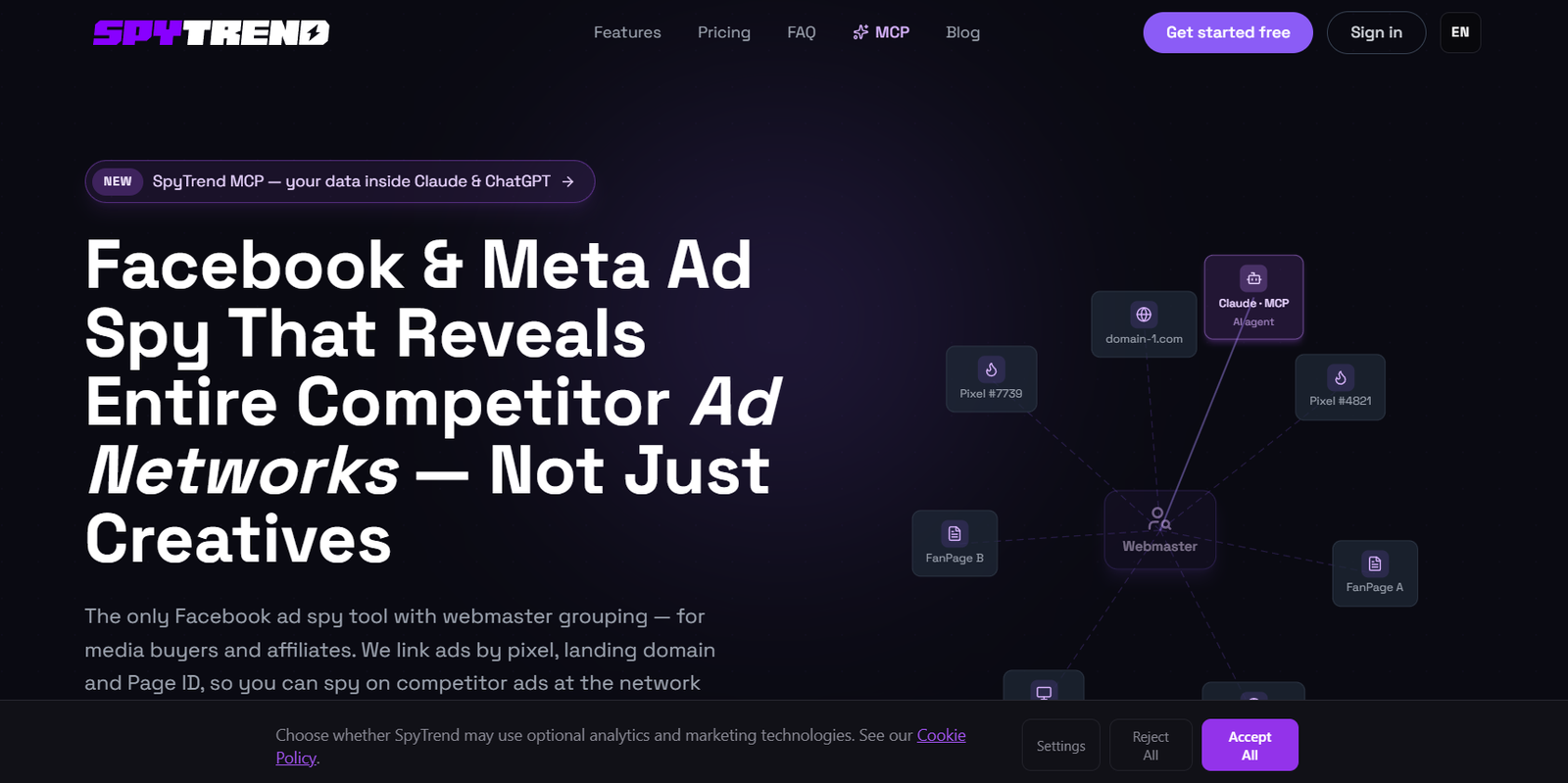
SpyTrend is an advertising intelligence and competitor-research platform designed for media buyers, affiliate marketers, agencies, e-commerce businesses, and performance marketing teams.
Instead of showing only individual advertisements, SpyTrend attempts to reveal the larger advertising operation behind them.
Its Webmaster Grouping technology connects ads using identifiers such as Pixel IDs, domains, Facebook Page IDs, and IP addresses. This allows users to examine groups of related landing pages, creatives, domains, and advertising accounts as part of a broader competitor profile.
The platform primarily focuses on Facebook and Meta advertising, where its deeper webmaster and pixel intelligence features are available. TikTok advertising is also searchable from the same environment.
SpyTrend states that its database contains more than 1.1 billion ads and indexes over 230 million new Meta ads each month.
Users can search advertisements, examine creatives, filter campaigns by vertical and geography, monitor how long advertisements remain active, analyze landing pages, identify related domains, and follow competitor activity over time.
The platform also provides an MCP server that connects its advertising database with compatible AI assistants. This enables marketers to conduct advertising research through natural-language requests rather than relying entirely on manual filtering.
Features
Large Advertising Database
SpyTrend currently states that its database contains more than 1.1 billion advertisements.
The company reports indexing more than 230 million new Meta advertisements each month.
Facebook and Meta Ad Research
Meta is the platform’s main source of advertising intelligence.
Users can search and analyze competitor advertisements running across the Meta advertising ecosystem.
TikTok Ad Search
TikTok is available as an additional advertising source.
Users can switch between Meta and TikTok data within the advertising search workflow.
Webmaster Intelligence
Webmaster Intelligence is one of SpyTrend’s distinguishing features.
Instead of treating every advertisement separately, the system attempts to identify the broader advertising operation behind it.
Webmaster Grouping
Related advertising assets can be grouped using four identifiers:
Pixel ID
Domain
Page ID
IP address
If several domains or pages share these identifiers, SpyTrend can connect them into a broader webmaster profile.
Pixel Intelligence
Users can investigate advertising relationships through tracking pixels.
This can help reveal multiple landing pages, domains, and campaigns associated with the same advertising operation.
Landing Page Intelligence
SpyTrend allows marketers to examine the landing pages connected with advertisements.
This makes it possible to study more than the creative itself and understand how the advertiser structures the broader funnel.
Creative Analytics
The platform analyzes advertising creatives and provides information about their usage.
Creative Deduplication
Repeated copies of essentially the same creative can be consolidated rather than appearing as dozens of independent results.
This can make large advertising datasets easier to analyze.
Days Active Tracking
SpyTrend tracks how long advertisements remain active.
Long-running advertisements can be useful research signals because advertisers are less likely to keep spending on campaigns that consistently fail.
However, campaign duration should be treated as a performance indicator rather than proof of profitability.
Live Activity Status
Advertisements and webmasters can be marked as active, inactive, or vanished.
This helps users distinguish currently operating campaigns from older advertising activity.
Near Real-Time Monitoring
SpyTrend regularly checks advertising activity and updates campaign status.
This can help marketers identify emerging campaigns and changes in competitor activity.
33 Advertising Verticals
The platform organizes advertisements across 33 broad verticals.
Examples include e-commerce, gambling, crypto, and nutra.
AI Subcategories
SpyTrend uses AI-based classification to organize advertisements into hundreds of more specific subcategories.
This makes it easier to narrow research to a particular product or offer type.
Custom Keyword Tracking
Users can create their own keyword and geographic tracking rules.
SpyTrend can then collect advertisements matching those criteria.
Geographic Trends
Users can analyze advertising activity by country and geography to identify markets where particular offers or categories are gaining attention.
Format Analysis
The dashboard provides information about advertising formats such as video and static creatives.
Manual Tagging
Users can manually tag advertisements and organize research according to their own workflow.
Personalized Filtering
Marketers can dismiss irrelevant creatives and shape the feed around the campaigns they actually want to monitor.
Similar Ads
Users can find related advertisements based on factors such as Facebook page and domain.
Historical Data
The Pro plan currently provides up to 90 days of history.
This helps users examine how campaigns and creatives have changed over time.
Data Export
Paid users can export advertising research for further analysis or reporting.
Quick Win Research
SpyTrend provides a Quick Win workflow highlighting active webmasters within a selected period.
This can help users begin competitor research without constructing complex searches manually.
MCP Server
SpyTrend provides an MCP server that connects its advertising intelligence to compatible AI assistants.
AI-Assisted Ad Research
Through MCP, users can ask an AI assistant to perform advertising research using natural-language instructions.
For example, an assistant can search ads, investigate a competitor’s pixel, analyze trends, connect related advertising entities, or retrieve campaign information.
Claude and ChatGPT Integration
The official website specifically presents MCP as a way to bring SpyTrend data into AI environments such as Claude and ChatGPT.
OAuth 2.1 Security
MCP connections use OAuth 2.1 with an explicit consent process.
The user’s SpyTrend password is not sent to the connected AI client.
How It Works
Step 1: Create an Account
Users can begin with the free Starter plan without entering a credit card.
Step 2: Select a Vertical
Choose the market or advertising niche you want to investigate.
SpyTrend currently organizes data across 33 verticals.
Step 3: Search the Ad Database
Search using criteria such as keywords, domains, Page IDs, pixels, categories, or other available filters.
Step 4: Examine Competitor Ads
Review advertising creatives, landing pages, activity status, and other available campaign information.
Step 5: Open a Webmaster Profile
Instead of examining one advertisement in isolation, investigate the advertiser’s broader network.
Step 6: Analyze Connections
Study relationships between pixels, domains, landing pages, Page IDs, and IP addresses.
Step 7: Check Campaign Longevity
Use days-active information to identify campaigns that have remained live for meaningful periods.
Step 8: Analyze Geographic and Category Trends
Look for markets, products, categories, and advertising approaches receiving increased activity.
Step 9: Study the Funnel
Examine the relationship between the creative, landing page, tracking infrastructure, and related campaigns.
Step 10: Adapt the Insights
Use the research as inspiration for developing an original advertising strategy rather than simply copying another advertiser’s protected creative assets.
Use Cases
Competitor Ad Research
Marketers can monitor how competitors advertise products and services.
Media Buying
Media buyers can research active campaigns before deciding which offers, creatives, or markets deserve further testing.
Affiliate Marketing
Affiliate marketers can investigate advertisers, landing pages, offers, and campaign networks.
E-Commerce Product Research
Online sellers can examine advertising activity around products and identify items receiving sustained promotional investment.
Creative Research
Advertising teams can study formats, hooks, messaging approaches, and visual trends.
Landing Page Research
Marketers can analyze the pages competitors use after users click an advertisement.
Advertising Funnel Analysis
Users can investigate the relationship between creatives, landing pages, domains, and tracking infrastructure.
Agency Competitive Analysis
Marketing agencies can prepare competitor research for clients without manually reviewing thousands of individual advertisements.
Campaign Monitoring
Users can follow competitors and observe new advertisements or changes in campaign activity.
Geographic Research
Advertisers can investigate which categories and campaigns are active in particular markets.
AI-Assisted Advertising Research
Teams can use MCP-connected AI assistants to query SpyTrend’s data using natural language.
Pricing
SpyTrend currently offers Starter, Pro, and Team plans.
Starter: $0 per month
Starter is free forever.
It includes:
Limited access to the advertising database
Basic ad information
Basic search access
No credit card is required.
Pro: $79 per month
Pro currently includes:
Unlimited searches
One AI category
Full Webmaster Grouping
Pixel Intelligence
Landing Intelligence
Creative deduplication
Data export
90 days of history
One user
Additional AI categories currently cost $50 per month each.
Team: From $63.20 per seat per month
Team is designed for groups of 4–20 members.
It includes the Pro features for each member along with:
Centralized billing
Invite links
Priority support
Volume discounts can affect the effective per-seat price.
Annual Billing
SpyTrend currently advertises a 20% saving with annual billing.
Money-Back Guarantee
The company currently offers a seven-day money-back guarantee on first-time payments.
Subscriptions automatically renew and can be cancelled from account settings.
Prices are listed in US dollars, while local currency may be displayed at checkout.
MCP Pricing and Usage
SpyTrend also uses a token system for some MCP-based AI research.
Trial
The MCP trial provides 500 tokens free.
One token generally corresponds to one returned result, such as an advertisement, webmaster, trend row, or entity card.
Creative media can consume additional tokens.
Pro MCP Allowance
Pro currently includes 40,000 MCP tokens per month.
Some Meta analytics operations through MCP are provided without token charges, while creative media and TikTok data can consume tokens.
Users planning extensive AI-agent research should review the current MCP usage rules before building automated workflows.
Strengths
Research Beyond Individual Ads
Webmaster Grouping helps users investigate broader advertising operations rather than isolated creatives.
Pixel Intelligence
Tracking pixels can reveal relationships between otherwise separate campaigns and domains.
Large Meta Dataset
SpyTrend reports indexing more than 230 million new Meta advertisements each month.
TikTok Support
Users can also research TikTok advertisements from the same environment.
Creative Deduplication
Removing repeated versions of the same creative can make large datasets easier to understand.
Campaign Longevity Tracking
Days-active data provides another signal when evaluating advertising activity.
Real-Time Monitoring
Current campaign status can help distinguish active strategies from outdated advertisements.
Vertical Classification
Thirty-three verticals and more detailed AI subcategories simplify niche research.
Free Plan
Users can explore basic functionality without entering payment information.
MCP Integration
Connecting advertising intelligence directly to AI assistants can significantly reduce repetitive manual research.
Natural-Language Research
Users can ask an AI assistant to investigate advertising data rather than constructing every query manually.
Drawbacks
SpyTrend’s deepest intelligence capabilities focus primarily on Meta advertising.
Although TikTok is supported, Webmaster Grouping is currently centered on Meta data.
Google Ads and native advertising networks are not currently covered.
The Pro plan costs $79 per month, which may be expensive for occasional users.
Only one AI category is included with Pro, while additional AI categories currently cost $50 per month each.
Campaign longevity can be a useful signal, but an advertisement running for more than five days does not prove that the campaign is profitable. Advertisers may continue running campaigns for many reasons.
Competitor advertising intelligence also cannot reveal every important variable behind campaign performance, such as exact targeting, margins, conversion rates, attribution settings, or backend customer value.
Users should therefore treat SpyTrend as a research tool rather than a guaranteed method for identifying profitable campaigns.
Comparison with Other Platforms
SpyTrend competes with advertising intelligence platforms such as AdSpy, BigSpy, Minea, AdHeart, and SocialPeta.
Many traditional ad-spy tools focus primarily on individual advertisements and advertiser pages.
SpyTrend’s main distinction is Webmaster Grouping.
By linking pixels, domains, Page IDs, and IP addresses, the platform attempts to reconstruct a broader view of the advertiser’s infrastructure.
Its Pixel Intelligence and landing-page analysis also move the research beyond simply viewing an advertisement.
Another differentiator is MCP connectivity. Instead of using only the conventional web interface, marketers can connect SpyTrend data to compatible AI assistants and perform more complex research through natural-language requests.
However, platforms covering a larger number of advertising networks may be more suitable for users who need extensive intelligence outside Meta and TikTok.
Customer Reviews and Testimonials
SpyTrend publishes several customer testimonials on its official website.
One testimonial is attributed to Alexey M., described as a gambling media buyer with more than three years of experience. He reports using Webmaster Grouping to uncover additional domains and Facebook pages associated with a competitor.
Another testimonial comes from Dmitry K., a marketing agency team lead, who says SpyTrend reduced the time required to perform competitive analysis for clients.
A third testimonial is attributed to Marina T., an e-commerce dropshipper, who reports using the days-active filter to identify potential products.
The website also states that more than 1,100 media buyers use SpyTrend.
These testimonials and usage figures are presented by SpyTrend itself and should be treated as company-selected social proof rather than independent customer-review data. Individual results can vary.
Conclusion
SpyTrend is an advertising intelligence platform designed to help performance marketers understand not only what competitors are advertising but also how their broader advertising operations are connected.
Its core advantage is Webmaster Grouping, which connects advertisements through Pixel IDs, domains, Page IDs, and IP addresses. Combined with Pixel Intelligence, landing-page research, creative deduplication, days-active tracking, geographic trends, and real-time campaign monitoring, this provides a deeper view than simply browsing competitor creatives.
Meta is currently the strongest part of the platform, while TikTok is also available as an additional advertising source.
The addition of MCP makes SpyTrend particularly relevant in an AI-driven marketing workflow. Media buyers can connect its advertising data to compatible AI assistants and conduct complex competitor research using natural-language instructions.
Its limitations include the $79 monthly Pro price, additional charges for extra AI categories, limited historical depth on the standard paid plan, and lack of Google and native-ad coverage.
For media buyers, affiliates, e-commerce marketers, and agencies that rely heavily on Meta advertising and want to investigate competitors at the campaign-network level rather than simply collect ad creatives, SpyTrend provides a distinctive approach to advertising intelligence.


