
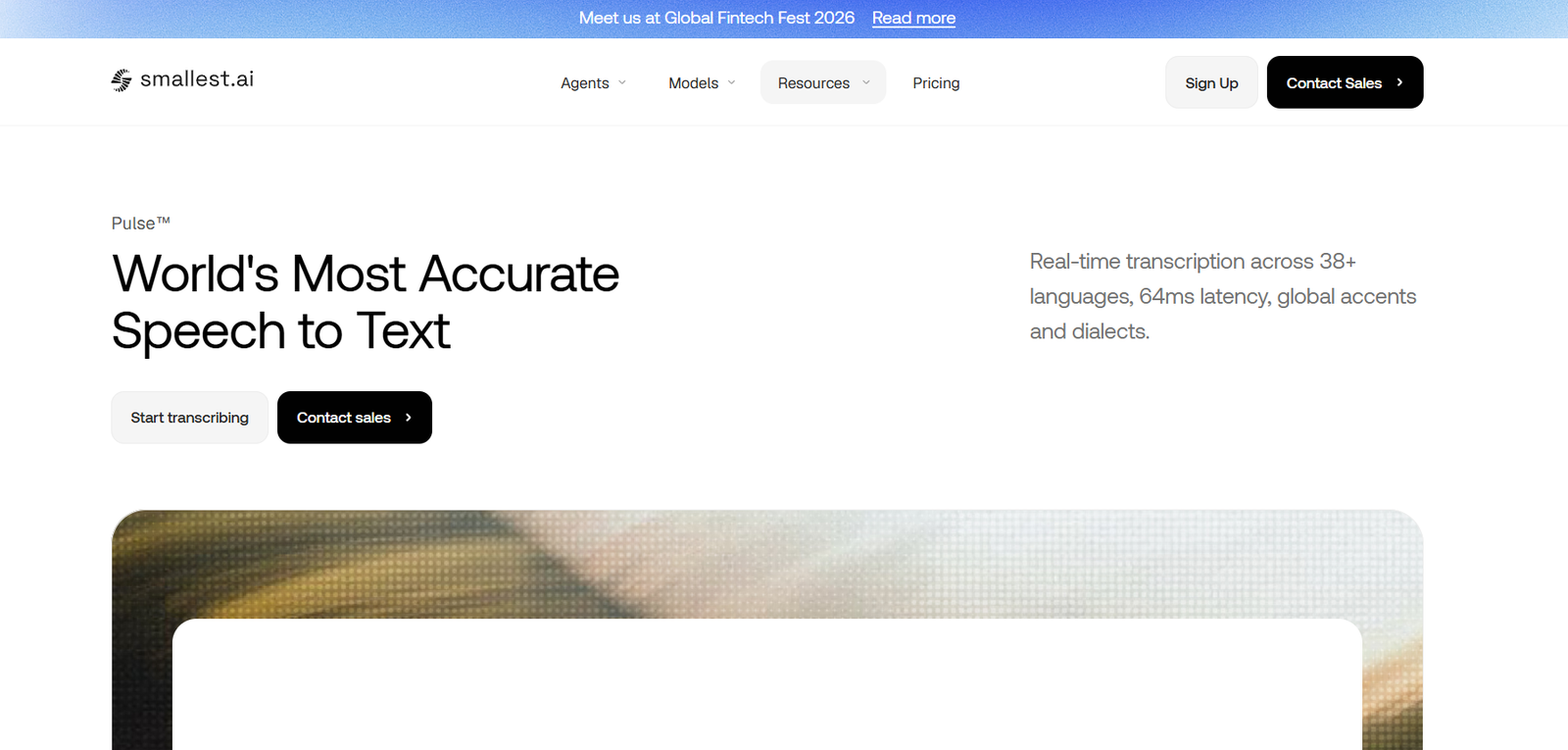
Smallest.ai is an AI voice platform for creating real-time conversational agents and integrating speech intelligence into applications.
Its voice-agent platform, Atoms, allows businesses and developers to create AI agents that can make and receive phone calls, answer questions, access knowledge, perform actions through APIs, and transfer conversations when necessary.
Smallest.ai also develops its own speech and conversational models. These include Lightning for text-to-speech, Pulse for speech-to-text, Hydra for speech-to-speech conversations, and Electron, a small language model optimized for real-time voice interactions.
Businesses can use the complete Atoms platform when they want a ready-to-deploy voice agent, or access individual models through APIs when building their own voice infrastructure.
The platform is suitable for use cases such as customer support, lead qualification, appointment handling, sales calls, customer surveys, reminders, and other high-volume voice workflows.
Developers also receive SDK, API, CLI, MCP, and AI coding-assistant integrations, making Smallest.ai suitable for both no-code-style configuration and custom development.
Features
Atoms AI Voice Agents
Atoms is Smallest.ai’s complete voice-agent platform.
Businesses can configure AI agents that hold real-time conversations with customers through the web or telephone.
Inbound Calls
AI agents can receive incoming customer calls.
This can be useful for support, enquiries, appointment requests, lead handling, and other customer-facing operations.
Outbound Calls
Agents can initiate telephone calls for appropriate business workflows.
Potential applications include follow-ups, qualification, reminders, surveys, and customer outreach.
Voice Agent Templates
Users can start from prebuilt templates rather than creating every agent from scratch.
Templates can be filtered according to factors such as industry and inbound or outbound use.
Custom Agent Prompts
Each agent can be given detailed instructions defining its role, objectives, conversation flow, tone, restrictions, and end conditions.
Multiple AI Models
Users can choose the language model that powers an agent.
Smallest.ai provides its own Electron model while also supporting selected external models such as GPT models.
Electron
Electron is Smallest.ai’s in-house small language model designed for real-time voice conversations.
It is optimized for low-latency interaction and tool calling.
Electron supports more than 70 languages, with particular emphasis on Indic-language capabilities.
Lightning Text-to-Speech
Lightning is Smallest.ai’s text-to-speech model family.
It is designed to convert text into natural-sounding speech with very low latency.
Low-Latency Speech
Lightning V3.1 advertises sub-100 millisecond time-to-first-audio performance.
Low latency is important for AI phone agents because long pauses can make conversations feel unnatural.
Multilingual Text-to-Speech
Lightning can automatically detect and switch between more than 14 languages.
This can help businesses serve multilingual audiences without building a separate voice workflow for every language.
Voice Cloning
Lightning supports instant voice cloning from a short audio sample.
The current model information states that a voice can be cloned from approximately five seconds of audio.
Users should only clone voices when they have appropriate consent and legal rights.
High-Quality Audio
Lightning provides a native sample rate of 44.1 kHz.
This makes the technology useful beyond telephone calls for applications requiring higher-quality generated speech.
Pulse Speech-to-Text
Pulse converts spoken audio into text.
It is available for both pre-recorded and real-time speech recognition.
Real-Time Transcription
Pulse Realtime can transcribe live conversations as they occur.
This is essential for interactive voice agents that need to understand a caller before generating a response.
Multilingual Speech Recognition
Pulse supports more than 20 languages, depending on the specific model and mode.
Speaker Identification
Supported Pulse workflows can identify different speakers in an audio recording.
Timestamps
Transcription results can include timestamps, helping developers connect spoken content with specific moments in an audio file.
Sensitive Data Protection
Pulse includes functionality for handling sensitive information during transcription workflows.
Hydra Speech-to-Speech
Hydra is Smallest.ai’s speech-to-speech model.
Instead of relying entirely on a traditional speech-to-text, LLM, and text-to-speech pipeline, speech-to-speech models can process conversational audio more directly.
Hydra is currently in beta.
Full-Duplex Conversation
Hydra is designed for fluid real-time conversations where interruptions can be handled naturally.
Interruptions
Voice agents can be configured to allow users to interrupt them while they are speaking.
This is important for making AI conversations feel less like rigid automated telephone menus.
Knowledge Base
Businesses can connect information to an agent through a knowledge base.
The agent can then use this information when responding to callers.
API Tools
Voice agents can call external APIs during conversations.
For example, an agent could retrieve information, check availability, update a business system, or trigger another workflow.
Client Tools
For browser-based and WebSocket sessions, agents can invoke functions within the user’s own application.
This can support actions such as updating a cart or navigating an interface.
Reusable Tools Library
Organizations can create tools once and make them available across multiple AI agents.
Updating a shared tool can then update its behavior across the agents that reference it.
Human Call Transfer
Agents can be configured to transfer calls when a human employee needs to take over.
End Call Controls
Businesses can define when and how an AI agent should end a conversation.
Phone Number Integration
Agents can be connected to telephone numbers for real-world inbound and outbound calling.
Campaigns
Smallest.ai supports voice-agent campaigns for managing outbound calling workflows.
Testing Suite
Agents can be tested before deployment.
Users can test through a browser-based voice call, telephony call, or text chat.
Web Call Testing
Developers can speak directly to an agent using their computer microphone.
Telephony Testing
A test call can be placed to a telephone number to evaluate the complete voice experience.
Chat Testing
Agents can also be tested through text before voice deployment.
Agent Versioning
Smallest.ai provides version-management capabilities for voice agents.
This allows changes to be developed and published through a controlled workflow rather than immediately affecting live calls.
Agent API
Developers can create and manage voice agents programmatically.
This allows Smallest.ai functionality to be embedded into larger applications and automated systems.
Python SDK
Smallest.ai provides a Python SDK for developers building custom applications.
Command-Line Interface
The Smallest.ai CLI can create, inspect, manage, and test agents directly from a development environment.
MCP Server
Smallest.ai provides an MCP server that allows compatible AI coding assistants to interact with the platform.
It works with development environments and assistants such as Claude Code, Codex, and Cursor.
AI Coding Assistant Support
Developers can use machine-readable documentation, MCP, Context7, and agent skills to help coding assistants generate integrations using current Smallest.ai APIs.
Custom Voice Stacks
Developers are not required to use the complete Atoms platform.
They can combine Pulse, Electron, and Lightning themselves to create a custom voice architecture.
How It Works
- Create a Smallest.ai account.
- Open the voice-agent dashboard.
- Create an agent from a template or start from scratch.
- Give the agent a name.
- Write a prompt describing its role, objectives, conversation flow, restrictions, and tone.
- Select an AI voice.
- Choose the default and supported languages.
- Select a language model such as Electron or another available model.
- Add a knowledge base when the agent needs access to business information.
- Configure tools if the agent needs to perform actions through APIs.
- Configure call-ending and human-transfer behavior.
- Test the agent through web voice, telephone, or chat.
- Refine the prompt and voice settings based on the results.
- Connect a telephone number for inbound or outbound calling.
- Publish and activate the agent.
- Monitor conversations and optimize the workflow as usage grows.
Developers who need only speech models can instead use Lightning, Pulse, Electron, or other supported models through APIs.
Use Cases
Customer Support
Businesses can build AI agents that answer routine questions and transfer complicated conversations to human representatives.
Lead Qualification
Voice agents can call or receive calls from prospective customers and gather qualifying information.
Sales
Sales teams can automate selected conversational tasks such as initial outreach and follow-up.
Appointment Management
Voice agents can help businesses handle appointment-related conversations when connected to appropriate scheduling systems.
Customer Surveys
Companies can conduct automated voice surveys and collect structured responses.
Call Centers
High-volume operations can use AI to handle repetitive conversations while reserving human staff for more complex interactions.
Multilingual Customer Service
The multilingual speech stack can help businesses communicate with customers across multiple languages.
Healthcare and Regulated Workflows
Enterprise deployment options may be relevant to regulated industries, subject to appropriate agreements, configuration, and compliance review.
Voice Applications
Developers can use the APIs to add speech recognition and generated speech to their own products.
Transcription
Pulse can transcribe recorded or live audio.
Voice Cloning
Businesses with appropriate consent can create customized AI voices for approved applications.
AI Coding Projects
Developers can use MCP and coding assistants to create and configure Smallest.ai agents through natural-language development workflows.
Pricing
Smallest.ai provides both pay-as-you-go and Enterprise pricing.
New users can currently start with $10 in free credits.
Voice Agents
Creating agents is not restricted by a per-agent fee under the current pay-as-you-go structure.
Users can create unlimited agents.
Voice-agent usage generally costs approximately:
$0.09 to $0.21 per minute
Actual cost depends on the models and architecture selected.
Some optimized enterprise configurations can reach approximately:
$0.05 per minute
Hosting
Standard Smallest.ai hosting currently costs approximately:
$0.01 per minute
LLM Costs
Language-model costs depend on the selected model and are charged as part of the voice-agent architecture.
Different GPT and Smallest.ai model options have different usage costs.
Lightning V3.1 Text-to-Speech
Approximately:
$0.175 per 10,000 characters
Lightning V3.1 Pro
Approximately:
$0.195 per 10,000 characters
Pulse Pre-Recorded Speech-to-Text
Starts at approximately:
$0.003 per minute
Pulse Realtime
Approximately:
$0.004 per minute
Pulse Pro Pre-Recorded
Approximately:
$0.0035 per minute
Electron
Electron is offered through enterprise arrangements with custom pricing for model-specific deployments.
Hydra
Hydra speech-to-speech is currently in beta.
Pricing may depend on access and deployment arrangements.
Enterprise
Enterprise pricing is customized.
Enterprise customers can receive higher concurrency, customized model pricing, on-premise options for supported models, and production-scale infrastructure.
Pricing can change, so businesses should confirm current model and telephony charges before estimating large-scale call-center costs.
Strengths
Complete platform for building real-time AI voice agents.
Supports both inbound and outbound calls.
Businesses can start with templates rather than coding an agent from scratch.
Smallest.ai develops its own speech models.
Lightning provides very low-latency text-to-speech.
Pulse provides inexpensive real-time and pre-recorded transcription.
Electron is optimized specifically for voice conversations.
Hydra introduces direct speech-to-speech capabilities.
Strong multilingual support.
Particular attention is given to Indic-language support.
Voice cloning is available.
Agents support interruption and natural turn-taking.
Knowledge bases can ground responses in business information.
API tools allow agents to perform real-world actions.
Human call transfer is supported.
Agents can be tested through voice, phone, or chat.
Pay-as-you-go pricing lowers the barrier to experimentation.
New users receive free credits.
Developers receive API, SDK, CLI, and MCP options.
Individual speech models can be used independently of the full agent platform.
Drawbacks
Voice-agent pricing can become complicated because the final cost depends on several components.
Telephony, hosting, speech recognition, language models, and speech generation may all contribute to the total cost.
Advanced deployments require technical configuration and testing.
AI voice agents can occasionally misunderstand callers or produce incorrect responses.
Businesses should maintain human escalation paths for sensitive or complex conversations.
Voice cloning creates ethical and misuse risks and should only be used with appropriate consent.
Some advanced capabilities, including Hydra, are still in beta.
Certain enterprise model and on-premise capabilities require custom pricing.
Businesses operating in regulated industries need to independently confirm that their exact deployment meets applicable legal and compliance requirements.
Automated outbound calling is subject to telecommunications, consent, privacy, and marketing laws that vary by jurisdiction.
Privacy and Security
Smallest.ai is operated by Smallest, Inc.
Its current Privacy Policy covers services including voice cloning, text-to-voice functionality, and AI agents that can handle inbound and outbound calls.
The company collects information necessary to provide its services, including account, usage, and service-related information.
Because voice applications can involve personal and potentially sensitive information, organizations should carefully review Smallest.ai’s current privacy, security, data-processing, and retention terms before production deployment.
Voice cloning should only be performed when the organization has permission to use the source speaker’s voice.
Businesses handling sensitive conversations should also evaluate enterprise security and deployment options before integrating Smallest.ai into regulated workflows.
Comparison with Other Platforms
Smallest.ai competes with AI voice-agent platforms, speech API providers, and conversational AI infrastructure companies.
Compared with a basic text-to-speech provider, Smallest.ai offers a much broader stack covering speech recognition, speech generation, conversational models, voice agents, telephony, tools, and developer infrastructure.
Compared with voice-agent platforms that primarily combine third-party models, Smallest.ai develops important parts of its own voice stack, including Lightning, Pulse, Electron, and Hydra.
Compared with companies that only provide a complete hosted voice agent, Smallest.ai gives developers more flexibility because individual models can also be accessed through APIs.
Its MCP, SDK, CLI, and AI coding-assistant integrations are particularly useful for developers who want to build or automate voice applications programmatically.
The platform’s strongest differentiators are its low-latency focus, integrated voice stack, multilingual support, developer tooling, and ability to choose between a complete agent platform and individual model APIs.
Customer Reviews and Testimonials
Smallest.ai’s official website focuses primarily on product capabilities, technical documentation, performance, developer resources, and enterprise applications.
Detailed independently verified customer reviews are not a major part of the official product information.
Because voice-agent quality depends heavily on the use case, prompt design, language, telephony environment, selected models, and external integrations, businesses should test Smallest.ai with realistic conversations before moving to large-scale production.
The availability of initial free credits makes it possible for prospective users to experiment with the platform before committing significant expenditure.
Conclusion
Smallest.ai is a comprehensive AI voice infrastructure platform for businesses and developers building real-time conversational applications.
Its most important advantage is that it covers multiple layers of the voice AI stack. Atoms provides the complete voice-agent environment, while Lightning handles text-to-speech, Pulse handles speech recognition, Electron provides a conversational language model, and Hydra is developing a more direct speech-to-speech approach.
Businesses can create agents for inbound and outbound calls, connect knowledge bases and APIs, enable human transfers, and test conversations before deployment.
Developers have additional flexibility through APIs, Python SDKs, command-line tools, MCP integration, and support for AI coding assistants.
The pay-as-you-go model, including $10 in initial free credits, makes the platform accessible for prototypes, while enterprise options provide additional flexibility for organizations operating at scale.
Smallest.ai is particularly suitable for customer support, sales automation, lead qualification, appointment workflows, multilingual voice services, transcription, and custom voice applications.
Overall, Smallest.ai stands out as both a voice-agent platform and a developer-focused speech AI infrastructure provider rather than simply a text-to-speech service.


