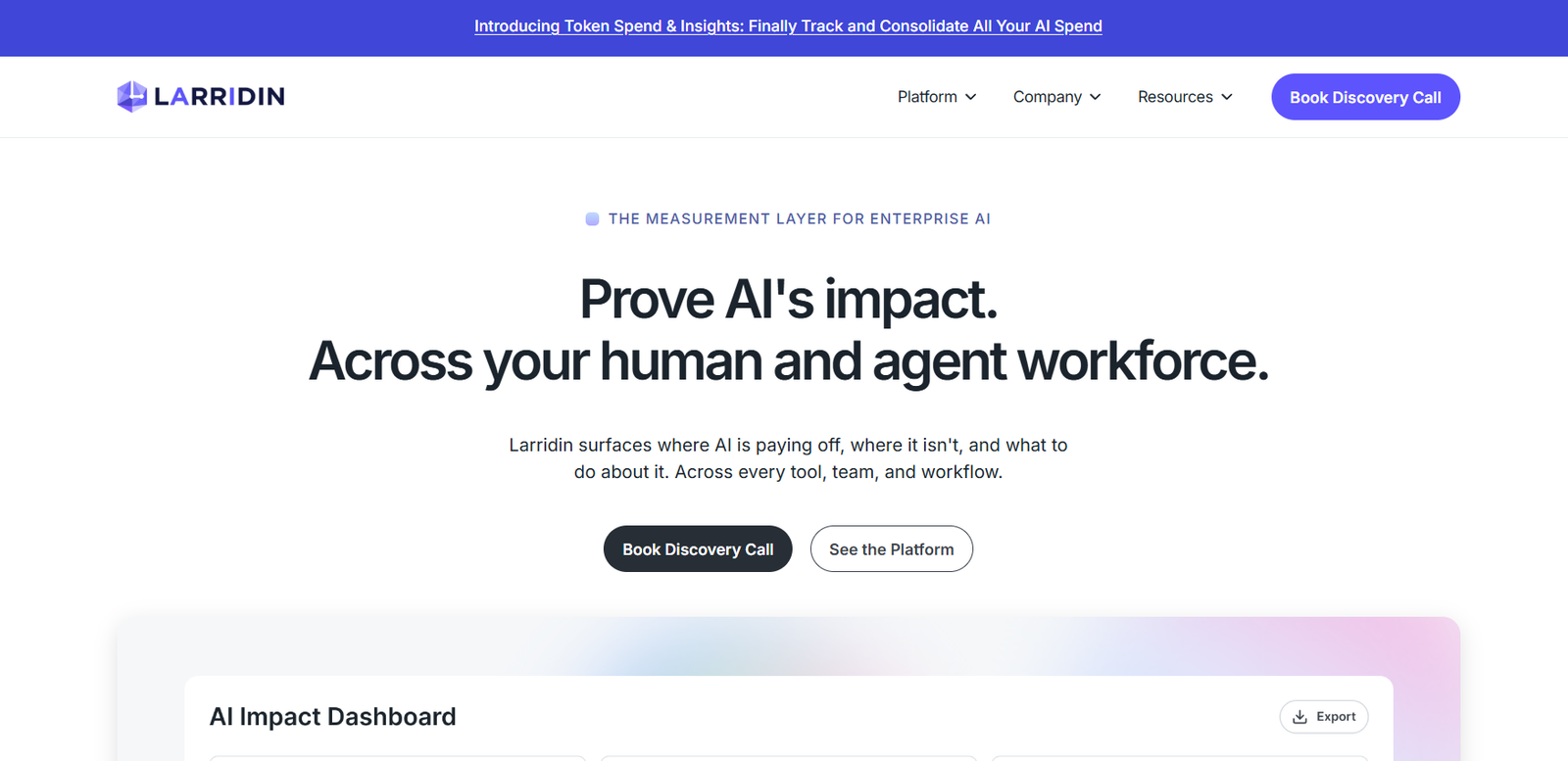
Larridin is an enterprise AI intelligence platform designed to help organizations understand whether their investments in artificial intelligence are actually improving business performance.
As companies adopt tools such as AI assistants, coding copilots, generative AI platforms, and autonomous agents, simply knowing how many licenses have been purchased is not enough. Organizations also need to understand who is actually using AI, how effectively employees use it, how much AI costs, which workflows are changing, and whether those changes are producing measurable business results.
Larridin provides this measurement layer.
The platform brings together information about AI adoption, usage, token consumption, spending, workforce fluency, business workflows, engineering activity, and outcomes. Leaders can then examine where AI is creating value, where investments are underused, and where additional automation opportunities may exist.
Larridin Scout is a central part of the platform. It uses a centrally deployed browser plugin and desktop application to identify AI tools and agents being used across an organization, including potentially unsanctioned or “shadow AI” applications.
Larridin can then analyze adoption patterns by department, role, team, location, and AI application.
For engineering organizations, it connects AI usage with development information from systems such as GitHub and Jira to examine whether AI-assisted developers are actually improving velocity, quality, and output.
The platform also provides AI spend and token intelligence, allowing businesses to examine licenses, model calls, tokens, usage, and potentially wasted expenditure.
Larridin is aimed primarily at medium and large enterprises rather than individual consumers. Its intended users include CIOs, CFOs, CTOs, Chief AI Officers, CISOs, engineering leaders, operations executives, HR leaders, and enterprise AI transformation teams.
Features
AI Adoption Measurement
Larridin helps organizations determine how widely AI is actually being used.
Instead of measuring only purchased licenses, it examines active usage and adoption patterns.
AI Tool Discovery
Larridin Scout can discover AI tools being used across an organization.
This gives leaders a broader inventory of the AI technologies that have entered the workplace.
Shadow AI Detection
Employees may begin using AI services without formal approval from IT or procurement.
Larridin can help surface these unsanctioned tools so organizations have greater visibility into their AI environment.
AI Usage Analytics
Organizations can examine AI activity by team, department, location, role, and application.
This can reveal where AI adoption is strong and where licenses or tools remain underused.
AI Fluency Measurement
Larridin goes beyond asking whether employees use AI.
It also examines how effectively different teams and roles are developing practical AI capability.
This allows organizations to identify power users as well as teams that may require additional training or support.
Team-Level Benchmarking
AI adoption and fluency can be compared across teams.
Leaders can identify which departments have successfully incorporated AI into everyday work and which are lagging behind.
AI Impact Measurement
Larridin is designed to connect AI activity with measurable business outcomes.
This helps enterprises move from basic adoption reporting toward understanding actual AI impact.
AI ROI Analysis
Businesses can use Larridin to examine whether AI investments are producing measurable returns.
This is particularly useful when leadership needs to justify AI budgets to finance teams or boards.
Spend Intelligence
Larridin provides visibility into enterprise AI expenditure.
Organizations can examine where their AI budget is going and how that spending relates to usage and outcomes.
Token Spend Intelligence
The platform can track model calls and token consumption.
This is increasingly important as enterprise AI costs shift from simple software subscriptions toward consumption-based pricing.
License Utilization
Businesses can identify AI licenses that are not being used effectively.
This can reveal opportunities to reallocate or eliminate unnecessary spending.
Model Overspend Detection
Larridin can help identify areas where organizations may be paying more than necessary for AI model usage.
Workflow Optimization
The platform maps how work is actually being performed across the organization.
It can identify where AI is already involved in workflows and where additional automation opportunities may exist.
AI Opportunity Discovery
Larridin helps organizations identify processes that could potentially benefit from additional AI adoption or automation.
This can help enterprises prioritize future AI initiatives instead of investing based only on assumptions.
Human and Agent Workforce Measurement
Larridin is designed for workplaces where employees increasingly work alongside AI agents.
The platform can examine activity across both human and agentic work.
Developer Intelligence
Engineering organizations can use Larridin to measure the effect of AI coding tools on software development.
GitHub Integration
Larridin can connect with GitHub data to examine engineering activity and output.
Jira Integration
Jira information can also be incorporated into developer-productivity analysis.
AI-Assisted Engineering Measurement
The platform can help organizations determine whether developers using AI coding tools are actually shipping more effectively.
Engineering Velocity
Development teams can examine whether AI usage correlates with improvements in delivery speed.
Engineering Quality
Productivity measurement is not limited to raw output.
Organizations can also consider quality-related information when evaluating AI-assisted engineering.
AI Seat ROI
Engineering leaders can evaluate whether investments in coding-assistant seats are producing measurable improvements.
AI Inventory
Larridin can create and maintain a continuously updated view of AI tools used across the workforce.
This can support broader governance and compliance initiatives.
Continuous Monitoring
Instead of relying only on occasional surveys or audits, Larridin provides ongoing measurement of AI activity.
Governance Evidence
Usage records, dashboards, and exports can provide evidence for internal governance processes and external audits.
ISO/IEC 42001 Support
Larridin positions Scout as an evidence and monitoring component that can support an organization’s AI Management System under ISO/IEC 42001.
The platform itself does not replace the organization’s complete compliance program.
Executive Dashboards
Leadership teams can view high-level information covering areas such as adoption, spend, workflows, productivity, and impact.
Department-Level Analytics
Executives can move beyond company-wide averages and examine how individual business functions are using AI.
Board-Ready Reporting
Larridin is designed to help organizations turn fragmented AI data into reports suitable for senior leadership and board discussions.
How It Works
- An enterprise begins with a discovery or consultation process with Larridin.
- The organization identifies the AI tools, teams, business functions, and outcomes it wants to measure.
- Larridin Scout is deployed through its browser plugin and desktop application.
- Scout detects AI tools and agents being used across the organization.
- Usage information is analyzed to understand adoption patterns.
- Larridin organizes results by factors such as team, department, role, location, and AI application.
- The organization can identify sanctioned and potentially unsanctioned AI usage.
- AI fluency measurements help determine how effectively different teams are using AI.
- Spend intelligence brings together information about AI licenses, model calls, and token consumption.
- Workflow analysis identifies where AI is already affecting business processes.
- For engineering teams, Larridin can connect with development systems such as GitHub and Jira.
- AI usage can then be compared with relevant productivity and business outcomes.
- Leaders review dashboards showing adoption, fluency, spend, workflows, developer performance, and AI impact.
- The organization identifies high-value AI investments as well as underused or inefficient spending.
- Leadership can use these insights to decide which tools to expand, reduce, replace, or investigate further.
Use Cases
For CIOs
CIOs can identify which AI tools are being used and determine where additional investment may have the greatest impact.
For CFOs
Finance leaders can connect AI expenditure with usage and outcomes rather than treating AI simply as another software cost.
For Chief AI Officers
AI leaders can monitor adoption, workforce capability, opportunities, and business impact across the organization.
For CTOs
Technology executives can evaluate AI usage across development teams and the broader technology stack.
For Engineering Leaders
Engineering managers can investigate whether tools such as coding copilots and AI coding agents are improving development velocity and output.
For CISOs
Security leaders can gain visibility into potentially unsanctioned AI tools being used by employees.
For HR and Workforce Leaders
Organizations can identify teams with strong AI fluency and groups that may need additional training.
For Operations Leaders
Operations teams can identify workflows where AI is already changing work and processes where further automation may be valuable.
For AI Governance
Organizations can maintain an inventory of workplace AI tools and generate ongoing usage evidence for governance programs.
For AI Budget Optimization
Businesses can identify unused licenses, unnecessary expenditure, and potentially inefficient model consumption.
For Enterprise AI Transformation
Organizations running broad AI initiatives can use Larridin as an independent measurement layer across multiple tools and departments.
For Board Reporting
Executives can consolidate AI adoption, spend, productivity, and impact information into more understandable leadership reporting.
Pricing
Larridin does not publicly list standard subscription prices on its official website.
The platform is sold as an enterprise solution.
Prospective customers are directed to book a discovery call or request a platform demonstration.
Pricing is therefore likely to depend on factors such as:
Organization size
Number of employees
Number of teams or business units
Required platform capabilities
Deployment requirements
Integrations
Security requirements
Data and reporting needs
Support requirements
On-premise or regulated-industry requirements
Organizations interested in Larridin should contact the company for a customized commercial proposal.
There is no clearly advertised permanent free plan or standard self-service monthly subscription on the official website.
Strengths
Provides enterprise-wide visibility into AI adoption.
Measures actual usage rather than relying only on purchased-license information.
Can identify unsanctioned or shadow AI.
Tracks AI fluency by team and role.
Combines AI adoption with business-impact measurement.
Provides token and AI spend intelligence.
Can identify potentially unused licenses and wasted AI expenditure.
Maps AI usage across business workflows.
Helps identify new AI automation opportunities.
Supports measurement across both human employees and AI agents.
Developer intelligence connects AI usage with engineering activity.
Integrations with development systems such as GitHub and Jira can provide more meaningful engineering measurement.
Continuous monitoring is more useful than relying only on occasional employee surveys.
AI inventory and monitoring can support governance programs.
Provides executive and board-oriented reporting.
Designed specifically for enterprise AI transformation rather than general SaaS usage analytics.
Drawbacks
Public pricing is not available.
There is no obvious self-service plan for individuals or small businesses.
Deployment across an enterprise may require coordination with IT, security, legal, HR, and other departments.
AI productivity is difficult to measure objectively, and correlations between AI usage and business outcomes do not automatically prove that AI caused those outcomes.
Different jobs require different definitions of productivity, so organizations need to interpret metrics carefully.
Employee monitoring can create privacy and workplace-trust concerns if implementation is not communicated transparently.
Enterprises should establish clear policies explaining what data is collected and how it will be used.
The platform may be more sophisticated than necessary for companies with only a small number of AI users.
Some business-impact capabilities depend on connecting Larridin information with relevant operational and outcome data.
Privacy and Security
Larridin states that most sensitive information collected by Scout is processed within the browser and does not leave the user’s machine.
According to its FAQ, only summary statistics are sent to the Larridin cloud.
The company states that Scout is SOC 2, HIPAA, and GDPR compliant.
On-premise deployment options are also available for highly regulated organizations through supported enterprise hardware arrangements.
The public website privacy policy states that Larridin does not sell personal information.
Website information may be processed by service providers supporting functions such as hosting, analytics, and marketing.
Larridin also states that its customer platforms, Scout and Nexus, are governed by separate commercial agreements and Data Processing Addendums rather than the public website privacy policy.
Enterprises should review those contractual terms and technical security documentation before deployment.
Comparison with Other Platforms
Larridin occupies a specialized position between AI management, software analytics, FinOps, workforce intelligence, and developer-productivity platforms.
Traditional SaaS management tools can tell an organization which software licenses it has purchased, but they may provide less detail about how effectively employees actually use AI or whether that usage improves business results.
Traditional FinOps platforms focus primarily on technology expenditure. Larridin extends the cost question toward AI tokens, tools, adoption, workflows, and outcomes.
Developer analytics platforms can measure engineering activity, while Larridin adds the specific question of how AI-assisted development affects engineering performance.
Employee surveys can provide useful information about AI adoption, but they depend on self-reporting. Larridin instead emphasizes continuous measurement of actual AI usage.
Its key differentiator is therefore its attempt to connect several questions in one platform: What AI is being used? Who is using it? How effectively? What does it cost? How is work changing? And is the organization getting measurable value from it?
Customer Reviews and Testimonials
Larridin publishes customer stories and enterprise usage examples on its official website.
The company displays organizations such as Vertiv, Gainsight, Klaviyo, SurveyMonkey, Globality, TigerConnect, EcoVadis, ConnectPay, Rev.io, The Joint Chiropractic, University of Hertfordshire, and others under its “Trusted by AI-Forward Enterprises” section.
One published enterprise SaaS customer story describes a 2,000-person company that needed visibility into AI adoption across product, engineering, customer success, and sales.
According to Larridin, the engagement resulted in $1.2 million of AI spend being reallocated, a 38% increase in power users, and board-ready reporting within 60 days.
Larridin also publishes broader platform performance figures, including an average 47% lift in measurable team output, median AI spend optimization of $2.4 million in the first year, and three-times faster time to AI fluency compared with internal programs.
These performance statistics and customer results are presented by Larridin itself and should be treated as company-reported outcomes rather than independent benchmarks guaranteed for every customer.
Conclusion
Larridin is an enterprise intelligence platform built to answer one of the increasingly important questions facing organizations investing heavily in artificial intelligence: Is AI actually improving the business?
Instead of measuring only software licenses or employee logins, Larridin brings together AI adoption, fluency, workflows, token consumption, expenditure, engineering activity, and business outcomes.
Its Scout technology helps enterprises discover which AI tools and agents employees are actually using, including potentially unsanctioned applications. Leaders can then examine differences between teams, identify stronger AI users, detect underused investments, and determine where additional training or automation may be worthwhile.
Spend Intelligence adds another important dimension by tracking licenses, model calls, and tokens, while Developer Intelligence helps engineering organizations evaluate whether AI-assisted developers are actually improving output.
Larridin is therefore most appropriate for medium and large enterprises making substantial investments in generative AI, coding assistants, AI agents, and workforce transformation.
It is not a typical AI content generator or productivity assistant. Instead, it is the measurement and intelligence layer designed to help organizations understand whether all those other AI tools are creating measurable value.