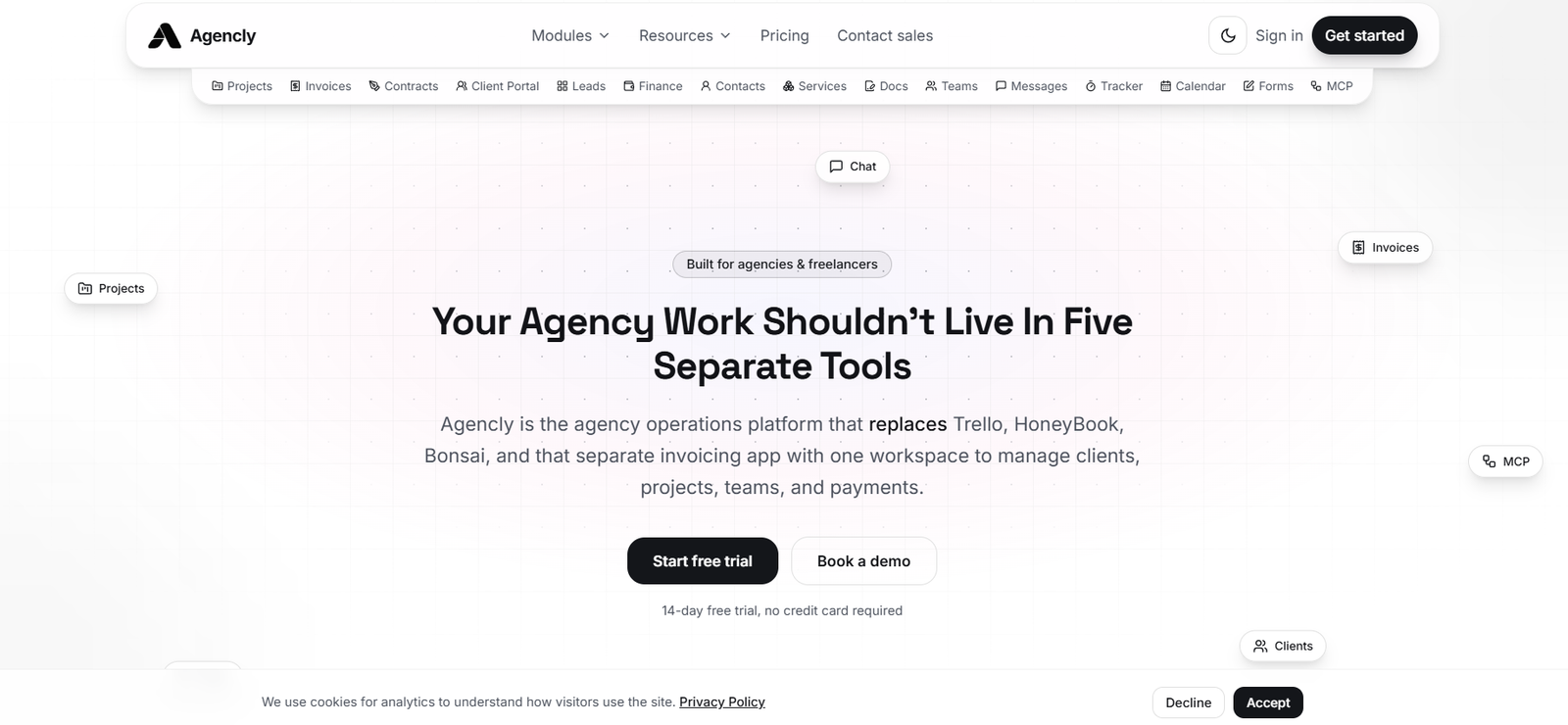
Agencly is an all-in-one agency operations platform designed for freelancers, consultants, creative studios, marketing agencies, development teams, and other service businesses.
Its main purpose is to replace the collection of separate tools many agencies use for project management, CRM, contracts, invoicing, time tracking, client communication, documents, and reporting.
Instead of maintaining client information in one application, projects in another, invoices elsewhere, and communication through scattered emails or messages, Agencly brings the complete client lifecycle into a shared workspace.
A new lead can enter the system, receive a proposal, sign a contract, become a project, generate billable work, receive invoices, and follow progress through a dedicated client portal.
Agencly currently provides 15 core modules covering major areas of agency operations. Agencies can use the modules they need while keeping related information connected across the platform.
The service is fully hosted, so businesses do not need to install or maintain their own servers. It also provides role-based access, encrypted data storage and transmission, automatic backups, and data export.
Agencly is best suited to agencies that want operational software built specifically around client-service workflows rather than combining a general project manager, CRM, invoicing system, contract tool, and client portal themselves.
Features
Project Management
Agencly provides project-management tools for organizing client work.
Projects can include milestones, deliverables, tasks, deadlines, budgets, assignments, and client-facing information.
Multiple Project Views
Teams can organize work through different views, including lists, boards, and spreadsheet-style interfaces.
This allows different teams to manage projects according to their preferred workflow.
Kanban Boards
Tasks can move through visual status columns on Kanban-style boards.
This makes it easier to see what is waiting, in progress, completed, or blocked.
Milestones and Deliverables
Large projects can be divided into milestones and individual deliverables.
Teams can use these structures to track progress and keep client expectations connected to actual work.
Client Portal
Every client can receive a dedicated portal.
The portal can bring together projects, invoices, contracts, messages, meetings, documents, and other information relevant to that client.
Role-Based Client Access
Agencies control what clients can see.
Each client’s portal is isolated from other clients, helping prevent information from being exposed across accounts.
CRM and Lead Management
Agencly includes tools for capturing and managing prospective clients.
Teams can follow opportunities through their sales pipeline and convert successful deals into active client work.
Lead-to-Project Workflow
When a lead becomes a client, information can move into the operational workflow instead of requiring manual re-entry across separate applications.
Contacts
Agencly provides a central contact directory for clients and stakeholders.
Contacts can be associated with companies, projects, invoices, contracts, conversations, and portal access.
Company Profiles
Multiple contacts can be grouped under a single client company.
This is useful when an agency works with several stakeholders at the same organization.
CSV Import and Export
Existing contact and lead information can be imported from CSV files.
Users can also export their data when required.
Contracts
Contracts and proposals can be created and managed inside Agencly.
This reduces the need for a separate contract-management service.
E-Signatures
Clients can electronically sign contracts through the platform.
Features include signing workflows, reminders, signer management, and signed-document export.
Proposal Builder
Agencies can create proposals containing information such as scope, pricing, services, and timelines.
Accepted proposals can then feed into the broader client workflow.
Contract Templates
Reusable templates reduce the need to recreate common agency agreements for every new client.
Advanced custom contract-template functionality is available on higher plans.
Invoicing
Agencies can create, send, and track invoices from the same workspace where client projects are managed.
Invoice statuses can show whether an invoice is in draft, sent, paid, or overdue.
Online Payments
Agencly supports online payment workflows connected with invoices.
Hosted billing means the agency does not need to handle card information directly.
Time Tracking
A built-in time tracker lets team members record billable and non-billable work.
Users can run a timer or enter time manually.
Billable Rates
Different rates can be configured according to the project, client, or team member.
Time-to-Invoice Workflow
Tracked hours can be converted into invoice line items.
This reduces the need to copy time records manually from a separate tracking application into invoicing software.
Finance Dashboard
Agencly provides financial reporting for agency operations.
Users can examine information such as revenue, expenses, cash flow, and billing trends.
Expense Tracking
Business expenses can be recorded alongside incoming revenue.
This gives agencies a broader view of their financial position.
Analytics
Higher-tier plans provide advanced analytics.
Agencies can review operational and financial information such as revenue trends, close rates, and billing performance.
Service Catalog
Agencly lets agencies define the services they sell.
Each service can include a description, category, default pricing, and other relevant information.
Reusable Service Pricing
Once a service has been created, it can be reused across proposals, contracts, projects, and invoices.
This reduces repetitive data entry.
Fixed, Hourly and Subscription Services
Service offerings can support different pricing approaches, including fixed-price, hourly, and recurring arrangements.
Spreadsheets
Agencly includes spreadsheet functionality within the workspace.
Its spreadsheet system supports features such as formulas, dropdowns, conditional formatting, data validation, and CSV imports.
Leads as Spreadsheets
Agencies that prefer flexible spreadsheet-style lead management can organize prospect information in structured grids.
Documents and Files
Client and project documents can be kept inside the same operational environment.
This helps teams avoid spreading important client material across unrelated tools.
Messages
Client communication can take place within the workspace.
This helps keep conversations connected with the appropriate client and project.
Meetings
Agencly includes tools for coordinating meetings and related client communication.
Intake Forms
Businesses can collect structured information from prospects or clients using forms.
This can be useful during onboarding and project discovery.
Team Permissions
Different roles can be assigned according to what each person should be able to access.
Available role structures include Owner, Admin, Member, Client, and Guest.
White-Label Client Portal
The Agency plan includes white-label client portal functionality.
This is useful for businesses that want clients to interact with a more agency-branded experience.
Custom Branded Portal
The Pro plan provides custom branding for the client portal.
AI Integrations
Agencly advertises AI integrations within its broader operations platform.
However, AI is not the primary product proposition. The platform’s core value comes from combining agency CRM, project delivery, billing, contracts, client communication, and related workflows.
How It Works
- Create an Agencly workspace.
- Start the 14-day free trial without providing a credit card.
- Import existing leads or contacts from CSV if required.
- Add prospective clients to the lead-management workflow.
- Define the services your agency provides in the Service Catalog.
- Create a proposal using the appropriate services, scope, pricing, and timeline.
- Send the proposal to the prospective client.
- Create and send a contract when the client is ready to proceed.
- Collect the client’s electronic signature.
- Convert the successful engagement into a project.
- Break the project into milestones, tasks, deliverables, and deadlines.
- Assign work to team members.
- Track billable and non-billable time against projects.
- Give the client access to the appropriate information through their dedicated portal.
- Share progress, files, messages, meetings, contracts, and invoices as needed.
- Convert billable time and project work into invoices.
- Track invoice and payment status.
- Monitor revenue, expenses, cash flow, project delivery, and other operational information from the workspace.
Use Cases
For Marketing Agencies
Marketing agencies can manage retainers, campaigns, client approvals, deliverables, contracts, invoices, and communication in one system.
For Creative Agencies
Design and creative studios can organize projects, client feedback, files, proposals, contracts, and billing.
For Web Development Agencies
Development teams can track milestones, tasks, billable hours, budgets, client communication, and invoices.
For Freelancers
Independent professionals can use Agencly instead of maintaining separate tools for projects, contracts, invoices, and clients.
For Consultants
Consultants can manage prospects, proposals, signed agreements, client work, time, and billing from one workspace.
For Growing Agencies
Agencies moving beyond spreadsheets can centralize operational information without immediately adopting several separate enterprise applications.
For Client Management
Businesses can give each customer a dedicated portal for projects, invoices, contracts, documents, and communication.
For Agency Billing
Teams can connect project delivery and time records directly with invoices.
For Service Businesses
Businesses selling fixed-price, hourly, or recurring services can define their offerings once and reuse them throughout the client lifecycle.
For Remote Teams
Distributed agency teams can keep client work, documents, tasks, billing, and communication accessible from a hosted workspace.
Pricing
Agencly currently offers three main paid plans and a 14-day free trial.
No credit card is required to start the trial.
Starter
$19 per month
Designed primarily for solo agency owners and freelancers.
Includes:
10 projects
1 team member
15 clients
5 GB storage
Core platform functionality
Projects and tasks
Invoices and online payments
Contracts and e-signatures
Time tracking
Finance functionality
Client portals
Messages and documents
Leads
Intake forms
Email support
Pro
$49 per month
Designed for growing agencies.
Includes:
Unlimited projects
Up to 5 team members
Unlimited clients
25 GB storage
Everything in Starter
Custom branded client portal
Advanced analytics
Service Catalog and custom service offerings
Priority support
Agency
$99 per month
Designed for agencies that need higher limits and branding flexibility.
Includes:
Unlimited projects
Unlimited team members
Unlimited clients
Unlimited storage
Everything in Pro
White-label client portal
Custom contract templates
Dedicated support
Early access to new features
Annual Billing
Agencly currently advertises approximately 16% savings when users choose yearly billing.
Free Trial
All plans can be evaluated through a 14-day free trial.
No credit card is required.
Agencly states that the trial provides access to the full platform without normal feature restrictions.
Users can cancel or switch plans without long-term lock-in.
Strengths
Combines several agency-management functions in one platform.
Project management is connected directly with billing and client information.
Built-in CRM reduces the need for a separate lead-management system.
Contracts and e-signatures are included.
Invoices and online payment workflows are built in.
Time tracking connects directly with projects and invoicing.
Each client can receive a dedicated portal.
Service Catalog allows agencies to define offerings once and reuse them.
Spreadsheet-style lead management provides additional flexibility.
Role-based access helps separate internal and client information.
Custom and white-label client portal options are available.
Starter pricing is accessible for freelancers and solo operators.
The Pro and Agency plans provide unlimited projects.
The Agency plan allows unlimited team members.
No credit card is required for the 14-day trial.
Data can be exported, reducing platform lock-in.
Drawbacks
Agencly is not primarily a generative AI product, despite offering AI integrations.
Organizations seeking a dedicated AI agent or content-generation platform will need other tools.
The Starter plan is limited to one team member, 10 projects, 15 clients, and 5 GB of storage.
Custom client-portal branding requires Pro or higher.
Full white-label functionality requires the Agency plan.
Advanced analytics are not included at the Starter level.
Very large agencies may require deeper enterprise integrations than those currently highlighted by the platform.
Businesses already heavily invested in mature CRM, project-management, accounting, and contract platforms may face migration work before consolidating everything into Agencly.
As with any all-in-one platform, specialist applications may provide deeper functionality in individual areas.
Agencly appears to be a relatively young platform, so organizations with complex requirements should test their workflows during the free trial before migrating critical operations.
Security and Privacy
Agencly states that traffic is encrypted in transit using TLS 1.2 or higher.
Stored data is encrypted at rest using AES-256 on managed infrastructure.
Its current infrastructure includes AWS EC2 for computing, AWS RDS for databases, Cloudflare R2 for file storage, and AWS SES for transactional email.
Database connections use TLS, while Cloudflare R2 provides encryption for stored objects.
Role-based access controls help determine what Owners, Admins, Members, Clients, and Guests can access.
Client portals are isolated so clients can only access information intentionally shared with them.
The platform also provides audit visibility for meaningful actions and uses automated backups.
Agencly states that customer data belongs to the customer and can be exported.
Organizations with specific regulatory or compliance requirements should review the latest security documentation before moving sensitive client information to the service.
Comparison with Other Platforms
Agencly competes with a combination of agency-management, project-management, CRM, invoicing, and freelancer-business platforms.
Compared with project-management applications such as Trello or Asana, Agencly goes beyond tasks and boards by incorporating contracts, e-signatures, invoicing, time tracking, CRM, client portals, and financial reporting.
Compared with a traditional CRM such as HubSpot or Salesforce, Agencly is more specifically structured around the operational lifecycle of agencies and service businesses.
Compared with freelancer-focused platforms such as Bonsai, Agencly is designed to scale from solo operators toward larger agency teams.
Its main proposition is consolidation. Instead of choosing the most specialized application for each individual function, an agency can keep the lead, proposal, contract, project, time records, invoice, documents, and client communication connected inside one workspace.
This makes Agencly particularly relevant to small and growing agencies that want to reduce the number of separate SaaS applications involved in running their business.
Customer Reviews and Testimonials
Agencly currently presents limited traditional customer-review material on its official website.
The homepage includes comments from founder Tabish Bin Ishfaq explaining that the product grew from the difficulty of running client work across spreadsheets, a separate invoicing application, and direct messages.
The website currently reports more than 20 agencies onboarded across more than five countries.
These figures and comments are published by Agencly itself and should be treated as company-provided information rather than independently verified review data.
Because Agencly provides a 14-day trial without requiring a credit card, prospective customers can test the complete workflow before subscribing.
Conclusion
Agencly is an all-in-one operations platform designed around the way agencies and service businesses manage clients.
Its main advantage is connectivity between different stages of client work. A lead can become a proposal, a signed contract can become a project, project time can become an invoice, and the client can follow relevant information through a dedicated portal.
This eliminates some of the repeated data entry and context switching that occurs when agencies use separate applications for CRM, project management, contracts, time tracking, invoicing, and client communication.
The $19 Starter plan makes the platform accessible to solo operators, while Pro expands the service for growing teams and Agency provides unlimited users, storage, white-labeling, and additional support.
Agencly should not be viewed primarily as a generative AI application. Its core strength is agency operations software, with AI integrations forming part of the wider feature set.
For freelancers, creative studios, marketing agencies, development teams, consultants, and other service businesses looking to consolidate their operational software, Agencly offers a practical platform covering much of the journey from initial lead to completed and paid client work.