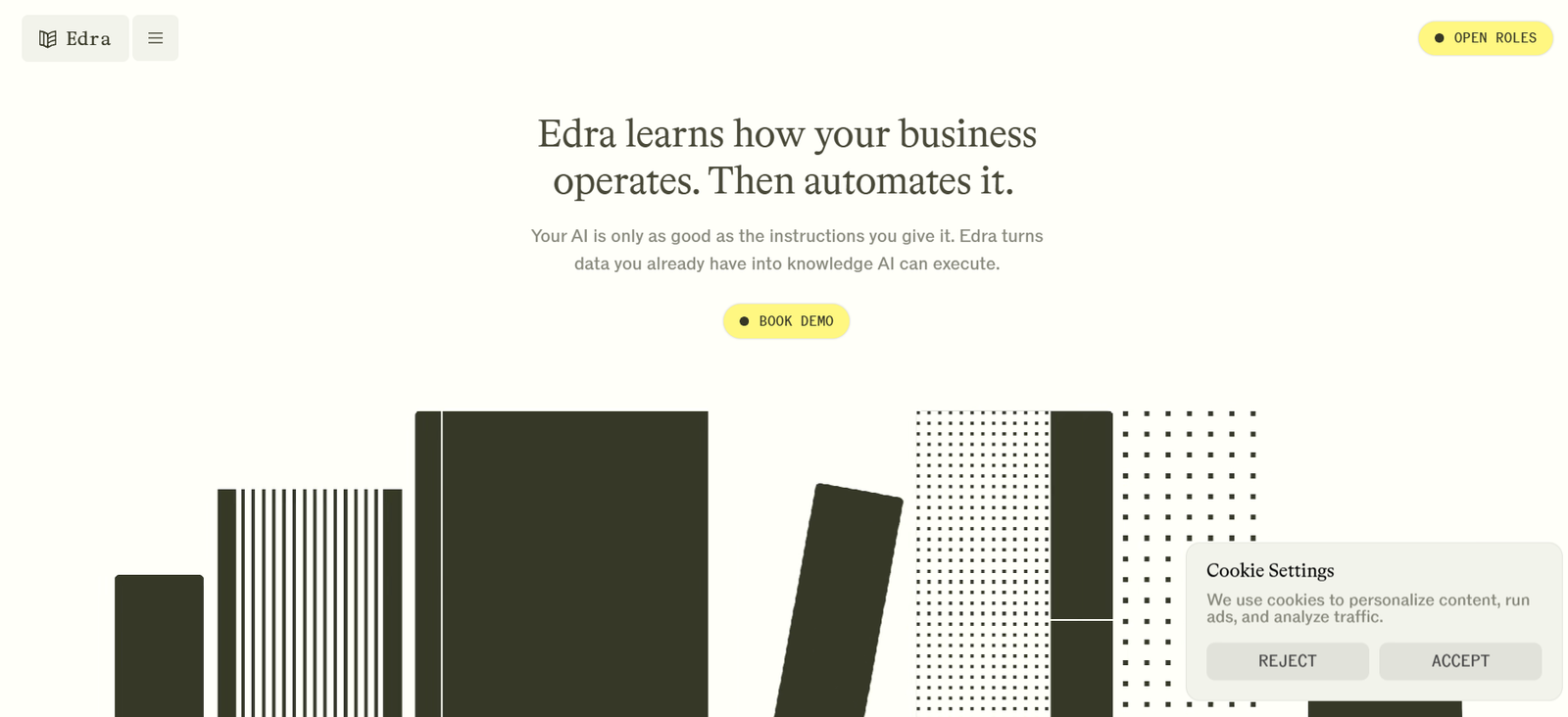
Edra is an enterprise AI platform designed to learn how a business actually operates and turn that operational knowledge into processes that AI agents can execute.
Many organizations have important knowledge scattered across support tickets, internal messages, system logs, documentation, and the experience of individual employees. This can make AI automation difficult because an AI agent needs more than general information. It needs to understand the organization’s actual rules, exceptions, decisions, and workflows.
Edra addresses this problem by analyzing information that already exists inside business systems. It can study tickets, logs, messages, and related operational data to identify how employees handle different situations.
The platform then converts what it learns into human-readable playbooks. Organizations can inspect, edit, and control these playbooks before using them to power AI agents.
Edra is designed to work with existing enterprise systems rather than requiring businesses to replace their current technology stack. The company lists systems such as ServiceNow, Jira, Zendesk, Salesforce, and Outlook among the environments it can work with.
The platform is particularly focused on areas such as IT service management and technical support, where large numbers of recurring requests and operational procedures make accurate organizational knowledge especially valuable.
Features
Zero-Setup Process Discovery
Edra analyzes existing operational information to discover how work is actually being performed.
Instead of beginning with lengthy employee interviews and manual process-mapping workshops, the platform can study existing tickets, messages, logs, and other records.
Automatic Knowledge Extraction
The platform extracts operational knowledge from existing business activity.
This can help uncover procedures and decisions that employees understand but that may never have been formally documented.
Executable Knowledge
Edra does more than create conventional documentation.
It organizes discovered processes into knowledge that can be used by AI agents when carrying out actual tasks.
Human-Readable Playbooks
The platform produces transparent playbooks describing the rules and procedures behind an automated process.
Teams can inspect and understand what the AI is expected to do instead of relying entirely on a black-box automation system.
Editable Business Rules
Organizations can review and edit the rules that power their AI automation.
This gives employees greater control over how processes are interpreted and executed.
AI Agent Automation
Once organizational knowledge has been structured, AI agents can use it to execute supported business processes.
This is particularly relevant for high-volume workflows where employees repeatedly handle similar requests.
Continuous Learning
Edra is designed to keep its knowledge library current as the organization changes.
The system can detect process changes, inconsistencies, and gaps in existing knowledge.
Employee Feedback
Employees can provide feedback that helps improve the underlying playbooks.
This allows practical knowledge from experienced team members to become part of the organization’s reusable AI knowledge.
Institutional Memory
Edra helps convert knowledge held by individual employees into organizational knowledge.
This can reduce dependence on a small number of experienced people who know how unusual situations should be handled.
IT Service Management Automation
Edra can be used for IT service management workflows.
By learning from historical tickets and existing processes, the platform can help AI agents respond according to how the organization’s IT team actually operates.
Technical Support Automation
Technical support teams can use Edra to build AI assistance grounded in their real support history and operational practices.
This can help AI systems provide more organization-specific responses than generic AI assistants.
Knowledge Base Improvement
Edra can identify gaps between formal documentation and the knowledge employees actually use when resolving issues.
This can help organizations expand and improve knowledge-base coverage.
Existing-System Integration
Edra is designed to operate on top of established enterprise systems.
The company currently highlights environments including ServiceNow, Jira, Zendesk, Salesforce, and Outlook.
Existing AI Integration
Organizations that already have AI assistants or agent systems can use Edra as a knowledge layer rather than necessarily replacing their current AI implementation.
Process Transparency
Teams can see the knowledge and rules that agents use when performing work.
This can make reviewing and improving AI automation easier than with systems where agent reasoning is largely hidden.
Zero-Setup Pilot
Edra offers a pilot designed to demonstrate process discovery using a sample of the organization’s existing data.
The company states that it can show customers a view of their processes, prepared for AI-agent use, within approximately one week.
How It Works
- An organization identifies a process or operational area it wants to understand or automate.
- Relevant existing data is made available to Edra.
- This information may include tickets, logs, messages, and records from existing enterprise systems.
- Edra analyzes the historical data to understand how employees actually handle different situations.
- The platform identifies repeated processes, decision patterns, exceptions, inconsistencies, and knowledge gaps.
- This information is organized into a library of operational knowledge.
- Edra converts the knowledge into human-readable playbooks.
- Employees review the playbooks and can modify rules where necessary.
- AI agents use the approved knowledge to execute supported processes.
- The agents can operate within existing business platforms rather than requiring employees to move to an entirely separate environment.
- Employee feedback and new operational activity provide additional information about how processes are evolving.
- Edra updates the knowledge library as procedures, rules, and organizational practices change.
Use Cases
For IT Service Management
IT teams can use Edra to discover how service requests and incidents are actually handled and make that knowledge available to AI agents.
For Technical Support
Support organizations can transform historical ticket-resolution knowledge into structured playbooks that help AI systems resolve recurring customer issues.
For Enterprise AI Assistants
Organizations that already operate an AI assistant can use Edra to provide it with more accurate operational knowledge.
For Knowledge Management
Businesses can capture knowledge that currently exists across messages, tickets, logs, and employee experience rather than relying exclusively on manually written documentation.
For Process Discovery
Operations teams can use Edra to understand how a process actually works before attempting to automate it.
For Employee Onboarding
Structured playbooks can help preserve organizational procedures that would otherwise need to be explained repeatedly by experienced employees.
For Support Knowledge Bases
Support teams can identify gaps between their formal knowledge base and the procedures employees actually use when solving customer problems.
For Enterprise Automation
Organizations can use executable knowledge as a foundation for automating repetitive business processes through AI agents.
For Process Standardization
Companies can identify cases where different employees handle similar situations differently and determine whether processes should be standardized.
For Organizational Knowledge Retention
Businesses can reduce the risk of important operational knowledge disappearing when experienced employees change roles or leave the company.
Pricing
Edra does not currently publish standard subscription plans or fixed prices on its official website.
The platform is positioned primarily as an enterprise product, with organizations invited to book a demonstration and discuss their requirements.
Edra also offers a Zero-Setup Pilot in which a portion of company data can be analyzed to demonstrate how its process-discovery approach works.
Pricing details are not clearly mentioned on the official website.
Organizations interested in using Edra need to contact the company for a customized proposal.
Strengths
Edra learns from operational data that organizations already have.
It can reduce the amount of manual process documentation required before AI automation begins.
The platform focuses on understanding how work actually happens rather than relying only on formal documentation.
Human-readable playbooks make automation rules more transparent.
Teams can review and edit the knowledge used by AI agents.
Continuous learning helps operational knowledge evolve as business processes change.
Edra can help capture undocumented knowledge held by experienced employees.
It works with common enterprise systems such as ServiceNow, Jira, Zendesk, Salesforce, and Outlook.
Organizations can potentially use Edra with existing AI implementations rather than replacing their entire AI environment.
Its approach is particularly relevant for complex enterprise processes involving rules, exceptions, and institutional knowledge.
The pilot program gives organizations an opportunity to evaluate discovered processes before considering broader deployment.
Drawbacks
Edra is primarily an enterprise platform rather than a self-service AI tool for individuals or small businesses.
Public pricing is not available, making it difficult to estimate the cost before speaking with the company.
The effectiveness of process discovery depends on the quality and completeness of the organization’s historical operational data.
Old tickets and messages may contain inconsistent or outdated procedures that require human review.
AI automation still requires governance and monitoring, particularly for processes with significant business consequences.
Organizations dealing with sensitive information need to evaluate security, privacy, access controls, retention, and compliance requirements before providing operational data to an AI platform.
Edra is most compelling for organizations with enough historical process data to learn from. Very small or newly established teams may have less information available for automatic process discovery.
Human review remains important because a process being frequently followed in historical data does not necessarily mean it represents the organization’s desired future procedure.
Comparison with Other Platforms
Edra differs from conventional knowledge-management systems that primarily depend on employees manually creating and updating articles.
Its approach begins with existing operational data and attempts to discover the procedures employees are already following.
Compared with general-purpose enterprise AI assistants, Edra focuses more specifically on converting company processes into structured and executable knowledge that can ground AI agents.
Compared with traditional process-mining platforms, Edra places greater emphasis on producing operational knowledge that AI agents can use, rather than limiting the output to process analysis and visualization.
Compared with conventional workflow automation platforms, Edra focuses on learning the rules and exceptions behind workflows before automating them.
This makes Edra particularly relevant for organizations where processes are complex, partially undocumented, or dependent on experienced employees’ practical knowledge.
Customer Reviews and Testimonials
Edra publishes several enterprise customer stories on its official website.
ASOS
Edra reports that its work with ASOS increased IT knowledge-base coverage from approximately 30% to 90%.
This case illustrates Edra’s use in discovering operational knowledge that was not adequately represented in existing documentation.
HubSpot
Edra states that HubSpot’s AI assistant operates using knowledge managed through Edra.
The customer story focuses on technical support and maintaining the operational knowledge required by an AI assistant.
Marosa
Edra also presents a technical-support case involving Marosa, where the existing knowledge base was unable to keep pace with changing operational reality.
Additional case studies on the website cover areas including faster ticket resolution and moving an implementation from kickoff to production.
These results are presented by Edra through its own customer stories and should therefore be considered company-published case-study information rather than independent reviews.
Conclusion
Edra is an enterprise AI platform focused on one of the difficult problems behind successful AI automation: teaching AI how a particular organization actually works.
Instead of expecting employees to manually document every process before deploying AI agents, Edra analyzes existing tickets, logs, messages, and operational records to discover procedures automatically.
It then converts those discoveries into transparent, human-readable playbooks that organizations can review, edit, and use to power AI agents.
This approach makes Edra particularly relevant for IT service management, technical support, enterprise knowledge management, and other operational environments where important knowledge is distributed across systems and experienced employees.
Its ability to continuously update organizational knowledge is also significant because business processes rarely remain unchanged.
Edra is less suitable for individuals looking for a simple AI productivity tool. It is primarily aimed at larger organizations with established processes, historical operational data, and serious AI automation requirements.
For enterprises that already have AI agents but struggle to provide them with accurate, current, and executable organizational knowledge, Edra offers a specialized approach to turning everyday operational activity into an automation-ready knowledge layer.