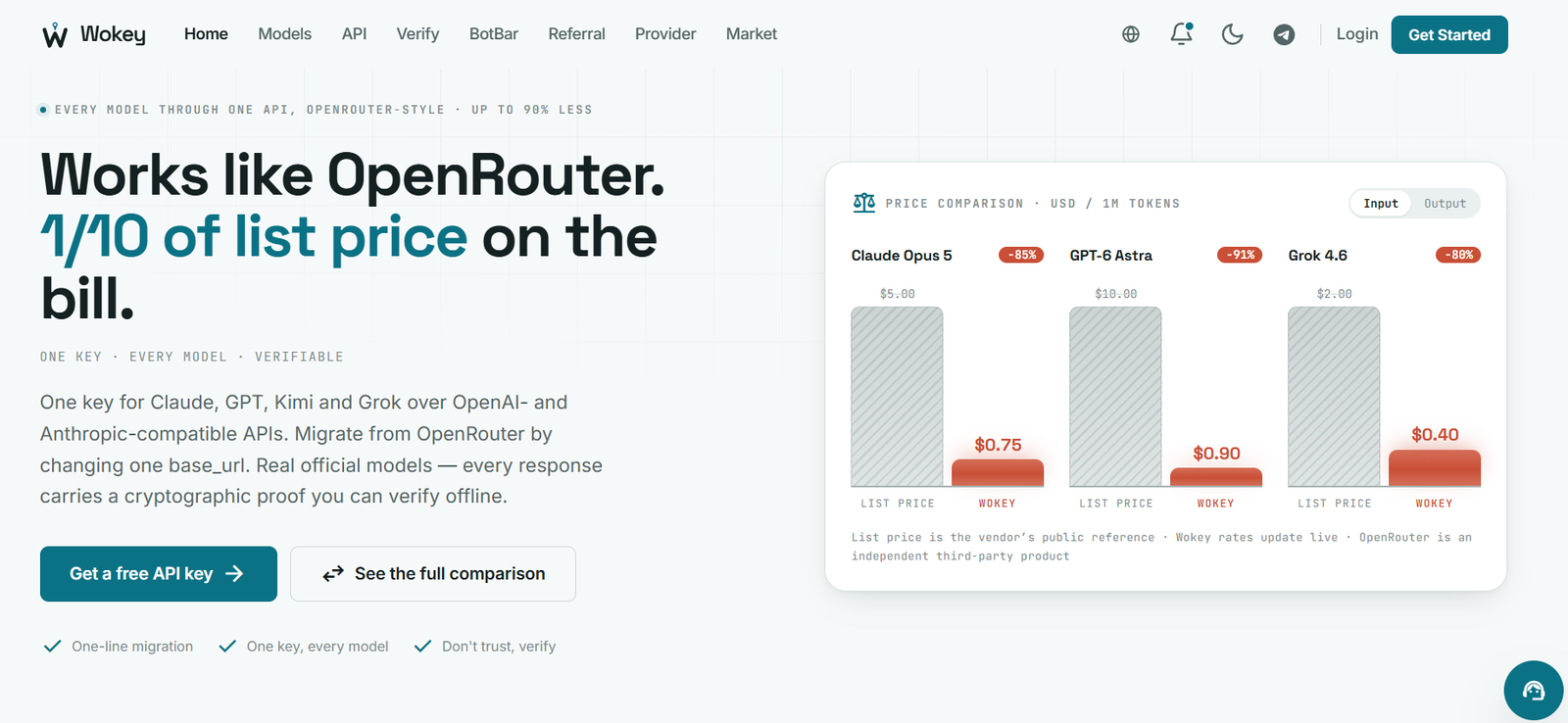
Wokey is a unified AI API platform designed to give developers access to multiple artificial intelligence models through a single API key.
Instead of creating separate integrations and billing arrangements for every AI provider, developers can connect to Wokey and access supported models from providers such as OpenAI, Anthropic, xAI, DeepSeek, Google, Zhipu, MiniMax, Moonshot AI, and others.
The platform uses OpenAI-compatible request formats, which can make migration easier for applications already built around commonly used AI API structures.
Wokey operates as both an API gateway and a model marketplace. Developers can browse available models, compare pricing and capabilities, and select the model that suits a particular application.
The platform also has a provider side. Its Provider Node allows users with eligible unused official AI subscription quota or upstream capacity to connect that capacity to Wokey’s routing network and potentially earn from actual usage.
Beyond text and coding models, Wokey provides AI image and video generation. Its Image Studio supports conversational image creation and editing, while Video Studio allows users to generate short AI videos through a browser or API.
Wokey is therefore particularly relevant for developers, startups, AI application builders, coding-tool users, and technical teams that want flexible access to many AI models without maintaining a separate integration for each provider.
Features
One API Key for Multiple AI Models
Wokey provides one platform API key that can be used across its supported model marketplace.
This reduces the need to maintain different keys and integrations for every available AI provider.
Large Model Marketplace
The platform offers access to a broad selection of AI models covering general reasoning, coding, language generation, image creation, and other AI tasks.
Its current catalog includes models from several major AI ecosystems.
OpenAI-Compatible API
Wokey supports OpenAI-compatible API request formats.
Developers already using compatible SDKs or applications can often connect by changing the API base URL, authentication key, and model identifier rather than rebuilding their complete integration.
Chat Completions
Supported models can be accessed through familiar chat-completion style API requests, depending on the capabilities of the selected model.
Responses API Support
Some models also support a Responses-style API interface for more modern agentic and tool-based applications.
Anthropic-Compatible Messages
Certain models can be accessed using Anthropic-style message formats where supported, providing additional flexibility for existing developer applications.
Transparent Model Pricing
Wokey publishes pricing information for individual models in its marketplace.
Model pages can show input, output, cache, context, and other relevant pricing information when available.
Real-Time Pricing
Prices can change based on model supply, demand, and network conditions.
Requests are billed according to the applicable price when they are processed, so developers should check current pricing rather than relying permanently on an older price snapshot.
Model Capability Information
Individual model pages provide technical information such as context window, maximum output, streaming support, tool support, available API formats, and current supply status.
AI Image Studio
Wokey includes a browser-based Image Studio for generating images from natural-language descriptions.
Users can create content such as illustrations, posters, avatars, logos, stickers, and photographs.
Conversational Image Editing
After creating an image, users can describe desired changes in natural language.
The platform can refine the existing image rather than requiring the user to begin every generation from the beginning.
Multiple Image Models
The Image Studio currently provides access to several underlying image-generation models, allowing users to choose the model they want to use.
Image Generation API
Developers can access image-generation and image-editing functionality programmatically through compatible API endpoints.
AI Video Studio
Wokey also provides browser-based AI video generation.
Users can describe a scene, submit a video-generation job, monitor progress, and download the completed clip.
Video Generation API
Developers can integrate video generation into their own applications through Wokey’s video API.
Video generation uses an asynchronous workflow because processing can take longer than standard text requests.
Provider Node
Wokey provides a Provider Node for users who want to contribute eligible unused AI subscription quota or upstream capacity.
The system can connect that capacity to Wokey’s routing network and provide earnings and status tracking.
Unified Billing
Developers can manage usage through Wokey rather than maintaining completely separate billing relationships for every model accessed through the platform.
Usage-Based Access
Wokey’s model marketplace is designed around usage pricing rather than requiring developers to purchase a separate monthly subscription for every underlying model.
Streaming
Many supported language models offer streaming responses, allowing applications to display generated output progressively.
Tool Support
Selected models support tool use, making Wokey suitable for applications involving agents, coding workflows, external functions, and more complex AI systems.
How It Works
- Create a Wokey account.
- Add funds or configure the required billing method.
- Generate a Wokey platform API key.
- Browse the model marketplace.
- Compare available models based on provider, capabilities, context limits, supported API forms, and current pricing.
- Select the model required for your application.
- Configure your existing OpenAI-compatible client or application to use Wokey’s API gateway.
- Replace the existing API key with your Wokey platform key.
- Enter the appropriate Wokey model ID.
- Send the API request.
- Wokey routes the request through available model capacity.
- Usage is billed according to the applicable request-time price.
- Developers can switch between available models without creating a completely separate integration for each provider.
- For images or videos, users can either use the browser-based studios or integrate the corresponding API into their applications.
Use Cases
For AI Application Developers
Developers building AI products can access several model families through a single API integration.
For Startups
Startups can experiment with different AI models without establishing a separate technical integration for every provider.
For Coding Applications
Developers building coding assistants, development agents, and programming tools can compare coding-oriented models and route requests through one gateway.
For AI Agents
Agent developers can use models supporting tools, large context windows, streaming, and compatible API formats.
For Model Comparison
Technical teams can test different models within the same broader API environment to determine which options best suit their applications.
For Multi-Model Applications
Applications that use different models for different tasks can access several options through one Wokey account and API key.
For Image Generation
Developers and creators can generate AI images through Wokey’s browser interface or integrate image generation into their own software.
For Image Editing
Users can refine generated images conversationally by describing the changes they want.
For Video Generation
Creators and developers can generate short AI video clips through the Video Studio or API.
For Small Development Teams
Teams that do not want to manage many separate AI provider accounts can centralize more of their model access through Wokey.
For AI Capacity Providers
Eligible users with unused official AI subscription quota or upstream capacity can explore Wokey’s Provider Node and potentially earn from capacity routed through the network.
Pricing
Wokey does not use one fixed subscription price for all AI models.
Instead, the platform primarily follows a usage-based pricing model.
Prices vary according to the selected model and can include separate charges for input tokens, output tokens, cache usage, images, videos, or other model-specific resources.
The official model marketplace publishes the current prices for supported models.
Wokey states that pricing can change based on supply, demand, network load, and other factors. Billing is based on the price applicable when each request is processed.
For example, different language models may have substantially different input and output token prices. Image and video generation also use their own pricing structures.
Because Wokey’s model prices are dynamic, publishing a fixed price list can quickly become outdated.
Users should therefore check the current model marketplace before making cost-sensitive decisions.
Strengths
One API key provides access to many AI models.
OpenAI-compatible formats can simplify integration for developers already using compatible applications.
The model marketplace makes it easier to compare available AI models.
Pricing information is displayed for individual models.
Developers can switch models without building a completely independent integration for every provider.
Wokey supports models from multiple AI ecosystems rather than locking users into one provider.
Text, coding, image, and video capabilities are available within the broader platform.
Image Studio supports conversational image creation and editing.
Video generation is available through both a browser interface and API.
The Provider Node creates a mechanism for eligible users to contribute unused upstream AI capacity.
Usage-based billing may be attractive to developers who prefer paying according to consumption rather than maintaining several separate subscriptions.
Drawbacks
Wokey adds an additional intermediary between the developer and the underlying AI provider.
Model availability may change depending on upstream supply and network conditions.
Prices are dynamic, so developers cannot assume that a model’s current price will remain unchanged.
Applications requiring highly predictable costs should monitor usage and pricing carefully.
Underlying model policies and restrictions still apply in addition to Wokey’s own acceptable-use requirements.
Reliability can depend partly on upstream model providers and available network capacity.
Organizations with strict enterprise security, compliance, data residency, or procurement requirements should carefully review Wokey’s terms, privacy practices, and architecture before sending sensitive information.
Wokey’s provider model is more complex than purchasing API access directly from a single AI company, so organizations should understand how routing and capacity sourcing work before production deployment.
Some developers may prefer direct relationships with model providers when they require dedicated enterprise agreements, guaranteed capacity, or provider-specific support.
Comparison with Other Platforms
Wokey operates in a similar broad category to multi-model API gateways and model-routing platforms such as OpenRouter and other unified AI API services.
Compared with accessing AI providers directly, Wokey reduces the number of separate integrations developers need to maintain. A single Wokey key can provide access to models from multiple providers.
Compared with a single-model API service, Wokey offers greater model choice and makes it easier to experiment with different models.
Compared with OpenRouter and similar model marketplaces, Wokey emphasizes competitive pricing, transparent model-level pricing, OpenAI-compatible integration, and its Provider Node system for contributing eligible upstream capacity.
Wokey also extends beyond language-model routing through its browser-based Image Studio and Video Studio.
Direct provider APIs may still be preferable for businesses that require dedicated enterprise contracts, guaranteed capacity, specialized support, or the closest possible relationship with the model developer.
Wokey is more suitable for developers who value flexibility, model choice, unified access, and the ability to experiment across different AI ecosystems.
Customer Reviews and Testimonials
Customer reviews and testimonials are not clearly available on the official website.
Wokey provides technical documentation, model information, pricing comparisons, API examples, and information about its routing and provider systems, but it does not currently present a substantial collection of verified customer testimonials.
Users evaluating Wokey for production applications should therefore consider testing its API directly and independently evaluating reliability, latency, model availability, support, and cost for their specific workload.
Conclusion
Wokey is a unified AI API gateway designed for developers who want access to multiple AI models without managing a completely separate integration for each provider.
Its core proposition is straightforward: developers receive one platform API key and can use it to call supported models from several major AI ecosystems through familiar API formats.
The platform becomes more interesting through its broader model marketplace, transparent usage pricing, Image Studio, Video Studio, and Provider Node.
Wokey may be particularly useful for AI startups, independent developers, small technical teams, coding-tool builders, and multi-model applications where flexibility and model experimentation are important.
Its dynamic pricing and upstream routing model also mean that developers should monitor cost, availability, reliability, privacy, and compliance requirements carefully before depending on it for critical production systems.
For developers comfortable with a multi-provider gateway rather than working exclusively with direct model APIs, Wokey offers a flexible way to access a broad range of AI capabilities through one integration.