
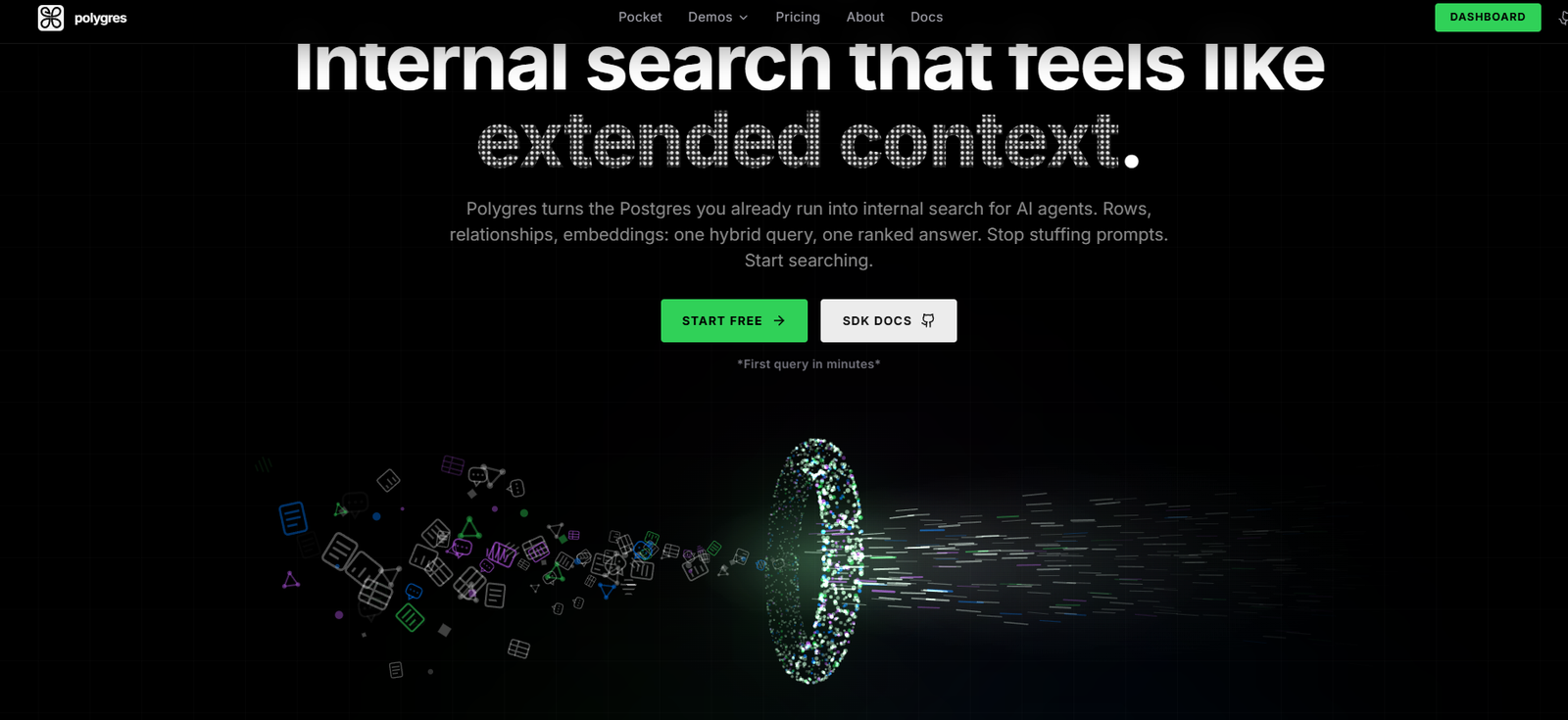
Polygres is a database and retrieval platform designed to help AI agents search and use information stored in PostgreSQL. It combines relational data, graph relationships, vector embeddings, full-text search, and other retrieval methods so an AI agent can find relevant context without loading an entire database into its prompt.
The basic idea is to give AI agents access to much more information than can fit inside a model’s context window. Instead of deciding in advance which database records should be inserted into a prompt, developers can allow an agent to search the database when information is needed.
Polygres can host a PostgreSQL database directly or connect to an existing Postgres environment. The official website specifically mentions Supabase, Neon, and other hosted PostgreSQL databases that provide a connection string.
The platform is built around two open source components, pgGraph and pgContext. pgGraph handles relationships and graph traversal, while pgContext provides AI oriented search across embeddings and other retrieval methods.
Polygres is primarily designed for developers, AI startups, engineering teams, and organizations building agents, RAG systems, AI memory, search applications, and other software that needs to retrieve relevant information from large databases.
Features
Hybrid Search
Polygres combines multiple types of retrieval instead of relying exclusively on vector similarity. Relational information, graph connections, semantic search, full-text search, sparse retrieval, filters, and other methods can contribute to the same query.
AI Native Search
The pgContext engine provides multiple search methods that can run against live database tables. Results from different retrieval channels are combined and reranked into a single result set.
Vector Search
Embeddings can be stored and searched directly inside PostgreSQL. Polygres uses HNSW indexing to provide fast nearest-neighbor retrieval.
Full-Text and Sparse Search
Vector search is not always ideal for exact words, product codes, IDs, names, or other specific values. Polygres combines semantic retrieval with sparse and full-text methods to improve these types of searches.
Graph Search
Polygres can use foreign-key relationships as a graph. This allows agents to move between related records and explore connections across database tables.
Multi-Hop Graph Traversal
The pgGraph component supports capabilities such as multi-hop traversal, shortest paths, neighborhood searches, and connected components.
Context Assembly
Developers can request the information an agent needs and receive a ranked, token-ready context block. This reduces the need to manually assemble context from several retrieval systems.
Result Fusion
Results from different search methods are merged, deduplicated, and reranked. This gives the application one ranked set of results instead of requiring developers to reconcile outputs from separate search engines.
Existing PostgreSQL Support
Developers do not necessarily have to migrate everything to a completely new database technology. Polygres can work with PostgreSQL environments and existing schemas.
Managed PostgreSQL Hosting
Users who do not want to operate the infrastructure themselves can deploy a managed PostgreSQL instance through Polygres.
Supabase and Neon Connectivity
Existing PostgreSQL databases hosted through services such as Supabase and Neon can be connected to Polygres.
Polygres CLI
The Polygres command line interface allows developers to manage projects, import data, and run queries directly from a terminal.
Python SDK
Developers can integrate Polygres into applications through its SDK rather than interacting only through a graphical interface.
Schema Playground
Polygres provides a visual environment for configuring relationships, managing join tables, and building hybrid indexes.
Open Source Components
The core pgGraph and pgContext engines are open source. Developers can inspect the code and run the underlying technology on their own infrastructure.
Polygres Pocket
Polygres is also developing Pocket, a CLI oriented product intended to provide persistent searchable context for coding agents such as Claude Code, Codex, and Cursor.
Pocket is designed to index memories, files, and entire codebases and make relevant information available to an agent through retrieval rather than attempting to place everything into the model’s prompt.
How It Works
Step 1: Choose a Deployment Approach
Developers can use Polygres managed hosting or work with supported PostgreSQL infrastructure.
Step 2: Connect the Database
An existing PostgreSQL database can be connected using its connection information. The platform can work with services such as Supabase and Neon as well as other hosted Postgres environments.
Step 3: Configure the Data
Developers identify the tables, relationships, embeddings, and other information that should be available for retrieval.
Step 4: Build Search Indexes
Vector, full-text, sparse, graph, and other supported retrieval mechanisms can be configured according to the application.
Step 5: Send a Query
An AI agent or application describes the information it needs.
Step 6: Search Across Retrieval Methods
Polygres searches relevant data through several methods, including semantic matching, graph relationships, full-text retrieval, and filters.
Step 7: Fuse and Rank Results
Results are merged, deduplicated, and reranked to identify the information most relevant to the request.
Step 8: Control the Context Size
Developers can limit the amount of information returned according to the token budget available to the AI agent.
Step 9: Send Context to the Agent
The selected information becomes context for the AI model or agent, allowing it to answer or act using relevant database information.
Use Cases
AI Agents
Developers can give agents searchable access to large amounts of application or business data without trying to place every record inside the prompt.
RAG Applications
Polygres can provide retrieval infrastructure for applications that need to combine semantic search with structured database information.
AI Memory
Agent interactions, user preferences, events, and other persistent information can remain stored and searchable instead of disappearing when a model’s conversation context is exceeded.
Customer Support Agents
Support agents can retrieve information across customers, orders, payments, tickets, products, and related records to build context around a support request.
Ecommerce Applications
AI systems can search products, customers, transactions, orders, inventory, and relationships between those records.
Enterprise Search
Organizations can build internal search experiences across structured records, relationships, and semantic information stored in PostgreSQL.
Coding Agents
The upcoming Pocket product is intended to allow coding agents to search large codebases and retrieve only the files and passages relevant to a particular problem.
Recommendation Systems
Polygres includes discovery and recommendation-oriented retrieval methods that can help applications surface related database records.
Research Applications
Developers can combine structured metadata, semantic similarity, and graph relationships when building AI research and information discovery tools.
Pricing
Polygres currently offers Self-Hosted, Launch, Scale, and Enterprise options.
Self-Hosted: Free Forever
The self-hosted option costs $0.
Developers can run the open source components on their own PostgreSQL infrastructure. Community support is available.
Launch: $16 per month
The Launch plan is listed at $16 per month but is currently marked as free for now.
It is intended for personal projects, hobby applications, and early-stage AI agents.
The plan includes managed cloud database hosting along with email and community Discord support.
Scale: From $256 per month
Scale is currently listed with minimum usage of $256 per month.
It is intended for companies and teams operating production AI agents. Features include automated vertical and horizontal scaling, email and community support, a private Discord or Slack support channel, and defined support hours.
The Scale plan is currently marked as coming soon.
Enterprise: From $4,096 per month
Enterprise is listed with minimum usage of $4,096 per month.
It is designed for organizations that require dedicated database cluster infrastructure, custom compliance requirements, high availability, 24/7 support, and dedicated uptime and support SLAs.
Enterprise is also currently marked as coming soon.
Pricing and plan availability may change as the service develops, so users should check the current official pricing page before deploying production workloads.
Strengths
Built for AI Agent Retrieval
Polygres is designed around the problem of giving AI agents access to large, persistent data sources rather than treating retrieval as an afterthought.
Combines Several Search Methods
Vector, graph, relational, sparse, full-text, filtering, and other retrieval methods can work together.
Uses PostgreSQL
Organizations already using PostgreSQL can potentially build AI retrieval capabilities without adopting a completely separate database architecture.
Reduces Context Window Pressure
Agents retrieve the information they need when they need it rather than attempting to keep an entire dataset inside the prompt.
Graph and Vector Search Together
The combination of semantic similarity and relationship traversal can be valuable when the correct answer depends on both meaning and connections between records.
Open Source Core
Developers can inspect and self-host the underlying pgGraph and pgContext technology.
Managed and Self-Hosted Options
Teams can choose between operating the technology themselves or using managed infrastructure.
CLI and SDK Access
Command line and programmatic interfaces make Polygres suitable for developer and agent workflows.
Privacy Controls
Polygres states that hosted databases are isolated and private, database data is encrypted in transit and at rest, and database contents are not sold.
Drawbacks
Polygres is developer infrastructure rather than a ready-made consumer AI application. Users need technical knowledge of databases, PostgreSQL, APIs, and AI application architecture to benefit from it.
The platform is also relatively specialized. Businesses that simply need a chatbot or general AI assistant will probably not need this level of retrieval infrastructure.
Some advanced managed plans are currently marked as coming soon. Organizations considering Polygres for large production deployments should therefore confirm current availability and service conditions.
Although Polygres reduces the need for separate retrieval infrastructure, developers still need to design their database schema, agent architecture, permissions, and retrieval strategy appropriately.
The upcoming Pocket product should also be distinguished from functionality that is already generally available. Its official page currently presents it as a forthcoming product.
Comparison with Other Platforms
Polygres sits between traditional PostgreSQL databases, vector databases, graph databases, and AI retrieval platforms.
Dedicated vector databases focus primarily on semantic similarity between embeddings. Graph databases specialize in relationships and connected information. Traditional PostgreSQL provides strong relational capabilities but normally requires additional components or extensions for sophisticated AI retrieval.
Polygres attempts to bring these capabilities together around PostgreSQL. Structured records remain relational, relationships can be traversed as graphs, embeddings can support semantic search, and several retrieval methods can be fused into one ranked response.
This approach can reduce the need to maintain a separate vector database, graph database, and synchronization pipeline for the same AI application.
However, dedicated database platforms may still provide deeper functionality for highly specialized vector or graph workloads. Polygres is likely to be most attractive when developers already value PostgreSQL and want to expand it into a broader retrieval layer for AI agents.
Customer Reviews and Testimonials
Customer reviews and testimonials are not clearly available on the official website.
The website provides interactive demonstrations, open source repositories, documentation, and links to its developer community, but it does not currently present a substantial collection of clearly identified customer testimonials.
Conclusion
Polygres is an interesting infrastructure option for developers who want AI agents to work with far more information than can realistically fit inside a model’s context window.
Instead of continually expanding prompts, Polygres allows agents to search live PostgreSQL data and retrieve a ranked selection of relevant information when it is needed. Its combination of relational data, graph traversal, vector embeddings, full-text search, sparse retrieval, and result fusion provides a broad retrieval layer within the PostgreSQL ecosystem.
It is particularly relevant for AI agents, RAG applications, persistent memory systems, enterprise search, recommendation systems, customer support agents, and other applications that need to reason over large connected datasets.
The free self-hosted option and currently free Launch offering make it accessible for experimentation. For developers already using PostgreSQL who want to build richer memory and retrieval capabilities into AI applications, Polygres provides a focused approach worth exploring.


