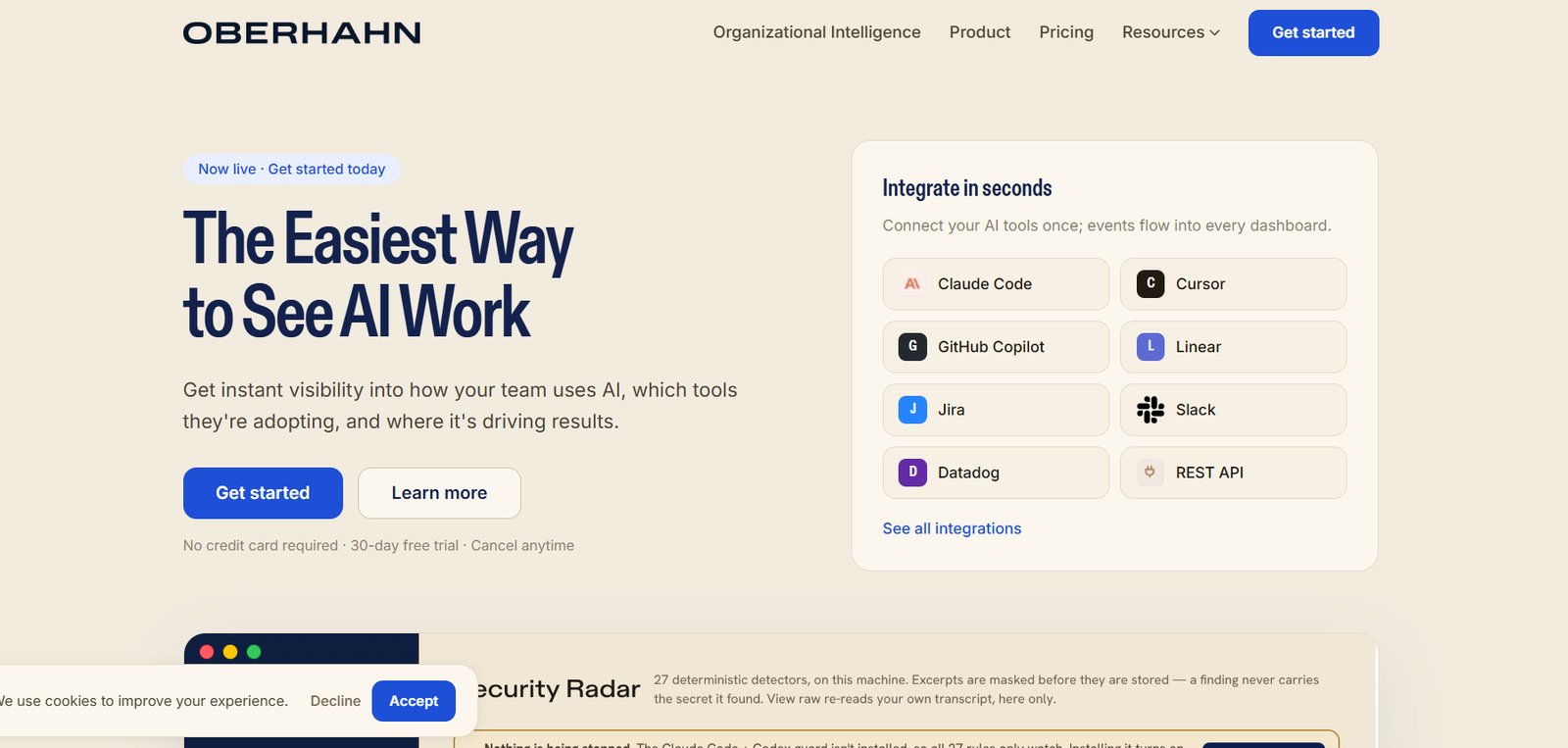
Oberhahn is an organizational intelligence platform designed to help companies understand how artificial intelligence is actually being used across their teams.
As organizations adopt multiple AI models, coding assistants, agents and development tools, it can become difficult to know who is using what, how much it costs, which workflows deliver useful results, and where resources are being wasted. Oberhahn brings this information together in a centralized system.
The platform connects with AI providers, coding agents, SDKs, gateways and business tools. It then attributes AI activity to specific people, teams, projects and workflows. This allows managers to move beyond a simple monthly AI bill and understand what the spending is producing.
Oberhahn also analyzes AI efficiency, forecasts future spending, identifies opportunities to reduce unnecessary costs and detects potential security issues within prompts and tool calls.
It is primarily designed for engineering leaders, CTOs, platform teams, DevOps professionals, security teams and organizations making significant use of AI across their operations.
Features
Unified AI Usage Visibility
Oberhahn provides a central view of AI activity across connected tools and providers. Instead of checking multiple dashboards, organizations can see AI usage in one environment.
AI Usage Attribution
Every model call can be associated with a person, team and workflow. This helps organizations understand not only how much AI is being used but also where that usage originates.
AI Spend Ledger
Oberhahn maintains a normalized ledger of AI usage events and sessions. Users can filter information by source, team, project, model, tag or consumer to investigate spending in greater detail.
Cost Per Session
The platform calculates AI costs at the session level. This can help teams understand which workflows consume the most resources and whether those costs are justified by the results.
Workflow Intelligence
Oberhahn helps identify AI workflows that appear to work effectively. Organizations can use this information to discover useful practices developed by individual employees or teams and potentially adopt them more widely.
AI Spend Forecasting
The platform forecasts expected month-end AI spending based on current usage patterns. This gives managers an earlier indication when costs appear likely to exceed expectations.
Cost Optimization Opportunities
Oberhahn can identify areas worth investigating, such as oversized models, repeated cache misses, unusually long sessions and similar tasks being handled inefficiently across different teams.
Model Right-Sizing
The platform can identify situations where an expensive or powerful AI model may be unnecessary for a relatively simple task. This can help organizations consider lower-cost alternatives for suitable workloads.
AI Security Monitoring
Oberhahn analyzes prompts and tool calls for potential security exposures. Examples include credentials appearing in prompts, environment information being exposed or sensitive files being accessed during AI sessions.
Work Attribution
AI sessions can be linked to actual work tracked through tools such as Jira, Linear and GitHub. This can help organizations connect AI spending with projects, issues and delivered work.
Built-In AI Copilot
Users can ask questions about their organization’s AI activity and spending. The built-in assistant uses connected organizational data to provide relevant answers.
AI Model Benchmarking
Oberhahn can compare new models against existing workflows. Instead of relying only on public benchmarks, organizations can evaluate models using the types of tasks their own teams actually perform.
Dashboards and Reports
The platform provides dashboards, reports and other monitoring capabilities for understanding AI adoption, costs, efficiency and organizational patterns.
Broad Integrations
Oberhahn supports a wide range of AI and development tools, including OpenAI, Anthropic, Google Gemini, Claude Code, Cursor, GitHub Copilot, Devin, LiteLLM, vLLM, SGLang, LangChain, LlamaIndex, GitHub, Jira, Linear, Slack, Notion, Salesforce and Datadog.
How It Works
- Create an Oberhahn account and begin the free trial.
- Connect the AI providers, coding assistants, agents or other supported tools used by the organization.
- Oberhahn begins collecting and normalizing AI usage information from connected sources.
- AI activity is attributed to relevant users, teams, projects and workflows.
- Review the dashboard to understand total spending, cost per session, active users, model usage and efficiency.
- Use the Spend Ledger to investigate individual sessions and understand where AI costs originate.
- Connect project-management and development tools to relate AI activity to actual work and projects.
- Review forecasts to understand how current usage may affect future monthly costs.
- Examine optimization opportunities to identify oversized models, inefficient workflows, cache problems or unusually expensive sessions.
- Review security findings for possible credential exposure and risky AI activity.
- Identify successful workflows and practices that could be adopted across other teams.
Use Cases
For CTOs and Engineering Leaders
Technology leaders can understand AI adoption across engineering teams and determine which tools, models and workflows are producing useful results.
For AI and Platform Teams
Platform teams can monitor AI usage across different providers, coding agents and internal applications from a centralized environment.
For Finance and Operations Teams
Organizations spending heavily on AI can use Oberhahn to understand costs, forecast future expenditure and identify areas where unnecessary spending may be reduced.
For DevOps Teams
DevOps professionals can connect AI usage information with infrastructure and development workflows while monitoring efficiency across different tools.
For Security Teams
Security teams can investigate potential exposures involving prompts, credentials, environment information and AI tool calls.
For Engineering Managers
Managers can compare AI adoption and workflows across team members and identify practices that appear worth sharing more broadly.
For Developers
Individual developers can understand how they use AI, which workflows consume the most resources and where their AI-assisted work may become more efficient.
For Organizations Using Multiple AI Tools
Companies using several AI providers and coding assistants can consolidate usage information instead of relying on separate provider dashboards.
Pricing
Oberhahn currently offers Individual, Manager and Enterprise options.
Individual
The Individual plan costs $49 per month, billed monthly.
It supports up to two people and provides access to the full product. Users can connect their AI tools, associate AI sessions with workflows, compare usage patterns and analyze costs and efficiency.
A 30-day free trial is available without requiring a credit card.
Manager
The Manager plan costs $399 per month, billed monthly.
It supports teams of up to 100 people and includes the capabilities of the Individual plan along with team-oriented intelligence.
Managers can identify which tools, models and prompts are performing effectively, compare team workflows and spread successful AI practices across the organization.
A 30-day free trial is also available without a credit card.
Enterprise
Enterprise options are available for organizations with requirements beyond the standard plans.
Pricing details for Enterprise are not clearly published on the official website and should be requested directly from Oberhahn.
Strengths
Oberhahn brings AI usage from multiple providers and tools into one centralized view.
Its attribution capabilities help organizations understand which people, teams and workflows are responsible for AI activity and spending.
The platform goes beyond basic cost tracking by connecting AI spending with actual work and outcomes.
Forecasting can alert teams to potential overspending before the end of a billing period.
Optimization insights can help identify unnecessary model costs and inefficient usage patterns.
Security monitoring adds another layer of visibility by detecting potentially sensitive information exposed through AI interactions.
The platform supports both commercial AI providers and self-hosted open-model infrastructure.
Its broad integration support makes it relevant to organizations using multiple AI tools.
The 30-day trial does not require a credit card.
Drawbacks
Oberhahn is currently in beta, so the product and available capabilities may continue to evolve.
The platform is specialized for organizations with meaningful AI usage. Small businesses using only one AI tool occasionally may not need this level of monitoring.
The Individual plan costs $49 per month, which may be relatively expensive for casual individual users.
The Manager plan is designed for teams and costs $399 per month, so organizations should consider whether their AI spending and complexity justify the additional monitoring expense.
Connecting multiple AI providers, coding tools and organizational systems may require careful configuration to obtain the most useful attribution.
The value of its organizational intelligence depends on having sufficient AI activity and connected data to identify meaningful patterns.
Security findings and optimization recommendations should still be reviewed by qualified people rather than treated as automatic decisions.
Comparison with Other Platforms
Oberhahn operates across AI observability, AI cost management and organizational intelligence.
Traditional provider dashboards generally show usage and spending for one AI provider. Oberhahn instead aims to combine information from multiple AI providers, coding assistants, agents and other sources into a unified view.
Compared with general observability platforms such as Datadog, Oberhahn is specifically focused on understanding organizational AI usage rather than monitoring the entire technology infrastructure.
AI development observability tools may focus more heavily on debugging, tracing and evaluating individual AI applications. Oberhahn places greater emphasis on understanding how AI is being used across people, teams and workflows, what that usage costs and which working patterns should be repeated.
This makes Oberhahn particularly relevant for organizations where AI has moved beyond experimentation and is becoming a significant part of everyday engineering and operational work.
Customer Reviews and Testimonials
Customer reviews and traditional customer testimonials are not clearly available on the official website.
The website does include statements from Oberhahn’s founders and a public Agent Guestbook containing comments submitted by AI systems. These should not be treated as independent customer reviews.
Organizations considering Oberhahn may therefore want to use the 30-day free trial to evaluate the platform with their own AI workflows and data.
Conclusion
Oberhahn addresses an increasingly important challenge for organizations adopting AI at scale: understanding what their AI investment is actually doing.
Instead of showing only tokens and monthly costs, the platform connects AI usage with people, teams, workflows and actual work. It then adds spending forecasts, efficiency analysis, optimization opportunities and security monitoring to help organizations make better decisions about their AI stack.
Oberhahn is particularly suited to CTOs, engineering leaders, platform teams, DevOps teams and organizations using several AI models, coding assistants or agents.
For companies where AI usage is growing quickly and separate provider dashboards no longer provide enough visibility, Oberhahn offers a focused way to understand AI adoption, control costs, identify effective workflows and manage AI usage across the organization.