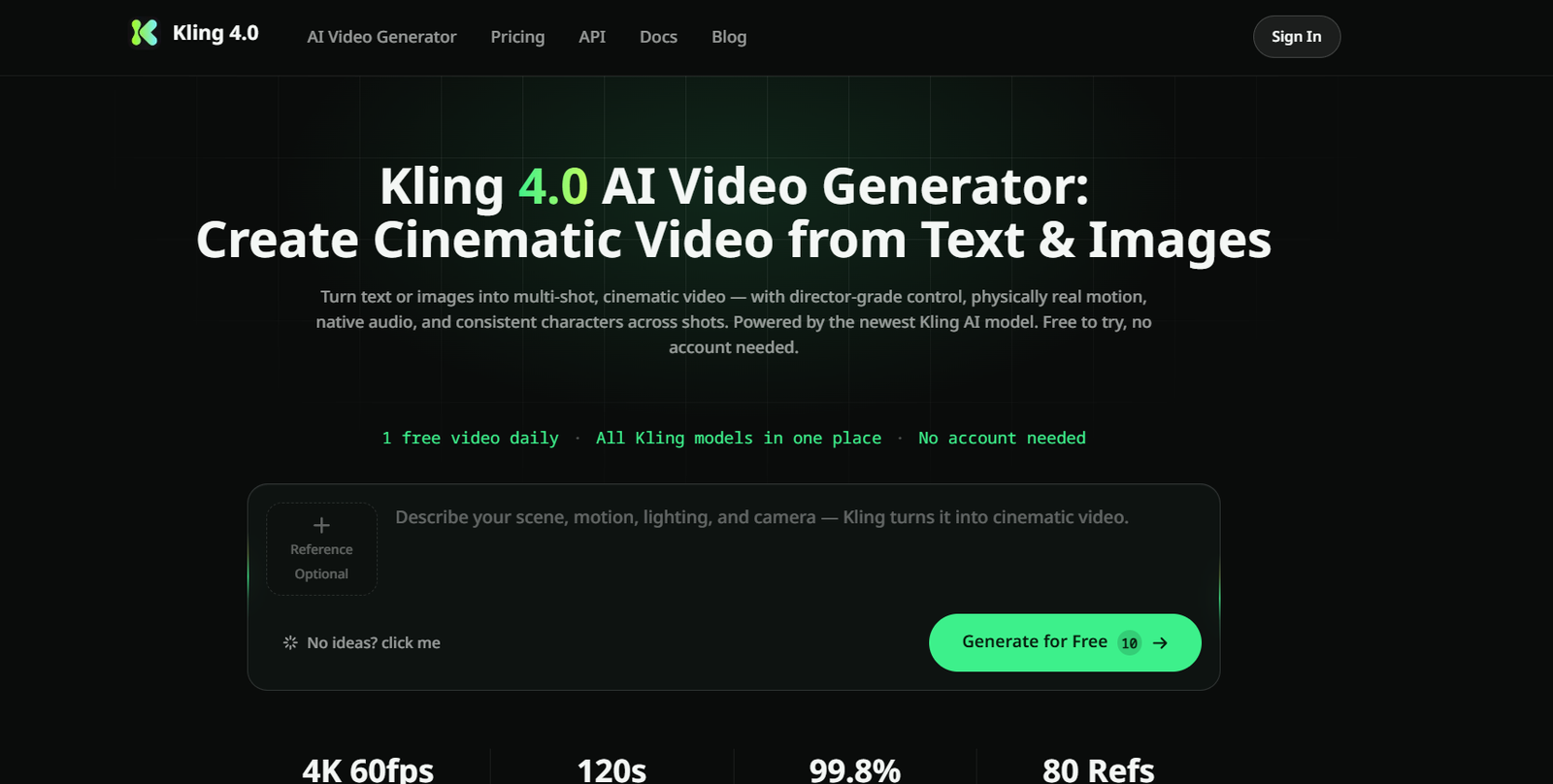
Kling-4.ai is an independent AI video generation platform built around the Kling model family. It allows users to create AI-generated videos from text prompts and reference images directly through a web browser.
The platform is not the official website of Kuaishou Technology, the company behind Kling AI. Kling-4.ai clearly states that it operates independently and is not affiliated with or endorsed by Kuaishou.
Users can describe a scene using natural language, specify elements such as the subject, action, camera movement and lighting, and then generate a video using a supported Kling model. Reference images can also be added to provide greater visual direction.
The platform is particularly focused on cinematic AI video creation. Its website provides example prompts covering product advertisements, fashion videos, cinematic scenes, social media content, visual effects and character-driven sequences.
Kling-4.ai is also preparing its platform for Kling 4.0. However, the website states that Kuaishou has not yet announced an official Kling 4.0 release date. Therefore, several advanced Kling 4.0 capabilities described on the website should currently be understood as anticipated or platform-stated future capabilities rather than confirmed publicly available Kling 4.0 features.
Users can currently work with supported models from the existing Kling model family while following future Kling 4.0 developments through the platform.
Features
Text-to-Video Generation
Users can describe a scene through a text prompt and generate a video using supported Kling AI models.
Prompts can specify subjects, actions, environments, camera movements, lighting and overall visual style.
Image-to-Video Generation
Users can provide a reference image and use it as the visual starting point for an AI-generated video.
This can be useful when creators want more control over a character, product, environment or overall visual appearance.
Cinematic Prompt Control
Kling-4.ai encourages detailed prompts that describe camera movements, framing, lighting, subject behavior and cinematic atmosphere.
This gives creators more control than a simple one-line video prompt.
Reference Images
Users can upload reference images to guide the appearance and identity of subjects within supported generations.
Reference images can currently be used without creating an account, according to the website.
Feature Video Uploads
The platform supports Feature Video uploads for suitable workflows. According to the current website, this functionality requires users to sign in with Google.
Multiple Aspect Ratios
Users can select an aspect ratio appropriate for their project, making it possible to create videos for traditional landscape formats as well as vertical and square content.
Video Duration Controls
Supported configurations allow users to select video duration before starting generation.
Available duration options depend on the model and generation configuration being used.
Credit Cost Preview
The platform displays the required credit cost before a supported generation begins. This allows users to check how much of their available balance a particular configuration will consume.
Prompt Gallery
Kling-4.ai provides a collection of example videos and prompts that users can study and recreate.
Examples cover areas such as fashion, visual effects, product advertising, social video, transitions and cinematic action.
Prompt Recreation
Users can take inspiration from existing gallery examples and reuse prompt structures when creating their own videos.
This can be useful for beginners who are still learning how to describe camera movement and cinematic scenes effectively.
AI Video API
Kling-4.ai provides an API architecture for developers who want to integrate supported Kling video generation into applications or automated workflows.
The API uses key-based authentication and asynchronous video generation jobs.
Model-Based API Access
Developers can specify supported models through the API. The platform states that a future kling-4-0 model option will activate when provider support for Kling 4.0 becomes available.
Video Download
After generation is complete, users can preview and download their resulting video.
Free Credits
The platform currently allows visitors and registered users to explicitly claim free credits and use supported generation configurations when their available balance is sufficient.
Expected Kling 4.0 Capabilities
Kling-4.ai describes several capabilities it expects or plans around Kling 4.0. Because Kuaishou has not yet officially announced Kling 4.0’s release date, these specifications should not currently be treated as confirmed released functionality.
Long-Form Generation
The platform describes Kling 4.0 as targeting continuous video generation of up to 120 seconds.
4K 60fps Output
Kling-4.ai describes a target of native 4K output at 60 frames per second.
Multimodal References
The website describes a future system supporting up to 80 multimodal references, potentially including images, video, audio and 3D references.
Character Consistency
The proposed reference system is designed to maintain faces, clothing, props and other important visual elements across different shots.
Native Audio
Kling-4.ai describes future native audio capabilities involving dialogue, lip-sync, environmental sound and background music.
Physics-Aware Motion
The platform describes advanced motion modeling intended to improve the appearance of fabric, fluids, human movement and other physical interactions.
These capabilities are prominently described on Kling-4.ai, but users should check the platform again after an official Kling 4.0 release before relying on these specifications.
How It Works
Step 1: Open the Generator
Visit Kling-4.ai and access the video creation interface.
Step 2: Describe the Scene
Write a prompt explaining what should happen in the video.
For better control, include information about the subject, action, environment, camera movement and lighting.
Step 3: Add a Reference
Users can optionally upload a reference image to guide the visual appearance of the generated video.
Step 4: Configure the Video
Choose the available model, aspect ratio, duration and other supported generation settings.
Step 5: Check Credit Cost
The platform displays the credit requirement for the selected configuration before generation.
Step 6: Generate
Start the generation process and allow the selected Kling model to create the video.
Step 7: Preview the Result
Watch the completed clip and determine whether the movement, composition and visual style match the intended result.
Step 8: Create Variations
If necessary, modify the prompt or reference material and generate another version.
Step 9: Download
Download the completed video for further editing or suitable personal and creative use.
Use Cases
Social Media Videos
Creators can generate short videos for TikTok, Instagram Reels, YouTube Shorts and other social platforms.
Product Advertising
Businesses and creators can experiment with cinematic product shots and advertising concepts using product reference images and descriptive prompts.
E-Commerce Videos
Online sellers can explore AI-generated product demonstrations and promotional video concepts.
Short Films
Filmmakers can experiment with scenes, camera movements, characters and visual concepts before committing to conventional production.
Concept Visualization
Directors, designers and creative teams can turn written concepts into moving visual references during early project development.
Fashion Content
Creators can generate fashion-oriented videos involving models, clothing movement and commercial-style camera work.
Visual Effects
The platform’s example prompts demonstrate creative transformations and cinematic effects that can be explored without conventional VFX production.
Marketing Content
Marketing teams can experiment with promotional concepts and campaign visuals before investing in larger production budgets.
YouTube Content
YouTube creators can generate suitable visual sequences for storytelling, entertainment and other creative video projects.
Developers
Developers can use the API to integrate supported AI video generation into applications and automated content workflows.
Pricing
Kling-4.ai is currently operating with free-credit access.
Visitors and signed-in users can claim free credits and use supported Kling configurations when their available credit balance covers the displayed generation cost.
Importantly, the current official website states that during its present MVP stage, Kling-4.ai does not offer paid plans.
Some older material on the website’s blog previously described Basic, Pro and Studio subscription plans. However, the current main website now states that paid plans are not presently offered.
Therefore, those older subscription prices should not be considered current pricing.
The most accurate current description is that Kling-4.ai presently provides free-credit-based access, with the required credit cost shown for supported generation configurations.
Users should check the pricing and terms again as the platform develops because its commercial model may change when additional models, including Kling 4.0, become available.
Strengths
Kling-4.ai provides a straightforward way to experiment with supported Kling video models through a browser.
Its text and reference-image workflow makes the platform accessible to creators without traditional animation or video production experience.
The prompt gallery is particularly useful for beginners because users can study examples of cinematic camera movement, product advertising, fashion content and visual effects.
Displaying the required credit cost before generation also gives users greater visibility into resource consumption.
The platform provides API documentation for developers who want to incorporate supported video generation into other products or workflows.
Free-credit access provides an opportunity to experiment before any future paid subscription becomes necessary.
Most importantly, the website clearly discloses that it is an independent platform and is not the official Kuaishou website.
Drawbacks
Kling-4.ai is not the official Kling AI platform operated by Kuaishou. Users specifically looking for first-party Kling access should be aware of this distinction.
The website heavily promotes Kling 4.0 even though it also states that Kuaishou has not yet announced an official Kling 4.0 release date.
As a result, users may initially assume that all of the advertised Kling 4.0 capabilities are already officially available.
Several specifications presented for Kling 4.0, including 120-second generation, 80 multimodal references and 4K 60fps output, should therefore be treated cautiously until officially confirmed.
There is also some inconsistency between older blog content describing paid subscriptions and the current main website, which states that the platform is presently free-credit-only during its MVP phase.
As with other generative video platforms, results may require several attempts before motion, character appearance and scene composition match the user’s expectations.
Users should also review usage rights carefully before using AI-generated videos commercially.
Comparison with Other Platforms
Kling-4.ai competes with third-party AI video platforms that provide hosted access to advanced video generation models.
Its main focus is the Kling model family, whereas broader AI video platforms may provide models from several different AI companies within a single interface.
Compared with traditional video editing applications, Kling-4.ai approaches video creation from generation rather than manual editing. Users describe the desired result and allow AI to create the footage instead of filming and editing every element themselves.
Compared with the official Kling AI service, Kling-4.ai should be understood as an independent third-party platform providing its own interface, generation pipeline, credit system and API around supported Kling models.
Its future value will depend partly on how quickly and reliably it provides access to new Kling models after those models are officially released and supported.
Customer Reviews and Testimonials
Independent customer reviews and testimonials are not clearly available on the official Kling-4.ai website.
The website provides generated video examples and discusses creator use cases, but these should not be considered independently verified customer reviews.
Conclusion
Kling-4.ai is an independent AI video generation platform focused on providing browser-based access to the Kling model family.
Users can create videos from text prompts and reference images, experiment with cinematic prompt structures, study example generations and access supported video generation through an API.
The platform is positioning itself strongly around the future Kling 4.0 model. However, users should understand that Kling-4.ai is not operated or endorsed by Kuaishou and that the website currently acknowledges that Kuaishou has not announced an official Kling 4.0 release date.
For this reason, proposed capabilities such as 120-second narratives, 80 multimodal references, native 4K 60fps video and expanded native audio should be treated as anticipated specifications until officially confirmed.
For creators who want to experiment with supported Kling models today, Kling-4.ai provides a convenient free-credit-based environment. Users specifically interested in Kling 4.0 should monitor official release information before treating the platform’s future specifications as confirmed capabilities.