Caveman is an AI efficiency and token optimization platform designed for developers, engineering teams and organizations running AI agents and large language model applications.
Its core purpose is to reduce the number of tokens AI systems consume while preserving the technical information required to complete a task. This can help developers control AI API costs, reduce unnecessary context and make agent workflows more efficient.
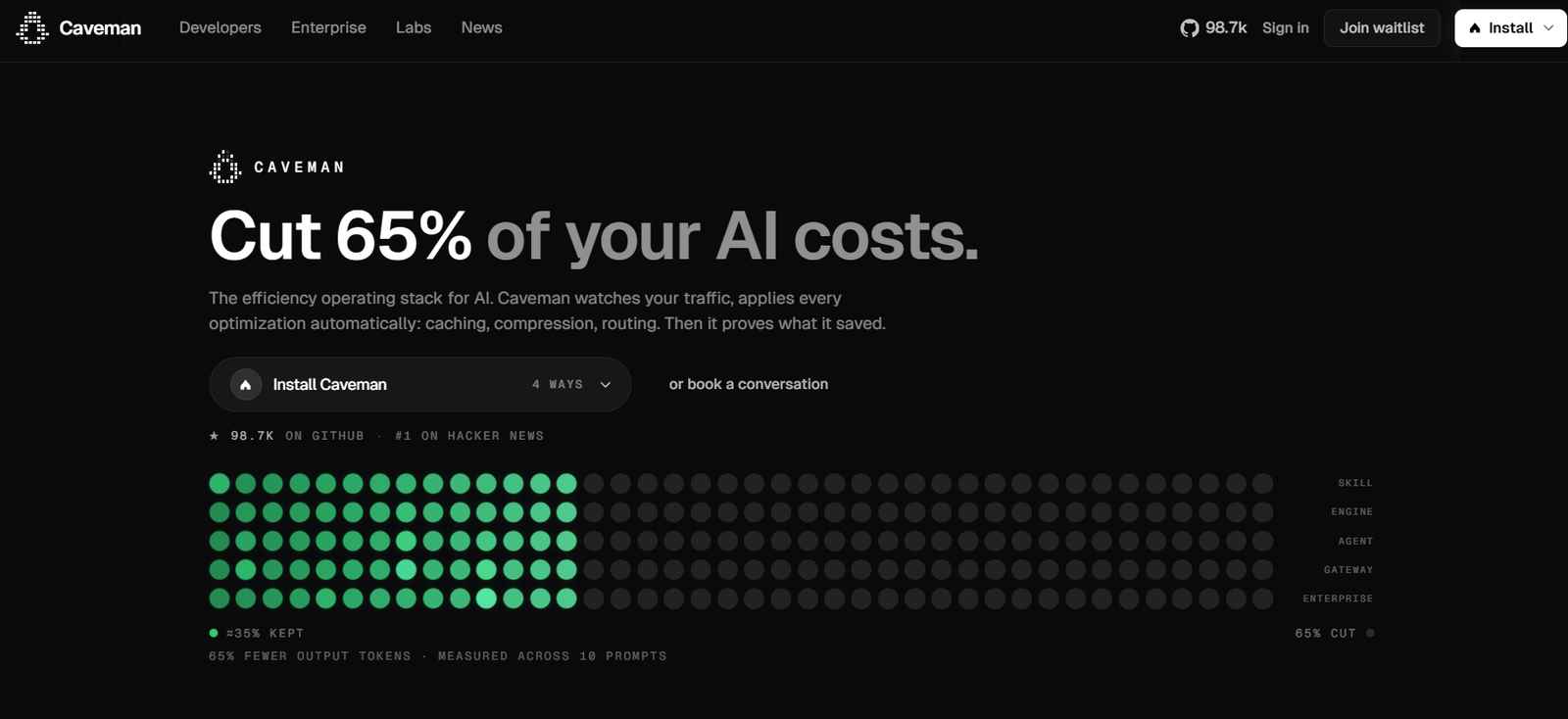
Caveman started with the open source Caveman Skill, which instructs coding agents to respond in an extremely concise style while preserving important technical details. According to Caveman’s published benchmark, the skill reduced output tokens by an average of 65% across a 10 prompt test. This is a company reported benchmark and results will vary depending on the task.
The broader Caveman stack includes the Caveman Skill, local Proxy, Agent SDK and developing Cloud and Enterprise products. These components address different parts of AI efficiency, including context compression, caching, model routing, spending analysis and evaluation based optimization.
Caveman is primarily a developer infrastructure product rather than a general purpose consumer AI assistant.
Features
Caveman Skill
Caveman Skill is the simplest entry point into the platform and is available as an open source project under the MIT license.
It changes how supported coding agents respond by removing unnecessary words and filler while keeping technical information, code, commands and error messages intact.
The official website reports an average reduction of approximately 65% in output tokens across its published 10 prompt benchmark.
Support for Multiple Coding Agents
The Caveman Skill works with more than 30 AI coding agents and development environments.
The website specifically highlights compatibility with tools such as Claude Code, Codex and Cursor, allowing developers to introduce concise response behavior into existing workflows.
Caveman Proxy
Caveman Proxy provides recoverable local context compression for AI agents.
It sits between the agent and model provider and identifies content such as logs, JSON, code, diffs and tables that may be compressed before being sent as model context.
Original information is retained locally so it can be recovered when necessary.
Local Processing
The Proxy can run directly on the developer’s machine.
This allows eligible context compression to occur locally without requiring a Caveman account for the basic local workflow.
Recoverable Context Compression
Caveman is designed to reduce repetitive or unnecessarily large context while preserving access to the original information.
This is particularly useful for AI agents that repeatedly send large logs, tool results, code structures or JSON objects back to an LLM.
Multiple Compression Methods
The Caveman Engine is designed to recognize different types of information rather than applying exactly the same compression method to everything.
The website describes compression methods for JSON, logs, code, tables, bulk context, schemas, diffs, search results and HTML.
AI Cost Visibility
Caveman’s broader stack is designed to show how AI spending is distributed.
Organizations can analyze usage according to factors such as team member, API key, workflow and AI model.
This can help engineering teams understand where token costs originate.
Provider Based Cost Measurement
The platform calculates spend using provider reported usage combined with public model pricing.
Unknown models remain unpriced instead of being assigned an estimated cost.
AI Caching Optimization
Caveman can apply provider native caching hints when requests qualify.
Repeated context can potentially benefit from caching rather than being processed as completely new context every time.
Model Routing
Caveman is developing model routing that evaluates whether a task can be moved to a cheaper model without failing defined quality checks.
If the lower cost model does not pass the required evaluation, the task remains on the original model.
Evaluation Gates
Cost reduction is not intended to be applied blindly.
Caveman describes an evaluation process that checks areas such as exactness, data structure validity, task success, latency and cost before an optimization is moved into production.
Automatic Rollback
If an optimization produces a regression, Caveman’s planned production workflow is designed to roll back the change.
This can reduce the risk of saving tokens at the expense of application quality.
Savings Verification
Caveman distinguishes between different levels of savings evidence.
Potential savings can begin as inferred estimates, then move through replayed measurements and finally become verified when supported by provider level evidence from active traffic.
Cave Plan
Cave Plan is designed to identify potential cost reduction opportunities within an organization’s own AI traffic.
Examples include caching repeated system prompts, reducing unnecessary tool schemas and routing suitable workloads to less expensive models.
Caveman Agent SDK
The Caveman Agent SDK is available for developers building production AI agents.
It provides local catalog price guards, token accounting and evaluation based context planning.
The SDK is offered as a TypeScript package and supports selected agent frameworks and development workflows.
CaveGemma
CaveGemma is an experimental model from Caveman Labs based on Google’s Gemma family.
According to Caveman’s published research, its fine tuned model produced 27% fewer output tokens across 193 held out pairs while maintaining high code fence exactness.
These figures come from Caveman’s own research and should not be interpreted as guaranteed results for every workload.
Caveman Cloud
Caveman Cloud is being developed as a managed environment for applying compression, caching and model routing to AI traffic.
At the time of review, the Cloud offering is still described as being in private development with a waitlist.
Enterprise Deployment
The planned Enterprise offering is designed for deployment in an organization’s cloud or data center.
Caveman describes support for zero data retention controls, SSO/SAML, role based access and organizational isolation for enterprise environments.
How It Works
Step 1: Choose a Caveman layer
Developers can begin with the free open source Caveman Skill or use the local Proxy and Agent SDK for deeper optimization.
Step 2: Install Caveman
Install the relevant component into a supported AI coding or agent environment.
Step 3: Use the AI agent normally
Continue working with the existing coding agent or LLM workflow.
Step 4: Reduce verbose output
The Caveman Skill encourages the agent to remove unnecessary prose while preserving technical details.
Step 5: Compress eligible context
With the Proxy, eligible logs, JSON, code, tables and other large context can be compressed locally before being sent to the model.
Step 6: Preserve recoverability
Original information is stored before lossy replacement so it can be recovered when required.
Step 7: Measure token usage
Caveman can analyze how many tokens are being consumed and where costs originate.
Step 8: Identify optimization opportunities
More advanced workflows can identify opportunities involving caching, context reduction and model selection.
Step 9: Evaluate changes
Optimizations are checked against defined quality requirements before being considered safe for production.
Step 10: Monitor savings
Organizations can distinguish estimated savings from replayed or verified reductions rather than treating every projected saving as confirmed.
Use Cases
AI Coding Agents
Developers using coding agents can reduce verbose explanations while preserving code, commands and error information.
Software Developers
Individual developers can use the open source Skill or local Proxy to reduce token consumption during coding sessions.
AI Agent Developers
Teams building autonomous agents can use the SDK and compression technology to manage large amounts of tool output and context.
Large Context Applications
Applications processing lengthy logs, JSON, tables or repeated context may use compression to reduce the information sent to the model.
AI Cost Management
Organizations with substantial LLM API spending can analyze where tokens and costs are being consumed.
Development Teams
Teams using multiple AI models can explore routing appropriate tasks toward less expensive models while maintaining evaluation requirements.
Enterprise AI
Large organizations can evaluate Caveman’s planned on premises and private deployment options for controlling AI infrastructure costs.
AI Research
Researchers interested in token efficiency can explore Caveman Labs and CaveGemma experiments around concise model output.
Pricing
Caveman currently combines free and commercial components.
Caveman Skill
The Caveman Skill is free and open source under the MIT license.
Caveman Proxy
The local Caveman Proxy is described as free to run, and basic local compression does not require a Caveman account.
Caveman Agent SDK
The Agent SDK is available for developers, but a separate standard public subscription price is not clearly presented for the SDK on the official website.
Caveman Cloud
Caveman Cloud is currently described as being in private development with a waitlist.
Enterprise
Enterprise deployment is also being developed for organizations requiring private cloud or on premises infrastructure.
Complete commercial pricing for Cloud and Enterprise products is not clearly published on the official website.
Therefore, pricing details are not clearly mentioned on the official website for Caveman’s commercial Cloud and Enterprise products.
Strengths
Caveman addresses a practical issue in AI development: unnecessary token consumption.
The open source Skill provides a simple entry point that developers can try without purchasing a subscription.
Its local Proxy takes optimization beyond shorter answers by addressing large context such as logs, JSON, code and tables.
Recoverable compression is useful because original information can remain available even when a smaller representation is sent to the model.
Caveman also separates inferred, replayed and verified savings, which provides a more careful way of presenting cost reduction.
Evaluation gates help address the risk that aggressive cost optimization could reduce application quality.
The combination of compression, caching, model routing and cost visibility gives the platform a broader scope than a simple prompt compression tool.
Drawbacks
Caveman is primarily a technical product and is unlikely to be useful to ordinary users who simply want a general AI chatbot.
Some of its most ambitious capabilities, including Caveman Cloud and Enterprise functionality, are still described as being in development.
The headline 65% token reduction comes from Caveman’s own 10 prompt benchmark. Actual savings can differ considerably according to prompts, models, coding tasks and existing optimization.
Reducing output length is not always desirable. Some applications need detailed explanations, documentation or reasoning oriented responses.
Context compression must also be carefully evaluated because removing apparently repetitive information can potentially affect model performance.
Developers should therefore test Caveman against their own workloads rather than assuming published savings will apply equally to every application.
Comparison with Other Platforms
Caveman differs from conventional AI observability platforms because its goal is not simply to show developers how many tokens they are spending. It also aims to actively reduce that consumption.
Compared with prompt compression tools, Caveman has a broader stack covering concise output, recoverable context compression, caching, cost measurement, model routing and evaluation based optimization.
Compared with AI gateways, Caveman places unusual emphasis on proving whether an optimization actually produced savings rather than presenting all projected reductions as realized cost savings.
The platform is also closely connected to developer and coding agent workflows, making it particularly relevant for environments where large logs, code, tool schemas and structured data frequently enter the model context.
However, more established AI gateways and observability platforms may offer broader production integrations and mature enterprise functionality today. Caveman’s Cloud and Enterprise layers are still developing.
Customer Reviews and Testimonials
Detailed customer reviews and testimonials are not clearly available on the official website.
The official site reports strong community adoption of the open source project, including approximately 74,000 GitHub stars at the time of review, and states that Caveman reached number one on Hacker News and GitHub Trending.
These are indicators of developer interest rather than conventional verified customer reviews.
Conclusion
Caveman is an interesting AI infrastructure project focused on a problem that becomes increasingly important as organizations use more AI agents: token efficiency.
Its simplest product, Caveman Skill, encourages coding agents to communicate much more concisely while preserving important technical information. The local Proxy goes further by compressing eligible context such as logs, JSON, code and tables before that information consumes model tokens.
For larger AI systems, Caveman is developing a broader optimization stack involving caching, model routing, cost attribution, evaluation gates and verified savings measurement.
The platform is most suitable for developers, AI startups, engineering teams and organizations running token intensive AI applications. It is less relevant for casual AI users who do not manage API usage or agent infrastructure.
Caveman’s published token reduction figures are promising, but they should be treated as company reported benchmark results rather than guaranteed savings. Teams considering the platform should test it using their own models, prompts and workloads.
Overall, Caveman is worth exploring for developers who want to reduce AI token usage and costs without treating efficiency as simply a matter of choosing a cheaper model.