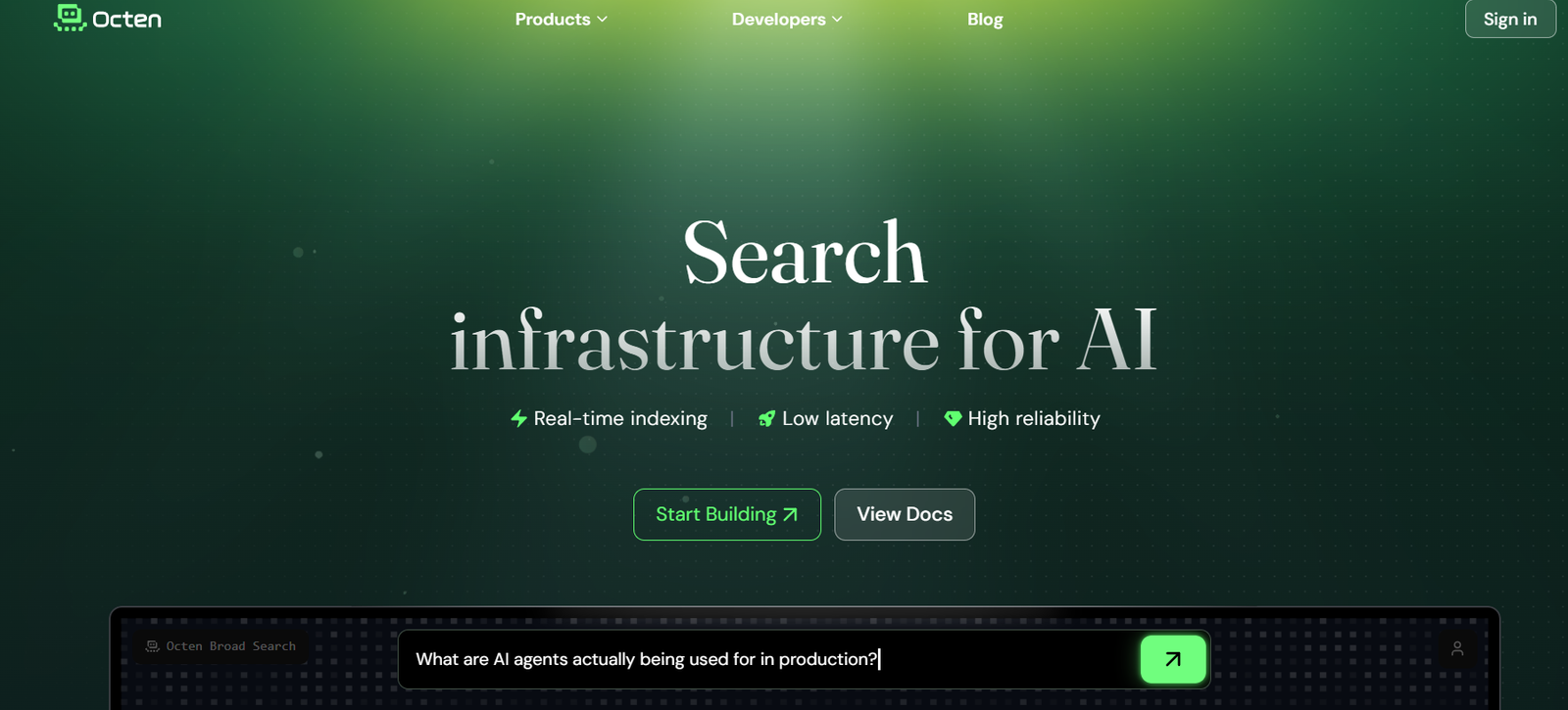
Octen is an AI native search and retrieval infrastructure platform built for developers, AI agents and applications that need fast access to current information from the web.
Traditional search engines are primarily designed around a human entering a query and reviewing results one by one. Octen takes a different approach. Its search infrastructure is designed for AI systems that may need to run many searches concurrently, retrieve information quickly and feed structured results directly into a large language model or AI agent.
Its core offering is the Octen Web Search API, which provides real-time web retrieval with an emphasis on low latency, freshness and reliability. Developers can connect the API to AI assistants, research agents, monitoring systems and other applications that need information beyond the model’s built-in knowledge.
Octen has expanded beyond basic web search into a broader retrieval stack. Its products include Broad Search, Extract, text embeddings, multimodal embeddings and a Model Gateway. Image Search and Video Search are also being developed, while multimodal chat and grounded generation are presented as early access capabilities.
The platform is primarily aimed at developers and organizations building AI products rather than ordinary consumers looking for a traditional search engine.
Features
Web Search API
Octen provides a web search API specifically designed for LLMs and AI agents.
Applications can submit queries programmatically and receive structured search results that can be passed to an AI model for analysis, answering questions or completing tasks.
Real-Time Indexing
Fresh information is an important part of Octen’s positioning.
Its infrastructure continuously indexes the web so AI applications can work with recently published information instead of depending only on static training data.
This can be useful for applications involving news, markets, sports, research and other rapidly changing subjects.
Concurrent Search
Octen is designed around parallel rather than purely sequential search.
An AI agent can break a complex problem into multiple subqueries and search them concurrently, potentially reducing the time needed for large research tasks.
Broad Search
Broad Search is designed for AI workflows that need to explore a topic across many searches rather than relying on one narrow query.
This can be useful for research agents that need to collect information from different angles before producing an answer.
Image Search
Octen is developing multimodal retrieval that can search for images from the live web.
This allows AI applications to work with visual information in addition to conventional text search.
Image Search is currently presented as an early access capability.
Video Search
The platform is also developing Video Search for retrieving relevant video content.
This expands its search infrastructure beyond traditional text based web documents.
Video Search is currently listed as early access.
Extract
Octen’s Extract API turns a web page into cleaner content that can be used by an AI system.
Instead of forcing an application to process an entire webpage with navigation, formatting and unrelated material, Extract can provide clean Markdown together with relevant highlights and page classification.
Text Embeddings
Octen provides its own embedding models for semantic retrieval.
Its current model family includes Octen Embedding models at different sizes, allowing developers to convert text into numerical representations for semantic search, retrieval augmented generation and related applications.
Multimodal Embeddings
Octen also develops vision-language embedding technology.
These models create a common retrieval space across text, images, videos and visually complex documents.
This can be valuable for AI applications that need to find information across several content formats rather than text alone.
Model Gateway
The Model Gateway provides one API for accessing supported AI models together with Octen Search integration.
It supports text and image generation, helping developers combine model inference with real-time search without independently connecting every component.
Deep Research
Octen demonstrates a Deep Research capability for source backed research across large numbers of web pages and documents.
This can help AI applications investigate complex questions requiring information from many sources.
Multimodal Chat
Multimodal Chat is an early access capability for analyzing and searching across text, images and complex documents within a conversational workflow.
Grounded Generation
Grounded Generation is another early access feature.
It is designed to generate images using real-world references retrieved through live web search, connecting generative image creation with current source material.
Finance Search
Octen can retrieve current financial information such as stock quotes, candlestick data and fundamental metrics for publicly traded companies through its search infrastructure.
Sports Search
The API can also retrieve current sports information including scores, standings, player statistics and match results.
Skills Integration
Octen can be added as a skill for supported AI development environments, providing another way to bring its search capabilities into agent workflows.
MCP Support
The platform supports Model Context Protocol workflows.
This can make Octen’s retrieval tools available to AI applications and development environments that support MCP.
CLI Access
Developers can also use Octen through command line workflows, providing another integration option alongside the API and MCP.
Public Documentation
Octen provides developer documentation explaining how to make API requests and connect search functionality with applications.
A basic REST request can be made without installing a dedicated SDK.
How It Works
Step 1: Create an Octen account
Developers create an account through the Octen API Platform.
Step 2: Get an API key
Copy the API key from the developer console.
Step 3: Connect the Search API
Add the Octen API to an application, AI agent or development workflow.
Developers can begin with a standard REST API request without installing an SDK.
Step 4: Submit a query
Send the search request to Octen with the required query and result parameters.
Step 5: Retrieve structured results
Octen searches its index and returns structured web results containing information such as titles, URLs, relevant content and publication or crawl information where available.
Step 6: Pass results to the AI
The retrieved information can be supplied to an LLM or agent as current context.
Step 7: Expand into parallel research
More sophisticated agents can break a question into several subqueries and search them concurrently.
Step 8: Use additional retrieval tools
Developers can add Extract, embeddings, multimodal retrieval or Model Gateway functionality depending on the application.
Use Cases
AI Agent Developers
Developers can give autonomous agents access to current web information rather than limiting them to knowledge contained in an underlying model.
AI Search Engines
Teams can build search experiences that retrieve information and use an LLM to synthesize the results into a direct answer.
Deep Research Agents
Research applications can perform many searches, collect relevant sources and use AI to create detailed research outputs.
RAG Applications
Developers building retrieval augmented generation systems can use Octen’s search, extraction and embedding capabilities as part of the retrieval pipeline.
Financial Applications
AI applications can retrieve current market information, stock quotes and other supported financial data.
Sports Applications
Developers can build AI assistants that answer questions using current scores, standings, player statistics and match results.
News Monitoring
AI agents can monitor recently published information and use fresh web results when preparing summaries or alerts.
Multimodal AI
Developers working with text, images, videos and visual documents can explore Octen’s multimodal search and embedding technology.
Enterprise AI
Organizations building internal or customer facing AI systems can integrate real-time external information with their existing AI workflows.
Pricing
Octen does not clearly display complete standard self-service pricing on its main public website.
The company provides an API Platform where developers can create an account and begin using its services.
For organizations with larger requirements, Octen provides enterprise scaling options and custom pricing based on the intended use case and estimated API volume.
Therefore, pricing details are not clearly mentioned on the official public website.
Businesses requiring high query volumes or enterprise functionality should contact the Octen team for current pricing.
Strengths
Octen is purpose built for AI retrieval rather than adapting a conventional consumer search interface for machine use.
Real-time indexing makes the platform relevant for AI systems that need information about events and data that change frequently.
Parallel subquery processing can support research agents that need to investigate many aspects of a topic quickly.
The platform provides more than search. Extract, embeddings, multimodal embeddings and Model Gateway functionality create a broader retrieval infrastructure.
Octen’s own embedding models have reported strong performance on public retrieval benchmarks.
Multimodal embeddings allow developers to work across text, images, video and visual documents.
Support for API, Skills, MCP and CLI provides several ways to connect Octen with modern AI development workflows.
The website also states that Octen has achieved SOC 2 Type II compliance, which may be relevant for organizations evaluating infrastructure providers.
Drawbacks
Octen is primarily developer infrastructure, so it may not be suitable for non-technical users looking for a simple consumer AI research tool.
Integration generally requires understanding APIs, AI agents and retrieval workflows.
Some interesting capabilities, including Image Search, Video Search, Multimodal Chat and Grounded Generation, are currently described as early access rather than fully mature general availability products.
Complete public pricing is not clearly displayed, making it harder to estimate costs before creating an account or contacting the company.
Performance and benchmark figures displayed on the website are company reported and should be evaluated in the context of each developer’s actual workload.
Organizations should therefore test search relevance, latency, coverage and reliability using their own queries before making Octen a critical part of a production AI system.
Comparison with Other Platforms
Octen operates in the AI native search and retrieval infrastructure category alongside services designed to give LLMs and agents access to current web information.
Its approach differs from conventional search engines because the primary customer is an AI application rather than a person scrolling through search results.
Compared with simple web search APIs, Octen offers a broader retrieval stack that includes content extraction, text embeddings, multimodal embeddings and model access.
Its emphasis on concurrent subqueries is particularly relevant for AI agents. A research agent can investigate multiple parts of a question in parallel instead of reproducing the slower search, read and search again pattern of human web research.
Other AI search infrastructure providers may offer different strengths in search coverage, developer ecosystems, pricing or specialized retrieval. Developers should therefore compare providers using their own production queries rather than relying entirely on headline benchmark results.
Customer Reviews and Testimonials
Customer reviews and testimonials are not clearly available on the official website.
The website focuses primarily on technical capabilities, benchmarks, product demonstrations and developer documentation rather than publishing a large collection of customer testimonials.
Conclusion
Octen is a search and retrieval infrastructure platform built specifically for the growing world of AI agents and real-time AI applications.
Its core value is straightforward: an AI model’s internal knowledge is limited and eventually becomes outdated, so many useful agents need a reliable way to retrieve fresh information from the outside world. Octen provides infrastructure for doing this programmatically and at high speed.
Its Web Search API forms the foundation, while Broad Search, Extract, embeddings, multimodal embeddings and Model Gateway expand the platform into a more complete retrieval stack. Image Search, Video Search and other multimodal capabilities further indicate its direction toward AI systems that need to understand more than text.
Octen is best suited to AI developers, startups, research platforms and enterprises building agents, RAG applications, AI search engines and other products requiring current web information.
It is less relevant for ordinary users looking for a standalone chatbot or traditional search engine. For developers building AI systems that need fast and fresh access to the web, however, Octen is a platform worth evaluating.