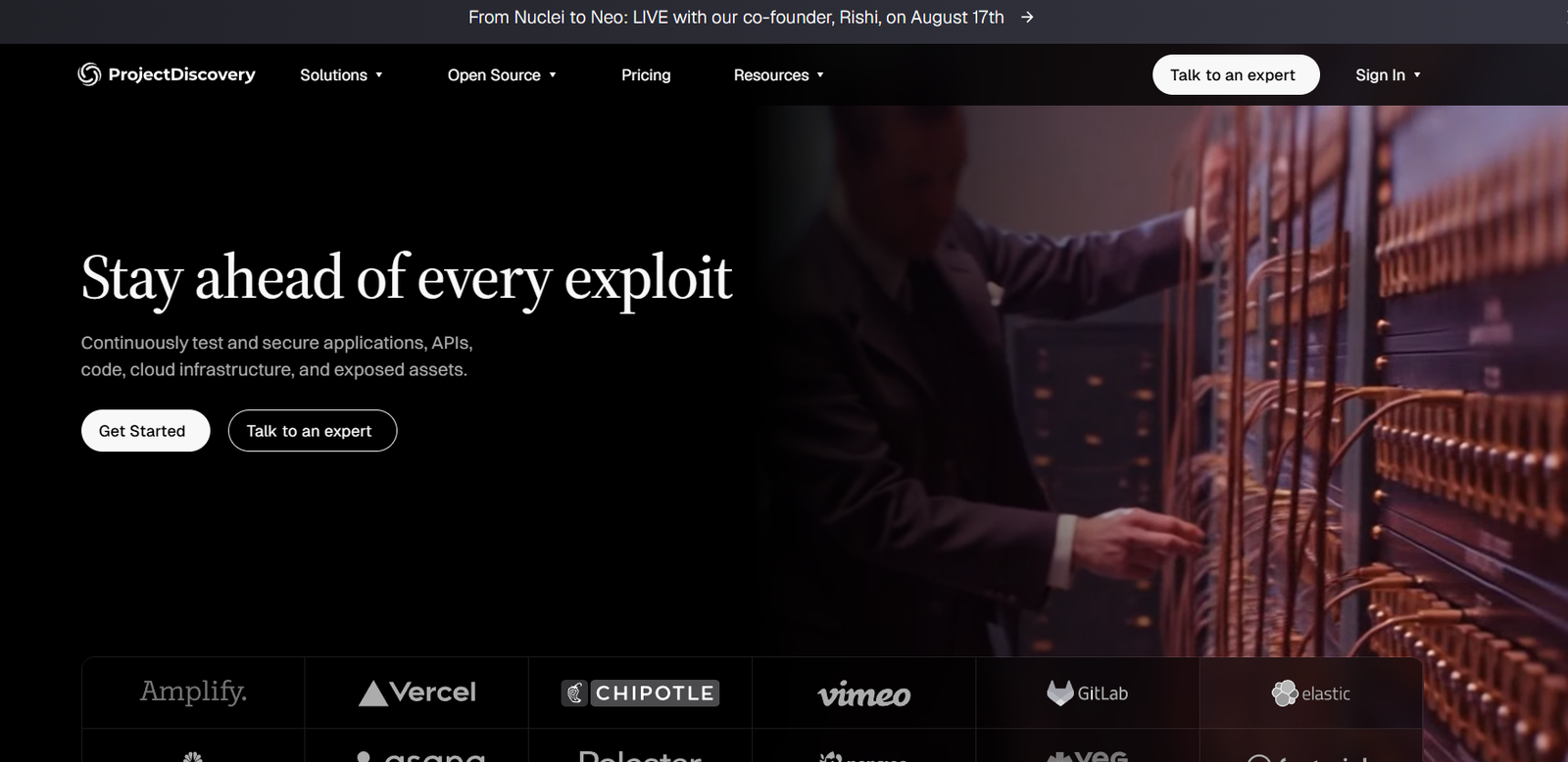
ProjectDiscovery is a cybersecurity platform that combines artificial intelligence, automated security testing and a large open-source security ecosystem to help organizations discover and verify vulnerabilities across applications, APIs, code, cloud infrastructure and exposed digital assets.
Its current AI-powered platform, Neo, is designed to continuously test an organization’s technology environment and identify security weaknesses before they become serious problems. Rather than functioning only as a traditional vulnerability scanner, the platform can map attack surfaces, perform application and API pentesting, review code and pull requests, analyze exposures, triage vulnerabilities and support remediation workflows.
ProjectDiscovery is also the company behind Nuclei, a widely used open-source vulnerability scanner based on customizable YAML templates. Its community contributes detection templates covering vulnerabilities and emerging security threats.
The platform is mainly designed for cybersecurity professionals, application security teams, penetration testers, security engineers, DevSecOps teams and organizations that need continuous security testing at scale.
Features
AI-Powered Security Testing
ProjectDiscovery uses AI to support automated offensive security testing. Its Neo platform can reason across applications, APIs, code and infrastructure to identify security weaknesses and help teams investigate them.
AI Pentesting
Neo supports application and API penetration testing. It is designed to test systems in ways that go beyond basic vulnerability scanning, including investigating application behavior and potential business logic weaknesses.
Attack Surface Management
ProjectDiscovery continuously maps exposed organizational assets such as domains, APIs, endpoints, ports and cloud services.
As infrastructure changes, the attack surface can be updated so security testing is based on the organization’s current environment.
Vulnerability Detection
The platform scans applications, infrastructure, cloud environments and networks for known vulnerabilities and security misconfigurations.
Nuclei Vulnerability Scanner
Nuclei is ProjectDiscovery’s popular open-source vulnerability scanner. It uses YAML-based templates that describe how specific security issues should be detected.
Its template-driven design allows security professionals to customize tests according to their own environments.
Community-Powered Vulnerability Templates
ProjectDiscovery maintains a large library of Nuclei templates supported by its security community.
These templates cover vulnerabilities, CVEs, cloud misconfigurations, exposed services and other security issues.
AI Template Generation
ProjectDiscovery provides AI assistance for creating Nuclei templates. Security professionals can use AI to help convert vulnerability information into reusable detection templates.
PR Security Review
Neo can review code and pull requests for security problems. This allows organizations to bring security testing closer to the software development process instead of waiting until an application has already been deployed.
Vulnerability Verification
ProjectDiscovery emphasizes verification of detected security issues. A separate verification process attempts to reproduce findings before they are sent into the remediation workflow.
This approach is intended to reduce unnecessary alerts and help security teams focus on exploitable vulnerabilities.
Vulnerability Triage
The platform can help analyze and prioritize detected vulnerabilities. This can reduce the amount of manual work required to investigate large numbers of security alerts.
Vulnerability Remediation
Verified vulnerabilities can be routed into engineering workflows so developers can investigate and fix them.
Cloud Security Testing
ProjectDiscovery can examine cloud infrastructure for vulnerabilities, exposures and configuration problems.
Integrations are available for major cloud and deployment environments including AWS, Google Cloud, Azure, Cloudflare and Vercel.
API Security Testing
Organizations can test APIs for known vulnerabilities, configuration issues and exploitable weaknesses.
Network Security
Nuclei can test network services and infrastructure in addition to conventional websites. This includes services using protocols such as SSH, FTP and SMB.
Custom Security Automation
Organizations can create custom automation for their particular security requirements and workflows.
Red Teaming
Neo includes red-team-oriented security capabilities that can be used to test systems from an offensive security perspective.
Code and Infrastructure Context
The platform can combine information from code, tickets, infrastructure and previous findings when conducting security testing.
CI/CD Integration
Nuclei and ProjectDiscovery workflows can be integrated into software development pipelines. This allows security testing to become part of continuous development and deployment.
GitHub and Slack Apps
The Pay as you go plan includes native GitHub and Slack applications, helping security findings connect with development and collaboration workflows.
Internal Network Auditing
Enterprise customers can use internal network auditing capabilities for testing assets that are not publicly accessible.
VPC Deployment
Enterprise customers can use dedicated VPC deployment where greater infrastructure isolation and control are required.
How It Works
Organizations first create a ProjectDiscovery account and define the systems or assets they are authorized to test.
They can connect relevant infrastructure, cloud environments, code repositories or other supported systems.
ProjectDiscovery maps the available attack surface, including domains, endpoints, APIs, ports and cloud resources.
Security testing can then be performed against applications, APIs, infrastructure and other approved assets.
Neo uses AI-powered workflows alongside ProjectDiscovery’s vulnerability detection technology to investigate possible weaknesses.
Nuclei and its community-powered template library can run targeted tests for known vulnerabilities and misconfigurations.
Potential findings are analyzed and verified before they are presented as exploitable security issues.
Security teams can review vulnerabilities, evidence, severity and other relevant information.
Verified findings can then be routed into development and remediation workflows.
After a vulnerability has been fixed, teams can retest the issue to confirm that remediation was successful.
Organizations can also automate recurring testing so their security posture is continuously reassessed as infrastructure and applications change.
Use Cases
Application Security Teams
AppSec professionals can continuously test web applications and APIs for vulnerabilities and configuration problems.
Cybersecurity Teams
Security teams can monitor exposed assets, investigate vulnerabilities and prioritize remediation.
Penetration Testers
Authorized penetration testers can use Nuclei and Neo to automate parts of vulnerability discovery and security assessment.
DevSecOps Teams
Organizations can integrate vulnerability testing into CI/CD pipelines so security checks take place during development and deployment.
Software Developers
Developers can receive verified security findings connected to code and pull requests, helping them address problems earlier in development.
Cloud Security Teams
Teams managing AWS, Google Cloud, Azure and other cloud environments can use ProjectDiscovery to identify exposed assets and configuration weaknesses.
Red Teams
Authorized red teams can use the platform’s offensive security capabilities to evaluate how real-world weaknesses could be exploited.
Vulnerability Researchers
Security researchers can create and customize Nuclei templates for newly discovered vulnerabilities.
Enterprise Security Operations
Large organizations can use continuous scanning, asset discovery, vulnerability triage and remediation workflows across complex infrastructure.
API Security
Organizations operating large numbers of APIs can use ProjectDiscovery to identify vulnerabilities and misconfigurations across their API infrastructure.
Pricing
ProjectDiscovery currently offers Pay as you go and Enterprise options for Neo.
Pay as you go
The Pay as you go plan starts at $250 per user per month and includes 50 credits per seat.
Additional credits can be purchased at $5 per credit.
The plan supports up to five seats and includes capabilities such as:
Application and API pentesting
Attack surface management
Code and pull request security review
Red teaming
Mobile application security in beta
Vulnerability triage
Custom automation
GitHub and Slack native applications
AWS, GCP, Azure, Cloudflare and Vercel integrations
An annual option is also available. Current terms list the 50-credit annual plan at $2,625 per user per year, representing a discount compared with monthly billing.
Credit usage varies depending on the type and depth of security test being performed.
Enterprise
Enterprise pricing is customized according to organizational requirements.
It includes the capabilities available in Pay as you go along with features such as volume credit discounts, unlimited seats, Bring Your Own Key, internal network auditing, SSO and SAML provisioning, dedicated VPC infrastructure, static egress IPs, organizational spending controls and dedicated support and onboarding.
Organizations need to contact ProjectDiscovery for an Enterprise quotation.
ProjectDiscovery also maintains open-source security tools such as Nuclei that can be used separately from the commercial Neo platform.
Strengths
ProjectDiscovery combines AI-driven security testing with a well-established open-source cybersecurity ecosystem.
Nuclei’s customizable template architecture gives security professionals considerable flexibility when building vulnerability detection workflows.
Its large community helps expand coverage for newly discovered vulnerabilities and emerging attack techniques.
The platform goes beyond conventional vulnerability scanning by combining attack surface discovery, AI pentesting, code review, vulnerability verification, triage and remediation.
Verification of findings can help reduce time spent investigating false positives.
Integration with development and cloud infrastructure makes ProjectDiscovery suitable for continuous DevSecOps workflows.
Its open-source tools also allow security professionals to start using ProjectDiscovery technology without immediately adopting the commercial platform.
Drawbacks
ProjectDiscovery is primarily designed for cybersecurity professionals and technical teams. It may be difficult for users without experience in security testing, networking or vulnerability management.
The Neo Pay as you go plan starts at $250 per user per month, which may be expensive for individuals or small teams requiring only occasional security testing.
The credit-based pricing model means actual costs can vary according to the number and complexity of security workflows being run.
Some advanced capabilities, including internal network auditing, dedicated VPC deployment, SSO and certain organizational controls, are restricted to Enterprise customers.
Nuclei’s flexibility also means users may need technical knowledge to create, customize and manage templates effectively.
As with any automated security platform, findings should be evaluated within their technical and business context rather than relying entirely on automated decisions.
The tools should only be used to test systems for which the user has appropriate authorization.
Comparison with Other Platforms
ProjectDiscovery differs from many conventional vulnerability management platforms through its combination of open-source security tooling, community-powered detection and AI-driven security workflows.
Traditional vulnerability scanners often rely heavily on centrally maintained vulnerability databases and scheduled scanning. ProjectDiscovery’s Nuclei ecosystem allows researchers and security professionals to create reusable templates that can rapidly extend detection coverage.
Neo adds another layer by combining AI pentesting, attack surface management, code review, vulnerability triage and remediation workflows.
Compared with traditional enterprise scanners, ProjectDiscovery may offer greater flexibility and customization for technically experienced security teams. Established enterprise platforms may, however, provide different compliance, governance and reporting capabilities depending on organizational requirements.
Its strongest appeal is likely to be among security teams that value automation, open-source tooling and continuous offensive security testing.
Customer Reviews and Testimonials
ProjectDiscovery publishes customer case studies and success stories on its official website.
The featured organizations include Elastic, ConnectWise and Paddle. These case studies describe how security teams have used ProjectDiscovery technologies for vulnerability detection, attack surface visibility and security automation.
For example, the ConnectWise case study describes using ProjectDiscovery to streamline vulnerability detection across a large AWS environment, while Elastic’s story discusses scaling proactive security detection using ProjectDiscovery Cloud and open-source tools such as Nuclei.
These are company-published customer stories rather than independent third-party reviews.
Conclusion
ProjectDiscovery is a powerful cybersecurity platform for organizations that want to combine continuous vulnerability detection with AI-powered security testing.
Its ecosystem brings together Neo, Nuclei and other open-source security technologies to cover applications, APIs, code, cloud infrastructure, networks and exposed assets.
The platform is particularly relevant for application security teams, penetration testers, DevSecOps professionals, cloud security teams and larger organizations that need continuous and customizable security testing.
Nuclei remains an important advantage because its open-source and community-driven approach gives security professionals extensive flexibility. Neo builds on that foundation with AI pentesting, verification, triage, remediation and enterprise automation.
ProjectDiscovery is therefore best suited to technically experienced security teams that want modern, automated and extensible vulnerability testing rather than a simple consumer-oriented security scanner.