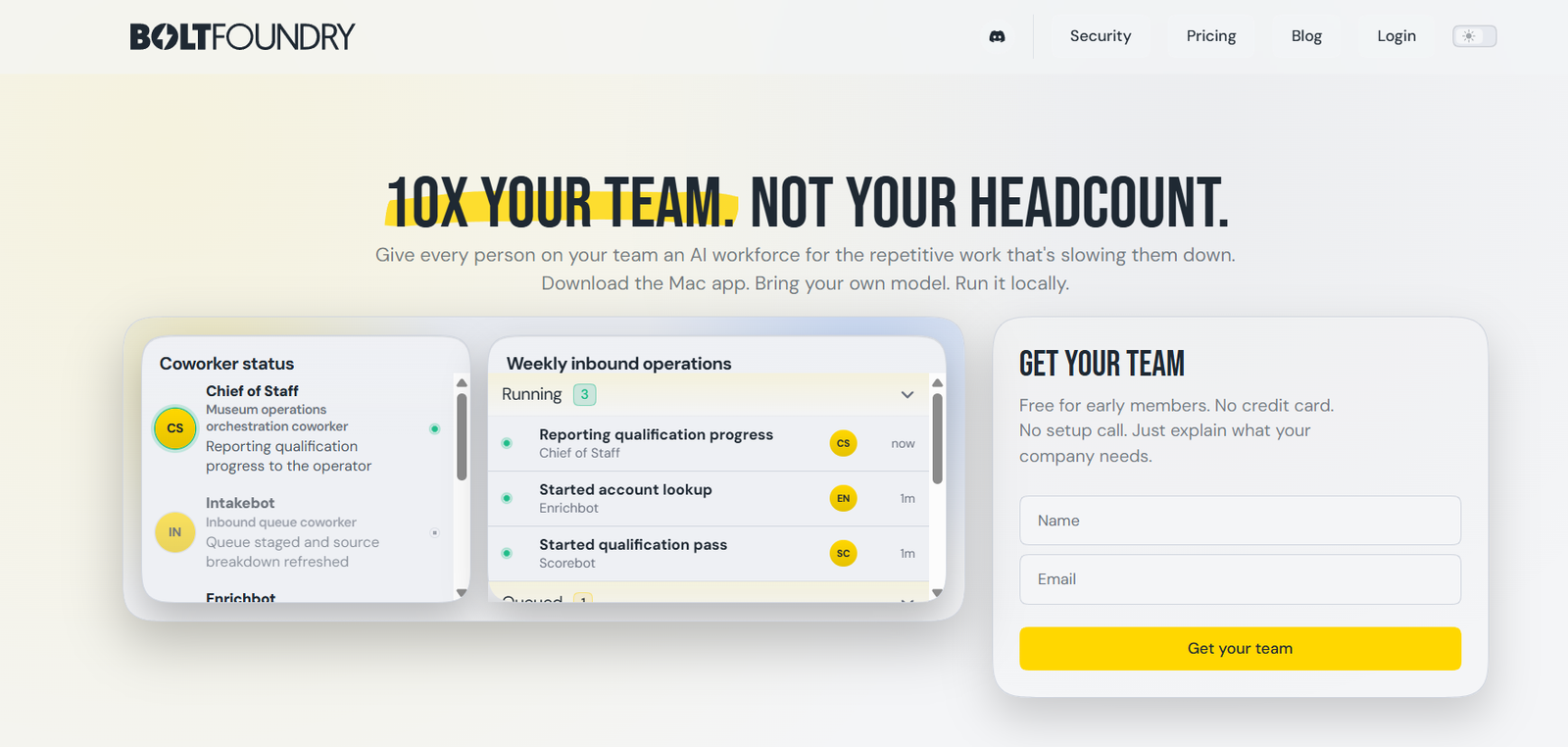
Bolt Foundry is a local first AI agent platform designed to give individuals and teams a group of specialized AI agents that can handle repetitive operational work. Instead of relying on a single general purpose chatbot, users can create an AI workforce where different agents have defined responsibilities.
The platform is aimed at product teams, startups, agencies, sales professionals and businesses that want AI to carry out ongoing work such as research, inbound processing, lead qualification, follow ups, reporting and operational coordination.
Bolt Foundry uses a Chief of Staff style agent as a central coordinator. Users explain what they need in natural language, and specialized agents can then be assigned to different functions. The human user remains responsible for reviewing, approving and directing the work.
Privacy and control are important parts of the platform. Bolt Foundry runs agents locally on the user’s machine, keeps files on local hardware and limits agents to approved workspaces and permissions. Users can also choose between hosted and local AI models rather than being restricted to a single model provider.
Bolt Foundry also develops Gambit, an open source framework for building and verifying LLM workflows. Gambit provides tools for running agents locally, tracing their activity, testing behavior and evaluating outputs.
Features
AI Chief of Staff
Bolt Foundry provides a Chief of Staff agent that acts as the coordinating layer for an AI workforce.
Users describe what needs to be accomplished in plain language. The Chief of Staff can then help delegate work to specialized agents and report progress back to the human operator.
Specialized AI Agents
Instead of giving one AI assistant every responsibility, Bolt Foundry supports agents with specific roles.
Examples presented by the platform include Intake, Research, Outreach, Scoring and Operations agents. Each is designed around a particular type of business work.
Intake Agent
The Intake agent can help process incoming information and organize new items that require attention.
This can be useful for teams handling incoming leads, requests or operational queues.
Research Agent
Research agents can conduct deeper investigations, gather intelligence and support market monitoring.
This can reduce the amount of repetitive information gathering that employees need to perform manually.
Outreach Agent
The Outreach agent can help prepare follow ups, draft messages and support relationship management workflows.
Human review remains important before AI generated communications are used in sensitive or high value situations.
Lead Scoring
Scoring agents can help qualify and rank leads according to urgency, fit or other relevant signals.
This can help sales teams concentrate attention on opportunities that appear most relevant.
Operations Agent
Operations agents can assist with activities such as scheduling, reporting and coordination.
These capabilities are intended to move repetitive administrative work away from employees while allowing them to supervise the overall process.
Autonomous Workflows
Bolt Foundry is designed for agents that continue performing assigned work rather than waiting for a new chat prompt for every individual action.
The platform emphasizes a workflow where agents perform work while humans review, approve and guide important decisions.
Bring Your Own AI Model
Users are not restricted to one AI model.
Bolt Foundry supports using hosted models, local models or a combination of both. Different models can be selected for different agent roles according to the user’s requirements.
Local First Architecture
Bolt Foundry’s desktop application runs agents locally rather than requiring all work to take place on the company’s cloud infrastructure.
Files remain on the user’s hardware, which can provide greater control over business information.
Workspace Boundaries
Agents operate inside workspaces selected and approved by the user.
They are designed not to have unrestricted access to other files, services or operating system information outside those boundaries.
Controlled Network Access
Outbound network activity is policy controlled. According to Bolt Foundry, requests use explicit host mediated paths rather than giving agents unrestricted network access.
The company also states that the application makes no silent network requests.
Protected Credentials
Provider credentials are kept in operating system backed storage.
Agents receive limited permissions rather than being given unrestricted access to raw API credentials.
Readable Work Artifacts
Agent work is stored in readable Markdown files rather than only in a proprietary application format.
This allows users to inspect, understand and potentially version the work their agents have completed.
Automated Test Bots
The Basic version includes automated test bots that can help users evaluate AI workflows and agent behavior.
Gambit Open Source Framework
Bolt Foundry develops Gambit, an open source agent harness framework for building and verifying LLM workflows.
Gambit supports local execution, typed workflows, trace streaming, debugging and evaluation. It is particularly relevant for developers building AI systems where reliability and repeatability matter.
How It Works
Step 1: Get Bolt Foundry
Users can start through Bolt Foundry and download its Mac application.
Step 2: Create a local workspace
Choose the files, folders and workspace where the AI agents are allowed to operate.
Step 3: Connect an AI model
Select a supported hosted or local AI model according to the needs of the workflow.
Step 4: Explain the objective
Tell the Chief of Staff agent what needs to be accomplished using normal language.
For example, a sales professional could ask for help processing new leads, researching companies and preparing follow up messages.
Step 5: Assign specialized agents
Different agents can handle individual parts of the workflow, such as intake, research, scoring, outreach and operations.
Step 6: Allow the agents to work
Agents perform their assigned tasks inside the permitted environment and according to their defined roles.
Step 7: Review progress
Users can inspect what is running, queued and completed.
Step 8: Approve important actions
Human users remain responsible for reviewing and steering the work, particularly where decisions or external actions have meaningful consequences.
Use Cases
Founders
Solo founders can use specialized AI agents for research, lead generation, follow ups, reporting and routine operational work.
Startups
Small startup teams can give individual employees dedicated groups of agents to assist with repetitive work without immediately expanding headcount.
Sales Teams
Sales professionals can use AI agents for inbound processing, account research, lead qualification, scoring and follow up preparation.
Marketing Teams
Marketing professionals can use agents to support research, content related workflows, market monitoring and recurring operational tasks.
Product Teams
Product teams can use Bolt Foundry to coordinate repetitive research, planning, reporting and operational activities while keeping work artifacts locally accessible.
Agencies
Agencies can use specialized agents to support repetitive client research, reporting, outreach and administrative coordination.
Researchers
Research agents can gather information, monitor areas of interest and organize findings for further human analysis.
Operations Teams
Operations professionals can delegate recurring scheduling, coordination and reporting activities while supervising agent output.
Developers
Developers can use the open source Gambit framework to create, test and verify AI agent workflows with explicit inputs, outputs and guardrails.
Pricing
Bolt Foundry currently offers a Basic plan, while Pro and Enterprise options are listed as coming soon.
Basic
The Basic plan is currently free.
It includes:
Local first desktop application
Single local workspace
Automated test bots
Local storage
Source available software
Bolt Foundry also states that early members can currently get started free without providing a credit card.
Pro
The Pro plan is listed at $79 per month and is marked as coming soon.
It is intended for individual operators requiring additional trust, control and continuity features.
Planned features include:
Everything in the current core offering
Individual user certificate
Verifiable outputs
Access control
Encrypted backup synchronization
Interested users can join the waitlist.
Enterprise
The Enterprise plan is also listed as coming soon, with pricing not publicly specified.
Planned Enterprise capabilities include:
Self issuing certificates
SSO
SCIM
Role based access control
Shared workspaces
SLA support
On premise management
Organizations interested in Enterprise deployment need to contact Bolt Foundry directly.
Strengths
Bolt Foundry’s local first architecture is one of its strongest differentiators. Agents operate on the user’s machine and files remain on local hardware.
The platform uses specialized agents rather than expecting one general purpose chatbot to perform every task.
Users can choose the AI models they trust and can combine local and hosted models for different roles.
Explicit workspace boundaries help reduce the risk of an agent accessing unrelated information on a computer.
Readable Markdown artifacts make agent activity easier to inspect than workflows stored entirely inside an opaque proprietary system.
The Chief of Staff concept can simplify coordination by giving users one central place to describe their objectives while specialized agents handle individual functions.
Its open source Gambit framework also gives developers tools for testing and evaluating AI agent behavior.
Drawbacks
Bolt Foundry is currently more limited in platform availability because its main application is presented as a Mac app.
The Pro and Enterprise versions are still marked as coming soon, so several advanced security, backup, collaboration and organizational features are not yet generally available.
Users need to bring or configure suitable AI models, which may involve additional model provider costs depending on the models they choose.
Running agents locally can also mean that performance depends partly on the user’s hardware and model configuration.
Autonomous agents still require supervision. AI generated research, lead scoring, messages and operational decisions can contain errors and should be reviewed before important actions are taken.
Teams already using mature enterprise automation platforms may also need to evaluate whether Bolt Foundry currently provides all the integrations and administrative capabilities their workflows require.
Comparison with Other Platforms
Bolt Foundry differs from general AI assistants such as ChatGPT or Claude because its focus is not primarily on having a conversation with one AI assistant. Instead, it creates groups of agents with specialized roles that can perform ongoing work.
It also differs from many cloud based agent platforms through its local first architecture. Agents operate on the user’s machine, files stay on local hardware and access is limited to explicitly approved workspaces.
Compared with traditional workflow automation platforms, Bolt Foundry emphasizes AI agents that can interpret tasks and perform role based work rather than relying entirely on manually constructed sequences of triggers and actions.
Its ability to use local or hosted models also provides greater model flexibility than platforms tied to a single AI provider.
However, more established enterprise automation platforms may currently provide larger integration ecosystems, more mature collaboration features and broader administrative controls.
Customer Reviews and Testimonials
Bolt Foundry displays customer testimonials on its official website.
Daohao Li, CEO of Munch Insights, describes using Bolt Foundry to keep internal documentation current and run agents that support company operations.
Mark Johnson, VP of Sales at Dunamat, describes creating a lead generation agent that finds and qualifies potential customers.
Aaron Murphy, CTO of Bethesda Therapy, highlights the ability to run autonomous agents without continuously supervising each step.
Independent public feedback is still relatively limited. Product Hunt currently shows Bolt Foundry with a 5.0 rating based on two reviews, although some older feedback relates to an earlier version of the company’s product.
Conclusion
Bolt Foundry is an interesting AI agent platform for teams that want AI to perform ongoing operational work rather than simply answer questions inside a chatbot.
Its approach centers on creating a workforce of specialized agents for functions such as research, intake, outreach, lead scoring and operations, coordinated through a Chief of Staff style agent.
The local first architecture is particularly important. Files remain on the user’s hardware, agents operate within defined workspace boundaries and users can choose between local and hosted AI models.
Bolt Foundry may be especially useful for founders, startups, agencies, sales teams and product teams that have repeatable work they want to delegate while maintaining human supervision.
The current free Basic offering makes it possible to explore the platform, although organizations requiring advanced collaboration, identity management, encrypted backup or enterprise controls should note that the Pro and Enterprise offerings are still listed as coming soon.
Overall, Bolt Foundry is best suited to users interested in combining autonomous AI agents with local control, explicit permissions and a more inspectable approach to AI assisted work.