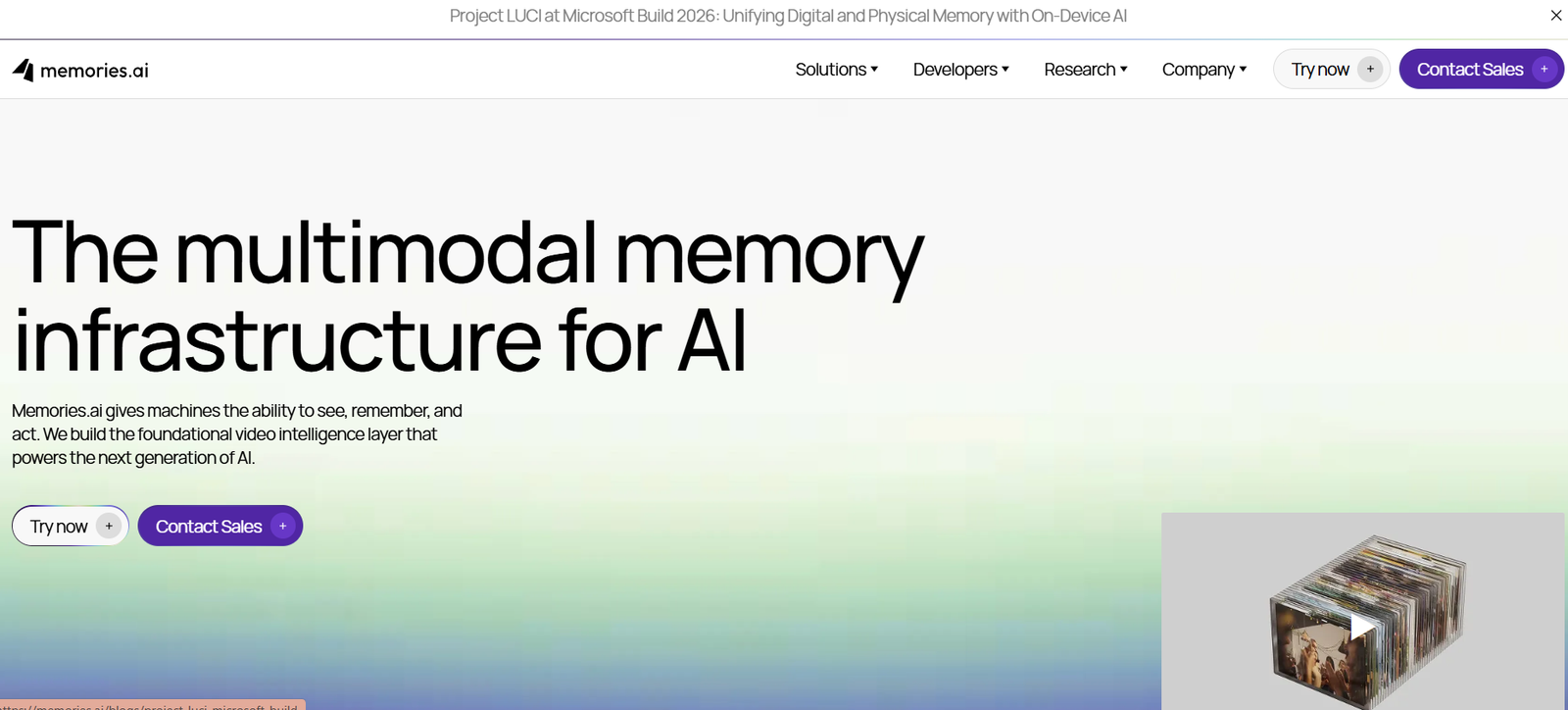
Memories.ai is an AI powered video intelligence and visual memory platform designed to help machines understand, remember, search and act on information contained in video.
Unlike traditional video search systems that depend heavily on filenames, tags or manually entered metadata, Memories.ai analyzes the actual visual and audio content of videos. It can process frames, scenes, people, actions and spoken words and organize this information into searchable visual memory.
At the core of the platform is its Large Visual Memory Model technology. The system is designed to retain structured information across video collections so AI applications can retrieve relevant events and context later.
Memories.ai is primarily useful for developers, enterprises, media organizations, security operations, sports applications, robotics and businesses managing large quantities of video. It also provides user facing AI tools for video chat, clip search, transcription, editing and content analysis.
Features
Visual Understanding and Indexing
Memories.ai analyzes video content and converts it into structured information. It can process frames, faces, scenes and spoken content so that large video collections become easier to understand and retrieve.
Persistent Visual Memory
The platform creates a persistent memory layer from video. Information about people, actions, events and context can remain organized and searchable across time instead of treating every video as an isolated file.
AI Video Search
Users can search indexed videos using natural language. Instead of knowing an exact filename or timestamp, they can describe what they are looking for and retrieve relevant video moments.
Video Chat
Memories.ai allows users to interact with video through conversational AI. Users can ask questions about indexed videos and receive responses based on their content.
Clip Search
The platform can locate specific moments inside videos. This can help users find relevant scenes without manually watching hours of footage.
Video Transcription
Memories.ai provides transcription capabilities for extracting spoken information from videos. Transcripts can then become part of the searchable video knowledge layer.
Multimodal Understanding
The platform processes both visual and audio information. This allows it to understand more than a transcription only system that relies primarily on spoken words.
Multi Video Analysis
Multiple videos can be analyzed together, helping users identify information and context spread across a larger collection of footage.
Memory Augmented Generation
Memories.ai uses a Memory Augmented Generation approach to retrieve relevant visual information and provide context for AI generated responses.
This can help AI applications answer questions using information preserved in previously indexed video.
One Time Video Indexing
Videos can be indexed once and the resulting information reused for multiple downstream tasks. This can reduce repeated processing when the same footage is searched or analyzed multiple times.
AI Video Editor
Memories.ai provides an AI assisted video editing capability. Users can select videos and describe what they want to create, allowing AI to generate edited clips from longer footage.
AI Agents
The platform provides specialized agents for tasks such as video editing, video marketing and creator insights. Enterprise options provide additional agent capabilities.
Video Intelligence API
Developers can access video intelligence through APIs. Capabilities include video understanding, captioning, indexing and other video processing functions.
Visual Search API
The Visual Search API is designed for applications that need to host, index and search video at scale.
Social Media Video Processing
The platform provides functionality for processing video from sources such as Instagram, TikTok and YouTube, depending on the API and usage configuration.
Video Summarization
Businesses and developers can use AI to generate summaries of video content, helping users understand longer recordings more quickly.
Frame Descriptions
The platform can generate descriptions of individual video frames, supporting applications that require detailed visual understanding.
Speaker Recognition and Diarization
Memories.ai provides speaker related processing capabilities, including speaker recognition, diarization and transcription with speaker labels.
On Premise Deployment
Enterprise customers can deploy Memories.ai on premise. The platform can also work through cloud and edge deployment models depending on organizational requirements.
Enterprise Security
Memories.ai states that it is SOC 2 Type II certified. Enterprise deployment options can also support organizations that require additional control over their infrastructure and visual data.
How It Works
Users begin by uploading video content or connecting video sources through supported APIs and integrations.
Memories.ai then indexes the content. During this process, the system analyzes visual frames, spoken words, people, scenes, actions and other contextual information.
The indexed information is converted into structured visual memory that can be reused later.
Users or applications can then submit natural language searches to locate particular people, events, actions or moments within the video collection.
Video Chat allows users to ask questions about their videos conversationally.
Developers can integrate Memories.ai into their own products using the Video Intelligence and Visual Search APIs.
Businesses can also build automated workflows and AI agents on top of the visual memory layer so that video information can trigger analysis, organization or other actions.
Use Cases
Media and Entertainment
Media companies can index large libraries of footage and locate specific scenes, dialogue, people or events without manually reviewing every file.
Video Production
Production teams can use AI to retrieve footage, generate descriptions, extract scripts, identify highlights and assist with video editing workflows.
Content Creators
Creators can analyze videos, search clips, generate transcripts and use AI tools to repurpose longer recordings into shorter content.
Video Marketing
Marketing teams can analyze existing video libraries and identify useful content for campaigns, social media and other promotional activities.
Security and Safety
Security operations can use video intelligence to search footage and identify relevant incidents, people, objects or activities. Appropriate human review remains important when AI output affects safety or security decisions.
Sports Analytics
Sports organizations can use visual search and video analysis to identify players, actions and specific moments across large quantities of match or training footage.
Robotics
Robotics and physical AI systems can use visual memory to retain information about what a machine has previously observed and use that context during later operations.
Developers
Developers can integrate video search, transcription, indexing, summarization and visual understanding into applications through APIs.
Enterprises
Organizations managing large video collections can create searchable visual knowledge layers instead of relying entirely on conventional file storage and metadata.
AI Applications
AI agents can use persistent visual memory as additional context when reasoning about video based information.
Pricing
Memories.ai currently offers Free, Plus and Enterprise options for its platform.
Free
The Free plan costs $0 per month and provides 100 credits per month.
It includes access to agents such as Video Editor, Video Marketer and Creator Insight, along with Video Chat, Clip Search and Video Transcription in the Playground.
Users can upload up to three videos at the same time.
Plus
The Plus plan is listed at $20 per month, or approximately $15 per month when billed annually.
It provides 5,000 credits per month and includes the platform’s main agents and Playground tools.
Enterprise
Enterprise pricing is customized according to the organization’s requirements.
It provides custom credit allowances, additional agent capabilities and customizable upload limits.
Additional Credits
Users can purchase extra credit packages. The official platform currently lists packages including:
2,000 credits for $9.20
4,000 credits for $18.40
10,000 credits for $46
20,000 credits for $92
40,000 credits for $184
API Pricing
Memories.ai also provides usage based API pricing rather than charging per user.
Prices vary significantly according to the service being used. Examples include visual search, video indexing, storage, transcription, video summarization, embeddings, speaker recognition and direct model calls.
New developer or startup accounts are currently offered $100 in free credits, with no credit card required.
Enterprise customers can contact the company for volume pricing and deployment options.
Strengths
One of the main strengths of Memories.ai is its focus on understanding actual video content rather than relying mainly on conventional metadata.
Persistent visual memory is particularly useful for applications that need to retain context across large quantities of video and long periods of time.
Natural language search makes video retrieval easier because users do not necessarily need to know exact timestamps or filenames.
The combination of video search, transcription, summarization, visual understanding and conversational interaction provides several ways to work with the same indexed content.
Developers benefit from APIs that can bring video intelligence into their own products.
One time indexing can also make repeated searches and analysis more efficient because the same video does not necessarily need to be completely reprocessed for every task.
Cloud, edge and on premise deployment options make the platform relevant to larger organizations with different infrastructure requirements.
Drawbacks
Memories.ai is more technically sophisticated than a simple consumer video summarizer, so some users may find the broader visual memory concept and API ecosystem more complex than necessary.
The credit based system may require users to understand how different operations consume credits before estimating their actual costs.
API pricing varies considerably depending on the service, processing volume and AI model being used, which can make cost estimation more involved for large applications.
Some advanced capabilities are aimed primarily at enterprise customers rather than casual individual users.
Video understanding technology can also produce imperfect interpretations. Organizations should not assume that every automatically identified person, action, event, transcript or summary is completely accurate.
For security, safety and other important decisions, AI generated findings should be combined with appropriate human review.
Comparison with Other Platforms
Memories.ai differs from conventional AI transcription and video summarization platforms because it focuses on creating persistent visual memory rather than processing each video only as an isolated recording.
Traditional transcription tools mainly convert speech into text. Memories.ai additionally analyzes visual information, scenes, people, actions and other contextual signals.
Compared with basic video search systems, its natural language retrieval and multimodal indexing can provide a deeper way to search within large video libraries.
The platform also differs from general purpose AI assistants because its infrastructure is specifically designed around video understanding, indexing and long term visual memory.
However, users who only need occasional transcription or simple video summaries may find a more focused tool easier and potentially more economical. Memories.ai is more compelling when video search, persistent memory, APIs or large scale video intelligence are central requirements.
Customer Reviews and Testimonials
The official website presents Memories.ai as working with technology partners and organizations across consumer electronics, security, telecommunications and enterprise AI.
The company also states that its partner ecosystem includes organizations such as NVIDIA, Lenovo, Samsung, Vivo, Ring and Comcast.
However, detailed customer reviews and individual testimonials are not clearly available on the official website in a form suitable for presenting as independently verified user reviews.
Conclusion
Memories.ai is an advanced AI video intelligence platform built around an interesting idea: AI systems should not simply see video but should also be able to remember and retrieve what they have previously seen.
Its combination of multimodal video understanding, persistent visual memory, natural language search, video chat, transcription, visual retrieval, APIs and AI agents makes it particularly relevant for businesses dealing with large or continuously growing video collections.
Media companies, developers, security teams, sports organizations, robotics companies and enterprise AI teams may find the platform especially useful because video can be converted from passive footage into structured and searchable information.
Individual users can explore Memories.ai through its Free plan, while developers can use its APIs and usage based pricing. Larger organizations can explore Enterprise deployment for more customized infrastructure.
For users who need more than simple video transcription or summarization and want AI that can search and reason over large collections of visual information, Memories.ai offers a distinctive approach centered on long term visual memory.