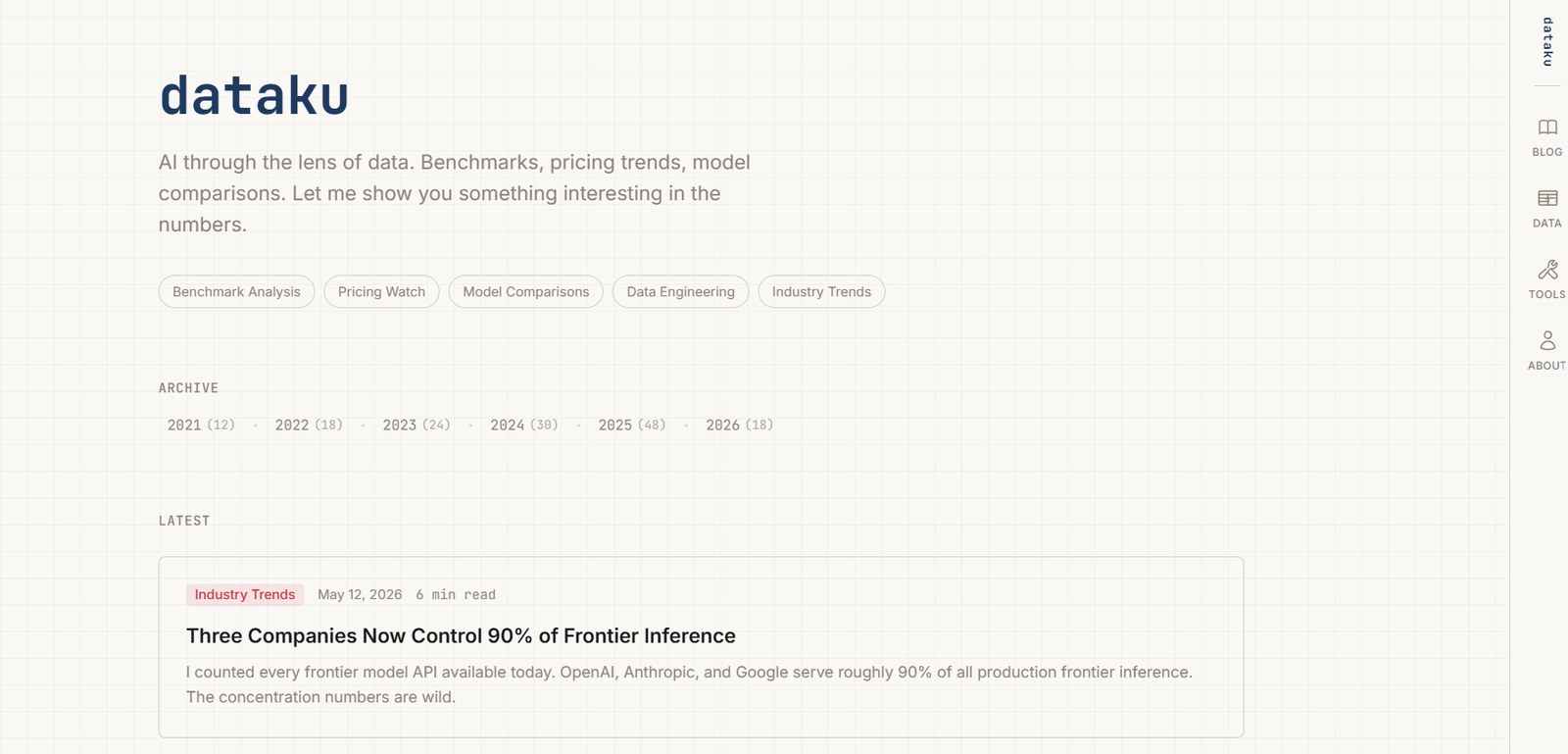
Dataku is an AI data and analysis website focused on understanding artificial intelligence through benchmarks, pricing information, model comparisons and industry data.
Unlike AI platforms that generate text, images or videos, Dataku is primarily a research and intelligence resource. It tracks AI models, API prices, benchmark performance, infrastructure costs and broader developments across the artificial intelligence industry.
The platform organizes its research into areas including Benchmark Analysis, Pricing Watch, Model Comparisons, Data Engineering and Industry Trends. This makes it useful for developers, AI startups, researchers and technology professionals who need quantitative information when comparing models or planning AI projects.
Dataku also provides free AI data tools. These include resources for calculating LLM costs, understanding AI benchmarks and visualizing model sizes.
One of Dataku’s notable projects is its historical AI API price tracking. The platform has collected pricing information across multiple AI providers over several years, allowing users to see how the economics of AI inference have changed.
Features
AI Model Comparisons
Dataku publishes detailed comparisons of major AI models.
The analysis examines factors such as model quality, coding ability, reasoning, multimodal performance, context capabilities, speed and cost.
This can help developers decide which model is more appropriate for a particular application rather than automatically choosing the largest or most expensive option.
AI Benchmark Analysis
The platform regularly analyzes AI benchmark results.
Instead of simply publishing leaderboard scores, Dataku examines what benchmarks measure, where they may be unreliable and how model performance differs across different tasks.
AI API Pricing Tracker
Dataku tracks historical pricing changes across AI model providers.
Its published AI API pricing dataset contains dozens of price points covering multiple providers and several years, allowing users to examine how rapidly inference costs have fallen.
Pricing Watch
The Pricing Watch section focuses on the economics of using AI models.
It covers topics such as API price changes, inference costs, token pricing and comparisons between different model tiers.
LLM Cost Calculator
Dataku provides a free LLM cost calculator designed to help users understand the potential cost of running language models.
This can be useful for developers and businesses estimating AI API expenses before deploying applications at scale.
Benchmark Decoder
The Benchmark Decoder is a free tool intended to help users understand AI benchmarks.
It can be useful for people who encounter benchmark names and scores but are unsure what those measurements actually represent.
Model Size Visualizer
Dataku also provides a model size visualization tool.
This helps users understand and compare the scale of different AI models more intuitively.
Historical AI Data
The website maintains an archive of AI-related analysis extending across multiple years.
Historical information can help users understand longer-term changes in model performance, pricing and AI infrastructure rather than focusing only on the latest model release.
Downloadable Data
Some Dataku research projects include downloadable datasets.
For example, its historical AI API pricing project provides underlying pricing information that can be used for additional analysis.
Data Engineering Analysis
Dataku covers technical topics related to data engineering and AI infrastructure.
This can help developers understand the systems and costs involved in deploying AI applications rather than considering model performance in isolation.
Industry Trends
The platform analyzes broader AI industry developments, including model releases, infrastructure, funding, inference providers and market concentration.
These reports provide context around how the AI ecosystem is changing.
How It Works
Step 1: Visit Dataku
Users can access Dataku directly through a web browser without needing a complex setup.
Step 2: Select a Research Area
Choose an area such as Benchmark Analysis, Pricing Watch, Model Comparisons, Data Engineering or Industry Trends.
Step 3: Find Relevant Analysis
Browse current or historical articles according to the AI model, provider or topic being researched.
Step 4: Review the Data
Dataku presents numerical information, comparisons, charts and explanatory analysis.
Step 5: Compare Models
Users can examine differences in factors such as cost, benchmark performance, context size and other model characteristics.
Step 6: Use Free Tools
Open the available tools when a calculation or visualization is required.
Step 7: Estimate AI Costs
Developers can use pricing information and cost tools when planning applications that depend on paid AI APIs.
Step 8: Explore Historical Trends
Use the archive to compare current AI developments with earlier years.
Step 9: Download Available Data
Where a project provides underlying datasets, users can download the information for further analysis.
Use Cases
AI Model Selection
Developers can compare model performance and pricing before deciding which AI model to integrate into an application.
AI API Cost Planning
Startups can estimate how different model choices may affect the operating costs of an AI product.
Benchmark Research
Researchers can use Dataku to better understand popular AI benchmarks and how meaningful particular scores may be.
Developer Research
Software developers can follow changes in AI model capabilities, APIs and inference economics.
AI Startup Planning
Founders can compare AI infrastructure and model costs before deciding how to build their products.
Model Performance Comparison
Users can compare competing models across coding, reasoning, multimodal and other capabilities.
AI Industry Research
Analysts can follow model releases, infrastructure developments, funding and other AI market trends.
Academic Learning
Students studying artificial intelligence can use the platform to understand how models, benchmarks and AI economics are evolving.
Technology Journalism
Writers covering artificial intelligence can use Dataku’s data-oriented analysis to understand trends that may not be obvious from individual product announcements.
AI Infrastructure Planning
Teams building AI products can study inference costs and provider comparisons when planning their technical architecture.
Pricing
Dataku currently presents its AI data tools and published analysis as freely accessible resources.
The website specifically promotes free AI data tools, including its LLM cost calculator, benchmark decoder and model size visualizer.
Standard paid subscription plans for accessing Dataku’s main research content are not clearly presented on the official website.
Pricing details for a premium Dataku subscription are not clearly mentioned on the official website.
Strengths
Dataku’s biggest strength is its data-driven approach to artificial intelligence.
Instead of focusing mainly on announcements or marketing claims, the platform emphasizes numerical comparisons, benchmarks, pricing and measurable trends.
Its historical pricing information can be particularly useful because AI API prices change rapidly.
The combination of model comparisons and pricing analysis helps developers consider both performance and cost when selecting AI models.
Free tools such as the LLM cost calculator provide practical value beyond written articles.
The historical archive also allows users to understand how AI technology has changed over time.
Dataku covers several dimensions of AI, including model performance, economics, infrastructure and industry trends, making it useful for people who want a broader view of the market.
Drawbacks
Dataku is primarily an AI research and data resource rather than an AI productivity application.
Users looking for an AI assistant, content generator, coding agent or image generator will not find those core functions here.
Benchmark results should also be interpreted carefully because performance on standardized tests does not always represent performance in every real-world application.
Some Dataku analyses involve the author’s own testing, datasets and methodology. Users making important technical decisions should therefore compare findings with additional independent benchmarks and their own testing.
The platform also focuses strongly on quantitative analysis, so users looking for beginner-oriented AI tutorials may find some topics more technical.
Comparison with Other Platforms
Dataku differs from general AI news websites because its emphasis is on quantitative analysis rather than primarily reporting announcements.
It also differs from conventional AI leaderboards. Leaderboards often present model scores without extensive interpretation, while Dataku examines pricing, benchmark limitations, model characteristics and historical trends alongside performance results.
Compared with AI model comparison websites that mainly display specifications, Dataku provides longer analytical articles explaining what the numbers may mean for developers and businesses.
Its historical API pricing data is another useful distinction. Tracking changes over several years helps users understand the economics of AI rather than viewing each new model price in isolation.
Dataku is therefore better suited to users who want evidence-based AI comparisons and trend analysis rather than simply discovering the latest AI products.
Customer Reviews and Testimonials
Customer reviews and testimonials are not clearly available on the official website.
Dataku functions primarily as an independent AI data, research and analysis resource rather than a conventional SaaS platform centered around customer subscriptions and testimonials.
Conclusion
Dataku is a useful research resource for anyone who wants to understand artificial intelligence through data rather than relying only on product announcements and marketing claims.
Its combination of AI model benchmarks, API pricing history, model comparisons, infrastructure analysis and free analytical tools can help developers and businesses make more informed AI technology decisions.
The platform is particularly relevant for AI developers, researchers, startup founders, technology analysts and professionals comparing the cost and performance of different models.
Dataku is not a conventional generative AI tool. Its value comes from helping users understand the rapidly changing AI ecosystem through benchmarks, pricing data and quantitative analysis. For an AI tools directory, it fits best within categories such as AI Research, AI Model Comparison, AI Analytics or Developer Resources.