
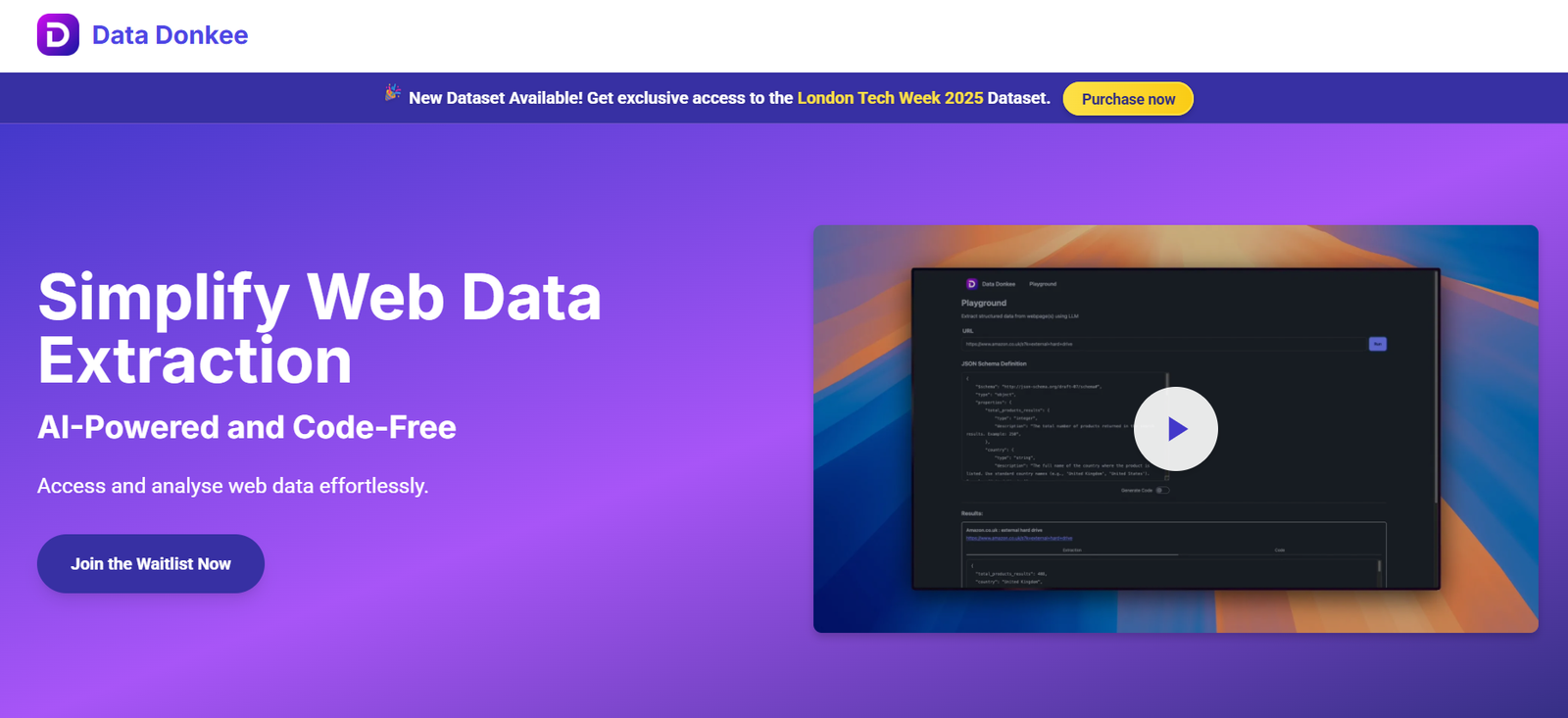
Data Donkee is an AI-powered web data extraction platform designed to make web scraping easier for users who do not want to write and maintain complex scraping code. Its AI Web Agent allows users to describe the information they need in natural language and define the required output structure using a JSON schema.
The platform then creates a custom scraper based on those requirements. Once the extraction is complete, users receive structured data that can be used for research, analytics, business intelligence, product analysis and other data-driven applications.
A key idea behind Data Donkee is reusable extraction. Instead of repeatedly using an AI model to interpret every webpage from scratch, the platform can generate reusable scraping code. This approach is intended to reduce repeated AI processing and make larger extraction projects more cost-effective.
Data Donkee is particularly relevant for researchers, developers, ecommerce teams, analysts, marketers and businesses that need structured information from complex or frequently changing websites.
The product is currently presented as an early-access solution, with users invited to join its waitlist.
Features
AI Web Agent
Data Donkee provides an AI Web Agent that translates users’ data requirements into a web extraction process.
Users can explain what information they need in ordinary language instead of manually creating a complete scraper.
No-Code Data Extraction
The platform is designed to remove much of the coding normally associated with web scraping.
Users without programming experience can describe the required information and allow the AI to build the extraction process.
Natural-Language Instructions
Users can explain their requirements using normal language.
This can make scraper creation more accessible to analysts, researchers and business professionals who understand the information they need but do not know scraping frameworks.
JSON Schema Support
Data Donkee allows users to define the desired output using JSON schema.
This provides greater control over the fields, data types and structure of the information returned by the extraction process.
Custom Scraper Generation
After receiving the natural-language request and schema, Data Donkee creates a custom scraper designed around those requirements.
This reduces the need for users to manually build scraping logic.
Reusable Scraping Code
One of Data Donkee’s notable features is its focus on reusable extraction code.
Once the AI has created an appropriate scraper, that code can be reused instead of requiring expensive AI processing for every extraction.
Complex Website Navigation
The AI Web Agent is designed to navigate more complicated website structures automatically.
This can be useful when the required information is spread across pages or organized in structures that are difficult to handle with basic extraction tools.
Structured Data Output
Instead of providing only raw webpage content, Data Donkee returns structured information based on the user’s requested schema.
This makes the resulting data easier to analyze or move into other applications.
Large-Scale Extraction
Data Donkee positions its technology as suitable for scalable web extraction.
Reusable code and reduced repeated processing are intended to make larger extraction projects more economical.
Dynamic Website Support
The platform is designed to address some of the challenges associated with complex and dynamic websites.
This is important because modern websites frequently change layouts or rely on interactive structures that can cause conventional scraping scripts to fail.
Dataset Availability
Data Donkee also offers prepared datasets for specific purposes.
For example, the official website currently promotes a London Tech Week 2025 dataset, showing that the company is exploring both web extraction technology and ready-made data products.
How It Works
Step 1: Define the Information Needed
Users begin by deciding which information they want to extract from a website.
Step 2: Describe the Data
Explain the required information using natural language.
Step 3: Define the JSON Schema
Specify how the extracted information should be structured.
For example, an ecommerce extraction could include product name, price, currency, product identifier and website domain.
Step 4: Submit the Requirements
Provide the instructions and schema to the Data Donkee AI Web Agent.
Step 5: AI Builds the Extraction
The platform creates a custom scraper based on the requested structure.
Step 6: Navigate the Website
The agent processes the target website and locates the required information.
Step 7: Extract the Information
Relevant webpage data is collected according to the specified schema.
Step 8: Structure the Results
The extracted information is converted into a clean, structured format.
Step 9: Download the Data
Users can collect the resulting dataset and use it for further analysis or business applications.
Step 10: Reuse the Extraction
Generated scraping code can be reused for similar extraction jobs, helping reduce repeated processing requirements.
Use Cases
Ecommerce Research
Ecommerce teams can collect structured product information such as product names, prices, currencies and identifiers.
Market Research
Researchers can collect information from relevant websites and organize it into datasets for market analysis.
Competitor Analysis
Businesses can gather publicly available information about competitors, products and market positioning.
Price Monitoring
Retailers can use structured web extraction to collect publicly displayed pricing information for analysis.
Product Intelligence
Companies can build datasets containing product characteristics, identifiers and other relevant marketplace information.
Business Intelligence
Organizations can collect external web information and combine it with internal data for broader business analysis.
AI Applications
AI developers can use structured web information when building applications that require external data.
Dataset Creation
Researchers and developers can turn information spread across websites into structured datasets for further processing.
Academic Research
Researchers can collect publicly accessible online information for legitimate academic and analytical projects.
Data Analysis
Analysts can receive structured data rather than spending significant time manually copying information from webpages.
Pricing
Data Donkee does not currently publish standard pricing plans for its AI Web Agent on the official website.
The platform is currently inviting potential users to join its waitlist for early access.
The company positions its technology as a cost-effective solution for large-scale extraction because it generates reusable scraping code and minimizes repeated AI processing costs.
A separate ready-made London Tech Week 2025 dataset is currently promoted for purchase, but this does not establish standard pricing for the Data Donkee web extraction platform itself.
Pricing details are not clearly mentioned on the official website.
Strengths
Data Donkee’s natural-language approach can make web scraping more accessible to people without programming experience.
JSON schema support provides users with control over how their extracted information should be structured.
Reusable scraping code is an interesting advantage because it can reduce the need to repeatedly run expensive AI processing on similar webpages.
The platform aims to handle complicated website structures automatically, reducing some of the maintenance associated with manually written scrapers.
Structured output also makes extracted information easier to use in databases, analytics applications and AI workflows.
Its combination of AI-based configuration and reusable conventional extraction provides a practical balance between AI flexibility and scalable processing.
Drawbacks
Data Donkee is currently an early-access product, and the official website invites users to join a waitlist rather than presenting a fully developed public self-service platform.
Standard pricing is not publicly available.
Detailed information about integrations, APIs, scheduling, proxy infrastructure and enterprise features is also not clearly provided on the current website.
Although the platform describes its extraction as consistent and reliable, users should still verify important information before using extracted data for business decisions.
Websites can change their layouts and access mechanisms, which can affect any automated extraction system.
Users are also responsible for ensuring that their web data collection complies with applicable laws, privacy requirements, intellectual property rules and website terms.
Comparison with Other Platforms
Data Donkee competes broadly with AI web scrapers, no-code data extraction platforms and developer-focused scraping services.
Traditional scraping frameworks require developers to create and maintain extraction logic manually. Data Donkee aims to reduce this work by allowing users to explain their requirements in natural language.
Compared with simple no-code scraping extensions, Data Donkee provides JSON schema support, which gives users greater control over the exact structure of the returned data.
Its reusable-code approach is another notable distinction. Some AI scraping systems rely heavily on large language models during every extraction request. Data Donkee aims to use AI to create the extraction logic and then reuse that code, potentially reducing ongoing processing costs.
However, more established scraping platforms may currently offer broader functionality such as mature APIs, proxy networks, scheduling and integrations. Data Donkee remains an early-stage option that should be evaluated as its platform becomes more widely available.
Customer Reviews and Testimonials
Customer reviews and testimonials are not clearly available on the official website.
Because Data Donkee is currently inviting users to join its waitlist for early access, there is not yet a substantial collection of official customer experiences presented on the website.
Conclusion
Data Donkee is a promising AI-powered web extraction platform that aims to make structured data collection easier without requiring users to become web scraping developers.
Its combination of natural-language instructions, JSON schema support, AI-generated custom scrapers and reusable extraction code provides an interesting approach to automating web data collection.
The platform may be particularly useful for analysts, researchers, ecommerce businesses, developers and data teams that regularly need structured information from websites but want to reduce scraper development and maintenance.
At present, Data Donkee appears to be in an early-access stage, so potential users should join the waitlist and evaluate the platform as more information about availability, pricing and production capabilities becomes available.


