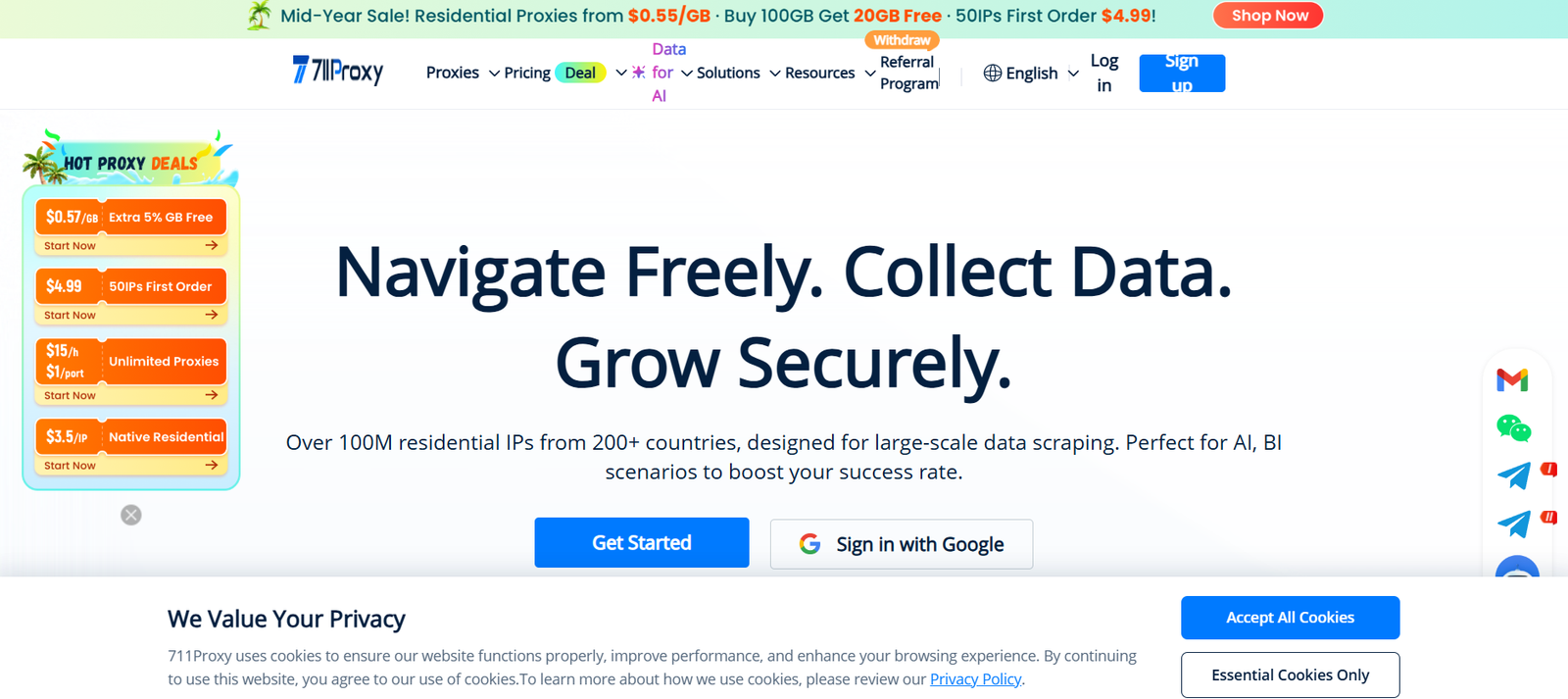
711Proxy is a global proxy service designed for businesses, developers, data teams and individuals that need reliable IP infrastructure for web data collection, AI projects, market research, ecommerce monitoring and other online activities.
The platform provides access to more than 100 million residential IP addresses covering over 200 countries and regions. Users can choose between rotating residential proxies, IP-based residential proxies, static residential proxies, mobile proxies, SOCKS5 proxies and unlimited proxy packages.
711Proxy is particularly relevant to AI and business intelligence applications that require large volumes of current web data. Its Data for AI solution is designed to support data acquisition for large language models, generative AI systems, knowledge bases and other data-intensive AI projects.
The service supports HTTP(S) and SOCKS5 connections, API access, rotating and sticky sessions, geographical targeting and unlimited concurrent requests on relevant products. Developers can integrate proxy services into applications and scraping workflows using common programming languages.
711Proxy is not itself a generative AI model. Its main role in the AI ecosystem is providing proxy and data infrastructure that can help AI developers and businesses collect publicly accessible web information at scale.
Features
100M+ Residential IPs
711Proxy provides access to more than 100 million residential IP addresses.
A large proxy pool can be useful for organizations that need to distribute data requests across different IP addresses instead of relying on a small number of servers.
Global Coverage
The residential network covers more than 200 countries and regions.
This geographical reach can support applications that need to access localized web content or collect information from different markets.
Residential Proxies by GB
Users can purchase residential proxy traffic according to bandwidth consumption.
This option includes rotating and sticky sessions, unlimited threads, API access and geographical targeting down to city and state level.
Residential Proxies by IP
711Proxy also provides an IP-based pricing option.
Instead of paying according to bandwidth, customers purchase a specific number of successful IP extractions. An IP can generally be used for up to six hours before another IP credit is consumed.
Unlimited Rotating Proxies
For high-bandwidth projects, 711Proxy provides unlimited rotating proxy packages.
These plans can remove traffic-based billing and are intended for workloads where large amounts of bandwidth are required.
Static Residential Proxies
Static residential proxies provide dedicated IP addresses for users who need a more consistent identity.
711Proxy describes these IPs as private and exclusive, with unlimited traffic and long-term stability.
Mobile Proxies
The platform provides real mobile IP addresses using 3G, 4G, 5G and LTE networks.
Mobile proxies support country and city filtering and custom rotation options.
SOCKS5 Proxies
711Proxy offers SOCKS5 proxies with a fixed number of IPs available each day.
IPs are refreshed daily and can be reused within the same 24-hour period.
Rotating Sessions
Rotating proxy sessions automatically change IP addresses according to the selected configuration.
This can be useful for large-scale web data collection where requests need to be distributed across many IPs.
Sticky Sessions
Sticky sessions allow users to maintain the same IP for a longer period.
This is helpful for workflows where continuity is important during a browsing or data collection session.
Precise Geographic Targeting
Depending on the selected product, users can target proxies according to country, state and city.
This can help businesses analyze localized websites, search results, prices and digital experiences.
API Access
711Proxy provides API capabilities for integrating proxy resources into automated systems.
Developers can use the API to incorporate proxies into web crawlers, data pipelines and other applications.
AI Data Collection
The platform has a dedicated Data for AI offering for collecting large-scale web information.
This can support LLM training, generative AI, retrieval systems, knowledge bases and other AI applications that depend on current external data.
Ready-to-Use Datasets
711Proxy also promotes ready-to-use datasets covering more than 100 domains.
These datasets can support AI training, knowledge-base creation and applications requiring structured information.
Dashboard
Users can manage proxies, configure services and monitor usage through an online dashboard.
This provides a central location for managing proxy resources without relying entirely on API commands.
Developer Support
711Proxy provides documentation and supports integration with common development environments and languages, including Python, Java, Node.js, PHP, Go and C++.
How It Works
Step 1: Create an Account
Users register with 711Proxy and access the online dashboard.
Step 2: Choose a Proxy Type
Select the proxy product that best matches the project, such as residential, static residential, mobile, SOCKS5 or unlimited proxies.
Step 3: Select a Pricing Model
For residential proxies, users can choose options such as bandwidth-based or IP-based billing.
Step 4: Configure the Location
Where supported, select the required country, state or city.
Step 5: Choose Session Behavior
Configure rotating or sticky sessions depending on whether IP addresses should change or remain stable.
Step 6: Configure Authentication
Use the available authentication method, such as username and password or IP whitelisting.
Step 7: Connect the Application
Add the proxy information to a browser, scraping application, automation workflow or custom software.
Step 8: Start Collecting Data
The application sends web requests through the selected proxy network.
Step 9: Monitor Usage
Users can review proxy usage and available resources through the dashboard.
Step 10: Scale When Required
Businesses can purchase larger packages or enterprise arrangements as their bandwidth and IP requirements increase.
Use Cases
AI Training Data
AI developers can use proxy infrastructure to collect publicly accessible web information for creating or updating training datasets.
Generative AI
Organizations developing generative AI systems can use web data infrastructure to obtain information required for model development and related applications.
RAG and Knowledge Bases
Developers can collect current information for retrieval-augmented generation systems and AI knowledge bases.
Web Scraping
Data teams can route automated web requests through residential proxies when collecting publicly available online information.
Market Research
Businesses can gather market trends, competitor information and other public data from different geographical locations.
Ecommerce Monitoring
Retailers can monitor publicly available product information, pricing and marketplace activity across regions.
Price Monitoring
Businesses can track changes in online prices and compare product information across websites and locations.
Ad Verification
Advertisers and agencies can check how advertisements appear to users in different geographical markets.
Website Testing
Developers can test how websites perform or appear from different geographical locations.
Brand Protection
Businesses can monitor publicly available online information related to their brands and products.
Travel Aggregation
Travel platforms can collect publicly available airfare and hotel information from different markets.
Business Intelligence
Companies can use geographically distributed web data collection to feed analytical and business intelligence systems.
Pricing
711Proxy provides several pricing models depending on proxy type and usage.
Residential Proxies by GB
Residential proxy bandwidth starts from approximately $0.55 per GB for high-volume plans.
Examples of regular packages include:
5 GB: $15
40 GB: $56
100 GB: $117
250 GB: $215
500 GB plus 25 GB bonus: $400
Higher-volume enterprise packages can reduce the effective price per GB.
Residential Proxies by IP
IP-based residential proxies start from approximately $0.03 per IP at higher volumes.
Regular package examples include:
50 IPs: $10
200 IPs: $30
500 IPs: $50
1,000 IPs: $60
2,000 IPs: $100
Unused IP credits do not expire. Each successfully extracted IP generally remains usable for up to six hours before another IP credit is required.
Unlimited High-Bandwidth Proxies
Unlimited high-bandwidth proxy packages start from approximately $15 per hour.
These plans provide unlimited traffic and concurrent sessions and are designed for bandwidth-intensive workloads.
Unlimited Proxies by Port
Port-based unlimited proxies start from approximately $1 per port.
Rotation intervals can range from around 3 to 30 minutes.
Static Residential Proxies
Dedicated static residential proxies start from approximately $3.50 per IP.
These proxies provide dedicated addresses with unlimited traffic.
Mobile Proxies
Mobile proxy traffic starts from approximately $1.45 per GB on the current official website.
SOCKS5 Proxies
SOCKS5 packages start from $30 for 15 days.
One available package provides up to 100 IPs per 24 hours, with IP addresses refreshed daily.
Prices vary according to proxy type, volume, bandwidth and enterprise requirements, so users should confirm the current cost before purchasing.
Strengths
One of 711Proxy’s main strengths is its large residential network of more than 100 million IPs across over 200 countries and regions.
The variety of proxy products allows customers to select a pricing and technical model appropriate for different workloads.
Flexible billing is another advantage. Businesses can choose bandwidth, IP, port, time-based or customized enterprise options depending on the proxy product.
Support for rotating and sticky sessions makes the service useful for different data collection requirements.
City and state-level targeting can help organizations working with geographically specific information.
API access and support for popular programming languages make 711Proxy suitable for automated development and data workflows.
Its dedicated Data for AI offering is also relevant for companies building LLMs, generative AI systems and knowledge-based applications.
Drawbacks
711Proxy is primarily infrastructure rather than a complete no-code data extraction application. Users may still need scraping software, automation tools or custom code to collect and structure information.
The large number of proxy types and pricing methods can initially be confusing for users unfamiliar with proxy infrastructure.
Costs can increase significantly for projects requiring very high bandwidth, large numbers of dedicated IPs or continuous proxy usage.
Different proxy types also have different limitations regarding location targeting, rotation and IP availability, so users need to choose the correct product carefully.
As with any proxy service, customers are responsible for ensuring their activities comply with applicable laws, privacy requirements, website terms and intellectual property rules.
Comparison with Other Platforms
711Proxy competes with residential proxy networks, web data infrastructure providers and proxy services used for automated data collection.
Compared with simple datacenter proxy providers, 711Proxy emphasizes real residential, static residential and mobile IP networks. These options can be useful when websites provide different content or access conditions based on the type and location of an IP address.
Its multiple pricing approaches are another distinction. Users can choose bandwidth-based residential proxies, IP-based plans, unlimited traffic packages, port-based proxies, mobile proxies and dedicated static residential IPs.
The platform also specifically positions part of its infrastructure for AI data collection. This makes it relevant to developers building datasets, RAG systems and other applications that depend on large-scale web information.
However, users looking for a completely managed scraping API that automatically extracts structured information from specific websites may prefer a dedicated web scraping platform. 711Proxy is more suitable when users want direct control over the underlying proxy infrastructure.
Customer Reviews and Testimonials
711Proxy displays several customer testimonials on its official website.
Customers identified as web performance engineers, data analysts, software developers, automation engineers and data scraping specialists describe using the service for geographical website testing, crawling, API-based automation and large-scale proxy access.
The official website currently displays an overall customer rating of 4.9 out of 5.
These testimonials provide examples of customer experiences published by 711Proxy. They should be considered vendor-presented feedback rather than guaranteed performance for every customer or use case.
Conclusion
711Proxy is a flexible proxy infrastructure provider for developers, data teams and businesses that need geographically distributed IP addresses for legitimate web data collection and online research.
Its network of more than 100 million residential IPs, coverage across more than 200 countries and regions, rotating and sticky sessions, mobile proxies, static residential proxies and multiple pricing options make it suitable for projects ranging from market research to large-scale AI data acquisition.
The platform is particularly relevant for AI developers who need web data for model training, retrieval systems and knowledge bases. However, it should be viewed primarily as the infrastructure layer for data access rather than an AI model or complete web scraping application.
For organizations that need flexible proxy types, broad geographic coverage and scalable data collection infrastructure, 711Proxy provides a wide range of options that can be adapted to different technical and budget requirements.