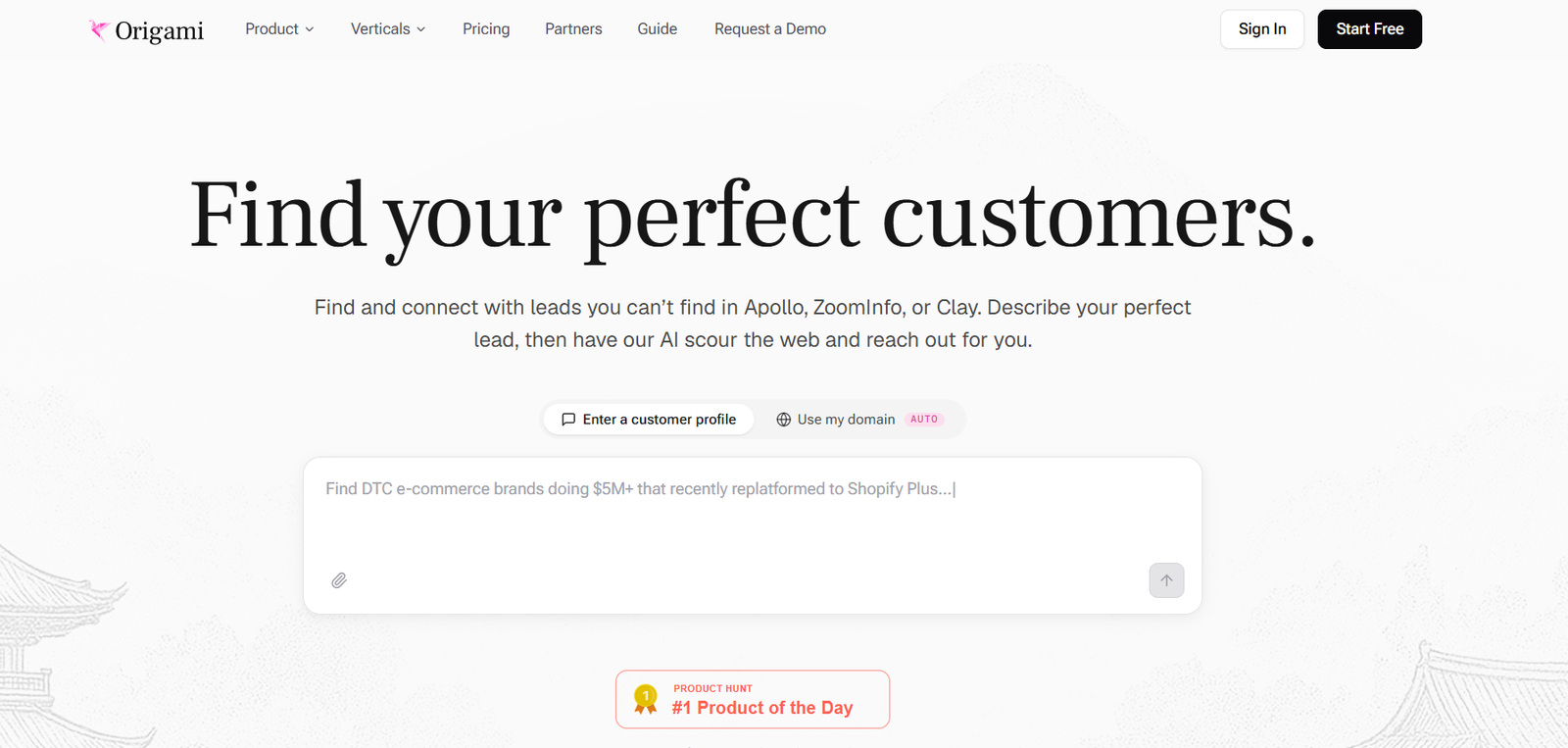
Origami is an AI-powered sales prospecting and lead generation platform designed to help businesses find potential customers using natural-language instructions. Instead of searching a traditional static contact database, users describe the type of customer they want, and Origami searches live web sources to build a targeted prospect list.
The platform searches more than 50 live sources, including Google Maps, social profiles, job boards, company websites and the open web. It can collect company and professional information, enrich leads with verified contact details and organize results in spreadsheet-style workspaces.
Origami is particularly useful for finding local businesses, small and medium-sized companies and niche prospects that may be difficult to discover using conventional B2B databases.
Beyond lead discovery, Origami includes a built-in Sequencer for email and social outreach. This allows sales teams to move from prospect research to outreach without exporting their lists into a separate sequencing platform.
Features
AI Prospecting Agent
Origami lets users describe their ideal prospects in plain English. The AI converts the description into a research process and searches relevant web sources automatically.
For example, users can request companies within a particular industry, location, employee range or other business criteria.
Live Web Research
Rather than depending only on a pre-built database, Origami searches live online sources when users perform research.
This approach can help identify recently updated companies and contacts that may not appear in traditional sales databases.
50+ Live Data Sources
Origami searches more than 50 sources across the web. These include Google Maps, social networks, job boards, company websites and other public sources.
Using several sources also helps the platform cross-check information before adding it to a prospect table.
Company Discovery
Users can search for companies based on industry, location, technology, employee count, revenue and other available characteristics.
Origami states that its research infrastructure covers more than 100 million companies.
People Search
The platform can identify professionals using criteria such as job title, seniority, skills and company information.
Origami states that its data infrastructure covers more than 350 million professional profiles.
Local Business Lead Generation
One of Origami’s notable capabilities is local business research.
Businesses can search for prospects such as dentists, restaurants, roofing companies, medical practices, contractors and other locally focused companies using sources such as Google Maps.
Contact Data Enrichment
Paid users can enrich prospects with verified email addresses and phone numbers.
Origami checks contact information through multiple data providers rather than depending on a single contact database.
Email Verification Waterfall
Email searches use multiple providers in sequence until a verified result is found.
This approach is designed to improve contact accuracy while avoiding charges when usable contact information cannot be found.
Phone Number Enrichment
Origami can also search multiple providers for professional and mobile phone information.
Available phone numbers are validated before being returned to the user.
Spreadsheet-Style Workspaces
Prospects are organized into structured tables where users can review, sort, enrich and work with their results.
This combines conversational AI prospecting with a familiar spreadsheet-style environment.
AI Research Columns
Users can add AI-powered research and enrichment fields to their prospect tables.
These can be used to investigate company characteristics, technologies, advertising activity, web information and other relevant signals.
Buying Signals
Origami can research signals that may indicate potential purchasing opportunities.
These signals can help sales teams prioritize prospects instead of treating every company equally.
Funding Signals
Businesses can identify companies associated with relevant funding activity and use this information when developing prospecting strategies.
Hiring Signals
Origami can research hiring activity, helping users identify companies that may be growing or investing in particular areas.
ICP Builder
The platform provides tools for defining and researching an Ideal Customer Profile.
This helps sales teams convert broad targeting ideas into more specific prospecting criteria.
Lookalike Prospecting
Users can work from existing customer information and identify companies with similar characteristics.
This can help teams expand prospect lists based on businesses they already know are a good fit.
Market Mapping
Origami can be used to research companies within a particular industry, geography or market segment and create structured market maps.
Competitor Research
Teams can research companies and markets to better understand competitors and related organizations.
Built-In Sequencer
Origami includes a multi-channel Sequencer on paid plans.
Users can move leads directly from research tables into outreach campaigns without exporting them to another application.
Email and Social Sequences
The Sequencer supports email and social outreach with up to 10 steps per channel.
Teams can combine both channels into coordinated prospecting sequences.
Shared Inbox
Replies from connected outreach accounts can be managed through a shared inbox inside Origami.
Multiple Sending Accounts
Businesses can connect multiple mailboxes and social accounts. Sending can be distributed across these accounts while respecting configured limits.
Time-Zone Aware Outreach
Outreach steps can follow sending windows based on the prospect’s local time when that information is available.
CSV Export
Paid subscribers can export prospect information to CSV for use in CRM platforms, spreadsheets and other business applications.
CRM Integration
Origami supports workflows for transferring prospect information to sales systems such as HubSpot and Salesforce.
Developer API
A developer API is available for teams that want to run prospecting and enrichment processes programmatically inside their own applications and workflows.
How It Works
Step 1: Create an Origami Account
Users can begin with the free plan without providing a credit card.
Step 2: Describe the Ideal Customer
Enter a natural-language description of the businesses or professionals you want to find.
For example, a user could request roofing companies in a particular city with a minimum number of employees and a strong Google rating.
Step 3: Origami Searches the Web
The AI searches relevant live sources, including company websites, Google Maps, social profiles, job boards and other online information.
Step 4: Review the Prospect Table
Matching companies and contacts are placed into a structured workspace where users can examine the results.
Step 5: Enrich the Leads
Paid users can add verified emails, phone numbers and other business information.
Step 6: Add Research
Users can request additional information about prospects, such as technologies, hiring activity or other business signals.
Step 7: Refine the List
The AI agent can be given follow-up instructions to narrow, expand or modify the prospect list.
Step 8: Export or Start Outreach
Qualified prospects can be exported or moved directly into Origami’s built-in Sequencer.
Step 9: Build an Outreach Sequence
Users can create email and social outreach steps and determine how prospects should move through the sequence.
Step 10: Manage Responses
Replies can be viewed and managed through the shared inbox.
Use Cases
B2B Sales Teams
Sales teams can find companies and decision-makers matching detailed customer profiles and move them directly into outbound campaigns.
Local Business Prospecting
Businesses selling to restaurants, contractors, medical practices, home-service companies and other local businesses can use Origami’s live web and Google Maps research.
Startup Sales
Startups can use the platform to build targeted prospect lists without purchasing several separate lead databases and enrichment tools.
Agencies
Marketing and lead-generation agencies can create prospect lists for different clients and organize them across separate workspaces.
SaaS Companies
Software businesses can identify companies based on industry, technology, employee count, hiring activity and other relevant characteristics.
Recruiters
Recruitment businesses can research companies and professionals using job titles, skills, hiring activity and company information.
Market Research
Businesses can map companies within a market and study competitors, industry segments and potential customers.
Account-Based Sales
Sales teams can identify target companies and then research appropriate professionals within those organizations.
Ecommerce Prospecting
Users can research ecommerce companies and enrich potential prospects with business and contact information.
AI and Developer Workflows
Technical teams can use Origami’s API to incorporate prospect discovery and enrichment into internal applications and automated sales systems.
Pricing
Origami currently offers Free, Starter, Pro, Scale and Enterprise options.
Free: $0
The Free plan provides 1,000 one-time credits.
It includes the Origami 1.2 Lite model, 20 messages to the agent, one workspace and up to 30 rows per table.
CSV exports, contact information and the Sequencer are not included in the free plan.
Starter: $29 per Month
Starter includes 2,000 credits per month and uses the Origami 1.2 Lite model.
It provides unlimited team members, unlimited agent messages, 40 workspaces, unlimited rows, CSV exports, contact information and unlimited use of the Sequencer.
Users can run up to 10 workspaces simultaneously.
Pro: $129 per Month
Pro includes 9,000 credits per month and uses the more advanced Origami 1.2 Max model.
It provides unlimited team members, up to 200 workspaces, CSV export, contact information and unlimited Sequencer access.
Users can run up to 20 workspaces simultaneously.
Scale: $499 per Month
Scale provides 40,000 credits per month and uses Origami 1.2 Max.
It supports up to 1,000 workspaces and 50 simultaneous workspace runs while including contact information, CSV export and unlimited Sequencer access.
Scale customers also receive a dedicated Slack channel.
Enterprise: Custom Pricing
Enterprise plans provide customized credit allocations, unlimited team members and workspaces, unlimited simultaneous workspace runs and unlimited Sequencer usage.
Additional enterprise features include SSO, SCIM, a custom SLA and a dedicated Slack channel.
Origami states that paid plans include unlimited team members without per-seat pricing.
Strengths
One of Origami’s main strengths is its use of live web research instead of relying entirely on a static B2B database.
Natural-language prospecting makes it easier to describe unusual or highly specific customer profiles without creating complicated combinations of filters.
Its local business research capabilities can be particularly valuable for businesses targeting companies that are poorly represented in traditional technology-focused B2B databases.
The combination of prospect discovery, contact enrichment and outreach sequencing reduces the need to move between multiple sales tools.
Unlimited team members on paid plans can also make pricing more attractive for growing sales organizations.
Contact waterfalls across multiple providers can improve the chances of finding usable email and phone information.
Drawbacks
Origami uses a credit system for lead generation, enrichment and AI research, so intensive prospecting can require a higher subscription tier or additional usage spending.
The free plan is useful for testing but restricts table size and does not include contact information, CSV export or sequencing.
Because Origami searches live online information, results can vary according to what information is publicly available for each business or professional.
AI-generated research, classifications and outreach should be reviewed by users before being relied upon or sent.
Companies running large or highly customized data-enrichment workflows may prefer platforms offering a broader range of configurable data providers and workflow logic.
Comparison with Other Platforms
Origami competes broadly with prospecting and sales intelligence platforms such as Apollo, ZoomInfo and Clay.
Traditional sales databases generally maintain large pre-built datasets that users search through filters. Origami takes a different approach by using AI agents to search live web sources based on a natural-language description of the desired customer.
This can make Origami particularly useful for discovering local businesses, SMBs and niche companies that may be less visible in conventional B2B databases.
Compared with highly configurable enrichment platforms, Origami emphasizes simplicity. Users describe who they want to find, and the AI handles much of the underlying search and enrichment process.
The built-in email and social Sequencer is another advantage for teams that want prospect discovery and outreach within the same environment.
Customer Reviews and Testimonials
The official Origami website displays customer logos and states that the platform is trusted by scale-ups and public companies for sales prospecting.
However, detailed conventional customer reviews and individual testimonials are not clearly presented on the main official website.
Conclusion
Origami is an AI-powered prospecting platform designed to simplify the process of finding, researching and contacting potential customers.
Its biggest difference from traditional lead databases is its live-search approach. Users describe their ideal customers in plain English, and Origami searches more than 50 web sources to identify matching companies and professionals.
The combination of real-time prospect research, verified contact enrichment, buying signals, spreadsheet-style workspaces and built-in email and social sequencing makes it particularly useful for sales teams that want to manage prospect discovery and outreach from one platform.
Origami may be especially valuable for startups, agencies, B2B sales teams and businesses targeting local companies, SMBs or specialized markets that are difficult to cover using conventional contact databases.