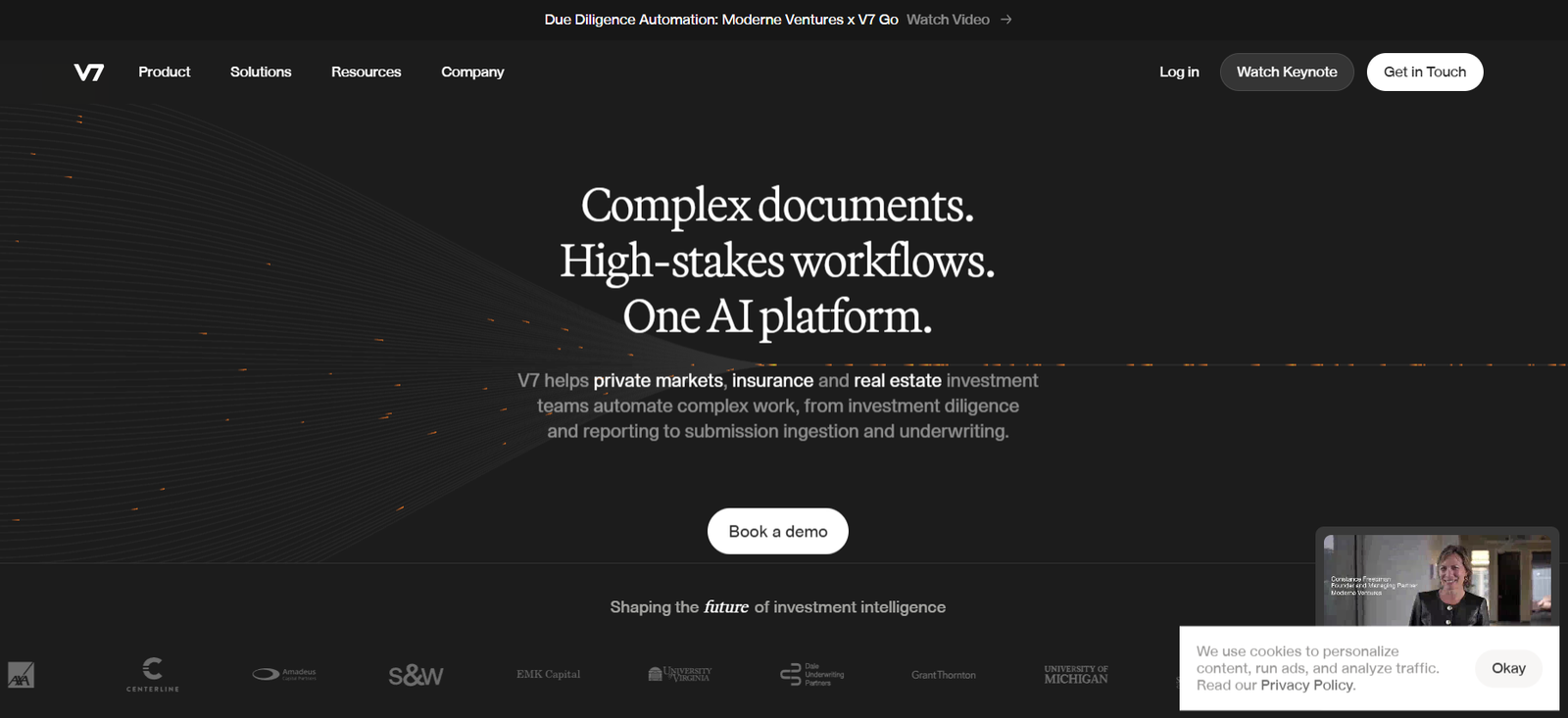
V7 is an AI company offering platforms for intelligent document automation and visual data workflows. Its primary business automation product, V7 Go, is designed to help organizations use AI agents to process complex documents, analyze information and automate knowledge-intensive workflows.
V7 Go combines large language models, multimodal AI, computer vision, OCR, Python, web search and workflow logic. Instead of simply asking an AI model questions, businesses can create structured agents that follow multiple reasoning steps, apply conditions, extract information and route sensitive decisions to human reviewers.
The platform currently focuses strongly on document-intensive workflows in private markets, finance, insurance and real estate. It can process information from complex files and transform it into structured data, analysis, reports and other business outputs.
V7 also operates V7 Darwin, a separate data annotation platform. Darwin is designed for teams creating training datasets and computer vision models from images, videos and medical imaging. V7 Go, by comparison, focuses on applying foundation models to business and document automation.
Features
AI Workflow Agents
V7 Go allows organizations to build AI agents that automate complex business processes. Agents can combine several tasks and reasoning stages instead of handling only one prompt at a time.
Users can create conditional logic, including if and then branches, and introduce human review at important decision points.
Intelligent Document Processing
The platform can read, understand and extract information from structured and unstructured business documents.
It is designed for difficult files including long documents, complicated layouts, handwritten information, damaged scans and mixed document formats.
Multimodal AI
V7 Go combines language and visual understanding, allowing agents to work with information contained in text, images and other document elements.
This can be useful when important information cannot be extracted accurately through text processing alone.
Advanced OCR
V7 uses OCR and computer vision to process scanned and image-based documents.
This extends document automation to files that may not contain a clean machine-readable text layer.
50+ Language Support
V7 Go supports document processing across more than 50 languages, making it suitable for organizations handling international documents.
Long Document Processing
The platform is designed to work with lengthy documents, including files containing hundreds of pages.
This can be useful for investment documents, legal agreements, financial reports and other information-heavy files.
Data Extraction
AI agents can identify specific information within documents and convert it into structured fields.
This can reduce repetitive manual data entry involving invoices, contracts, applications, reports, purchase orders and similar documents.
Document Classification
V7 Go can automatically classify files according to their content. For example, documents can be identified as contracts, invoices, reports or other relevant types and organized accordingly.
Context Graph
V7 Go provides a Context Graph designed to connect information and provide AI agents with relevant organizational context.
This helps agents work with relationships between documents and business information rather than treating each file as an isolated input.
Knowledge Hubs
Organizations can create searchable knowledge environments from document repositories.
AI can index documents, understand their content and make the resulting knowledge available to agents and analytical workflows.
Human Review
Organizations can add human review steps to sensitive workflows.
This is useful when AI can handle routine processing but important decisions or uncertain outputs still require professional verification.
Document Generation
V7 Go can transform processed information into new business documents and deliverables.
The platform supports workflows for producing outputs such as reports, presentations and PDFs from structured information.
Slides and Presentation Generation
Teams can create presentation workflows that convert data into editable business presentations.
Templates can help organizations maintain consistent document structures and branding.
Data Room Due Diligence
V7 Go can process large collections of investment documents and extract relevant information for due diligence.
This is particularly relevant to private equity, investment and private-market teams reviewing large data rooms.
Investment Memo Workflows
The platform supports workflows that turn information from documents such as Confidential Information Memorandums into structured investment analysis and internal materials.
Portfolio Monitoring
Investment teams can automate the collection and analysis of information needed to monitor portfolio companies.
Insurance Document Automation
Insurance organizations can use V7 Go for submission ingestion, underwriting and other document-heavy insurance workflows.
Real Estate Workflows
Real estate investment teams can process property and investment documentation and automate related analytical workflows.
LLM Flexibility
V7 Go supports multiple foundation models. Organizations can also connect their own API keys for supported models.
This provides greater flexibility than workflows tied exclusively to a single AI model.
Python Support
Agents can use Python as part of workflow logic, allowing technical teams to introduce calculations and customized processing.
Web Search
Web search can be incorporated into agents when a workflow requires external information alongside internal documents.
Integrations
V7 Go can connect with other business systems and document repositories.
Its platform includes integration and MCP capabilities for incorporating AI agents into existing organizational workflows.
Security and Access Controls
V7 provides enterprise-oriented security features such as encryption, fine-grained access controls and audit logs.
The company states that customer data is not used to train its AI models.
How It Works
Step 1: Identify a Workflow
An organization starts by selecting a repetitive or document-intensive process that it wants to automate.
Step 2: Provide Sample Documents
Teams can provide examples of the documents and information involved in the workflow.
Step 3: Build an AI Agent
V7 Go is configured to extract information, analyze documents and perform the reasoning steps required by the business process.
Step 4: Add Workflow Logic
Users can introduce conditions, calculations, Python functions and other logic to determine how different cases should be handled.
Step 5: Connect Knowledge
Relevant documents and organizational information can be indexed so agents have the context required to complete tasks.
Step 6: Add Human Review
Critical decisions or uncertain outputs can be routed to human reviewers before the workflow continues.
Step 7: Generate Results
The agent can produce structured data, analysis, reports, presentations or other required outputs.
Step 8: Connect Business Applications
Results can be transferred to relevant business systems and repositories through available integrations.
Step 9: Deploy Across Teams
Once a workflow performs reliably, organizations can make it available to additional users and teams.
Step 10: Monitor and Improve
Teams can review performance, usage and outputs and continue refining workflows over time.
Use Cases
Private Equity
Private equity firms can automate data-room review, investment diligence, CIM analysis, investment memo preparation and portfolio monitoring.
Investment Teams
Analysts can extract financial and operational information from lengthy documents and organize it for investment analysis.
Insurance
Insurance companies can automate submission ingestion, underwriting-related document analysis and other repetitive document workflows.
Real Estate
Real estate investment teams can analyze complex property, financial and transaction documentation.
Legal Teams
Legal professionals can use AI-assisted document processing for contracts and other large collections of legal information where structured extraction is required.
Financial Services
Finance teams can automate repetitive processes involving financial statements, reports and other complex business documents.
Due Diligence
Organizations performing acquisitions or investments can use agents to review large document collections and extract relevant risks, metrics and other information.
Data Entry
Businesses can automate manual data entry from invoices, forms, contracts, loan applications, purchase orders and reports.
Knowledge Management
Organizations can index internal documents and create searchable knowledge environments for employees and AI agents.
Reporting
Teams can turn structured information into reports, presentations and other business deliverables.
Pricing
V7 Go uses custom, usage-based pricing rather than publishing fixed standard subscription prices.
Pricing consists of three primary components:
Platform Fee
Organizations pay for access to the V7 platform and relevant AI agents or data-labeling tools.
User Licenses
Pricing includes team access based on the required users, roles and permissions.
Data Processing
Costs scale according to the volume of documents and tasks processed through the platform.
V7 states that organizations can receive a customized package based on workflow complexity, processing volume and integration requirements.
Because exact prices are not publicly displayed, businesses need to contact V7 and request a quotation.
Pricing details are not clearly mentioned on the official website.
Strengths
V7 Go is designed for complex enterprise workflows rather than simple AI document conversations.
Its combination of LLMs, multimodal AI, OCR, computer vision, Python and conditional logic allows organizations to build more sophisticated document-processing workflows.
Human review can be inserted into sensitive processes, providing additional oversight when AI confidence alone is insufficient.
The platform’s focus on traceability and document-based evidence can be valuable for high-stakes business environments.
Support for difficult documents, handwritten content, long files and more than 50 languages expands the range of information organizations can process.
V7’s separate Darwin platform also gives technical teams access to specialized visual data annotation capabilities when developing computer vision systems.
Drawbacks
V7 Go is primarily designed for organizations and enterprise workflows, so it may be unnecessarily complex for individuals who only need simple PDF summarization or occasional document extraction.
Pricing is customized rather than publicly listed, making it difficult for smaller organizations to estimate costs before speaking with the company.
Building advanced agents requires organizations to understand their workflows and define the logic they want to automate.
AI-assisted analysis still requires appropriate human oversight, particularly for financial, legal, investment and insurance decisions.
Organizations with very simple and predictable document extraction requirements may find conventional OCR or lightweight document-processing tools sufficient.
Comparison with Other Platforms
V7 Go competes broadly with intelligent document processing, enterprise AI automation and AI agent platforms.
Traditional OCR solutions primarily convert scanned information into machine-readable text. V7 Go goes further by applying multimodal AI and multi-step reasoning to extract, analyze and act on the information.
Compared with general-purpose AI assistants, V7 Go is designed around repeatable enterprise workflows, document processing, conditional logic, integrations and human review.
Its strong current focus on private markets, finance, insurance and real estate also differentiates it from more general document AI platforms.
V7 Darwin serves a different market. While Go automates knowledge and document workflows using foundation models, Darwin focuses on annotating visual datasets and developing computer vision training data.
Organizations should compare V7 with alternatives based on document complexity, accuracy requirements, workflow flexibility, human-review needs, integrations, security and total processing costs.
Customer Reviews and Testimonials
The official V7 website provides several customer stories and testimonials.
Centerline reports using V7 Go to automate diligence workflows involving data extraction and analysis, with the company reporting a 35% productivity increase during its first month.
Alaris Acquisitions highlights the speed at which V7’s team can turn difficult data challenges into working solutions.
V7 also presents reported results from organizations in investment, insurance, legal and real estate workflows, including reductions in processing time, errors and workflow costs.
These figures and testimonials are published by V7 and should be considered company-reported customer results rather than independent third-party ratings.
Conclusion
V7 Go is an advanced AI automation platform for organizations that work with complex documents and high-value business processes.
Rather than using AI only for basic document summaries, organizations can create agents that extract information, apply reasoning, follow conditional workflows, involve human reviewers and generate structured business outputs.
The platform is particularly relevant for private equity, finance, insurance, real estate, legal and other document-intensive teams where employees spend substantial time reviewing and processing complex information.
For organizations looking to move from simple AI experimentation toward repeatable document automation, V7 Go offers a strong combination of multimodal AI, workflow agents, enterprise controls and document intelligence.