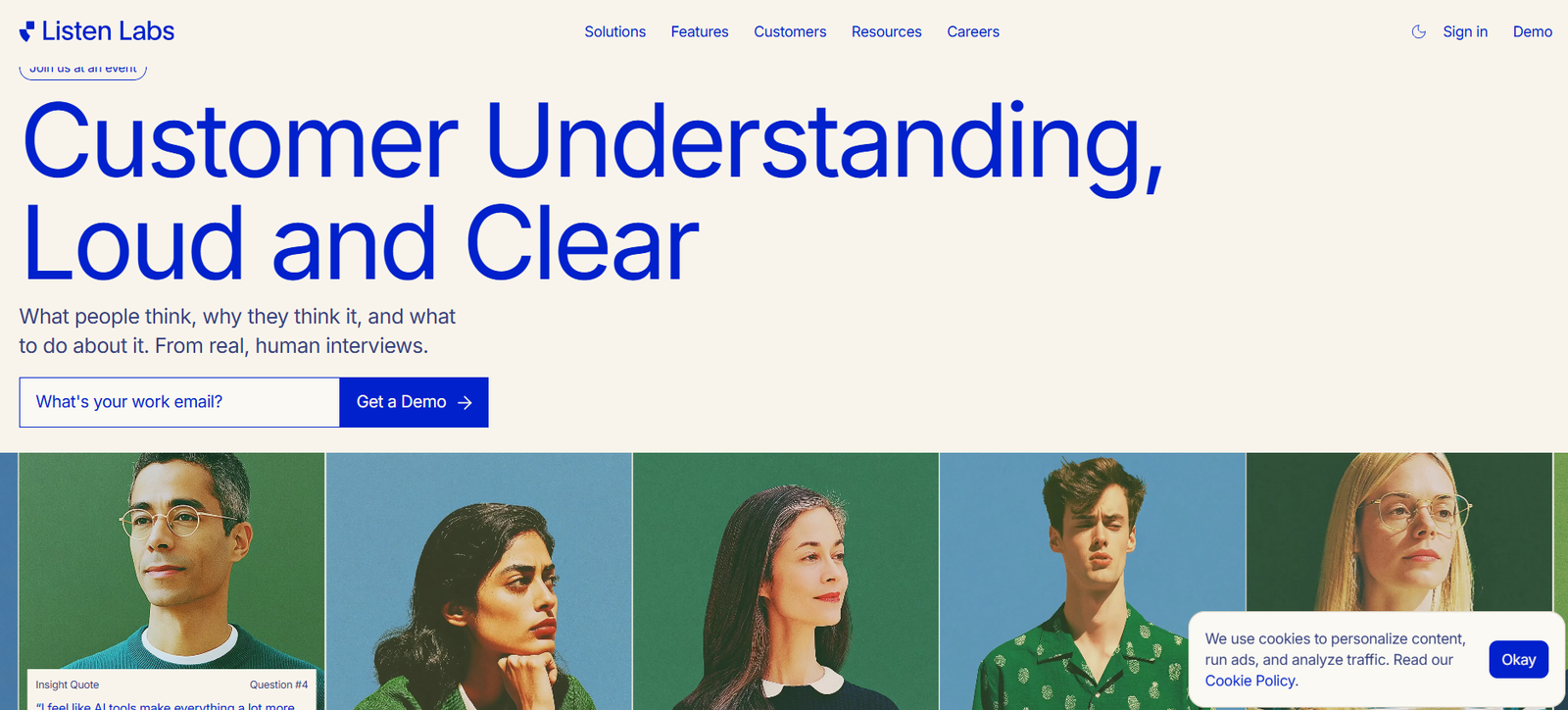
Listen Labs is an AI-powered customer research platform designed to help businesses understand what customers think, why they feel that way and how those insights can guide better decisions.
The platform automates much of the traditional research process. It can help create a research study, recruit suitable participants, conduct AI-moderated interviews and analyze responses before turning the findings into reports, charts, highlight reels and presentations.
A major advantage of Listen Labs is its ability to conduct qualitative research at a larger scale. Participants can complete AI-moderated interviews using text, voice or video, while the AI asks relevant follow-up questions based on their responses. This allows researchers to explore the reasoning behind people’s opinions rather than collecting only simple survey answers.
Listen Labs provides access to a participant network of more than 30 million people. This helps organizations recruit audiences based on specific research requirements without necessarily managing recruitment separately.
The platform is useful for consumer research, product research, concept testing, brand research, pricing studies, user experience research and other projects where organizations need deeper customer understanding.
Features
AI-Moderated Interviews
Listen Labs conducts interviews using AI rather than requiring a human moderator for every participant.
The AI can ask follow-up questions based on participant responses, allowing the interview to explore opinions, motivations and experiences in greater depth.
Text, Voice and Video Research
Research can be conducted through text, voice and video interviews.
Voice and video can provide additional context beyond written answers, particularly when researchers want to understand how participants react to products, concepts or experiences.
30M+ Participant Network
Listen Labs provides access to a global network of more than 30 million potential research participants.
Organizations can define their desired audience and use the platform to recruit participants matching relevant characteristics.
AI Research Agent
Research Agent is an AI assistant built specifically for analyzing research findings.
Researchers can ask questions about their study in natural language, explore patterns, compare segments and develop additional analysis without manually reviewing every response.
Segment and Cohort Analysis
Research Agent can compare different demographics, cohorts and audience groups.
The platform includes significance testing, helping researchers determine whether differences between groups may be meaningful rather than simply presenting surface-level comparisons.
Traceable Insights
Numbers, charts and findings generated through Research Agent can be traced back to the underlying participant responses.
This allows researchers to verify the evidence behind an AI-generated insight before using it in an important decision or presentation.
Highlight Reels
Listen Labs can identify important moments from large numbers of interviews and compile them into highlight reels.
This gives stakeholders an opportunity to hear or see relevant customer reactions rather than relying only on summarized research findings.
Emotional Intelligence
Listen Labs provides multimodal emotional analysis that considers signals such as facial expressions, voice tone and word choice.
The technology is designed to identify emotional reactions that may not be obvious from transcripts alone. It can identify core emotions as well as research-related signals such as confusion and frustration.
Quality Guard
Quality Guard is an AI-powered research quality system that operates across studies.
It analyzes signals such as response depth, voice patterns, engagement, contradictions, tab switching, screen reading, repeated participants and copy-pasted answers.
Responses receive quality scores, and responses that do not meet the required quality level can be removed and replaced.
Human Quality Review
Quality Guard is supported by a human review layer. Flagged responses can be manually examined by the company’s research team.
This provides additional oversight beyond automated fraud and quality detection.
Research Library
Research Library creates a searchable knowledge base from studies conducted within Listen Labs.
Teams can ask questions across previous research projects and receive synthesized answers linked to the original studies and respondents.
As organizations conduct more studies, the library can become a growing repository of customer knowledge.
Cross-Study Analysis
Researchers can analyze findings across several studies rather than treating each research project as completely separate.
This can help organizations identify patterns that emerge over time or compare customer attitudes across markets and audiences.
Automated Research Deliverables
Listen Labs can turn findings into stakeholder-ready outputs.
Research Agent can help generate presentations using company templates, downloadable memos, charts and custom CSV files with thematic coding.
Web Research
Research Agent can supplement participant findings with external web information.
This can help teams compare customer responses with industry developments, competitor activity or public benchmarks.
Multilingual Research
Listen Labs supports research across numerous languages, making it suitable for international and multi-market studies.
Its quality systems are designed to apply consistent standards across languages.
Enterprise Security
Listen Labs states that it is SOC 2 Type II, GDPR and CCPA compliant.
It also highlights ISO certifications covering AI management, information security and privacy. Data is protected with encryption, and the company states that customer data is not used to train AI models.
How It Works
Step 1: Define the Research Question
Start with the business question, customer issue, product concept or market assumption that needs to be investigated.
Step 2: Create the Study
Listen’s AI helps transform the initial research objective into a structured discussion guide.
Step 3: Define the Audience
Specify the type of participants required for the research.
Step 4: Recruit Participants
Listen Labs finds and qualifies suitable people through its participant network.
Step 5: Conduct AI Interviews
Participants complete AI-moderated interviews through supported formats such as text, voice or video.
Step 6: Ask Follow-Up Questions
The AI dynamically asks additional questions to explore important comments and understand the reasoning behind responses.
Step 7: Apply Quality Controls
Quality Guard evaluates participants and responses for signs of fraud, poor engagement and low-quality information.
Step 8: Analyze the Findings
Research Agent helps identify themes, compare audience segments, quantify responses and investigate important patterns.
Step 9: Verify the Evidence
Researchers can trace findings back to individual responses, quotes and interview material.
Step 10: Create Deliverables
The platform can transform findings into reports, charts, highlight reels, presentations and structured exports for stakeholders.
Use Cases
Consumer Research
Brands can conduct large-scale interviews to understand consumer needs, preferences, motivations and concerns.
Product Research
Product teams can investigate how customers use products, what problems they experience and which improvements matter most.
Concept Testing
Companies can present new ideas or concepts to target audiences and understand which options resonate and why.
Creative Testing
Marketing teams can test advertising messages, visuals and creative concepts before investing heavily in campaigns.
Brand Perception
Businesses can investigate how consumers perceive their brand and identify factors influencing brand preference.
Pricing Research
Companies can test pricing and packaging concepts and understand how customers react to different offers.
User Experience Research
UX researchers can interview users about digital products and identify confusion, frustration, unmet needs and usability problems.
Customer Experience
Customer experience teams can gather deeper feedback about interactions with a company’s products, services and support processes.
Market Research
Organizations can conduct research across different customer segments, markets and countries.
International Research
Multilingual capabilities make Listen Labs useful for businesses researching customers across multiple countries and languages.
Research Teams
Professional researchers can automate repetitive parts of recruitment, interviewing, analysis and reporting while retaining access to the original participant evidence.
Pricing
Listen Labs does not clearly display standard public subscription prices on its main official website.
The platform provides options to Try for Free and Book a Demo, allowing potential customers to explore the product or discuss their research requirements with the company.
Because research costs can depend on factors such as participant recruitment, audience characteristics, number of interviews, study size and enterprise requirements, organizations should contact Listen Labs for current commercial details.
Pricing details are not clearly mentioned on the official website.
Strengths
One of Listen Labs’ biggest strengths is its ability to combine qualitative depth with research at a larger scale.
AI-moderated interviews can ask follow-up questions, providing richer information than conventional surveys that use only fixed questions.
Access to a network of more than 30 million participants can simplify research recruitment.
Research Agent reduces manual analysis by allowing researchers to explore study data conversationally and create charts, comparisons and deliverables.
Traceability is particularly valuable. Researchers can connect AI-generated insights back to the original participant responses rather than relying entirely on a black-box summary.
Quality Guard adds automated fraud and response-quality monitoring, supported by human review.
Voice, video and emotional intelligence capabilities can provide additional insight into participant reactions beyond written transcripts.
Research Library also helps organizations retain and reuse customer knowledge instead of allowing valuable findings to disappear inside individual research reports.
Drawbacks
Public pricing is not clearly displayed, making it difficult to estimate research costs before contacting the company.
The platform appears primarily designed for professional research teams, product organizations and larger brands. Individuals with very simple survey requirements may find conventional survey tools more straightforward.
AI-moderated research cannot completely replace human research judgment. Study design, interpretation and major strategic conclusions still benefit from experienced researchers.
Emotion detection should also be interpreted carefully. Human emotions are complex, and automated analysis of facial expressions, speech and language should be treated as an additional research signal rather than an unquestionable measure of a person’s internal state.
Research involving personal data, video or sensitive topics also requires organizations to carefully consider participant consent, privacy and applicable regulations.
Comparison with Other Platforms
Listen Labs sits between traditional survey software, qualitative research platforms and AI-powered research tools.
Traditional survey platforms are effective for collecting structured quantitative answers from large numbers of respondents, but they may provide limited understanding of why a participant selected a particular response.
Conventional qualitative research can provide deeper insights through interviews, but conducting and analyzing hundreds of human-moderated interviews can require significant time and resources.
Listen Labs attempts to combine these approaches. AI can conduct in-depth interviews at scale, ask follow-up questions and then quantify patterns across responses.
Its integrated participant recruitment is another distinction. Teams can design a study, recruit respondents, conduct interviews and analyze results through one platform.
Features such as Research Agent, Quality Guard, Emotional Intelligence and Research Library extend the platform beyond basic AI interviewing into research analysis, quality control and institutional knowledge management.
Customer Reviews and Testimonials
Listen Labs presents customer stories and testimonials from well-known organizations on its official website.
The platform highlights companies such as Microsoft, Google, Canva, SKIMS, Nestlé, Mars, Chime and other organizations using Listen for customer and market research.
Customer stories describe applications such as understanding consumer preferences, conducting rapid research and bringing customer perspectives into business decisions.
These examples demonstrate how established organizations use the platform, although individual research outcomes will depend on study design, participant selection and the questions being investigated.
Conclusion
Listen Labs is a sophisticated AI customer research platform for organizations that want deeper customer understanding without waiting weeks for traditional qualitative research projects.
Its combination of participant recruitment, AI-moderated text, voice and video interviews, Research Agent, Quality Guard, emotional analysis and automated reporting covers much of the research lifecycle within one environment.
The platform is particularly useful for consumer brands, product teams, UX researchers, marketing departments and professional research teams conducting concept tests, brand studies, pricing research and customer experience analysis.
Listen Labs stands out by focusing not only on collecting answers but also on understanding the reasoning and human reactions behind those answers. For organizations making important product, marketing or customer decisions, that deeper context can make research considerably more useful.