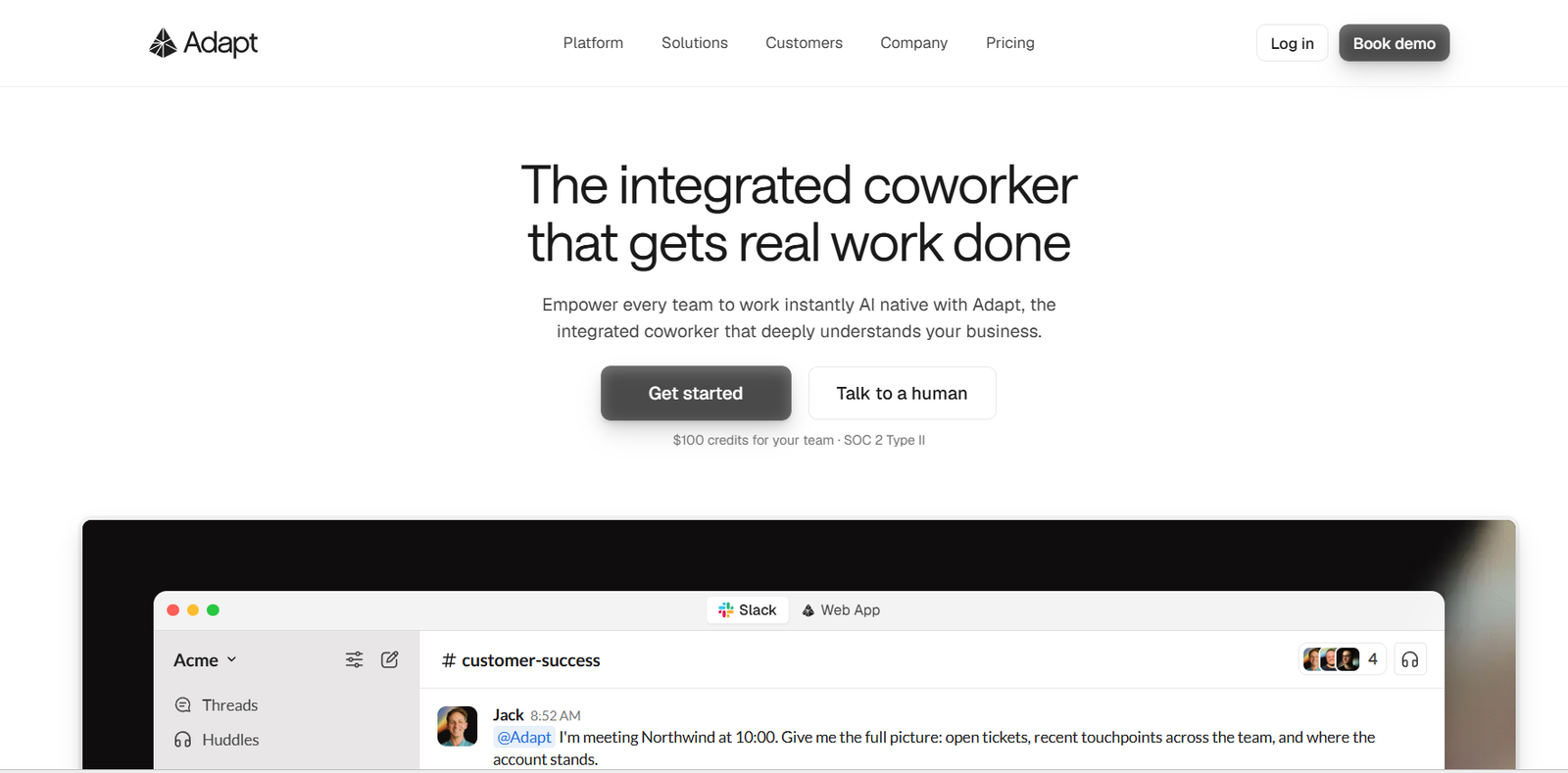
Adapt is an AI-powered workplace platform designed to act as an integrated coworker across an organization. It connects with a company’s applications, data, knowledge and workflows so employees can ask questions, perform analysis, automate repetitive work and create internal tools using natural language.
A central idea behind Adapt is the “company brain.” Instead of using an AI assistant with little understanding of the organization, teams can connect their business systems and provide company-specific knowledge, procedures and context. Adapt then uses this information when answering questions and carrying out tasks.
Employees can interact with Adapt through Slack or its web application. It also works with environments such as GitHub and Linear and supports the Model Context Protocol for connecting additional tools and agents.
Adapt can connect with a broad range of business systems, including Salesforce, HubSpot, Google Workspace, Slack, Snowflake, BigQuery, Shopify, Stripe, Zendesk, GitHub, Jira, Notion, QuickBooks, Google Analytics and many others. It can also connect with services that provide an API.
The platform is designed for organization-wide use across leadership, marketing, sales, product, engineering and operational teams.
Features
Integrated AI Coworker
Adapt is designed to do more than provide conversational answers. It can retrieve information from connected systems, reason over that information and take actions based on a user’s request.
This makes it closer to an AI coworker than a conventional standalone chatbot.
Company Brain
Adapt creates a shared intelligence layer using organizational knowledge, workflows and connected applications.
The company brain can contain business facts, policies, decisions and other contextual information that helps Adapt understand how the organization operates.
Company Knowledge
Organizations can add knowledge that improves the context behind Adapt’s responses and actions.
This is particularly useful when a company has its own terminology, policies, processes and business rules that a general AI model would not normally understand.
Skills
Skills are reusable procedures and workflows that teach Adapt how specific work should be performed.
Teams can use skills to create more consistent outcomes when recurring tasks need to follow established company processes.
Live Context
Adapt can retrieve current information from connected tools, APIs, documents and the web when completing tasks.
This helps employees work with live business information rather than depending entirely on static AI knowledge.
Intelligent Model Routing
Adapt can route tasks to appropriate AI models based on factors such as task requirements, quality, speed and cost.
This allows organizations to use different AI capabilities through one workplace interface.
Ask Your Data
Employees can ask questions about business data in natural language.
Adapt can pull live information, perform analysis and provide evidence-based answers without requiring every employee to write SQL queries or build dashboards.
Workflow Automation
Teams can automate recurring and multi-step workflows.
Examples include daily briefings, pipeline reports, system monitoring and other processes that would otherwise require employees to repeatedly gather and organize information.
Scheduled Tasks
Adapt can run tasks on a schedule. This makes it useful for reports, monitoring and recurring organizational workflows.
Internal App Builder
Users can describe an internal application, calculator, dashboard or utility they need, and Adapt can build it.
This provides teams with a way to create lightweight internal software without requiring a developer for every small business application.
Slack Integration
Employees can tag Adapt directly inside Slack channels or direct messages.
This allows teams to access AI assistance without moving away from one of their primary communication tools.
Web Application
Adapt also provides a dedicated web workspace for deeper analysis, dashboards and longer-running tasks.
GitHub Integration
Developers can use Adapt within GitHub pull requests and issues to investigate problems and perform relevant work inside software development workflows.
Linear Integration
Adapt can be used from Linear issues to investigate, triage and act on product or engineering tasks.
API Connectivity
Adapt states that if a service provides an API, it can be connected.
OAuth integrations provide easier setup for supported services, while other applications can be connected through API keys.
Large Integration Library
The platform supports integrations across CRM, ecommerce, analytics, finance, communication, databases, marketing, cloud infrastructure and developer tools.
Examples include Salesforce, HubSpot, Shopify, Stripe, Snowflake, BigQuery, Google Analytics, Zendesk, GitHub, Jira, Notion, Slack, QuickBooks, Xero, Databricks, PostgreSQL, OpenAI and Anthropic.
Security and Access Controls
Adapt encrypts organizational information in transit and at rest and runs tasks within isolated environments.
The platform also provides access controls and audit logging so organizations can manage and review how information is used.
Adapt states that company data remains private and is not used to train AI models. The platform is SOC 2 Type II compliant.
How It Works
Step 1: Create an Adapt Account
Organizations can start with free credits and begin testing the platform.
Step 2: Connect Business Applications
Connect relevant company tools such as Slack, CRM systems, databases, analytics platforms, help desks, payment systems and project management applications.
Step 3: Add Company Knowledge
Provide organizational information, policies, definitions and other context that Adapt should understand.
Step 4: Create Skills
Teams can define reusable procedures that explain how Adapt should perform recurring tasks.
Step 5: Ask Adapt
Employees can tag Adapt in Slack or use its web application to ask a question or request a task.
Step 6: Gather Context
Adapt retrieves relevant information from the company brain and connected applications.
Step 7: Reason Over the Information
The platform selects appropriate AI capabilities and analyzes the information required for the task.
Step 8: Produce or Perform the Work
Adapt can answer the question, create an analysis, prepare a deliverable or perform actions through connected systems where permissions allow.
Step 9: Automate Recurring Work
Frequently repeated processes can be converted into scheduled tasks or multi-step workflows.
Step 10: Expand Across Teams
Organizations can gradually connect additional systems and introduce Adapt to other departments without paying separate per-user fees.
Use Cases
Leadership
Executives can use Adapt for daily briefings, risk identification, board preparation and company-wide analysis.
Marketing
Marketing teams can analyze customer acquisition costs, campaign performance, attribution and other growth information across connected platforms.
Sales
Sales professionals can gather prospect intelligence, analyze pipelines and automate meeting preparation and follow-up activities.
Product Teams
Product teams can obtain information across different systems, synchronize data and improve cross-functional visibility.
Engineering
Engineering teams can use Adapt to investigate technical questions, analyze information and interact with development tools such as GitHub and Linear.
Customer Support
Teams can bring together information from customer support systems and other business applications to investigate customer issues.
Ecommerce
Ecommerce businesses can connect systems such as Shopify, WooCommerce, payment platforms, advertising services and analytics tools for cross-platform analysis.
Finance
Finance teams can connect accounting, payment and business data sources to investigate financial information and automate reporting.
Data Analysis
Employees can ask business questions in plain language rather than depending on a data analyst for every routine request.
Internal Application Development
Teams can create dashboards, calculators and internal utilities by describing what they need.
Recurring Business Reports
Organizations can automate regular reports such as pipeline summaries, performance briefings and operational monitoring.
Pricing
Adapt uses usage-based pricing rather than charging separately for each user.
Starter: $0 per month
The Starter plan provides free access with credits included.
The official pricing page currently states that users receive $25 in free credits, with additional opportunities for business-domain organizations to earn more free credits through integrations and team adoption.
Adapt also currently promotes a $100 Slack bonus when Slack is connected.
Pro: $50 to $5,000 per month
Pro provides flexible usage-based plans.
The standard conversion is 1 credit = $0.01 of usage. Higher-volume plans can include bonus credits, with up to a 10% bonus depending on spending level.
Automatic recharge can be enabled to prevent workflows from stopping when available credits run out.
Enterprise: Custom Pricing
Enterprise plans provide customized arrangements for organizations with larger requirements.
Available benefits include committed-usage discounts, invoicing, premium research integrations and access to a dedicated AI engineer.
Adapt does not charge per seat, allowing organizations to add users without purchasing individual licenses for each employee.
Self-service annual plans currently receive a 10% discount compared with equivalent monthly pricing.
Strengths
One of Adapt’s strongest advantages is its deep integration with business applications. Instead of functioning as an isolated AI chatbot, it can retrieve information from the systems where employees already work.
Its company brain helps provide business-specific context, which can make responses and workflows more relevant to the organization.
The ability to both answer questions and take actions makes Adapt broader than traditional enterprise search platforms.
Natural-language data analysis can also reduce routine requests to analytics and data teams.
The internal app builder allows employees to create useful dashboards and tools without waiting for conventional software development.
Unlimited users can be particularly attractive to growing organizations because costs are based on actual AI usage rather than the number of employees with access.
The ability to use Adapt directly within Slack also reduces the need for employees to learn another complicated interface.
Drawbacks
Adapt becomes most useful when an organization connects multiple business systems and provides sufficient company context. Teams using only a few applications may not benefit from its full capabilities.
Usage-based pricing can make monthly costs less predictable for organizations with rapidly increasing AI adoption.
More complicated requests consume more credits because they may require additional context, reasoning, processing or compute resources.
Connecting sensitive business systems also requires careful configuration of permissions and access controls.
Organizations should still review important AI-generated analysis and actions, particularly when the results influence financial, customer or strategic decisions.
The platform may be more comprehensive than necessary for individuals who simply need a general-purpose AI assistant.
Comparison with Other Platforms
Adapt overlaps with enterprise AI assistants, enterprise search platforms, automation software and conversational business intelligence tools.
Traditional enterprise search platforms primarily help employees locate documents and information. Adapt takes the concept further by retrieving live information, reasoning over it and performing work through connected systems.
Compared with standalone AI assistants, Adapt is more closely connected to company-specific knowledge, applications and workflows.
It also differs from traditional workflow automation platforms. Conventional automation software usually requires users to define triggers and actions explicitly. Adapt allows more work to begin with natural-language instructions and AI reasoning.
Another important distinction is its organization-wide company brain. Knowledge, skills and live context can be shared across teams rather than requiring each employee to build an isolated AI setup.
Organizations primarily needing document search may prefer a dedicated enterprise search solution. Businesses looking for an AI system that can combine search, analysis, automation and action across their technology stack may find Adapt more suitable.
Customer Reviews and Testimonials
Adapt features several customer testimonials on its official website.
Nathan Potter, CTO at Wander, describes Adapt expanding from data access into broader use across the company’s teams.
Ryan Clohessy, VP of Growth at Orion Sleep, describes using Adapt for attribution and understanding how media spending contributes to sales.
Jonathan Nahin, Founder of RevSend, describes using Adapt to centralize access to business insights and reduce repetitive data requests.
The website also features feedback from KnoCommerce executives describing Adapt’s role in answering technical questions and reducing repetitive internal requests.
These testimonials demonstrate practical applications of the platform, although individual results will naturally depend on the organization’s systems, data quality, adoption and workflows.
Conclusion
Adapt is a powerful AI coworker platform for businesses that want AI to work directly with their existing data, applications and organizational knowledge.
Rather than functioning only as a conversational assistant, Adapt can gather live information, analyze business data, automate workflows, perform actions and even create internal applications and dashboards.
Its combination of company knowledge, reusable skills, live integrations, Slack access, intelligent model routing and workflow automation makes it particularly relevant for organizations looking to expand AI across multiple departments.
Adapt is best suited to growing and established businesses with several connected software systems and frequent cross-functional information needs. Its unlimited-user, usage-based pricing model may also make it attractive to organizations that want broad employee access without managing AI licenses on a seat-by-seat basis.