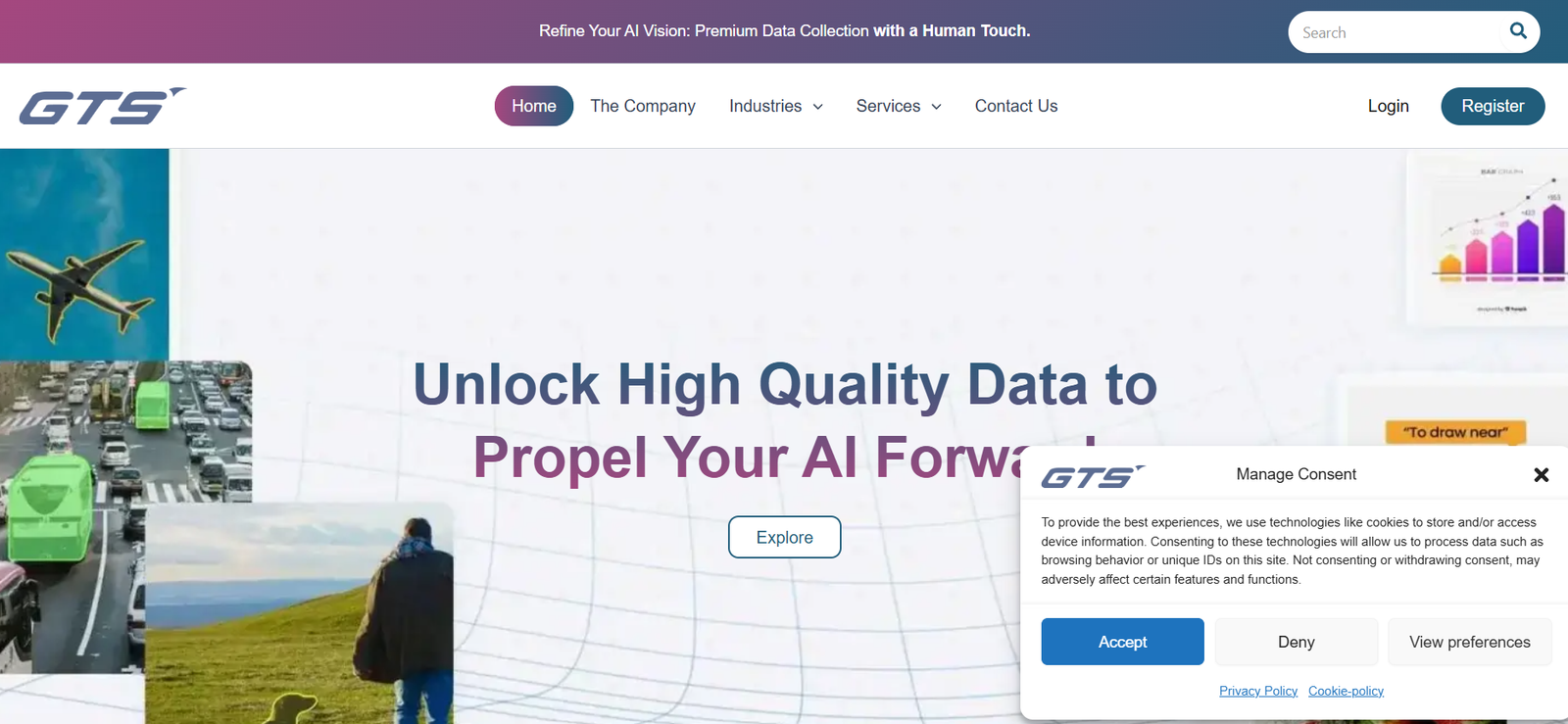
GTS AI, operated by Globose Technology Solutions, is an AI data collection and annotation company that provides training datasets and data services for artificial intelligence and machine learning projects.
The company helps AI developers, technology businesses and research teams collect, prepare, annotate and manage the data required to train machine learning models. Its services cover multiple data formats, including images, videos, speech, audio and text.
GTS AI supports projects involving computer vision, natural language processing, speech recognition, autonomous driving, facial recognition and other machine learning applications. Businesses can obtain customized datasets according to their model, geography, language and project requirements.
In addition to collecting raw data, GTS provides annotation and transcription services that turn unstructured information into labeled training data. Its human-in-the-loop approach combines technology with human contributors and quality assurance processes.
The company reports having a workforce and contributor network across 136 countries, which can be valuable for AI projects requiring geographically and linguistically diverse datasets.
Features
Image Data Collection
GTS AI collects customized image datasets for computer vision applications. These can include facial images, medical images, invoices and other visual information depending on the project.
The company can collect diverse human images across different geographical regions, helping developers create datasets that better represent the populations and situations where their AI models will operate.
Video Data Collection
Businesses can obtain customized video datasets for training computer vision and video analysis systems.
Possible applications include CCTV analysis, traffic monitoring, autonomous vehicles, human activity recognition and other applications where AI must understand objects and actions across video frames.
Speech Data Collection
GTS AI provides speech datasets for projects involving natural language processing, automatic speech recognition and other voice-based AI technologies.
Speech data can be collected according to languages, accents, demographics and other requirements relevant to the machine learning project.
Text Data Collection
The company collects text datasets for NLP and document intelligence applications.
Available categories can include documents, business cards, menus, receipts, tickets and other forms of textual information required to train text recognition or language-processing systems.
Image and Video Annotation
GTS provides annotation services for images and videos so machine learning systems can learn to identify objects, people, activities and other visual elements.
Available annotation techniques include bounding boxes and other methods appropriate for computer vision projects.
Audio Transcription
The company provides transcription services that convert recorded speech into structured text.
These datasets can support automatic speech recognition, virtual assistants, text-to-speech development and other language-related AI applications.
OCR Data Collection
GTS AI supports data collection for Optical Character Recognition projects.
Datasets can include printed text, handwriting, different document layouts, noisy images and multilingual information, helping OCR systems learn to recognize text under varied real-world conditions.
ADAS Data Collection
The company provides specialized data collection for Advanced Driver Assistance Systems.
ADAS datasets can support automotive AI models that need to understand roads, vehicles, pedestrians, traffic signs and other elements of the driving environment.
Custom Dataset Creation
Organizations are not limited to pre-existing datasets. GTS can collect customized data according to a client’s machine learning requirements.
This can be particularly useful when publicly available datasets do not adequately represent a specific geography, population, object type or business application.
Ready-to-Use Datasets
GTS AI also provides downloadable datasets for machine learning and research.
Its dataset collection covers different AI applications, including computer vision and image processing. For example, the platform lists datasets such as BG-20k for image-related machine learning research.
Synthetic Data
Synthetic information can be incorporated into certain AI training projects when additional data diversity is required.
Synthetic datasets can complement real-world information and help developers create additional training scenarios.
Human-in-the-Loop Data Operations
GTS combines automated processes with human contributors for data collection, annotation and quality assurance.
Human review is particularly valuable for tasks where contextual judgment or detailed labeling is required.
Quality Assurance
The company applies qualification and quality assurance processes to its data operations.
Accurate labels and consistent datasets are important because errors in training data can directly affect machine learning model performance.
Global Data Collection
GTS states that its workforce is distributed across 136 countries.
This international reach can help organizations collect geographically diverse datasets for global AI products.
Compliance and Security
GTS highlights certifications including ISO 9001:2015, ISO 14001:2015, ISO 45001:2018 and ISO 27001:2013 on its website.
The dataset section also highlights GDPR and HIPAA compliance as part of its approach to data security and regulated projects.
How It Works
Step 1: Define the Data Requirement
The customer identifies the type of AI or machine learning model being developed and the data required to train it.
Step 2: Contact GTS
Businesses can submit their requirements to GTS and request an estimate for the project.
Step 3: Establish Project Specifications
Requirements can include data type, volume, geographical coverage, demographics, language, annotation requirements and desired output format.
Step 4: Create Sample Data
For customized projects, initial sample data can be prepared so the customer can evaluate whether it matches the project requirements.
Step 5: Review the Sample
The customer reviews the initial results and provides feedback where changes are required.
Step 6: Collect the Complete Dataset
After the specifications are confirmed, GTS proceeds with the larger production and data collection process.
Step 7: Annotate or Transcribe Data
When required, images and videos can be labeled and speech can be transcribed to create structured machine learning training data.
Step 8: Perform Quality Checks
The dataset undergoes quality assurance to identify labeling, formatting or consistency problems.
Step 9: Deliver the Dataset
The completed information is exported according to the agreed project requirements for use in model training, validation or evaluation.
Use Cases
Computer Vision
Developers can obtain image and video datasets for object recognition, image classification and other computer vision applications.
Generative AI and LLM Development
AI teams can create text and conversational datasets for training and evaluating language models. GTS has published a case study involving 50,000 synthetic multi-turn conversations designed for conversational context understanding.
Autonomous Vehicles
ADAS datasets can support systems that need to identify pedestrians, vehicles, road environments and other driving-related information.
Speech Recognition
Speech and transcription datasets can be used to train automatic speech recognition systems across different languages and accents.
Virtual Assistants
Developers can use speech and language datasets when creating conversational assistants and voice interfaces.
OCR Systems
Document images, handwriting and text datasets can support AI systems designed to extract information from scanned or photographed documents.
Healthcare AI
Medical image datasets and other specialized data can support healthcare-related machine learning projects, subject to appropriate privacy and regulatory requirements.
Retail AI
Image and video data can be used for applications such as product recognition, shelf monitoring and retail analytics.
Financial Technology
Financial organizations can use annotated datasets for applications such as document processing, transaction-related AI and fraud detection.
Augmented and Virtual Reality
Image and video datasets can help train systems that need to recognize human actions, environments and objects in AR and VR applications.
Academic Research
Researchers can use downloadable or customized datasets for machine learning experiments and academic projects.
Pricing
GTS AI does not publish standard pricing packages for its data collection, annotation and customized dataset services.
The official website asks potential customers to provide their data collection requirements so the company can prepare a detailed estimate.
Costs are therefore likely to depend on factors such as dataset type, number of records, geographical coverage, annotation complexity, language requirements and project specifications.
Some datasets are available through the company’s dataset download section, but pricing and licensing conditions may vary by dataset.
Pricing details are not clearly mentioned on the official website.
Strengths
One of the main strengths of GTS AI is the breadth of data types it supports. Organizations can source image, video, text and speech data from the same provider.
Its global contributor network can be particularly useful for AI developers who need geographically or demographically diverse training information.
Custom dataset creation is another advantage. Businesses can define data requirements instead of relying entirely on generic public datasets.
The combination of collection, annotation and transcription allows organizations to obtain more complete machine learning data services from one provider.
Human-in-the-loop processes can provide additional quality control for tasks where automated labeling alone may not be sufficient.
GTS also highlights ISO certifications and compliance considerations, which can be important when organizations evaluate vendors for larger or sensitive AI projects.
Drawbacks
GTS AI is primarily a service provider rather than a simple self-service AI application. Customers with custom requirements may need to discuss project specifications before receiving their data.
Standard pricing is not publicly displayed, making direct cost comparisons with other dataset providers difficult.
Custom data collection can also require more time than purchasing an existing ready-made dataset because collection, annotation and quality assurance need to be completed according to project requirements.
Dataset quality and suitability should still be independently evaluated by customers before using information to train production AI systems.
Organizations handling sensitive information should also carefully review consent, privacy, licensing, security and regulatory requirements for their specific dataset and use case.
Comparison with Other Platforms
GTS AI competes with AI training data companies, annotation providers and machine learning dataset marketplaces.
Dataset marketplaces generally allow developers to download existing datasets quickly. GTS provides that option for some datasets but also emphasizes custom data collection when existing information does not match a project’s requirements.
Compared with annotation-only platforms, GTS covers a wider process because it can collect the original data and then provide annotation or transcription services.
Its global workforce can also be useful for projects requiring information from different countries, languages and demographic groups.
However, developers who only need a small standard dataset may find open-source repositories or self-service marketplaces simpler. GTS is more relevant when a project requires customized, large-scale or specifically annotated training data.
Customer Reviews and Testimonials
Customer reviews and testimonials are not clearly available on the official website.
The company does, however, publish case studies illustrating its data collection work. One example describes the creation of 50,000 synthetic multi-turn conversations for training and evaluating LLMs on conversational context.
These case studies can help potential customers understand the types of projects GTS can undertake, but they should not be interpreted as guaranteed results for every AI development project.
Conclusion
GTS AI is a specialized AI training data provider for organizations that need reliable image, video, speech and text datasets for machine learning development.
Its combination of custom data collection, annotation, transcription, global workforce coverage and human-in-the-loop quality processes makes it particularly relevant for AI companies, research teams, automotive developers, healthcare technology companies and businesses building computer vision, NLP or speech applications.
The platform is especially worth considering when publicly available datasets do not adequately match a project’s geography, language, demographic profile or technical requirements.
For organizations building AI models where the quality of training data matters as much as the model itself, GTS AI provides a broad range of services covering the data preparation lifecycle.