
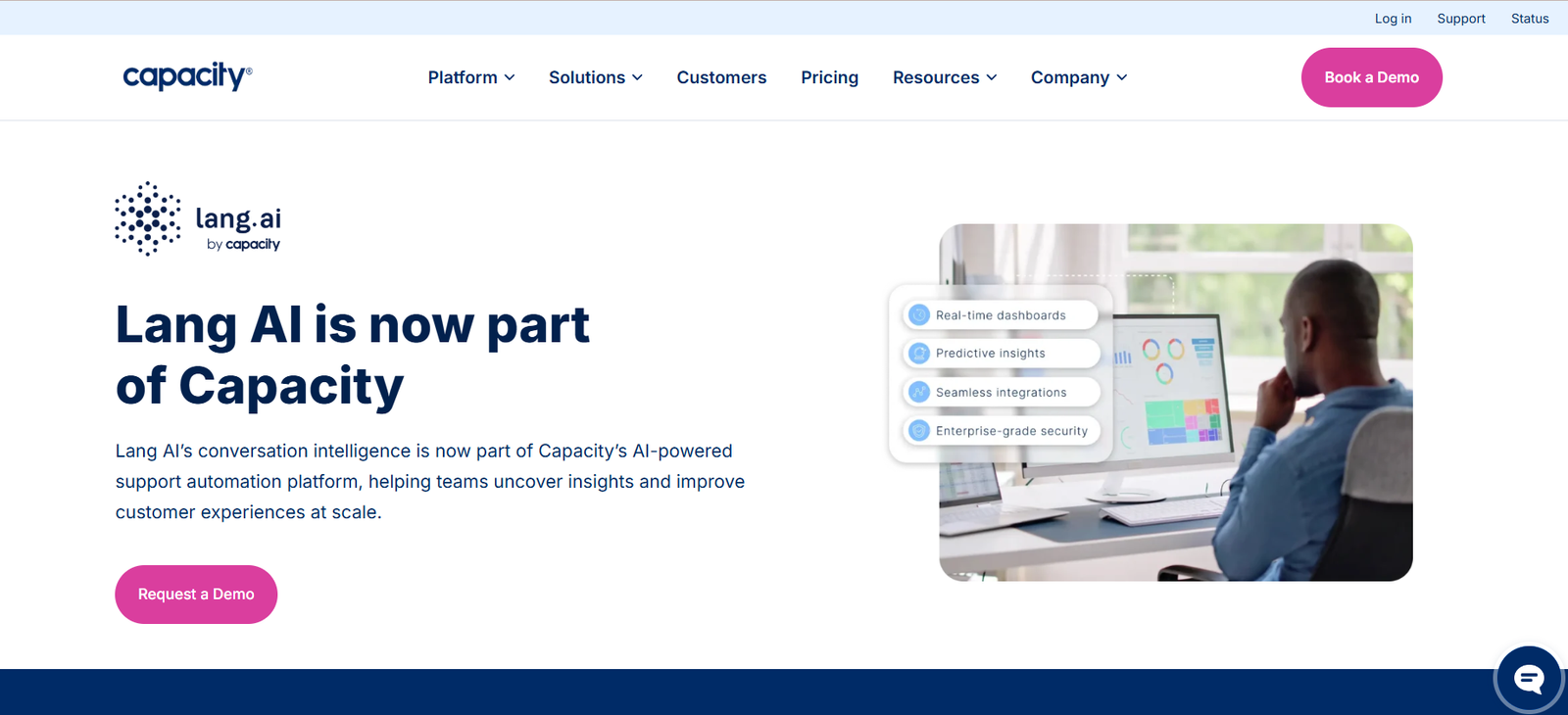
Capacity is an AI powered customer experience and support automation platform designed primarily for contact centers, customer service teams and larger organizations. It brings AI agents, knowledge management, agent assistance, workflow automation and conversation analytics into a unified environment.
The platform helps businesses automate repetitive customer interactions while supporting human agents when more complex situations require personal attention. Capacity can work across channels including chat, voice, email and SMS, allowing organizations to manage different types of customer conversations through a common AI powered system.
Capacity combines generative AI, agentic AI, retrieval based technology and an organization’s own information to generate context aware responses. Its AI agents can answer questions, perform certain actions, trigger workflows and transfer conversations to human agents when necessary.
The platform is particularly suited to mid market and enterprise organizations operating customer support or contact center environments. Capacity highlights applications across industries including healthcare, retail, financial services, insurance, education, technology and other service based sectors.
Features
AI Agents
Capacity provides AI agents that can manage customer interactions across chat, voice, SMS and email. These agents are designed to answer common questions, resolve routine requests and take actions through connected business systems.
AI Knowledge Orchestration
The platform provides a centralized knowledge layer that connects organizational information with AI agents and workflows. Businesses can maintain their knowledge in one environment and use it across different customer service channels.
Voice AI Agents
Capacity supports conversational voice AI for organizations that receive significant volumes of telephone enquiries. Voice agents can communicate with customers, provide information and automate common service interactions.
Chat, SMS and Email Automation
Businesses can deploy AI based support through chat, SMS and email. This allows customers to receive automated assistance through the communication channel they prefer.
Real Time Agent Assist
Capacity can support human customer service representatives during live conversations. It can surface relevant information, provide conversation guidance, analyze sentiment and suggest appropriate next steps.
Conversation Intelligence
The platform analyzes customer conversations to identify useful patterns and insights. Organizations can use these insights to understand customer needs, improve service processes and identify gaps in their existing knowledge.
Automated Quality Assurance
Capacity includes Auto QA capabilities for evaluating customer interactions. This can help contact centers monitor service quality across a larger number of conversations instead of relying entirely on manual reviews.
AI CSAT
AI based customer satisfaction analysis helps organizations understand the quality and outcome of customer interactions. It can complement traditional customer feedback and survey processes.
Agent Coaching
Capacity provides tools for improving agent performance using information collected from customer interactions. Managers can use conversation insights to identify areas where agents may require additional guidance.
Workflow Automation
Businesses can create workflows that automatically perform multi step processes when specific events occur. This can reduce repetitive administrative work associated with customer support.
Outbound Campaigns
Capacity supports proactive customer engagement through channels such as SMS and voice. Organizations can use automated campaigns for appointment reminders, payment notifications, promotions and similar communications.
Integrations
Capacity connects with a large range of business applications. The official pricing information mentions more than 250 ready made integrations, with examples including Salesforce, Zendesk, ServiceNow, Slack, Microsoft Teams, HubSpot, Google Workspace, Jira, Workday and other enterprise platforms.
Analytics
The platform provides analytics for understanding interactions, support performance and AI activity. These insights can help teams evaluate how effectively automated and human support processes are working.
How It Works
Step 1: Select the appropriate Capacity platform plan
Organizations can choose a platform tier based on their customer support requirements, expected scale and required features.
Step 2: Connect organizational knowledge
Businesses bring their knowledge, documents, data and relevant systems into Capacity so that AI agents can access appropriate information when responding to users.
Step 3: Connect existing applications
Capacity can be integrated with CRM systems, helpdesks, communication platforms, productivity applications and other tools already used by the organization.
Step 4: Build AI agents
Teams can configure AI agents according to their customer service requirements and determine the tasks and interactions they should handle.
Step 5: Choose communication channels
AI agents can be deployed through supported channels such as chat, voice, SMS and email.
Step 6: Automate actions and workflows
Organizations can configure workflows so AI agents can do more than answer questions. Depending on the integration and setup, they can trigger processes and perform actions in connected systems.
Step 7: Escalate complex conversations
When an issue requires human involvement, the system can transfer or escalate the interaction to a customer service representative.
Step 8: Analyze interactions
Teams can use conversation intelligence, automated QA, CSAT insights and other analytics to evaluate performance and identify opportunities for improvement.
Use Cases
Customer Support
Companies can automate frequently asked questions and repetitive service requests while keeping human agents available for more complicated customer problems.
Contact Centers
Contact centers can use Capacity to automate high volume interactions, assist agents during conversations, analyze calls and evaluate service quality.
IT Support
Internal IT teams can use AI agents and knowledge resources to answer common technical questions and automate routine support processes.
Employee Support
Organizations can provide employees with faster access to internal information and automate repetitive operational requests.
Healthcare
Healthcare organizations can use AI powered support for areas such as patient inquiries, scheduling and billing related interactions. Capacity also offers options designed around healthcare compliance requirements.
Financial Services
Banks, credit unions and other financial organizations can use Capacity for automated customer support and service operations while connecting AI capabilities with existing business systems.
Retail and Ecommerce
Retailers can automate common customer questions related to products, orders, services and other support requirements.
Education
Educational organizations can use AI agents to answer common questions from students and other users and reduce repetitive administrative enquiries.
Sales and Marketing
Businesses can use outbound automation for customer engagement, lead related communication, promotions and follow up activities.
Appointment Reminders
Organizations can automate proactive communications such as appointment reminders and other time sensitive customer notifications.
Pricing
Capacity uses a combination of platform subscription fees and usage based pricing.
The official website currently presents three main platform tiers: Core, Pro and Enterprise.
Core provides essential AI support capabilities including a knowledge base, helpdesk and automations, AI Agent Builder, data indexing, integrations, analytics and storage.
Pro includes the Core capabilities along with additional features such as live chat, inbox functionality, real time Agent Assist, conversation intelligence, automated quality assurance and developer platform capabilities.
Enterprise includes Pro features together with additional capabilities such as campaigns, CRM, advanced workflows, larger storage allowances and an available HIPAA package.
AI agent usage is charged according to usage and channel. Capacity identifies chat pricing per response, voice pricing per minute, email pricing per response and SMS pricing per message. Volume discounts may be available.
Specific monetary prices are not publicly displayed on the official pricing page. Businesses need to contact Capacity for a customized package based on platform requirements, usage volumes, channels, integrations and additional features.
Strengths
One of Capacity’s main strengths is its unified approach to customer experience automation. Instead of focusing only on a chatbot, it combines AI agents, human agent assistance, knowledge management, workflow automation, quality monitoring and analytics.
Its multichannel capabilities are another advantage. Organizations can automate interactions through voice, chat, SMS and email while using a shared knowledge foundation.
Capacity also offers extensive integration possibilities, making it useful for businesses that already depend on multiple enterprise applications.
Human agents remain part of the support process. AI can handle repetitive interactions while employees manage conversations requiring greater judgment or personal attention.
The platform’s conversation intelligence and automated quality monitoring capabilities can also help larger support teams understand performance across a high volume of customer interactions.
Drawbacks
Capacity appears primarily designed for mid market and enterprise organizations, particularly those operating substantial customer support or contact center operations. Small businesses with basic chatbot requirements may find the platform more extensive than necessary.
Exact monetary pricing is not publicly displayed, making it difficult for potential customers to estimate costs without contacting the company.
The combination of platform fees, usage based AI agent pricing and optional integrations or additional capabilities may also make overall costs less straightforward than tools offering simple fixed monthly subscriptions.
Organizations with complex systems may require planning and configuration before they can fully benefit from AI agents, integrations and automated workflows.
Comparison with Other Platforms
Capacity competes broadly with AI customer support, conversational AI, helpdesk automation and contact center platforms.
Some AI support products concentrate mainly on website chatbots or automated FAQ responses. Capacity takes a broader approach by combining AI agents across voice, chat, SMS and email with real time human agent assistance, conversation intelligence, automated QA and workflow automation.
Another notable aspect is its centralized AI knowledge approach. Organizations can connect their information and use that knowledge across multiple agents, workflows and customer communication channels.
Businesses comparing Capacity with other platforms should consider the number of support channels they operate, existing software integrations, contact center size, automation requirements, security needs and expected AI usage. Smaller organizations requiring only a simple chatbot may prefer a lighter platform, while organizations managing complex support operations may benefit more from Capacity’s broader feature set.
Customer Reviews and Testimonials
Capacity provides a substantial collection of customer stories and customer results on its official website.
Examples include organizations using the platform for customer inquiry automation, call deflection, support cost reduction, reservations, student enquiries and contact center operations. The website features customer stories involving organizations such as Culligan Water, DSW, Penske, Maryville University, Choice Hotels, PacSun and others.
Capacity also displays customer reviews sourced through G2 on its customer section. As with any vendor supplied case studies or testimonials, individual results should be considered examples rather than guaranteed outcomes for every organization.
Conclusion
Capacity is a comprehensive AI powered customer experience automation platform for organizations that want to combine automated customer support with human agent assistance.
Its ability to operate across chat, voice, SMS and email makes it particularly relevant for contact centers and businesses managing large volumes of customer interactions. Features such as AI agents, centralized knowledge orchestration, Agent Assist, conversation intelligence, automated QA, workflow automation and outbound engagement extend the platform beyond a traditional AI chatbot.
Capacity is likely to be most useful for mid sized and enterprise organizations looking to reduce repetitive support work while maintaining human involvement for complex customer interactions. Businesses considering the platform should request a demonstration and customized pricing proposal to determine whether its capabilities and usage based pricing structure fit their support requirements.


