Unibase is a decentralized AI infrastructure platform that provides a persistent memory layer for autonomous AI agents. Unlike traditional AI systems that lose context between sessions, Unibase enables agents to retain long-term memory, securely share knowledge across platforms, and continuously improve through ongoing interactions.
The platform combines decentralized memory, on-chain identity, interoperability protocols, autonomous payments, and high-performance data availability into a unified ecosystem for AI development. It is designed for AI developers, Web3 projects, enterprises, and researchers building intelligent agents capable of collaboration, knowledge sharing, and long-term learning.
Features
Persistent AI Memory
Unibase provides long-term memory that enables AI agents to remember previous conversations, stored knowledge, and completed tasks across sessions and devices. This allows agents to build experience instead of restarting with every interaction.
Membase Memory Engine
Membase is the platform’s decentralized memory system that stores conversations, knowledge bases, embeddings, and on-chain task coordination. Developers can integrate it through SDKs or Model Context Protocol (MCP).
Cross-Platform Interoperability
Using the AIP Protocol, AI agents can communicate, collaborate, and exchange knowledge across multiple frameworks and ecosystems without being locked into a single platform.
On-Chain Identity
Every AI agent receives a verifiable blockchain identity using ERC-8004 standards, allowing trusted authentication, permissions, and transparent collaboration across decentralized networks.
Autonomous Payments
Unibase Pay enables AI agents to discover services, purchase resources, and make blockchain payments automatically using the x402 protocol without human intervention.
High-Performance Data Layer
Unibase DA provides decentralized storage and data verification for AI workloads, including datasets, embeddings, checkpoints, and protocol data with high throughput and low latency.
Developer SDK
Developers can integrate Unibase into AI applications using SDKs, APIs, documentation, GitHub repositories, and MCP compatibility for rapid deployment.
Chrome Memory Extension
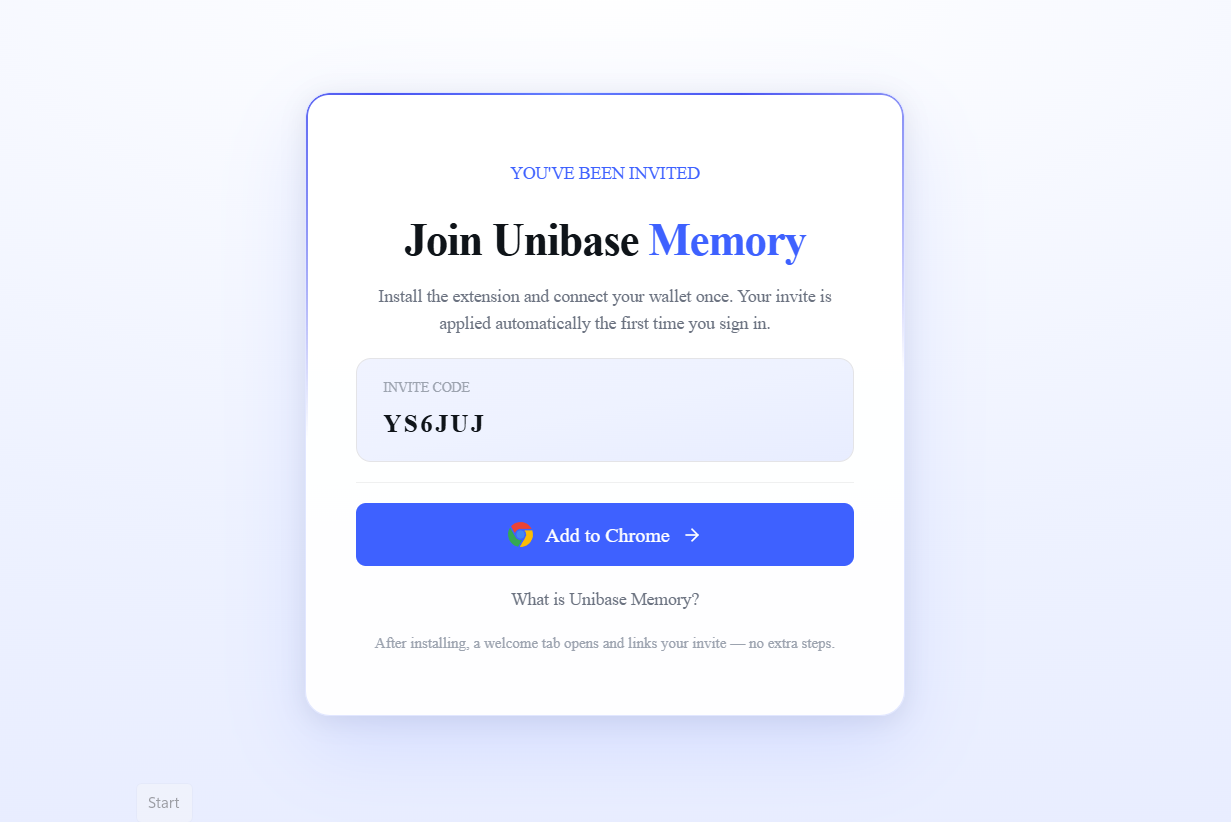
The platform offers Unibase Memory, a Chrome extension that lets users capture, organize, search, encrypt, and reuse conversations across AI assistants such as ChatGPT, Claude, and Gemini.
How It Works
- Create a Unibase account or install the Unibase Memory extension.
- Integrate the Membase SDK or connect your AI agent.
- Store conversations, knowledge, and agent state within decentralized memory.
- Enable AI agents to communicate using the AIP Protocol.
- Configure on-chain identities and autonomous payment capabilities if required.
- Deploy AI agents with persistent memory across supported platforms.
- Continue expanding agent knowledge while maintaining secure, verifiable long-term memory.
Use Cases
Developers can build AI assistants that retain long-term memory.
Organizations can deploy collaborative AI agents across multiple business systems.
Researchers can create decentralized knowledge graphs and Retrieval-Augmented Generation (RAG) applications.
Web3 projects can build autonomous blockchain-native AI agents.
Gaming platforms can develop persistent AI characters that remember player interactions.
DAOs can automate governance using intelligent agents with shared memory.
Financial applications can deploy personalized AI agents capable of learning user preferences over time.
Pricing
Pricing details are not clearly mentioned on the official website. The platform provides open documentation, developer SDKs, and publicly available infrastructure, while commercial pricing for enterprise deployments or premium services is not publicly listed.
Strengths
- Provides persistent memory for autonomous AI agents.
- Supports decentralized and verifiable AI infrastructure.
- Enables cross-platform agent interoperability.
- Includes blockchain-based agent identity.
- Offers SDKs and Model Context Protocol integration.
- Supports autonomous blockchain payments.
- High-performance decentralized data layer.
- Strong focus on Web3-native AI development.
Drawbacks
- Primarily designed for developers and enterprise AI projects rather than casual users.
- Requires familiarity with AI development or blockchain technologies.
- Some infrastructure components are still evolving.
- Public pricing information is limited.
Comparison with Other Platforms
Unlike conventional AI memory frameworks that store context locally or within proprietary cloud services, Unibase provides a decentralized, blockchain-backed memory layer with persistent storage, on-chain identities, interoperability, and autonomous payment capabilities. While traditional memory solutions focus mainly on conversation history, Unibase is designed to support long-term agent collaboration, decentralized knowledge sharing, and Web3-native AI ecosystems.
Customer Reviews and Testimonials
Customer reviews and testimonials are not clearly available on the official website.
Conclusion
Unibase is an advanced infrastructure platform for developers building next-generation AI agents that require long-term memory, decentralized identity, and cross-platform collaboration. By combining persistent memory through Membase, the AIP interoperability protocol, autonomous payments, and decentralized data storage, it provides a comprehensive foundation for creating intelligent AI systems that can continuously learn and evolve. It is particularly well suited for AI developers, Web3 innovators, enterprise research teams, and organizations developing autonomous AI applications.