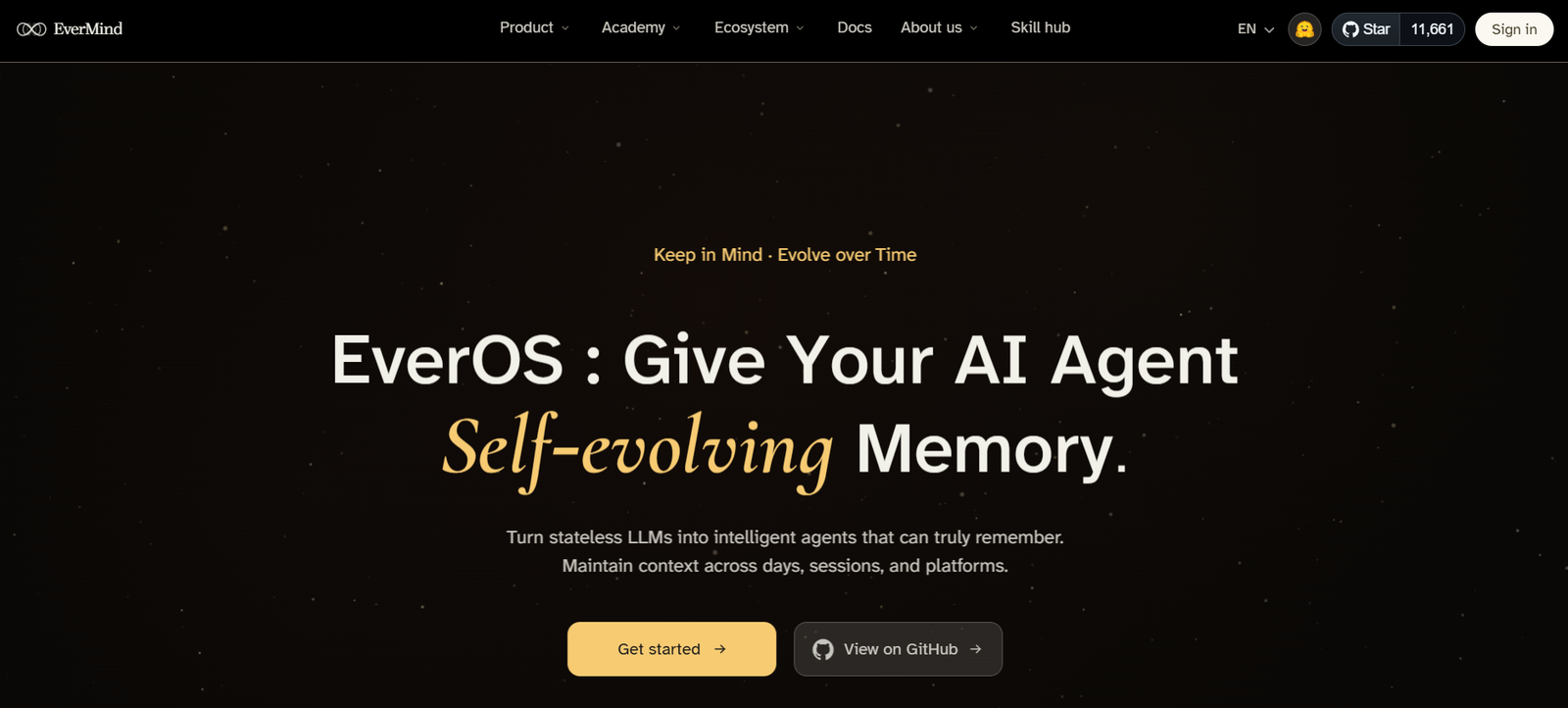
EverMind is an AI infrastructure platform that helps developers and organizations build AI agents with long-term memory and persistent context. Instead of treating every interaction as a new conversation, EverMind enables AI systems to remember previous interactions, learn from experience, and provide more consistent responses over time.
Its flagship platform, EverOS, functions as a memory operating system for AI agents. It combines multimodal retrieval, structured memory management, and self-evolving learning capabilities to support advanced AI applications. The platform is suitable for developers building AI assistants, enterprise knowledge systems, customer support solutions, multi-agent workflows, and personalized AI experiences.
Features
Persistent Long-Term Memory
EverMind allows AI agents to retain information across conversations, sessions, and platforms. This helps create AI systems that provide more personalized and context-aware interactions instead of starting from scratch each time.
Self-Evolving Agent Memory
The platform records previous agent activities and transforms repeated experiences into reusable knowledge. This enables AI agents to improve their performance over time by learning from earlier tasks.
Multimodal Retrieval
EverOS supports multiple content formats, including PDFs, Word documents, spreadsheets, presentations, images, web pages, emails, URLs, and text files. This allows AI agents to retrieve relevant information from diverse data sources through a single memory system.
Memory Bank
Users can inspect, organize, edit, and manage stored memories through a dedicated Memory Bank interface. Different types of memory, such as user memory, group memory, and agent memory, remain transparent and controllable.
Multi-Agent Collaboration
EverMind supports shared memory across multiple AI agents, allowing teams of AI assistants to exchange knowledge and maintain consistent context during collaborative workflows.
Open Source and Cloud Deployment
Organizations can choose between a managed cloud service or deploy the open-source version on their own infrastructure, providing flexibility for different security and compliance requirements.
Personal Memory Hub
EverMe extends the platform by creating a structured digital memory that multiple AI assistants can access. This helps maintain a consistent understanding of user preferences and history across different AI tools.
How It Works
Step 1: Create an EverMind account or deploy the open-source version.
Step 2: Connect your AI agent or application to the EverOS memory platform.
Step 3: Import documents, conversations, URLs, images, or other supported content.
Step 4: Allow the system to organize information into structured memory.
Step 5: AI agents retrieve relevant memories whenever they respond to users.
Step 6: As interactions continue, the platform continuously refines and expands the stored knowledge to improve future responses.
Use Cases
Developers can build AI assistants with persistent memory that improve over time.
Businesses can create enterprise knowledge bases that preserve organizational knowledge.
Customer support teams can deliver personalized service by remembering previous customer interactions.
AI researchers can experiment with memory-augmented large language models.
Organizations building multi-agent systems can enable collaboration through shared memory.
Productivity applications can maintain user context across devices and sessions.
Companies developing AI companions can provide more natural and personalized conversations.
Pricing
Pricing details are not clearly mentioned on the official website. The platform provides cloud and open-source deployment options, but specific subscription plans and pricing are not publicly listed.
Strengths
EverMind focuses specifically on long-term AI memory rather than general language models.
It supports multimodal data ingestion across numerous file formats.
The platform enables persistent context across sessions and applications.
Open-source deployment offers flexibility for organizations with strict data requirements.
Memory management is transparent through the dedicated Memory Bank interface.
It supports collaborative multi-agent environments.
Drawbacks
The platform is primarily designed for developers and enterprise users rather than casual consumers.
Deploying advanced memory infrastructure may require technical expertise.
Pricing information is not publicly available, making cost evaluation difficult.
Organizations may need additional development work to integrate EverMind into existing AI systems.
Comparison with Other Platforms
Unlike traditional AI chat platforms that primarily rely on a model’s context window, EverMind focuses on providing a dedicated long-term memory layer for AI agents. While many retrieval-based systems simply search stored documents, EverMind aims to organize, evolve, and manage memories that improve agent performance over time. This makes it particularly useful for enterprise AI applications, multi-agent environments, and personalized AI assistants where long-term consistency is important.
Customer Reviews and Testimonials
Customer reviews and testimonials are not clearly available on the official website.
Conclusion
EverMind is a specialized AI memory platform built for organizations and developers creating next-generation AI agents. By providing persistent memory, multimodal retrieval, structured knowledge management, and self-evolving learning capabilities, it addresses one of the biggest limitations of current AI systems: the inability to remember over long periods. It is a strong choice for teams building enterprise AI assistants, customer support platforms, knowledge management systems, and advanced AI agent workflows.