
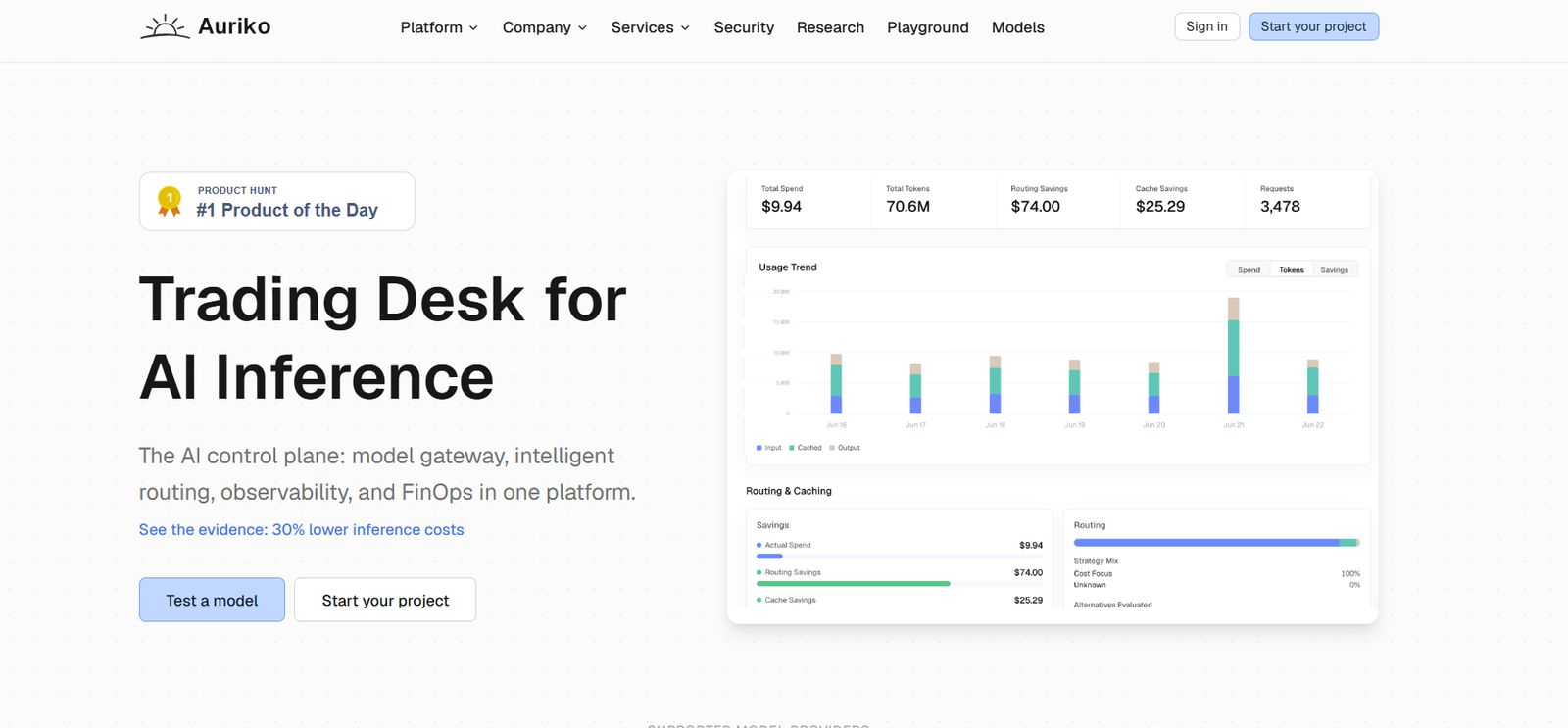
Auriko AI is an enterprise AI infrastructure platform that serves as an AI control plane for large language model (LLM) applications. It provides developers and businesses with a single OpenAI-compatible API to access multiple AI model providers while automatically optimizing requests for cost, speed, reliability, and availability.
Instead of integrating separately with multiple AI providers, users connect once to Auriko and gain access to models from providers such as OpenAI, Anthropic, Google AI Studio, xAI, DeepSeek, Together AI, Fireworks AI, and others. The platform also includes intelligent routing, automatic failover, observability, usage analytics, and budget management, making it suitable for production AI applications.
Features
Unified AI Gateway
Auriko provides one API for accessing multiple LLM providers, allowing developers to switch models without changing application logic.
Intelligent Model Routing
The platform automatically routes requests to the most suitable provider based on factors such as latency, pricing, cache performance, and reliability.
Cost Optimization
Auriko analyzes inference costs across providers and helps reduce AI expenses by selecting the most cost-effective route for each request.
Automatic Failover
If one provider becomes unavailable, Auriko automatically redirects requests to another supported provider to maintain application uptime.
Observability and Analytics
Users can monitor AI usage, latency, provider health, throughput, and inference performance through built-in observability tools.
Budget Controls
Organizations can configure spending limits, usage alerts, and workspace-level budgets to better manage AI operating costs.
API Key Orchestration
Auriko supports both customer-managed API keys and platform-managed keys, helping organizations optimize capacity across providers.
Global Infrastructure
The platform routes requests through a globally distributed edge network to improve performance and reduce latency.
How It Works
- Create an Auriko account.
- Generate an API key from the dashboard.
- Replace your existing OpenAI API endpoint with the Auriko endpoint.
- Select the AI model or configure routing preferences.
- Send API requests as usual using an OpenAI-compatible SDK.
- Auriko automatically manages routing, failover, cost optimization, and provider selection.
Use Cases
Developers can build AI applications using multiple LLM providers through one API.
AI startups can reduce inference costs while maintaining performance.
Enterprises can improve application reliability with automatic provider failover.
Engineering teams can monitor AI infrastructure using built-in observability.
Businesses can optimize AI spending with intelligent routing strategies.
Platform teams can manage API keys, budgets, and provider capacity from a centralized dashboard.
Pricing
The official website does not clearly publish fixed pricing plans. Users can start a project or request a demo, while pricing depends on usage and deployment requirements.
Strengths
Supports numerous leading AI providers through a single API.
OpenAI-compatible integration minimizes migration effort.
Intelligent routing helps reduce inference costs.
Automatic failover improves production reliability.
Built-in observability and budget management simplify AI operations.
Suitable for enterprise-scale AI deployments.
Drawbacks
Primarily designed for developers and enterprise engineering teams.
Requires technical knowledge to configure routing strategies effectively.
Pricing details are not publicly available.
Organizations remain dependent on an intermediary platform for AI routing.
Comparison with Other Platforms
Unlike platforms that connect developers to a single AI provider, Auriko acts as an AI control plane that intelligently routes requests across multiple providers. Its focus on cost optimization, observability, failover, and infrastructure management makes it particularly valuable for production AI systems where reliability and operational efficiency are important. Rather than replacing foundation models, Auriko enhances how businesses manage and optimize access to them.
Customer Reviews and Testimonials
Customer reviews and testimonials are not clearly available on the official website.
Conclusion
Auriko AI is a powerful infrastructure platform for developers and enterprises building production-grade AI applications. By combining a unified API, intelligent routing, automatic failover, observability, and cost optimization, it simplifies multi-model AI deployment while improving reliability and reducing operational complexity. Organizations seeking scalable AI infrastructure may find Auriko AI an effective solution for managing modern LLM workloads.


