Upstream Tech is a climate technology company that develops remote sensing tools to help organizations monitor and manage environmental resources at scale. By leveraging satellite imagery, machine learning, and data science, Upstream Tech provides actionable insights to land trusts, water utilities, conservation groups, and sustainability teams.
Founded with a mission to accelerate environmental work, the company delivers software products that make it easier to track ecosystem health, measure climate impact, and inform resource stewardship using high-resolution data.
Upstream Tech operates under the belief that better data leads to better decisions. With user-friendly platforms and science-backed analytics, the company empowers teams to make informed, cost-effective choices in land and water management.
Features
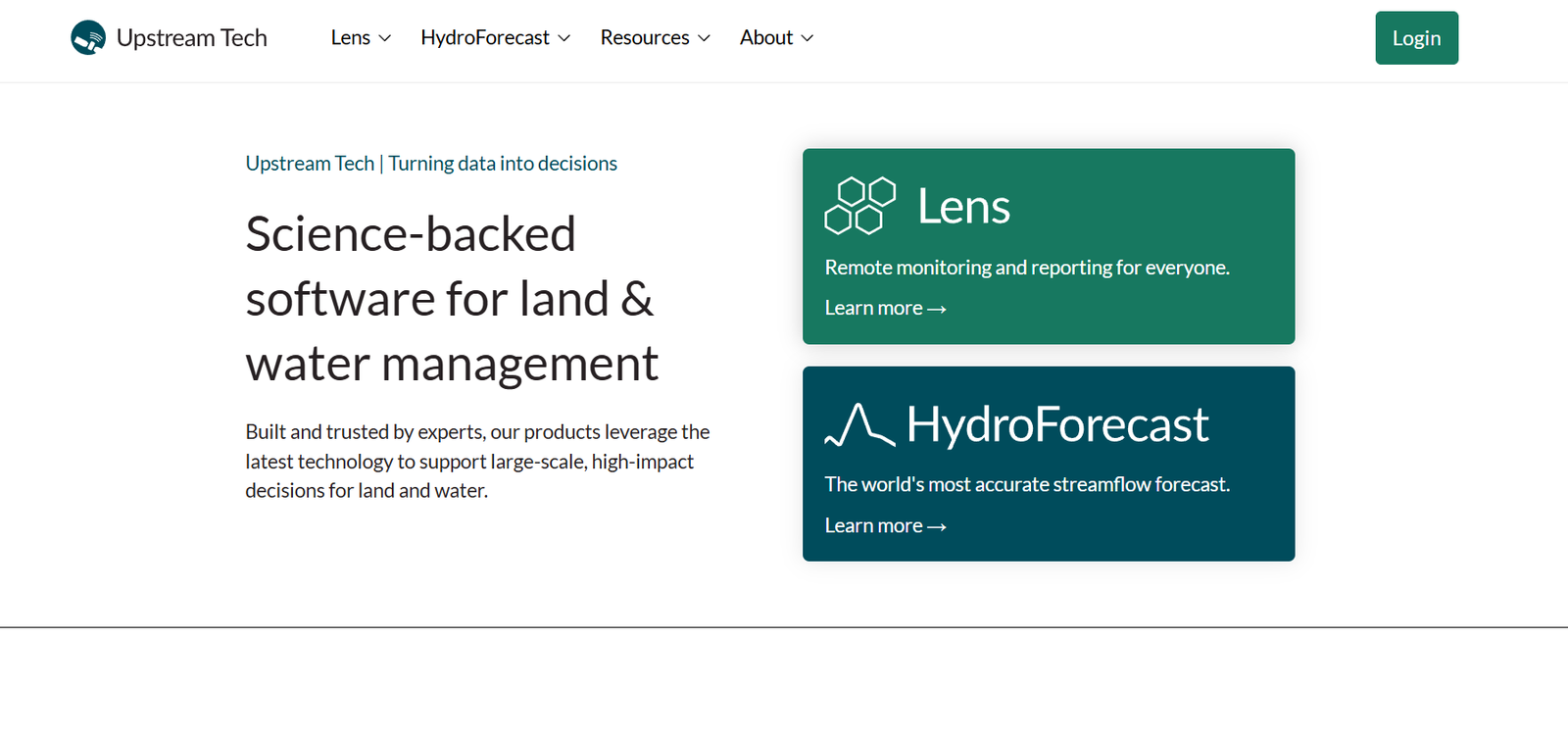
Upstream Tech offers two core products: Lens and HydroForecast, each serving distinct but complementary environmental monitoring needs.
Lens is a remote monitoring platform that uses satellite imagery and machine learning to track changes in landscapes over time. It is specifically built for land conservation and stewardship teams.
Access to multi-year satellite imagery from sources like Sentinel-2 and Planet
Automated change detection (e.g., vegetation loss, development, deforestation)
Custom monitoring reports and annotation tools for field teams
Historical imagery and cloud-free composites for clear visualization
Integration with property boundaries, easements, and stewardship records
HydroForecast is a water forecasting and decision-support platform that uses machine learning to generate streamflow forecasts for water managers, hydropower utilities, and environmental planners.
Accurate, real-time and long-range streamflow forecasting
No hardware needed – data is generated from remote sensing and meteorological inputs
Supports decision-making for reservoir management, flood control, and energy planning
Scalable across basins and adaptable to climate change scenarios
Both products include user-friendly dashboards, data exports, alerts, and integrations with existing planning and reporting tools.
How It Works
Upstream Tech’s platforms ingest satellite and weather data from global sources and use advanced analytics to generate meaningful insights for environmental monitoring.
For Lens, users begin by uploading parcels or conservation easement boundaries. The platform overlays these with satellite imagery to create visual timelines of the land. AI models detect changes in land cover or vegetation that may indicate unauthorized development, natural disturbance, or degradation.
Users can annotate, flag, and export reports to support compliance, stewardship, or donor engagement. Lens eliminates the need for frequent site visits while still ensuring robust oversight of protected lands.
For HydroForecast, Upstream Tech uses hydrologic modeling, remote sensing, and machine learning to produce accurate streamflow forecasts. The system is continuously updated with weather, snowpack, soil moisture, and vegetation data to improve predictive accuracy.
The platform outputs forecasts at daily to seasonal timescales, with confidence intervals and scenario modeling for drought, storm, or climate impacts.
Both platforms are cloud-based and require no on-site installation, making them ideal for teams working across large or remote geographies.
Use Cases
Upstream Tech supports a wide variety of stakeholders in environmental management, conservation, and climate resilience.
Land trusts and conservation NGOs use Lens to monitor protected properties, ensuring compliance with conservation easements and detecting unauthorized changes.
Hydropower and water utilities use HydroForecast to optimize reservoir operations, manage water supply, and plan energy generation based on real-time and predictive inflows.
Government agencies apply both platforms for land use monitoring, flood mitigation, habitat protection, and sustainable water management.
Climate-focused investment firms and carbon offset project developers use Lens for remote project verification, improving transparency and MRV (monitoring, reporting, verification).
Watershed managers and nonprofit organizations leverage HydroForecast for drought planning, flood control, and environmental flow restoration.
Universities and researchers use both platforms to support climate science, environmental economics, and policy analysis.
Pricing
Upstream Tech does not publish standard pricing on its website. Pricing is customized based on the number of properties or basins monitored, the level of data access required, and the features included.
Key pricing considerations include:
Number and size of parcels (for Lens)
Frequency of updates and satellite sources
Forecast customization and basin complexity (for HydroForecast)
User seats, data export needs, and integration scope
Organizations can request a demo or consultation through the Upstream Tech website to receive a tailored quote and platform access.
Both Lens and HydroForecast are available via annual subscriptions, with add-on features and support based on client requirements.
Strengths
Upstream Tech offers best-in-class environmental monitoring using satellite data and AI, with a focus on usability, scalability, and actionable insights.
Its platforms allow teams to cover large areas remotely, reducing the need for costly and time-consuming site visits.
The integration of machine learning ensures accurate detection of change in land or water conditions over time.
Lens is particularly valuable for conservation easement monitoring, offering photographic evidence and change alerts that support compliance and stewardship.
HydroForecast provides real-time water forecasts without the need for on-site sensors, making it ideal for climate-adaptive water planning.
The platforms are known for ease of use, elegant dashboards, and rapid deployment without technical overhead.
Upstream Tech’s commitment to environmental impact is reflected in its B Corporation certification and partnerships with conservation groups worldwide.
Drawbacks
The platform is optimized for U.S.-based and high-resolution satellite coverage areas—international or highly localized monitoring may require custom support.
Pricing is not transparent, which may deter small NGOs or projects with limited budgets from exploring the platform quickly.
Lens is tailored to land-based use cases, so marine or wetland monitoring may require adaptation or alternative tools.
HydroForecast works best for regions with robust weather and climate data inputs—in data-poor basins, forecast accuracy may be lower.
While user-friendly, custom model development or API integrations may require technical coordination with the Upstream Tech team.
Comparison with Other Tools
Compared to remote sensing platforms like Planet or Sentinel Hub, Upstream Tech delivers actionable insights, not just imagery—making it more suitable for non-technical teams.
Unlike general GIS platforms like ArcGIS, Upstream Tech’s products are purpose-built for environmental stewardship, reducing complexity and setup time.
While tools like LandPKS or OpenET offer specific datasets (e.g., soil, evapotranspiration), Upstream Tech provides a complete monitoring and forecasting workflow.
In contrast to HydroShare or other open-source water data platforms, HydroForecast delivers predictive analytics, not just real-time data.
Upstream Tech complements carbon MRV platforms like Carbonfuture or Sylvera by enabling landscape-level verification and visualization for nature-based projects.
Customer Reviews and Testimonials
Upstream Tech is widely used by leading conservation organizations, including The Nature Conservancy, Open Space Institute, River Network, and state and local governments.
Users highlight its intuitive design, accuracy of detection, and professional reporting tools as key benefits.
Land trusts report improved monitoring efficiency and stronger legal documentation through the Lens platform.
Hydropower clients note the accuracy and reliability of forecasts, enabling better water and energy management.
Multiple reviews emphasize excellent customer support and a mission-aligned team dedicated to environmental impact.
Conclusion
Upstream Tech is redefining how environmental work is done by bringing powerful satellite-driven insights to the fingertips of land and water managers. Its Lens and HydroForecast platforms are trusted tools for scaling stewardship, improving compliance, and planning for a climate-resilient future.
With its strong emphasis on usability, scientific rigor, and environmental mission, Upstream Tech is an essential partner for any organization committed to protecting natural resources and accelerating climate solutions.