
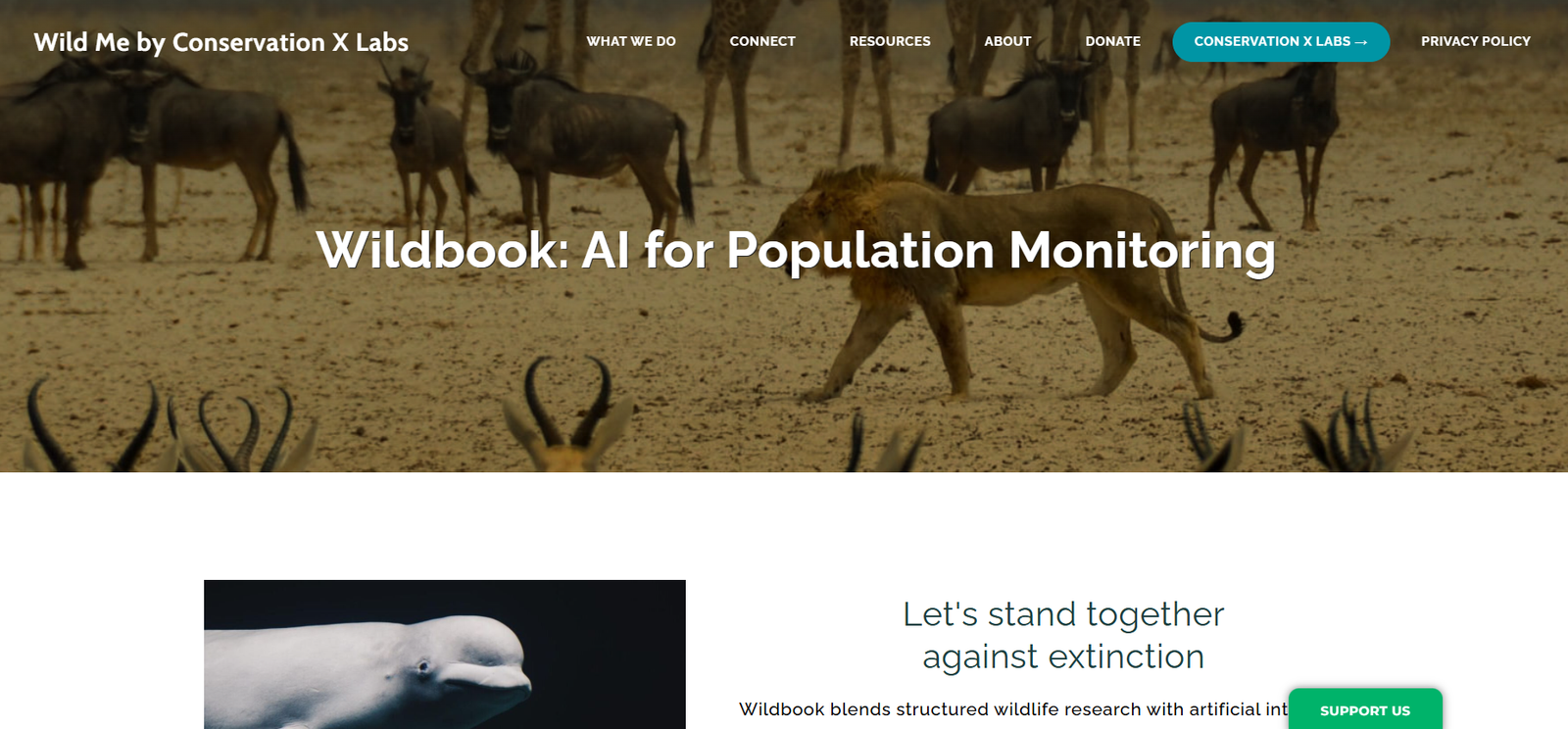
Wild Me is an innovative nonprofit organization that develops open-source, AI-powered software to support wildlife conservation. By using computer vision and machine learning, Wild Me enables researchers and conservationists to identify and track individual animals through photographs—removing the need for invasive tagging or physical tracking methods.
Founded to bridge the gap between cutting-edge technology and biodiversity research, Wild Me creates tools that automate the identification of wildlife species such as whale sharks, zebras, giraffes, snow leopards, and more. Its flagship platform, Wildbook, acts as both a research database and a citizen science portal where users around the world can contribute wildlife images and data.
Wild Me’s work is supported by partners like Microsoft AI for Earth and is widely used by conservationists, universities, NGOs, and government organizations to accelerate species monitoring, reduce data collection time, and enhance global biodiversity studies.
Features:
Wildbook Platform
A cloud-based database and analytics system for identifying and tracking individual animals using photos.AI-Powered Image Recognition
Uses machine learning and computer vision to detect species and match individual animals by unique physical patterns like stripes or spots.Citizen Science Integration
Allows the public to upload wildlife photos, increasing the volume of usable data for researchers.Species-Specific Wildbooks
Each species has a dedicated Wildbook (e.g., Whale Shark Wildbook, GiraffeSpotter) tailored to its unique identification features.Automated Matching Algorithms
Reduces manual work by suggesting matches for known individuals and flagging new ones.Open Source Software
Wild Me’s technology is free and open source, encouraging customization and collaboration.Photo-Based Mark-Recapture
Applies statistical methods to photo data for population estimates and conservation impact assessments.Collaborative Research Tools
Facilitates data sharing and joint analysis between global researchers and conservationists.Cloud-Based Architecture
Enables global access to data, supports scalability, and allows real-time updates.
How It Works:
Photo Collection
Wildlife photos are captured by researchers, tourists, camera traps, or citizen scientists.Photo Upload to Wildbook
Images are uploaded to the relevant Wildbook platform, along with metadata such as location, date, and photographer details.Image Analysis with AI
Wild Me’s system uses AI to detect the animal, identify species, and analyze visual patterns like spots, scars, or fin shapes.Individual Identification
If the animal is already in the system, it’s matched and updated. If it’s new, a unique ID is created.Tracking and Research
Researchers can monitor movement, health, and behavior over time, aiding conservation planning and population analysis.Data Sharing and Reporting
Tools within the platform allow for data export, reporting, and publication support for scientific and conservation work.
Use Cases:
Wildlife Conservation
Track endangered species populations and understand their migratory patterns to improve protection strategies.Ecological Research
Study individual animal behavior, health, and interactions over time using non-invasive tracking.Citizen Science Projects
Engage the public in conservation by allowing photo contributions that directly support scientific work.Protected Area Management
Use photo data to monitor wildlife in national parks and conservation reserves.Academic Research and Education
Support teaching and university research projects in ecology, data science, and conservation biology.
Pricing:
Wild Me’s software and platforms are completely free and open source, aligned with its nonprofit mission. Costs associated with usage may only arise from:
Hosting and infrastructure (for self-hosted versions)
Custom development or integration support
Research funding required for specific data collection projects
Wild Me also accepts donations and funding to support ongoing development and expansion. Organizations interested in collaboration can reach out through:
https://www.wildme.org/contact
Strengths:
Non-Invasive Monitoring: No need for physical tagging or collaring—uses photos to track animals.
Free and Open Source: Accessible to researchers and organizations regardless of budget.
Scalable AI Technology: Supports high-volume photo analysis and identification across various species.
Citizen Science Engagement: Expands data input and public involvement.
Global Reach: Used by researchers and conservationists across continents.
Species-Specific Adaptation: Offers tools tailored to the needs of individual animal types.
Collaborative Focus: Built for teamwork and data sharing within the global conservation community.
Drawbacks:
Requires High-Quality Photos: Accuracy is dependent on image clarity and resolution.
Limited to Visible Identifiers: Animals without unique physical patterns may not be easily tracked.
Internet Access Required: Cloud-based platforms need reliable connectivity for uploads and analysis.
Dependent on Volunteer Contributions: Some Wildbooks rely heavily on citizen uploads for data volume.
Not a Full Wildlife Management System: Wild Me focuses on identification and tracking, not habitat management or law enforcement tools.
Comparison with Other Tools:
Zooniverse: A broader citizen science platform for varied research topics; Wild Me focuses specifically on wildlife ID and tracking.
SMART (Spatial Monitoring and Reporting Tool): Designed for ranger patrols and anti-poaching; Wild Me is best for individual animal tracking via imagery.
Movebank: Tracks animal movement via GPS tagging; Wild Me uses non-invasive, image-based tracking.
iNaturalist: Encourages public species observations; Wild Me identifies individual animals and supports longitudinal research.
Customer Reviews and Testimonials:
Wild Me’s platforms are trusted by:
National Geographic Explorers
WWF
University researchers
Marine conservationists
Wildlife tourism operators
User feedback highlights:
“Incredibly useful for tracking individual whale sharks across regions.”
“A breakthrough in non-invasive animal research.”
“The automation tools save us hundreds of hours.”
Wild Me has received recognition and support from:
Microsoft AI for Earth
National Science Foundation
Esri Conservation Program
Conclusion:
Wild Me is redefining wildlife conservation with AI and open data. By automating individual animal identification from photographs, it removes barriers to tracking endangered species, making conservation more scalable, ethical, and effective. Through its Wildbook platforms, Wild Me brings together scientists, volunteers, and technology to protect biodiversity in a rapidly changing world.
Ideal for conservationists, academic researchers, and citizen scientists, Wild Me represents the future of wildlife monitoring—where AI, collaboration, and open science drive real-world impact.


