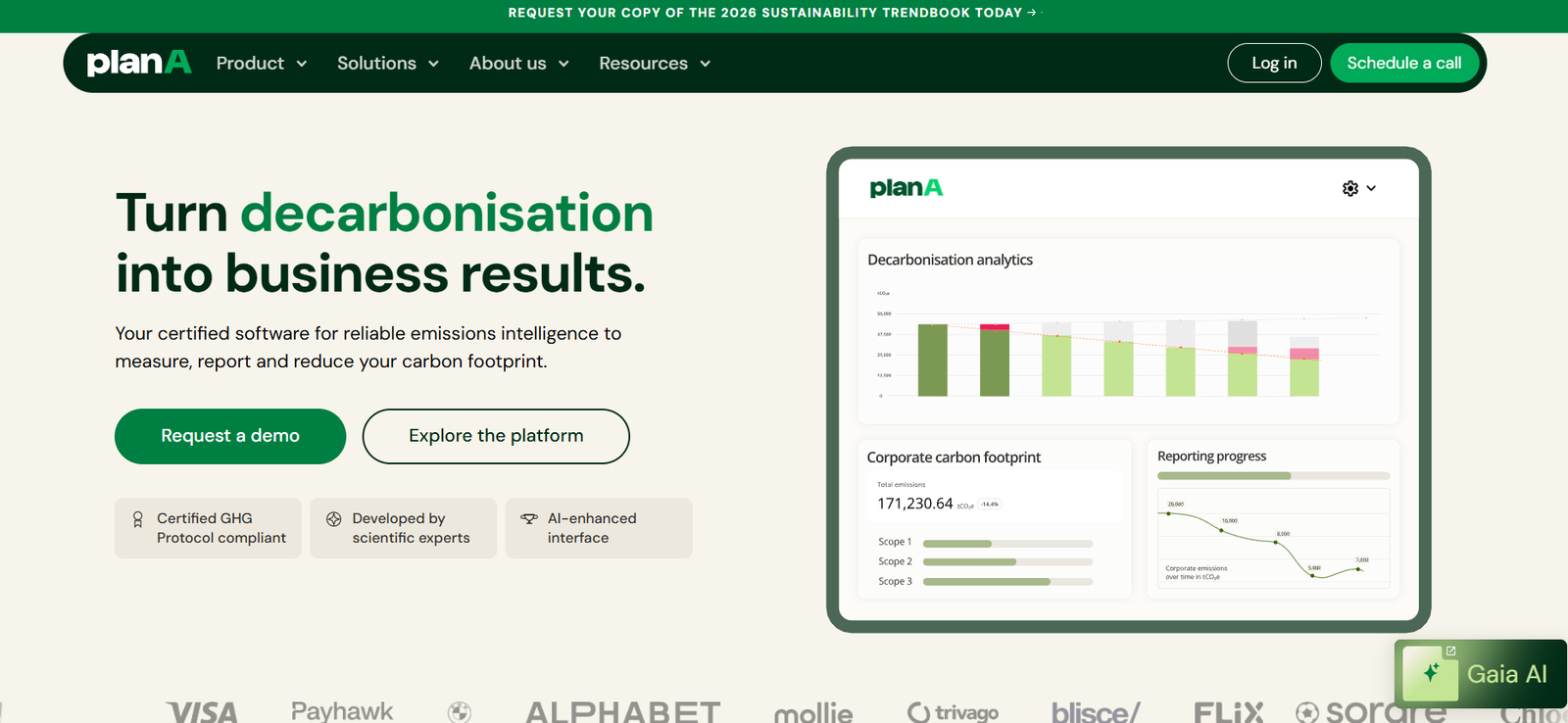
Plan A is a leading carbon accounting and ESG reporting platform designed to help enterprises measure, monitor, and reduce their environmental impact. Headquartered in Berlin, Germany, Plan A empowers companies with data-driven tools to achieve Net Zero targets, comply with evolving sustainability regulations like the CSRD and SFDR, and report according to leading global frameworks such as the GHG Protocol, CDP, TCFD, and SBTi.
Founded in 2017, Plan A has quickly become a key player in the climate tech space, providing a science-based, AI-driven platform that automates carbon footprint calculations across Scopes 1, 2, and 3. It also offers in-platform decarbonization planning, supplier engagement, and ESG performance tracking.
Plan A is used by global companies across sectors including manufacturing, finance, logistics, and retail, and it has earned recognition for its high standards, scientific accuracy, and ease of use.
Features:
Automated Carbon Accounting
Uses AI to automate emissions calculations across Scopes 1, 2, and 3 based on activity data, ensuring accuracy and scalability.Science-Based Methodology
Compliant with the GHG Protocol and aligned with the SBTi (Science Based Targets initiative) to ensure methodological transparency and credibility.Decarbonization Planning Tools
Helps businesses create and track customized emissions reduction strategies with measurable KPIs and ROI projections.ESG Reporting Automation
Supports automatic generation of reports aligned with frameworks like CSRD, CDP, TCFD, EU Taxonomy, and SFDR.Scope 3 and Value Chain Modeling
Models upstream and downstream emissions across supply chains, even with limited supplier data.Supplier Engagement Portal
Collects emissions data directly from suppliers, allowing companies to improve Scope 3 data accuracy and work toward shared goals.Data Quality and Assurance Tools
Tracks data completeness, quality, and improvement areas through a proprietary data assurance engine.Audit-Ready Dashboards
Enables easy export of verifiable data for internal use, investor reporting, or third-party audits.Integrations and APIs
Connects with enterprise systems such as ERP, procurement, and HR software for automated data ingestion.
How It Works:
Data Collection and Integration
Plan A integrates with internal systems or accepts manual uploads of operational, financial, and supplier data to establish an emissions baseline.Emissions Calculation
The platform uses industry-standard emissions factors to compute Scope 1 (direct), Scope 2 (indirect energy), and Scope 3 (value chain) emissions.Data Quality Scoring
Each data point is assessed and scored for accuracy, completeness, and granularity, helping organizations identify gaps and improvement areas.Decarbonization Planning
Businesses can simulate different emissions reduction strategies and receive actionable guidance tailored to their operations.ESG Reporting
Automatically generates formatted ESG disclosures that comply with CSRD, CDP, and other frameworks—eliminating manual ESG tracking.Continuous Monitoring
As new data is added, dashboards update in real time, allowing organizations to track performance and progress toward Net Zero goals.Supplier Engagement
Suppliers can log in to submit primary data, enhancing the quality of Scope 3 reporting and promoting collaboration across the value chain.
Use Cases:
Large Enterprises
Centralize emissions and ESG data to meet compliance and stakeholder expectations across global operations.Financial Institutions
Assess and report portfolio emissions, meet SFDR requirements, and integrate sustainability into investment decisions.Manufacturing and Logistics
Track plant- or route-level emissions, assess material-level impact, and plan cost-effective decarbonization.Retail and Consumer Brands
Capture product-level emissions, engage suppliers, and support sustainable sourcing initiatives.Sustainability and ESG Teams
Automate ESG reporting and use real-time analytics to drive data-informed climate strategies.
Pricing:
Plan A offers custom enterprise pricing based on the following factors:
Size and complexity of operations
Number of entities or locations
Scope and depth of emissions calculations
Level of reporting and regulatory compliance required
Need for integrations or advisory services
While pricing is not listed publicly, prospective customers can schedule a consultation and demo via the official website:
https://plana.earth/contact
Strengths:
Comprehensive Scope 1–3 Coverage: Allows accurate carbon accounting across the entire value chain.
Regulatory-Ready: Fully supports CSRD, SFDR, CDP, and SBTi reporting needs.
Built for Enterprises: Scalable architecture and robust integration support for complex organizations.
User-Friendly Interface: Intuitive dashboards and clean reporting tools simplify compliance and communication.
Supplier Collaboration Tools: Encourages primary data sharing, improving Scope 3 accuracy.
AI-Powered Automation: Reduces manual work and accelerates reporting cycles.
Verified by Third Parties: Methodologies validated by independent experts and aligned with science-based targets.
Drawbacks:
Enterprise-Only: Not suited for small businesses or individuals—tailored for mid to large companies.
Pricing Not Publicly Transparent: Requires direct inquiry for quotes and implementation timelines.
Requires Data Readiness: Full platform benefits depend on the availability of clean, structured internal data.
Learning Curve for New Users: While user-friendly, the platform’s depth may require onboarding support for some teams.
Comparison with Other Tools:
Watershed: Both platforms provide robust carbon accounting and ESG reporting. Plan A emphasizes supplier engagement and European regulatory compliance (e.g. CSRD, SFDR), while Watershed offers a real-time U.S.-centric approach.
Persefoni: Persefoni offers finance-grade carbon accounting, with a strong focus on audit readiness. Plan A adds decarbonization planning and more interactive supplier collaboration features.
Normative: Similar emphasis on Scope 3 and ESG compliance, but Plan A provides more advanced planning tools and a modular interface for enterprise users.
Sweep: Both tools support ESG tracking, but Plan A focuses more heavily on carbon accounting, science-based targets, and EU-aligned compliance.
Customer Reviews and Testimonials:
Plan A is trusted by global brands such as:
BMW Group
Societe Generale
Trivium Packaging
KFC France
Chloé
Customers report benefits such as:
Fast implementation and onboarding
High data accuracy and audit confidence
Ease of CSRD and CDP reporting
Better supplier engagement across value chains
Recognition:
Certified B Corporation
Selected by the World Economic Forum’s Global Innovators Community
Winner of several European climate tech awards
More case studies and resources are available here:
https://plana.earth/resources
Conclusion:
Plan A is a top-tier ESG and carbon accounting platform purpose-built for enterprises ready to meet the demands of a rapidly evolving regulatory and stakeholder landscape. With advanced emissions modeling, audit-ready reporting, and scalable decarbonization planning tools, Plan A enables companies to move beyond compliance and lead in sustainability performance.
Its AI-powered engine, intuitive design, and science-based approach make it a powerful tool for any organization looking to operationalize its Net Zero journey and future-proof its ESG strategy.