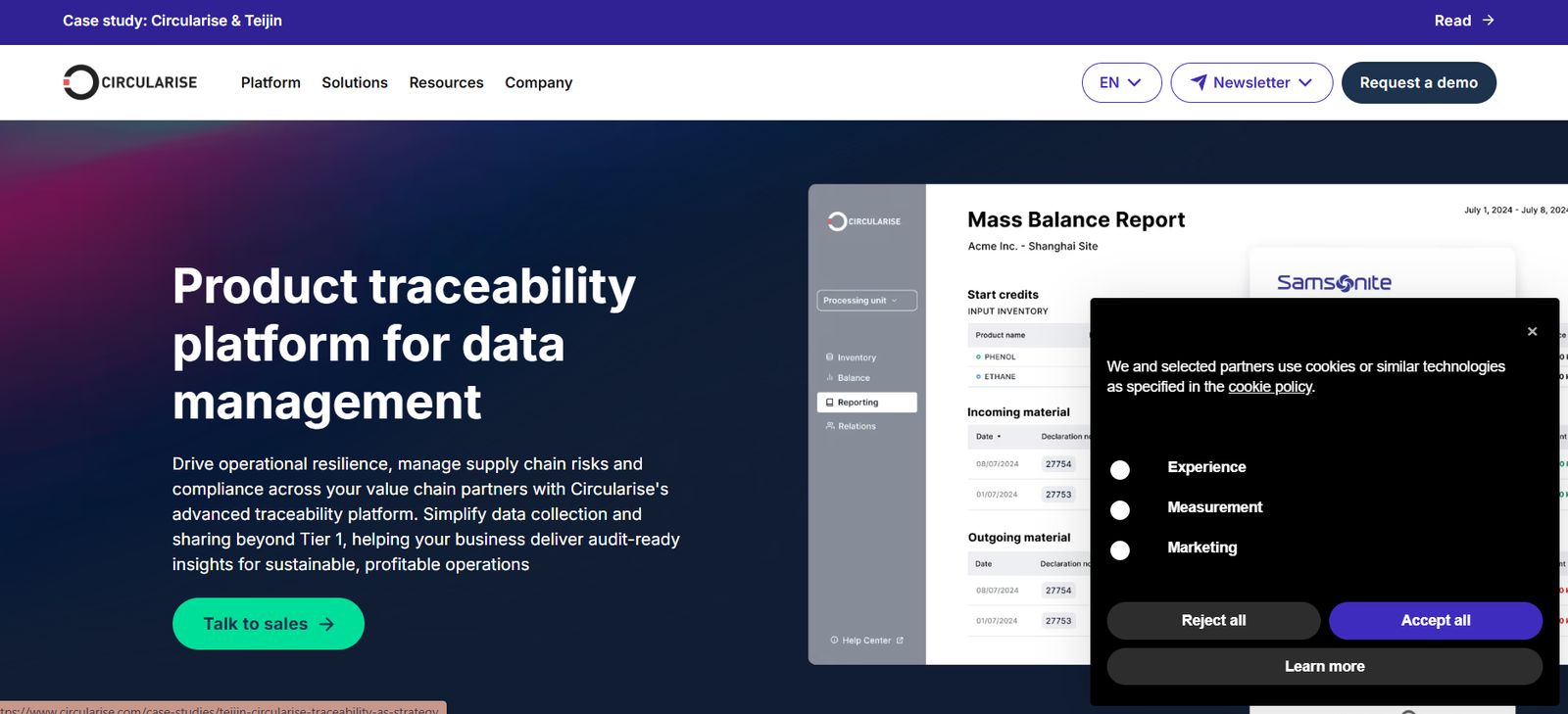
Circularise is a supply chain traceability and transparency platform that leverages blockchain technology to enable circular economy practices. It helps manufacturers, suppliers, and recyclers share verified information across complex supply chains—such as material composition, origin, carbon footprint, and compliance data—without disclosing sensitive business information.
Founded in the Netherlands, Circularise aims to make supply chains more sustainable and circular by enabling data sharing, while maintaining data confidentiality through a patented “Smart Questioning” technology. The platform is used in industries like automotive, chemicals, electronics, plastics, and fashion, where full transparency is often difficult due to the multi-tier nature of supply chains.
By combining decentralized infrastructure, digital product passports, and secure data exchange protocols, Circularise empowers businesses to comply with upcoming regulations such as the EU Battery Regulation, CSRD, and Digital Product Passport (DPP) requirements, while also meeting internal sustainability goals.
Features:
Blockchain-Based Traceability
Uses decentralized ledger technology to ensure immutable and verifiable records across supply chains.Smart Questioning Protocol
Patented technology that allows companies to request and receive verified answers to specific data queries (e.g., material origin, recycled content) without exposing sensitive information.Digital Product Passports (DPPs)
Creates digital identities for products and materials, allowing for easy tracking and regulatory compliance throughout a product’s lifecycle.Decentralized Data Sharing
Enables secure and confidential data exchange between suppliers, OEMs, and recyclers without central ownership.Compliance Reporting Tools
Supports regulatory compliance with CSRD, EU Battery Regulation, EPR (Extended Producer Responsibility), and other frameworks.Material and CO₂ Tracking
Allows organizations to monitor carbon emissions, recycled content, and material origin from raw material to end-of-life.APIs and Integration Support
Offers APIs for integration with ERP, PLM, and other enterprise systems to streamline workflows.User Access Control
Ensures data governance and security by allowing participants to define access rights and data visibility levels.Multi-Stakeholder Collaboration
Supports engagement across multiple supply chain tiers, fostering trust and coordination between all parties involved.
How It Works:
Digital Twin Creation
Companies create digital representations (digital twins) of their products or materials and upload relevant data securely to the Circularise platform.Smart Questioning Process
Stakeholders can ask questions about a product’s sustainability, origin, or compliance characteristics without accessing the full dataset. The platform validates and returns only the answer to the specific query.Blockchain Registration
All transactions and data exchanges are logged on a decentralized blockchain ledger, ensuring transparency and immutability.Access Control and Anonymity
Suppliers maintain control over what information is shared and with whom, preserving confidentiality and competitive advantage.Verification and Auditability
Verifiers or third-party certifiers can authenticate data (such as recycled content claims), and their confirmations are stored on-chain.Integration with Existing Systems
Businesses can integrate Circularise with their current digital infrastructure for seamless traceability and compliance workflows.
Use Cases:
Automotive Industry
Track materials like plastics, metals, and batteries across multi-tier supply chains to meet regulatory and OEM requirements.Plastics and Chemicals
Prove the recycled content of resins or the bio-based origin of inputs without disclosing proprietary formulations.Electronics and Batteries
Comply with the EU Battery Regulation by disclosing carbon footprint and critical raw material sourcing in a secure and auditable format.Fashion and Textiles
Offer end-to-end transparency on garment origin, material composition, and environmental impact to support circular fashion initiatives.Recyclers and Waste Managers
Use product passports to identify materials during disassembly and improve material recovery and sorting.Sustainability and Compliance Teams
Automate ESG reporting processes and prove sustainability claims with verifiable data trails.
Pricing:
Circularise follows a custom enterprise pricing model, which varies based on:
Number of digital product passports or assets tracked
Scope of supply chain mapping (tiers, number of participants)
Required integrations with ERP, PLM, or ESG systems
Volume of data queries and API access
Support and onboarding services
While pricing is not publicly disclosed, interested organizations can request a custom quote or book a demo via:
https://www.circularise.com/contact
Circularise also participates in publicly funded projects and industry consortiums, which may provide early access or co-funded implementations.
Strengths:
Patented Data Privacy Technology: Smart Questioning enables traceability without exposing sensitive supplier data.
Blockchain-Based Security: Provides immutable and verifiable data records.
Regulatory Readiness: Built to support Digital Product Passports, EU Battery Regulation, CSRD, and more.
Cross-Industry Use: Adaptable to a wide range of sectors, from chemicals to automotive to fashion.
Supports Circular Economy Goals: Helps companies trace material flows and improve recyclability and reuse.
Interoperability: Integrates with existing enterprise software and third-party verification systems.
Data Ownership and Control: Each participant retains ownership of their data with full control over who accesses it.
Drawbacks:
Enterprise-Focused: Not suitable for small businesses or individuals due to system complexity and integration needs.
Implementation Time: May require onboarding and training to map supply chains and align partners.
Requires Supplier Participation: Success depends on buy-in and data input from all supply chain stakeholders.
No Public Pricing: Lack of transparency may delay early-stage budgeting and comparison.
Relatively New Market Segment: Some companies may need additional education to fully understand blockchain-based traceability benefits.
Comparison with Other Tools:
Everledger: Focuses on blockchain traceability in luxury goods (e.g. diamonds). Circularise supports broader materials and industries.
Minespider: Specializes in supply chain transparency for raw materials. Circularise is more flexible across sectors and includes Smart Questioning for data privacy.
SAP GreenToken: Targets chemical traceability with a token-based model. Circularise offers a more open, decentralized approach with patented privacy features.
IBM Food Trust: Food-focused blockchain platform. Circularise is sector-agnostic and more privacy-oriented for industrial use.
Customer Reviews and Testimonials:
Circularise collaborates with major global brands and has been featured in several pilot projects, industry consortiums, and EU-funded initiatives. While individual user reviews are not publicly listed, key collaborations include:
Porsche – Tracing plastic components in the automotive supply chain.
Covestro – Tracking recycled and bio-based plastics across complex manufacturing networks.
Brightlands Chemelot Campus – Proving chemical origin in collaboration with research institutions.
Shell – Involved in circular plastics and digital product passport initiatives.
Industry recognition includes features in Forbes, Reuters, and winning the Solar Impulse Efficient Solution Label.
Conclusion:
Circularise is a next-generation traceability solution purpose-built for the circular economy. By combining blockchain security with privacy-preserving data sharing, it enables full supply chain transparency without sacrificing data confidentiality—a critical factor for highly competitive, multi-tier industries.
As regulations around product traceability and ESG disclosure become more stringent, Circularise offers companies a scalable, secure, and future-ready platform to meet compliance goals, build trust, and accelerate the transition to a circular and sustainable economy.