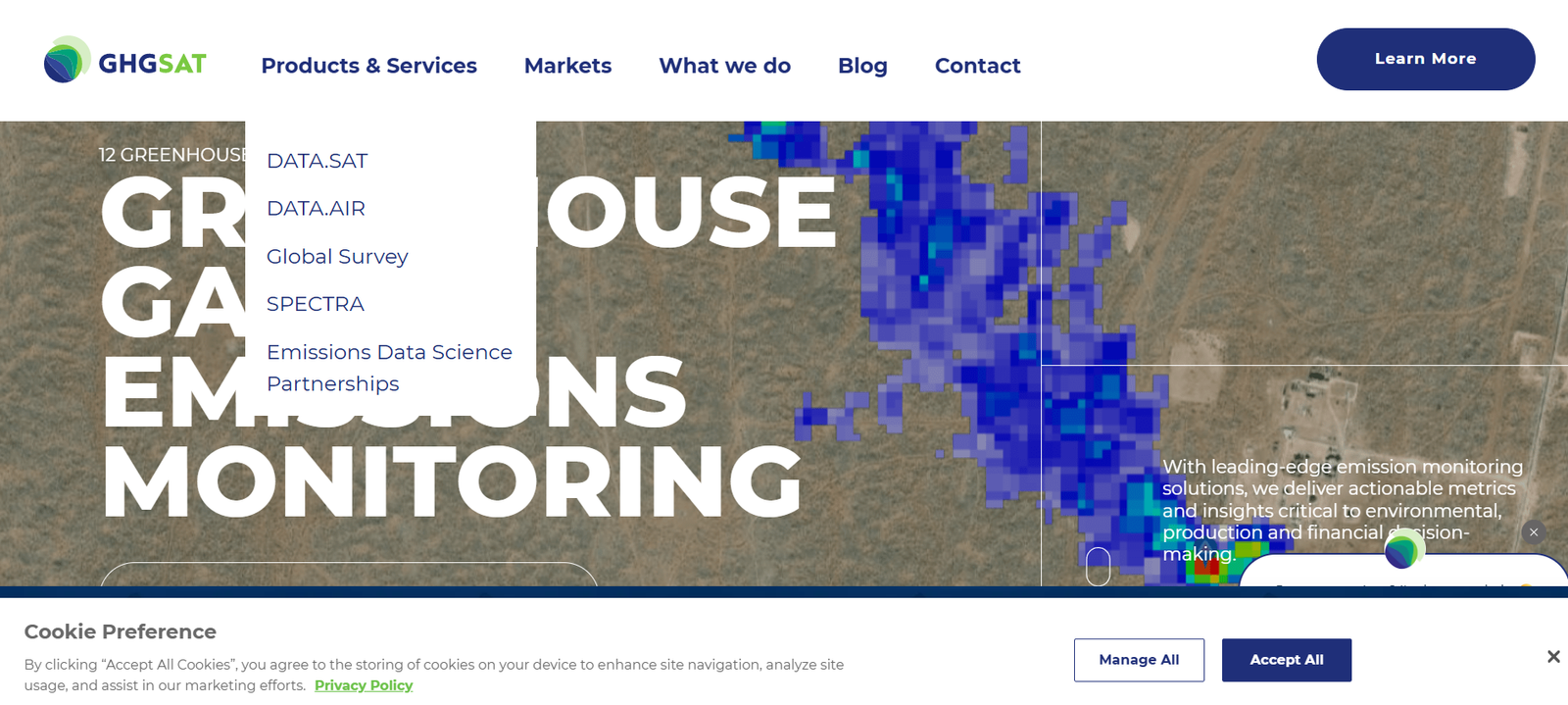
GHGSat is a pioneering satellite technology company specializing in the high-resolution monitoring of greenhouse gas (GHG) emissions—primarily methane (CH₄) and carbon dioxide (CO₂)—from individual industrial sites across the globe. Using a proprietary fleet of microsatellites and aircraft sensors, GHGSat delivers accurate, facility-level emissions data to help energy companies, governments, and environmental stakeholders track, manage, and reduce their carbon footprint.
Founded in Canada in 2011, GHGSat bridges the gap between climate science and corporate emissions accountability. Its remote sensing solutions enable cost-effective, scalable monitoring of emissions from sectors like oil and gas, mining, waste management, and agriculture. GHGSat’s mission is to provide the most precise emissions data available from space, supporting global efforts to combat climate change.
Features:
Satellite-Based Methane Detection
GHGSat satellites detect methane emissions from sources as small as individual oil and gas wells, with a spatial resolution of 25 meters.Carbon Dioxide Monitoring
High-resolution CO₂ measurements help companies identify and quantify emissions at the asset level.Facility-Level Precision
Unlike other satellite services, GHGSat focuses on individual sites, providing data with unparalleled granularity for direct mitigation action.Global Coverage
The satellite fleet monitors sites anywhere in the world, regardless of remoteness or terrain.Aircraft Sensor Integration
For enhanced accuracy and validation, GHGSat also uses aircraft-mounted sensors to complement satellite observations.Regular Monitoring Cadence
Clients can receive emissions data on a weekly, monthly, or customized schedule, depending on their operational needs.Analytics and Visualization Platform
Data is delivered via GHGSat’s online platform, offering dashboards, maps, and custom reports to support decision-making.Third-Party Integration
GHGSat data can be exported or integrated into existing ESG platforms, asset management tools, or carbon reporting frameworks.Compliance and ESG Support
Supports voluntary and regulatory emissions reporting, ESG disclosure, and environmental risk management.
How It Works:
Target Selection
GHGSat’s clients define the industrial sites or geographic areas they want to monitor for GHG emissions.Satellite Observation Scheduling
GHGSat schedules flyovers by its satellite fleet to capture high-resolution spectral imagery of the selected site.Spectral Data Analysis
Advanced algorithms analyze reflected sunlight to detect the presence and concentration of methane or carbon dioxide in the atmosphere.Source Attribution
Using proprietary models, GHGSat attributes emissions to specific facilities, enabling root-cause analysis and targeted mitigation.Data Delivery
Emissions data is delivered through an online platform or API, with visualizations, historical trends, and exportable reports.Validation and Insights
Aircraft sensors or other tools can be used to validate satellite data, and GHGSat provides expert support for interpreting results.
Use Cases:
Oil and Gas Industry
Monitor methane leaks at wellheads, pipelines, processing facilities, and storage sites to reduce fugitive emissions and meet regulatory requirements.Mining Operations
Track greenhouse gases from open-pit mines and processing sites to support ESG reporting and environmental compliance.Waste Management
Monitor methane emissions from landfills and waste treatment facilities to detect leaks and improve climate impact performance.Agriculture
Identify emissions from large-scale livestock operations or rice paddies and evaluate mitigation opportunities.Government and Regulators
Use independent emissions data to verify compliance, assess climate policies, and prioritize environmental interventions.Financial and ESG Reporting
Provide investors and stakeholders with verifiable emissions data tied to specific assets or regions.
Pricing:
GHGSat offers customized pricing based on several factors:
Number of Assets Monitored
Pricing scales depending on how many facilities or sites require regular observation.Frequency of Monitoring
More frequent observations (e.g., weekly vs. monthly) involve higher data acquisition costs.Types of Gases Tracked
Monitoring methane only vs. methane and CO₂ together may affect pricing.Level of Data Analysis
Raw data access is less expensive than full analytical reports and source attribution services.Integration and API Access
Clients who require integration with third-party tools or enterprise systems may incur additional costs.
To receive a custom quote or schedule a consultation, GHGSat provides a direct contact form:
https://www.ghgsat.com/contact-us
Strengths:
High-Resolution Data: Detects methane emissions at the facility level with unmatched spatial resolution.
Global Scalability: Monitors remote or hard-to-access regions without the need for ground equipment.
Science-Backed: Built on validated remote sensing technology and continuously peer-reviewed.
Independent Verification: Offers third-party emissions data for credible ESG reporting.
Actionable Intelligence: Helps operators identify exact leak locations and reduce emissions cost-effectively.
Cross-Sector Applications: Useful for oil & gas, mining, agriculture, waste, and government.
Complementary Aircraft Data: Enhances satellite data with airborne sensors for ground-truthing and precision.
Drawbacks:
Enterprise-Focused: Not suitable for small operations or individual landowners due to pricing and scale.
Satellite Revisit Limitations: Depending on scheduling, some areas may not be monitored daily.
Specialist Interpretation Required: Raw data may need expert analysis for actionable use in operations.
No Self-Service Platform: All monitoring must be coordinated through GHGSat’s team; there’s no instant user dashboard for new users.
Pricing Not Public: Lack of transparency may hinder early budgeting for small or mid-sized firms.
Comparison with Other Tools:
Carbon Mapper: A public-private partnership focused on methane detection. While useful for public awareness, GHGSat provides commercial-grade, proprietary data with higher spatial resolution.
Kayrros: Offers similar methane detection using satellites but relies more heavily on public data. GHGSat owns its satellite fleet and can offer targeted monitoring.
Sust Global: Focuses on geospatial climate risk and emissions exposure at a portfolio level. GHGSat is specialized in direct emissions measurement at the asset level.
Climate TRACE: A global emissions tracking initiative. GHGSat’s advantage is its precise, facility-level monitoring rather than country- or sector-level estimates.
Customer Reviews and Testimonials:
While GHGSat does not feature individual customer reviews on its website, the company has established credibility through:
Partnerships with Major Energy Companies: Including Shell, Chevron, TotalEnergies, and others working to reduce methane emissions.
Collaborations with Governments and Agencies: Including the Canadian and U.S. governments, ESA, and other regulatory bodies.
Scientific Publications and Recognition: GHGSat data is cited in peer-reviewed climate research and featured in top climate-focused media outlets.
Media Coverage: Featured in Bloomberg, Financial Times, Nature, and The New York Times for its innovative methane monitoring capabilities.
Conclusion:
GHGSat is at the forefront of satellite-based greenhouse gas monitoring, offering unmatched precision and scalability for organizations committed to climate responsibility. With the ability to detect facility-level methane and carbon dioxide emissions from space, GHGSat provides actionable intelligence that helps industries reduce leaks, comply with regulations, and meet climate goals.
Its technology empowers both private and public sectors to gain independent, verifiable insights into emissions—strengthening ESG reporting, enabling regulatory compliance, and advancing global decarbonization efforts.