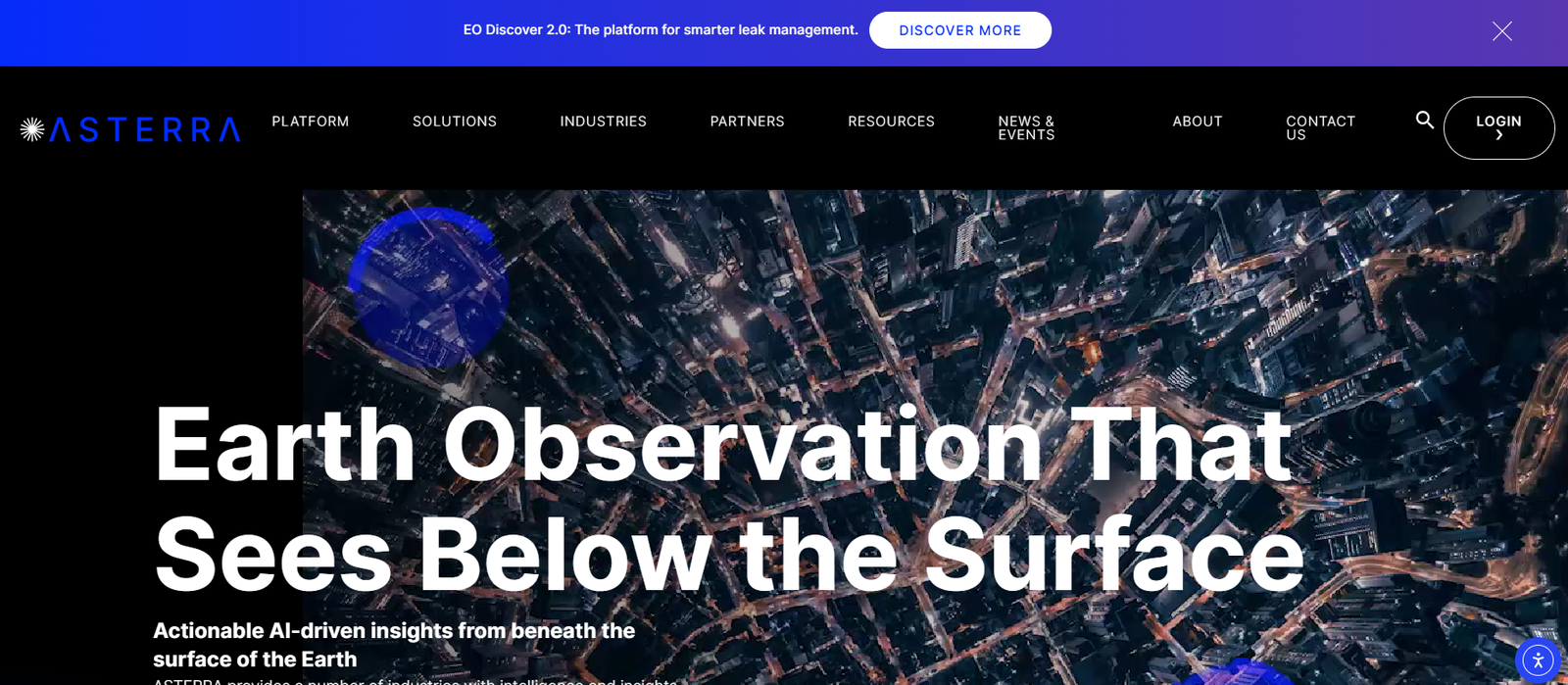
Asterra is an innovative infrastructure intelligence company that combines advanced satellite radar technology with artificial intelligence to detect underground water leaks, soil moisture anomalies, and other critical infrastructure issues. Headquartered in the United States, Asterra delivers actionable insights to utilities, cities, and industrial organizations by analyzing data collected from satellites using synthetic aperture radar (SAR).
Unlike conventional monitoring systems that require expensive and labor-intensive field inspections, Asterra uses satellite-based analytics to remotely assess infrastructure conditions with global reach and high precision. Their core technology allows them to see beneath the surface and identify issues that traditional visual inspections would miss.
Asterra’s mission is to improve the efficiency and sustainability of critical infrastructure management, particularly in sectors like water utilities, mining, roads, and disaster mitigation. The platform provides near real-time, cost-effective data to help clients reduce non-revenue water, detect subsurface anomalies, and proactively maintain infrastructure assets.
Features
SAR Satellite Data Analytics
Asterra leverages L-band synthetic aperture radar (SAR) from satellites that can penetrate soil and infrastructure layers to detect subsurface moisture changes. This technology enables consistent and accurate results regardless of weather or lighting conditions.
AI-Powered Interpretation
Artificial intelligence algorithms analyze radar signals to detect patterns associated with underground leaks, soil saturation, and other infrastructure vulnerabilities. The AI engine improves over time with each data input.
Non-Revenue Water Detection
One of Asterra’s primary applications is helping utilities detect and address water loss from hidden leaks in distribution systems, reducing non-revenue water and optimizing operations.
Underground Infrastructure Monitoring
Asterra monitors moisture-related anomalies around pipelines, roads, dams, and mining sites, providing early warnings of failures or inefficiencies.
TerraFlow and EarthWorks Platforms
The company offers two main solution suites: TerraFlow for leak detection in water systems and EarthWorks for infrastructure and geotechnical monitoring, including roads and slopes.
Rapid and Scalable Deployment
The platform can scan large areas remotely within days, offering a scalable solution for regional or national utilities and government agencies.
Geospatial Visualization
Asterra provides clients with interactive geospatial maps that highlight areas of concern, making it easier to direct field crews efficiently and effectively.
Global Coverage
Since Asterra uses satellite technology, it can monitor assets anywhere in the world, including remote or difficult-to-access areas.
Data Integration and API Access
The insights provided by Asterra can be integrated into clients’ existing GIS, asset management, and work order systems through APIs.
Environmental and Economic Impact
By reducing water loss, improving maintenance, and preventing infrastructure failures, Asterra contributes to both environmental sustainability and economic savings.
How It Works
Asterra’s technology is based on synthetic aperture radar (SAR), specifically using L-band signals which can penetrate foliage, soil, and certain infrastructure materials. These SAR signals are captured by satellites orbiting the Earth and are then transmitted to Asterra’s processing centers.
Once the radar data is received, it is processed using proprietary AI algorithms trained to identify moisture-related anomalies beneath the surface. These anomalies could indicate a variety of issues, such as leaking water pipes, accumulating soil moisture near roads, or shifts in terrain that could threaten infrastructure stability.
The AI engine evaluates moisture changes over time and correlates them with known infrastructure layouts. The platform filters out noise and irrelevant signals to pinpoint the most likely areas of concern. These findings are then visualized through geospatial interfaces provided to clients.
For example, in a water utility application, Asterra scans the network area, detects potential leak zones, and provides a prioritized list of areas for field inspection. This allows teams to focus efforts and resources where they are most needed, saving time, money, and water.
The process is continuous and can be repeated regularly, allowing for ongoing monitoring and trend analysis over time.
Use Cases
Water Utilities
Asterra helps municipal and private water utilities detect underground leaks that traditional methods cannot easily identify. This leads to significant reductions in non-revenue water and lowers operational costs.
Public Infrastructure Management
City governments use Asterra to monitor roads, embankments, and other public assets for subsurface moisture changes that might signal future failures or safety hazards.
Mining and Industrial Sites
Mining companies use Asterra to detect moisture changes around tailing dams and critical infrastructure, improving environmental safety and compliance with regulations.
Transportation Infrastructure
Road maintenance departments use EarthWorks to monitor moisture conditions beneath pavement and slopes, enabling preventive maintenance and reducing long-term repair costs.
Disaster Preparedness and Mitigation
Emergency response agencies use Asterra’s tools to monitor flood-prone areas, landslides, and soil stability in advance of potential disasters, enhancing community resilience.
Construction and Engineering
Engineering firms use Asterra’s data during planning and post-construction phases to monitor soil moisture and structural integrity in sensitive or unstable zones.
Insurance and Risk Management
Insurance providers leverage Asterra’s data to assess infrastructure risk profiles and mitigate potential claims due to water damage or structural failures.
Pricing
Asterra does not publicly list pricing on its official website, as costs vary depending on the size of the monitored area, frequency of scans, and type of application. Pricing is typically provided upon consultation and is tailored to the client’s infrastructure, geographic scope, and data integration needs.
Asterra operates on a subscription and service-based model, where clients pay for access to their data platform and insights over a specified contract term. This often includes:
Baseline scans and assessments
Periodic monitoring and updates
Access to geospatial dashboards
API integration for GIS and asset systems
Custom analytics or reporting, if required
To obtain a quote or discuss pricing options, clients are encouraged to contact the Asterra team directly through their website.
Strengths
Cutting-Edge Satellite Technology
By using SAR from satellites, Asterra achieves reliable, weather-independent results and eliminates the need for physical sensors on the ground.
High Accuracy and Precision
The combination of SAR and AI leads to pinpoint detection of underground leaks and subsurface anomalies with a high success rate.
Scalable and Global
Asterra’s satellite-based approach allows it to serve clients of any size, from small utilities to national infrastructure agencies.
Rapid Implementation
The platform can start delivering insights within days of satellite data acquisition, offering a quick path to value.
Environmental Benefits
By reducing water loss and preventing infrastructure damage, Asterra supports sustainability goals and reduces environmental risks.
Data Visualization
The user-friendly geospatial tools make complex data actionable, helping field crews and decision-makers quickly interpret insights.
Integrative Capability
Asterra’s data integrates well with existing enterprise software, including GIS and asset management systems.
Drawbacks
Custom Pricing Model
The lack of public pricing information may be a barrier for smaller organizations or early-stage inquiries.
Requires Technical Integration
For full benefit, clients may need to integrate Asterra data into existing systems, which could require IT or GIS expertise.
Limited Public Access
Asterra’s tools are designed for enterprise and industrial use, not individual users or small teams.
Not Real-Time in Every Case
While faster than traditional methods, there may be some latency between satellite passes and data delivery, depending on scan frequency and location.
Focus on Moisture-Related Applications
The technology is highly effective for moisture and leak detection but may not be applicable for other types of infrastructure diagnostics outside its core use cases.
Comparison with Other Tools
Compared to ground-based leak detection tools like acoustic sensors, correlators, or ground-penetrating radar, Asterra offers a less invasive and more scalable approach. Traditional methods require extensive fieldwork, whereas Asterra’s system can scan thousands of kilometers remotely with fewer human resources.
Versus platforms like Global Forest Watch or iNaturalist, which focus on environmental and ecological monitoring, Asterra targets infrastructure and utility management. Its use of radar for subsurface analysis gives it a unique technological advantage in that niche.
Other infrastructure analytics companies may offer data from drones or IoT sensors, but those approaches often involve installation and maintenance of physical equipment. Asterra eliminates that need by using satellite data alone, making it particularly attractive for hard-to-reach or vast geographic regions.
Customer Reviews and Testimonials
Asterra’s technology is widely praised by clients in the utility and infrastructure sectors. According to feedback shared on the company’s website and through industry reports, utilities using Asterra have significantly reduced non-revenue water and increased the efficiency of leak repair operations.
Many customers highlight the rapid ROI achieved by reducing unnecessary field inspections. The City of Atlanta, for example, reported improved operational planning and fewer emergency repairs thanks to Asterra’s actionable data.
The company has received industry recognition, including awards for innovation in water technology and mentions in global infrastructure forums. Its partnerships with major utilities and engineering firms reflect a high level of trust and satisfaction.
Conclusion
Asterra is transforming infrastructure management by bringing together satellite radar and artificial intelligence to offer an unmatched level of subsurface insight. Its scalable, remote monitoring capabilities make it ideal for utilities, governments, and industries seeking to optimize infrastructure health, reduce water loss, and mitigate disaster risks.
With proven results in the field, Asterra stands out as a technology-driven solution for modern infrastructure challenges. By replacing manual inspection methods with data-rich analytics, it helps organizations act smarter, faster, and more sustainably.
For any organization responsible for maintaining critical underground infrastructure, Asterra offers a forward-thinking, globally scalable solution built on the power of space and AI.