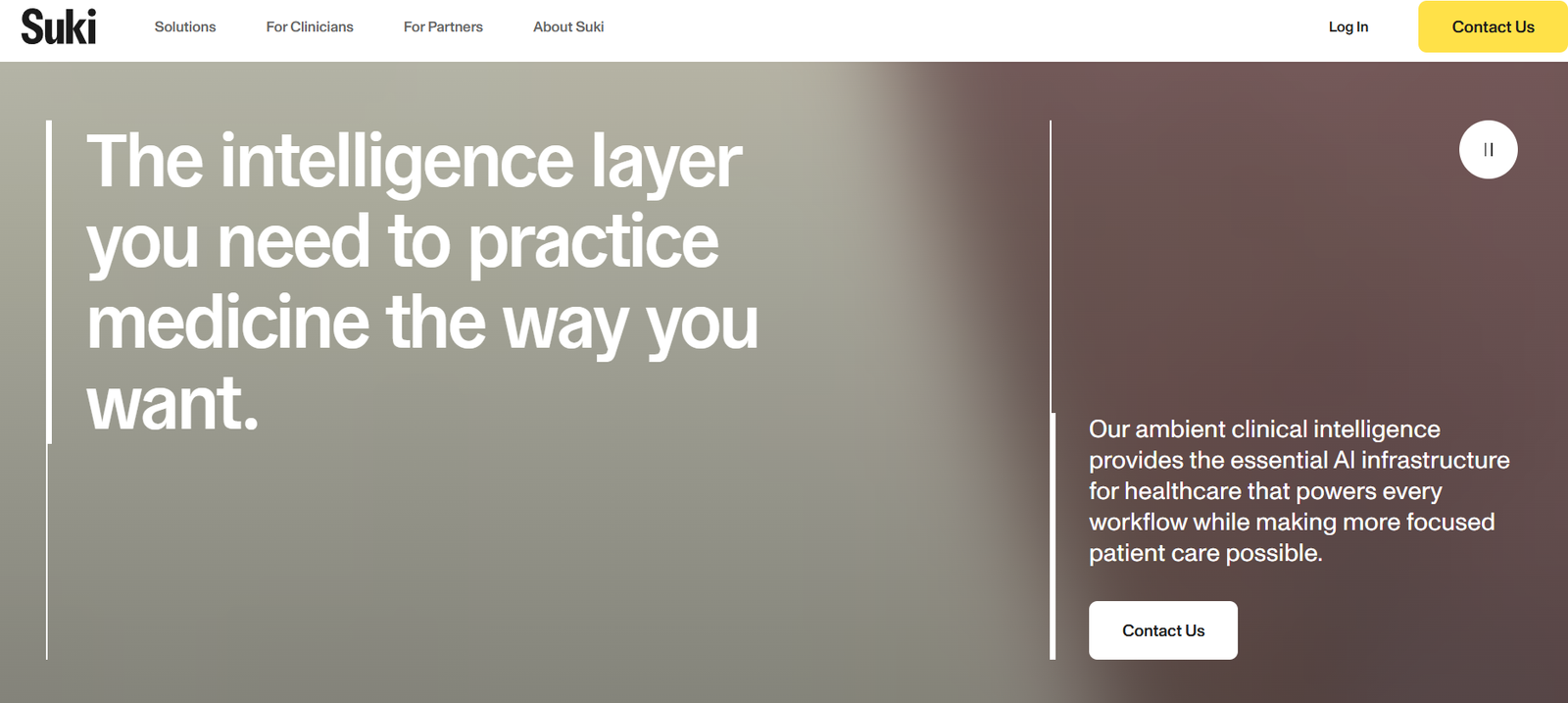
Suki is an AI-powered voice assistant designed to streamline clinical documentation for healthcare providers. Built specifically for the medical field, Suki uses advanced natural language processing and ambient AI technology to help physicians create, retrieve, and manage patient notes more efficiently.
By enabling hands-free, voice-driven workflows, Suki reduces the time clinicians spend on electronic health record (EHR) documentation, allowing them to focus more on patient care. The platform is accessible via mobile devices, desktop, or integrated directly into EHR systems, making it a flexible solution across different healthcare environments.
Suki supports a wide range of medical specialties and adapts to each physician’s individual style of documentation, improving both speed and accuracy. The company’s mission is to lift the administrative burden off clinicians and restore joy to the practice of medicine.
Features
Voice-Powered Documentation: Suki allows physicians to dictate patient notes using natural language, converting speech into structured clinical documentation in real time.
Ambient Mode: With Suki ambient, the assistant listens during patient visits and automatically generates a clinical note based on the physician-patient conversation, reducing the need for manual input.
Smart Learning and Personalization: The AI adapts to each user’s voice, style, and medical specialty over time, improving transcription accuracy and note formatting.
EHR Integration: Suki integrates with popular electronic health record systems like Epic, Cerner, and athenahealth, enabling seamless data syncing and workflow compatibility.
Mobile and Desktop Access: Clinicians can use Suki on their smartphones, tablets, or desktop computers, offering flexibility across clinical settings.
Command-Based Navigation: Users can issue voice commands to retrieve patient data, prescribe medications, or navigate EHR functions hands-free.
Real-Time Updates and Edits: Suki supports real-time editing and updates, allowing clinicians to correct or append information quickly without interrupting their workflow.
Security and Compliance: The platform is HIPAA-compliant and built with healthcare-grade data protection protocols to ensure patient privacy and safety.
How It Works
Suki starts by giving physicians access through a dedicated app or EHR-integrated interface. Once activated, the voice assistant listens to dictated speech and transcribes it into clinically relevant notes using AI and natural language understanding.
For standard voice dictation, clinicians speak naturally into the Suki app. The AI processes the audio input, formats the note according to clinical standards, and sends it directly to the EHR or a preferred destination. Suki automatically adds section headers like “History of Present Illness,” “Assessment,” and “Plan” based on the context of the dictation.
In ambient mode, Suki passively listens during a patient encounter and automatically generates a full draft note after the visit. Physicians can then review and approve the note, saving time without compromising documentation quality.
Because Suki continuously learns from user behavior, it becomes faster and more accurate over time, adapting to individual workflows and specialties.
Use Cases
Suki is used by physicians across various specialties including internal medicine, family medicine, cardiology, orthopedics, and pediatrics to reduce time spent on documentation.
In private practices, Suki helps small teams manage heavy documentation workloads without needing full-time scribes or dictation staff.
In large health systems, Suki scales to support hundreds of clinicians, integrating with existing EHR systems and reducing burnout from excessive administrative tasks.
For hospitalists and emergency medicine providers, Suki accelerates the creation of accurate, structured notes even in fast-paced environments.
Mobile clinicians such as home care or telehealth providers use Suki’s mobile interface to complete notes in real time while on the move.
Academic medical centers leverage Suki’s ambient capabilities to support resident physicians and improve documentation training.
Pricing
Suki does not publish public pricing on its website. Pricing models are customized based on the size of the organization, the number of users, chosen features, and integration requirements.
The company offers flexible licensing options for small practices, mid-sized provider groups, and enterprise healthcare systems.
Prospective customers can request a personalized demo and quote by contacting the Suki sales team directly through the official website.
Strengths
Suki’s AI-first approach to clinical documentation significantly reduces the time doctors spend writing notes, freeing up more time for patient care.
Its voice-first interface is intuitive, reducing the learning curve and increasing adoption among clinicians.
The ambient mode is particularly innovative, allowing automatic note generation from live conversations without disrupting the clinical encounter.
Personalization capabilities ensure that Suki adapts to individual user preferences and specialties, improving both speed and satisfaction.
Seamless integration with major EHR systems allows clinicians to use Suki within their existing workflow without needing to switch platforms.
Mobile and desktop compatibility makes Suki versatile for in-clinic, telehealth, or on-the-go documentation needs.
Suki has demonstrated measurable outcomes, including up to 76% reduction in documentation time and improved provider satisfaction scores.
Drawbacks
As with all AI tools, Suki’s accuracy may depend on factors like background noise, speech clarity, and user adaptation during early use.
Ambient documentation features may not be appropriate in all settings due to privacy concerns, especially in multi-party or sensitive consultations.
Suki is not currently offered as a consumer product; it is only available through healthcare providers or institutions.
Integration with some EHRs may require custom development, depending on system architecture and compliance requirements.
Organizations with limited IT resources may require onboarding support to ensure seamless deployment.
While Suki supports many specialties, niche or complex specialties may need more tailored customization for specific workflows.
Comparison with Other Tools
Suki competes with other clinical voice assistants such as Nuance Dragon Medical One, Notable, and Saykara (acquired by Nuance).
Nuance Dragon Medical is well-established and offers deep voice recognition capabilities, but often requires more manual input and setup. Suki focuses more on intelligent automation and ease of use.
Notable uses ambient AI similar to Suki but focuses on broader workflow automation, including administrative tasks beyond documentation.
Saykara offered ambient transcription features but was acquired and merged into Dragon, making Suki one of the few standalone, independent platforms focusing exclusively on AI-powered clinical note generation.
Suki’s emphasis on personalization, simplicity, and real-time documentation gives it a competitive edge for organizations seeking faster deployment and physician-centered design.
Customer Reviews and Testimonials
Suki has received strong endorsements from physicians, health system leaders, and IT administrators for its ability to reduce administrative burden and improve clinical efficiency.
Users report dramatic time savings, with many physicians completing their notes in less than half the time compared to traditional documentation methods.
Clinicians highlight Suki’s intuitive interface, minimal training requirement, and ability to adapt to their preferred dictation style.
The platform has received awards and recognition from organizations like the American Hospital Association and Becker’s Healthcare for innovation in clinical technology.
Healthcare systems that have implemented Suki report improved provider satisfaction and decreased burnout, with scalable results across multiple specialties.
Conclusion
Suki is redefining clinical documentation with its AI-powered voice assistant built specifically for healthcare providers. By combining natural language processing, ambient intelligence, and real-time dictation, Suki helps physicians complete their notes faster and with greater accuracy, improving both efficiency and quality of care.
Whether used in small practices or large health systems, Suki integrates smoothly into existing workflows, reducing the documentation burden that leads to physician burnout. Its personalized learning, EHR integration, and hands-free capabilities make it one of the most advanced voice solutions in the healthcare industry.
For providers and organizations seeking to modernize clinical documentation with AI, Suki offers a powerful, scalable, and clinician-friendly platform.