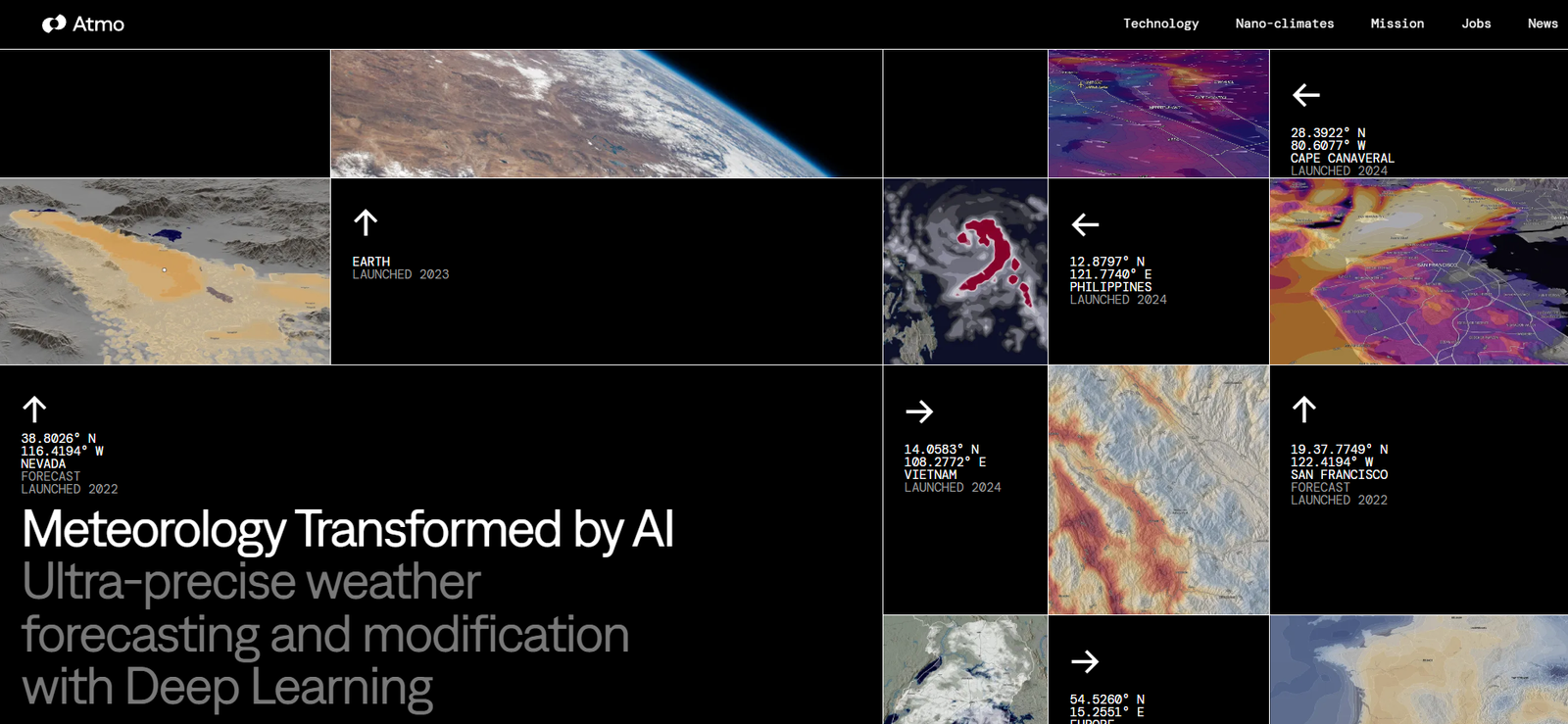
Atmo AI is a weather technology company that builds next-generation weather forecasting systems powered by artificial intelligence and edge computing. Based in the United States, Atmo aims to deliver ultra-accurate, global weather predictions that can be deployed in real-time and in regions that historically lacked access to high-quality forecasts.
Founded in 2019 by a team of engineers, scientists, and former NASA experts, Atmo focuses on transforming how weather forecasts are generated and distributed. Unlike traditional numerical weather prediction systems that rely on massive supercomputers and long computation cycles, Atmo uses lightweight, AI-based models that can run locally on edge devices or in compact cloud environments.
Atmo’s mission is to make accurate weather forecasting globally accessible, particularly in underserved regions vulnerable to climate change and extreme weather events. Its technology is currently used by governments, emergency responders, and meteorological agencies to improve planning, resilience, and disaster preparedness.
Features
Atmo AI’s platform includes several advanced features that differentiate it from traditional forecasting systems:
AI-Based Forecast Engine: Atmo replaces legacy physics-based weather models with AI models that learn atmospheric patterns from data, enabling faster and more adaptive forecasting.
Edge Deployment: Forecasts can be run directly on local servers or edge devices, allowing remote regions to generate accurate forecasts without needing centralized data centers.
Global Coverage: Atmo’s system is trained on global atmospheric data and optimized to work effectively in all geographic regions, including areas with sparse observation networks.
Real-Time Forecasting: The AI models operate with rapid inference times, producing forecasts in real time or near-real time to support fast decision-making.
High Spatial Resolution: Delivers hyper-local forecasts at resolutions fine enough for urban planning, disaster response, and infrastructure protection.
Low Infrastructure Requirements: Runs on standard hardware with minimal computational overhead, making it cost-effective and scalable for governments and organizations with limited resources.
Customizable Parameters: Users can configure the forecasting system for specific environmental variables such as precipitation, wind, humidity, or storm tracking.
Integration Capabilities: Can be integrated into existing early warning systems, public safety platforms, or mobile apps via APIs and modular services.
Climate Adaptation Insights: Supports planning for climate resilience by offering scenario-based forecasts and modeling capabilities.
Sovereign Forecasting Solutions: Enables national governments to build and operate their own forecasting systems without dependency on foreign or commercial platforms.
How It Works
Atmo AI’s weather forecasting system is built on machine learning models trained on historical weather data, satellite imagery, sensor feeds, and global climate patterns. Unlike traditional models that rely on solving complex physics equations, Atmo’s AI system learns relationships in the data and generates predictions based on pattern recognition and statistical inference.
The system is designed to run on both centralized cloud platforms and decentralized edge devices. This is particularly important for developing countries or disaster-prone regions where internet connectivity and computing infrastructure are limited. With Atmo’s edge-ready platform, even a local weather office can produce advanced forecasts without needing a supercomputer.
Atmo uses a combination of supervised learning, data assimilation techniques, and continual model updates to ensure high accuracy. The AI engine is updated with the latest atmospheric observations and satellite data to maintain up-to-date predictions.
The platform is modular and API-driven, allowing easy integration with visualization tools, mobile apps, public alert systems, and third-party platforms. Governments or enterprises can configure dashboards for different user groups, such as meteorologists, emergency managers, or the general public.
Use Cases
Atmo AI has a wide range of applications across both public sector and private industries, especially in areas where weather plays a critical role in safety, planning, or economics.
National Meteorological Agencies: Use Atmo to establish sovereign weather forecasting capabilities, reducing reliance on foreign data sources.
Disaster Response Agencies: Generate real-time weather alerts for floods, hurricanes, and extreme heat events to improve response time and coordination.
Agriculture and Food Security: Provide hyper-local forecasts to farmers for irrigation planning, crop protection, and yield optimization.
Urban Planning and Infrastructure: Forecast weather events like urban flooding or wind storms to protect transportation, power grids, and public infrastructure.
Aviation and Logistics: Support flight planning and logistics operations with high-resolution forecasts that improve safety and efficiency.
Climate Adaptation Programs: Use scenario forecasting tools to plan long-term infrastructure investments, zoning, and land use changes.
Defense and Homeland Security: Enable military or civil defense agencies to monitor weather patterns for operations planning and risk mitigation.
Insurance and Risk Management: Provide underwriters and insurers with predictive insights to price climate-related risks and model exposure.
Global Development Agencies: Deploy forecasting capabilities in regions vulnerable to climate change impacts, such as Sub-Saharan Africa or Southeast Asia.
Environmental Research: Allow academic institutions and researchers to study weather patterns and develop new adaptation strategies using localized data.
Pricing
Atmo AI follows a custom pricing model tailored to the needs of governments, enterprises, and NGOs. As of now, the company does not publish a standard pricing plan on its official website. However, general pricing guidelines include:
Custom Deployments: For national agencies or large-scale users, pricing is based on the number of regions served, infrastructure requirements, and support needs.
Edge System Installation: Atmo can deploy forecasting units on-site in regions with limited infrastructure. Costs depend on hardware, installation, and training.
Cloud-Based Access: Some organizations may opt for cloud deployment with scalable pricing based on API usage, forecasting zones, or data volume.
Pilot Programs: Atmo offers pilot deployments for eligible government agencies or development organizations to demonstrate effectiveness before full adoption.
Partnerships: Discounted or subsidized pricing may be available through partnerships with climate funding agencies, global NGOs, or innovation accelerators.
For accurate pricing details, interested parties are encouraged to contact Atmo’s sales or partnership team directly.
Strengths
Atmo AI offers a powerful alternative to legacy weather forecasting systems, particularly in resource-limited regions. One of its major strengths is the low infrastructure requirement. Governments and organizations no longer need supercomputers or high-bandwidth data pipelines to produce accurate forecasts.
Its edge computing model allows forecasts to be generated locally, ensuring resilience during internet outages or emergencies. The AI-first approach dramatically reduces the time required to produce forecasts while increasing spatial resolution.
Another strength is sovereignty. Atmo empowers national governments to control their own meteorological data and forecasting systems, which is especially important for countries dependent on foreign services.
The platform’s modularity and scalability make it suitable for a wide range of users, from local weather stations to global humanitarian organizations. Its strong focus on climate adaptation ensures that it is not just a reactive tool, but a forward-looking solution.
Drawbacks
While Atmo’s AI-first system presents many advantages, it also has limitations. As a relatively new platform, it may not yet have the long-term validation and institutional trust that traditional weather centers (such as NOAA or ECMWF) have built over decades.
The platform’s effectiveness still depends on the availability and quality of local data. In regions with very limited observation infrastructure, model accuracy could be affected despite AI compensation.
Another drawback is that pricing and access are not publicly transparent, which may delay adoption for smaller agencies or nonprofits seeking clarity on costs.
Since Atmo’s technology is deployed primarily through direct partnerships, onboarding may require technical consultation, training, and infrastructure alignment, making the adoption process more involved than plug-and-play solutions.
Comparison with Other Tools
Compared to traditional forecasting agencies like NOAA, the UK Met Office, or ECMWF, Atmo AI operates with a fundamentally different architecture. While traditional systems rely on large-scale physics simulations, Atmo replaces this with AI pattern recognition, enabling faster and more flexible deployments.
Against commercial weather services like The Weather Company (IBM) or AccuWeather, Atmo stands out by offering edge computing capability and sovereign forecasting, rather than just providing APIs or consumer-grade forecasts.
Unlike open-source platforms like WRF or GFS, which require high technical knowledge and infrastructure, Atmo is designed to be more accessible, particularly for emerging markets.
In the climate adaptation space, tools like Tomorrow.io or ClimateAI offer high-resolution forecasting, but Atmo’s focus on AI at the edge, and support for nation-state deployments, gives it a unique positioning.
Customer Reviews and Testimonials
As of the latest information, Atmo does not display customer reviews on its website. However, it highlights use cases and case studies with government agencies and global organizations.
Atmo has been recognized in global tech publications and weather science communities for its mission-driven approach to closing the global weather forecasting gap. Its work in Africa and Southeast Asia has been noted for improving local forecasting capacity and climate resilience.
Several public-sector partners and nonprofit agencies have praised Atmo’s ability to deliver forecasts where traditional systems were previously unavailable or unreliable.
Conclusion
Atmo AI represents a bold reimagining of how weather forecasts can be delivered globally. By combining artificial intelligence, real-time data processing, and edge computing, Atmo makes it possible for any region—regardless of infrastructure level—to access accurate and actionable weather intelligence.
Its unique approach offers national meteorological sovereignty, climate adaptation tools, and operational resilience in the face of growing climate-related risks. For governments, development organizations, and industries looking to enhance forecasting capabilities, Atmo AI delivers a future-ready platform built for the challenges of the 21st century.