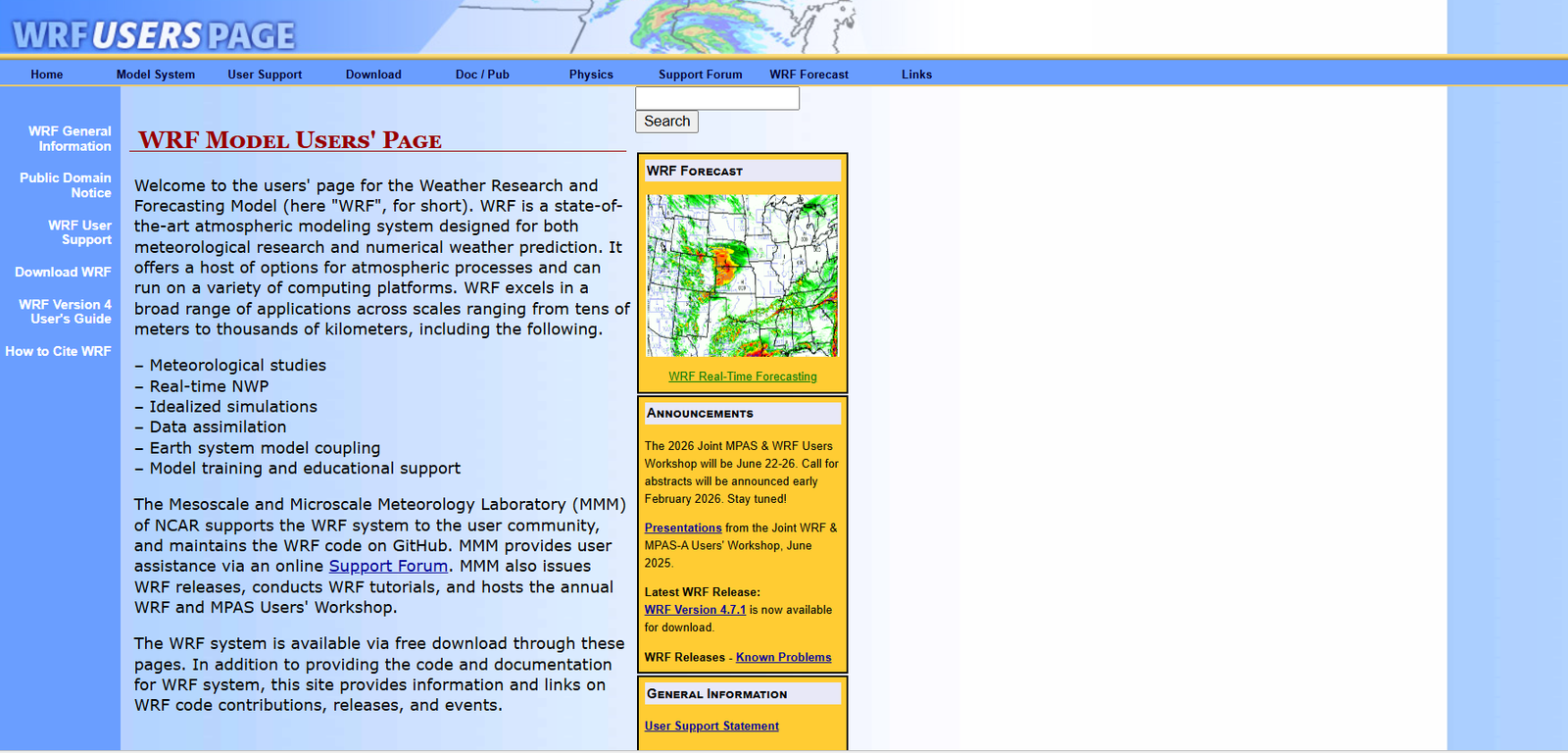
The Mesoscale and Microscale Meteorology Laboratory (MMM) is a division of the National Center for Atmospheric Research (NCAR), one of the world’s leading research institutions in atmospheric and climate science. NCAR MMM is dedicated to understanding and modeling mesoscale and microscale meteorological processes. These include weather systems ranging from regional storms and urban climate phenomena to turbulence and cloud microphysics.
Located in Boulder, Colorado, the MMM Laboratory works at the intersection of meteorology, computer science, and environmental engineering. It plays a pivotal role in advancing numerical weather prediction, severe weather forecasting, and climate model development through high-performance computing, observational science, and collaborative field campaigns.
The laboratory is known globally for the development of the Weather Research and Forecasting (WRF) model and its successor, the System for Integrated Modeling of the Atmosphere (SIMA). These tools are used by thousands of researchers and operational meteorologists worldwide to simulate, analyze, and predict atmospheric conditions at high spatial and temporal resolutions.
Features
NCAR MMM offers a broad array of research capabilities and technological features that contribute to meteorological and atmospheric science advancement.
WRF Modeling System: A community-supported numerical weather prediction model used for both research and operational forecasting around the world.
SIMA Framework: A next-generation, unified atmospheric modeling platform designed for coupled Earth system simulations, integrating weather and climate models.
DAReS (Data Assimilation Research Section): Focuses on advancing techniques for incorporating real-world observational data into atmospheric models to improve forecast accuracy.
Computational Modeling Support: Access to supercomputing facilities through NCAR’s Computational and Information Systems Lab (CISL), enabling high-resolution simulations.
Field Campaigns: Collaboration on global atmospheric field campaigns that gather in-situ and remote sensing data to validate and refine model outputs.
Observational Science: Development and deployment of radar, lidar, UAVs, and balloon systems to monitor atmospheric processes across different scales.
Code Repositories and Tools: Open-source model code, scripts, and documentation made available to the research community for simulation, validation, and training.
Educational Resources: Workshops, tutorials, and support documentation for researchers, students, and professionals using MMM-developed tools.
Community Engagement: Active engagement with universities, federal agencies, and international partners to co-develop and apply modeling systems.
Scientific Publications: Regular contribution to peer-reviewed meteorology and climate science journals, advancing theoretical and applied understanding.
How It Works
NCAR MMM functions as both a research institute and a development hub for numerical modeling systems. The laboratory’s core function involves developing physical and computational models that simulate the behavior of the atmosphere at various scales.
The WRF model is a key output of the lab. It uses mathematical equations and physical parameterizations to simulate weather processes. Users input initial atmospheric conditions—often derived from global data sources—and run the model over a region of interest. The result is a detailed forecast of weather variables such as temperature, wind, humidity, and precipitation.
MMM’s newer initiative, SIMA, aims to unify weather and climate modeling into a single, flexible framework. It enables coupling with ocean, land surface, and aerosol models to better simulate Earth system dynamics under both short- and long-term scenarios.
To support these models, MMM collaborates with CISL to run simulations on supercomputers like the NCAR-Wyoming Supercomputing Center (NWSC). These systems allow the lab to run high-resolution, large-domain simulations necessary for accurate mesoscale forecasting.
Data assimilation techniques developed at MMM further refine model accuracy by continuously incorporating observations from satellites, radar, and weather stations. This real-time updating process makes models more relevant for operational forecasting and emergency management.
Use Cases
NCAR MMM’s research and models are used across a broad spectrum of scientific, operational, and policy-oriented applications:
Severe Weather Forecasting: WRF is widely used by meteorological agencies to predict thunderstorms, tornadoes, hurricanes, and winter storms.
Air Quality Modeling: Simulations incorporate chemical transport models to analyze air pollution and dispersion patterns.
Urban Climate Studies: Researchers simulate city-scale weather dynamics, including heat islands and wind flow, to support urban planning.
Climate Research: Long-term simulations using coupled models help study climate variability, change, and feedback mechanisms.
Hydrological Forecasting: Integration with hydrology models enables flood prediction and water resource management.
Aviation Safety: High-resolution turbulence and wind shear forecasting support aviation safety and efficiency.
Renewable Energy: Wind and solar energy forecasts generated using WRF help optimize grid integration and resource planning.
Agricultural Planning: Models assist in understanding weather impacts on crop growth, pest activity, and irrigation needs.
Disaster Preparedness: Emergency planners use simulations to model the impacts of storms, floods, and heatwaves in advance.
Education and Training: Universities use WRF and MMM data for student research, coursework, and training in atmospheric sciences.
Pricing
As a publicly funded research institution, NCAR MMM does not charge commercial licensing fees for its core modeling tools like WRF and SIMA. These are open-source and freely available to the global scientific community.
Access to supercomputing time through NCAR is typically granted via competitive proposal processes and collaborations. Researchers affiliated with U.S. universities or government agencies can apply for allocations through the NSF-supported allocation process.
Workshops, tutorials, and documentation are also provided at no cost. However, in-person training events or specialized consulting may incur fees if provided on a custom basis or to non-academic partners.
Custom modeling support or partnerships with private-sector organizations may require a memorandum of understanding (MoU) or formal agreement through the University Corporation for Atmospheric Research (UCAR).
Strengths
NCAR MMM’s greatest strength is its scientific credibility and leadership in atmospheric modeling. The WRF model alone is cited in thousands of academic papers and used by over 160 countries for both research and operational forecasting.
Its collaborative structure, combining modeling, observation, and computational power, allows for end-to-end development and validation of atmospheric models.
The lab’s open-source philosophy and commitment to community support have fostered a global user base and consistent improvements to model capabilities.
NCAR’s infrastructure, including supercomputers, field research assets, and expert staff, positions MMM to take on large-scale interdisciplinary projects that smaller institutions cannot support independently.
The transition to SIMA represents a forward-looking investment in unified Earth system modeling, which is increasingly critical for understanding climate change and extreme weather events.
Drawbacks
One limitation of NCAR MMM’s tools is their complexity. Running models like WRF requires advanced technical knowledge in programming, meteorology, and computational systems. This can be a barrier for smaller institutions or new users.
While the tools are free, the requirement for high-performance computing infrastructure can make them less accessible for users without institutional support or cloud access.
Model configuration and tuning can be time-consuming, and documentation, while extensive, may be difficult to navigate for beginners.
NCAR’s support model also relies on community-based forums and workshops, which may not provide the same level of direct customer support as commercial weather software platforms.
Comparison with Other Tools
Compared to commercial weather platforms such as The Weather Company or Meteomatics, NCAR MMM’s tools offer far greater flexibility, customization, and scientific transparency. However, commercial platforms often have more user-friendly interfaces and turnkey solutions.
Against global modeling systems like the European Centre for Medium-Range Weather Forecasts (ECMWF), WRF and SIMA offer finer control over regional simulation parameters and are better suited for high-resolution, local applications.
Unlike services like Windy or OpenWeather, which focus on forecast delivery, MMM focuses on model development and raw simulation capacity for research and operational use.
Tools like NOAA’s HRRR (High-Resolution Rapid Refresh) are similar in purpose but often based on WRF itself, reflecting NCAR MMM’s foundational role in atmospheric modeling.
Customer Reviews and Testimonials
NCAR MMM’s tools are widely respected in the academic and operational weather communities. While not reviewed on commercial platforms like G2 or Trustpilot, their impact is demonstrated through extensive citations, endorsements, and adoption by meteorological agencies worldwide.
The WRF User Forum and related communities highlight user satisfaction with the model’s accuracy, customizability, and ongoing support from NCAR.
Agencies such as NOAA, NASA, and the FAA have integrated NCAR MMM’s models into operations or collaborated with the lab on major projects.
University faculty often recommend WRF as the gold standard for teaching numerical weather prediction.
Conclusion
NCAR’s Mesoscale and Microscale Meteorology Laboratory plays a vital role in advancing the science of atmospheric modeling. From pioneering the WRF model to developing SIMA for next-generation Earth system simulation, MMM leads global efforts in weather and climate research.
Its combination of open-source tools, high-performance computing, and collaborative research has made it a cornerstone of the global meteorological community. Whether for severe weather forecasting, climate research, or renewable energy planning, the outputs of NCAR MMM continue to inform science, policy, and public safety.