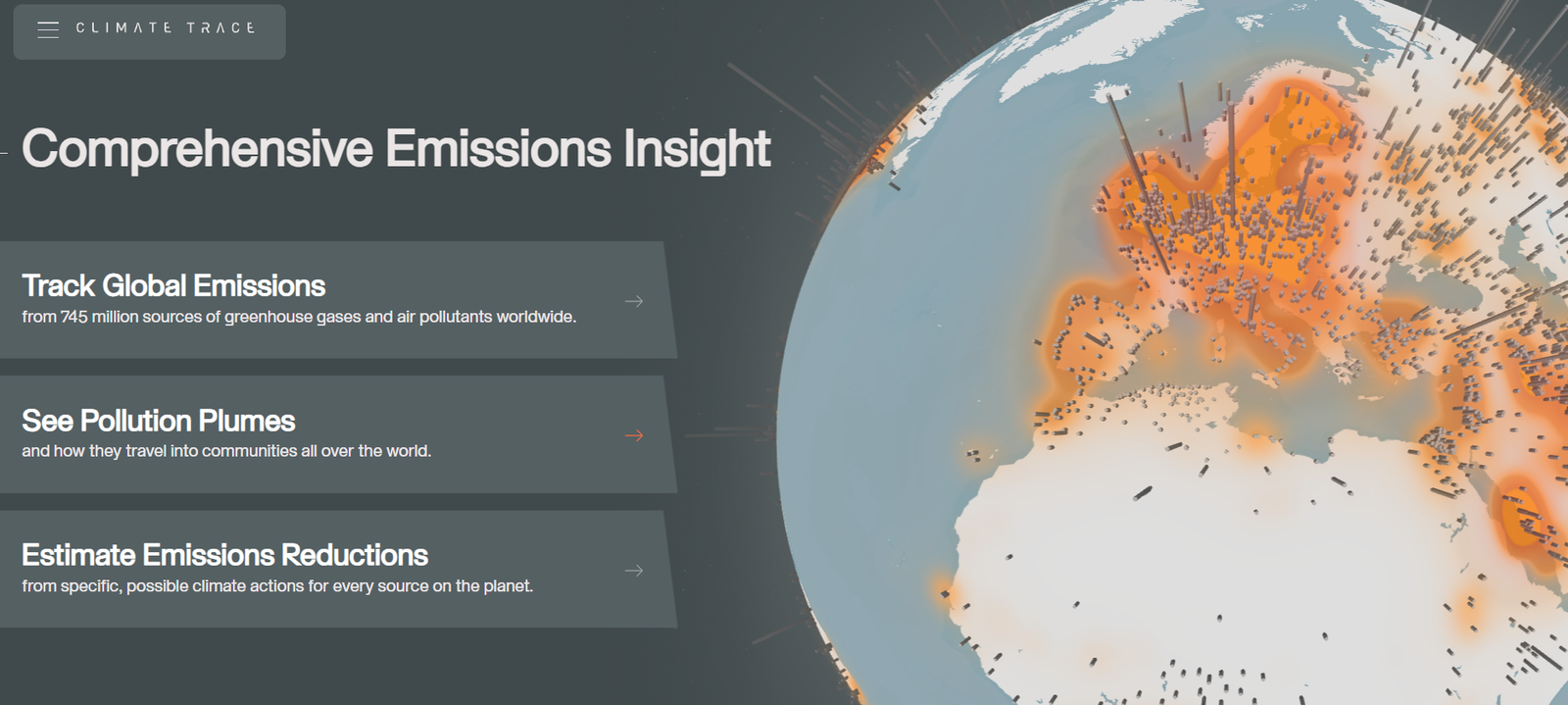
Climate TRACE is an independent global coalition harnessing artificial intelligence, satellite imagery, and remote sensing data to monitor and report greenhouse gas emissions in near real time. As the first global emissions tracking platform that does not rely on self-reported data, Climate TRACE offers unprecedented transparency into the world’s largest sources of carbon and methane emissions across sectors and geographies.
Founded in 2020 and co-led by former U.S. Vice President Al Gore and a consortium of climate and data science organizations, Climate TRACE aims to make climate accountability measurable and accessible. By using AI to analyze massive datasets from satellites and sensors, the platform generates high-resolution emissions estimates from over 352 million sources globally, covering industries such as energy, manufacturing, transportation, and land use.
Climate TRACE transforms how governments, corporations, researchers, and citizens understand emissions sources and trends, ultimately accelerating the global transition toward net-zero targets.
Features
Climate TRACE offers a range of powerful features centered on emissions transparency, climate accountability, and decision support.
AI-Powered Emissions Tracking: Uses machine learning and data fusion to quantify greenhouse gas emissions from millions of sources around the globe.
Global Coverage: Tracks emissions in every country and region, from power plants and oil fields to shipping lanes and industrial complexes.
Near Real-Time Data: Updated regularly using high-frequency satellite inputs and sensor networks, providing recent and actionable insights.
Source-Level Detail: Identifies specific facilities, fields, and operations responsible for emissions, including over 70,000 individual asset locations.
Sectoral Breakdown: Covers key emitting sectors such as power generation, oil and gas, transportation, cement, steel, agriculture, and land use.
Open Access Platform: Provides public access to data through an interactive web-based map and downloadable datasets.
Emissions Inventory Reports: Offers detailed analysis of sector-specific and facility-level emissions, compatible with reporting frameworks.
Transparency and Verification: Replaces self-reported data with independently verified estimates, improving reliability and global accountability.
Custom Search and Visualization: Allows users to filter emissions data by country, industry, or time period and visualize it through maps and graphs.
Collaboration-Ready Data: Supports researchers, policymakers, and climate advocates in building models, creating reports, and making decisions.
How It Works
Climate TRACE collects and analyzes data from over 300 satellites, remote sensors, public databases, and other sources. These inputs include thermal imaging, radar, ship tracking, aerial photography, and multispectral imagery. Using advanced algorithms and AI models, Climate TRACE translates this raw data into precise emissions estimates at the source level.
The platform’s data processing pipeline fuses satellite imagery with AI to identify activities such as fuel combustion, deforestation, methane flaring, and industrial production. Emissions are then estimated using sector-specific methodologies aligned with best available scientific research and validated through ground-truth comparisons wherever possible.
Users interact with the data through the Climate TRACE web platform, which features a global map highlighting emission sources. Each asset is labeled with its estimated emissions in metric tons of CO₂ equivalent (CO₂e), and users can drill down into specific countries, regions, and sectors. The platform also enables time-series analysis, helping users observe emission trends over time.
By bypassing delays in self-reported inventories and national reporting lags, Climate TRACE offers a dynamic and independent alternative for real-time climate monitoring.
Use Cases
Climate TRACE serves a wide array of users across governments, academia, the private sector, and civil society. Common use cases include:
Government and Policy Planning: National and subnational governments use Climate TRACE to design, monitor, and enforce climate policies, including tracking progress toward emission reduction targets.
Climate Accountability: NGOs and watchdog groups use the platform to verify emissions claims made by corporations and nations, promoting transparency and climate justice.
Corporate Emissions Disclosure: Companies can compare their self-reported emissions with independent estimates and identify high-impact areas for mitigation.
ESG and Finance: Asset managers and ESG analysts use Climate TRACE data to evaluate the climate risk of investments and align portfolios with sustainability goals.
Scientific Research: Climate scientists and academics use emissions data to model climate scenarios, validate satellite datasets, and improve forecasting accuracy.
Journalism and Advocacy: Reporters and campaigners use the data to highlight major emitters, investigate discrepancies, and educate the public on emission trends.
Carbon Markets and Offsets: Organizations involved in carbon offsetting use Climate TRACE data to assess real-world emissions baselines and validate offsets.
Education and Public Awareness: The platform serves as an educational tool to illustrate the real-world impacts of different sectors and regions on the climate.
Pricing
Climate TRACE is a non-profit, open-access initiative. The platform and its data are entirely free to use for the public. Users can explore the emissions map, access global data, and download detailed reports without registration or payment.
There is no subscription model or commercial offering currently associated with Climate TRACE. All funding comes from philanthropic support, and the organization remains committed to providing emissions transparency as a public good.
For organizations seeking collaboration, integration, or custom support, Climate TRACE may provide additional guidance or partner via formal request through their official contact page.
Strengths
The greatest strength of Climate TRACE is its independence and scientific rigor. Unlike many existing emissions inventories that rely on outdated or self-reported data, Climate TRACE provides near real-time, AI-verified data from physical observations.
Its source-level granularity allows for pinpointing emissions down to specific facilities, making it one of the most detailed and transparent emissions databases available. This is particularly valuable for sectors like oil and gas, where emissions are often underreported.
The platform’s open-access nature and intuitive map interface make it a uniquely democratic tool. It empowers citizens, researchers, and policymakers to access climate data without technical or financial barriers.
Another strength is the coalition model. Climate TRACE is led by over 100 collaborating organizations, ensuring multidisciplinary expertise across satellite analytics, AI modeling, environmental science, and climate policy.
Drawbacks
Despite its transformative potential, Climate TRACE has some limitations. The platform currently focuses on greenhouse gas emissions and may not include comprehensive coverage of other pollutants such as particulate matter, NOx, or SO₂.
While the data is updated regularly, it is not yet real-time in the literal sense. There is still some lag between data acquisition, processing, and publication. However, this lag is far shorter than traditional national reporting systems.
The platform also assumes a level of technical literacy from users. While the interface is visually accessible, interpreting emissions data accurately still requires some understanding of climate science and sectoral practices.
Another consideration is that while Climate TRACE is transparent in its methodology, users looking for raw satellite data or full algorithmic models may need to contact the organization directly for in-depth access.
Comparison with Other Tools
Climate TRACE differs significantly from tools like the Global Carbon Atlas or EDGAR (Emissions Database for Global Atmospheric Research), which rely heavily on national inventories and statistical estimates. Climate TRACE adds a layer of physical observation and AI analytics, allowing for independent verification.
Compared to company-specific ESG platforms such as CDP or S&P Global, Climate TRACE does not depend on corporate disclosures. This makes it more reliable for identifying underreported or unreported emissions.
While NASA and NOAA offer satellite data for climate monitoring, Climate TRACE goes further by applying AI to make that data actionable and human-readable at a source-specific level.
Other tools like the Climate Watch platform from WRI focus on national policy and historical trends. Climate TRACE complements these by adding near real-time emissions at facility scale.
Customer Reviews and Testimonials
Climate TRACE has received endorsements and praise from leading climate experts, governments, and organizations. Al Gore has described the project as a game-changer in the global fight against climate change. Its work has been featured in major media outlets including The New York Times, BBC, The Guardian, and Nature.
While the platform does not display user reviews in the traditional commercial sense, testimonials from the scientific and policy communities frequently emphasize its importance in driving accountability and improving climate action outcomes.
Researchers have noted the platform’s utility in filling data gaps, especially in regions where emissions data is sparse or unreliable. Climate NGOs have applauded the project for its transparency and potential to hold large emitters accountable.
Conclusion
Climate TRACE is a groundbreaking platform redefining how the world tracks greenhouse gas emissions. By combining satellite imagery, AI analytics, and open data principles, it offers an unprecedented level of transparency and accountability in global emissions reporting.
Whether you’re a policymaker, investor, researcher, or citizen, Climate TRACE equips you with actionable data to support climate decision-making. Its commitment to independence, scientific integrity, and open access makes it a valuable resource in the fight against climate change.