
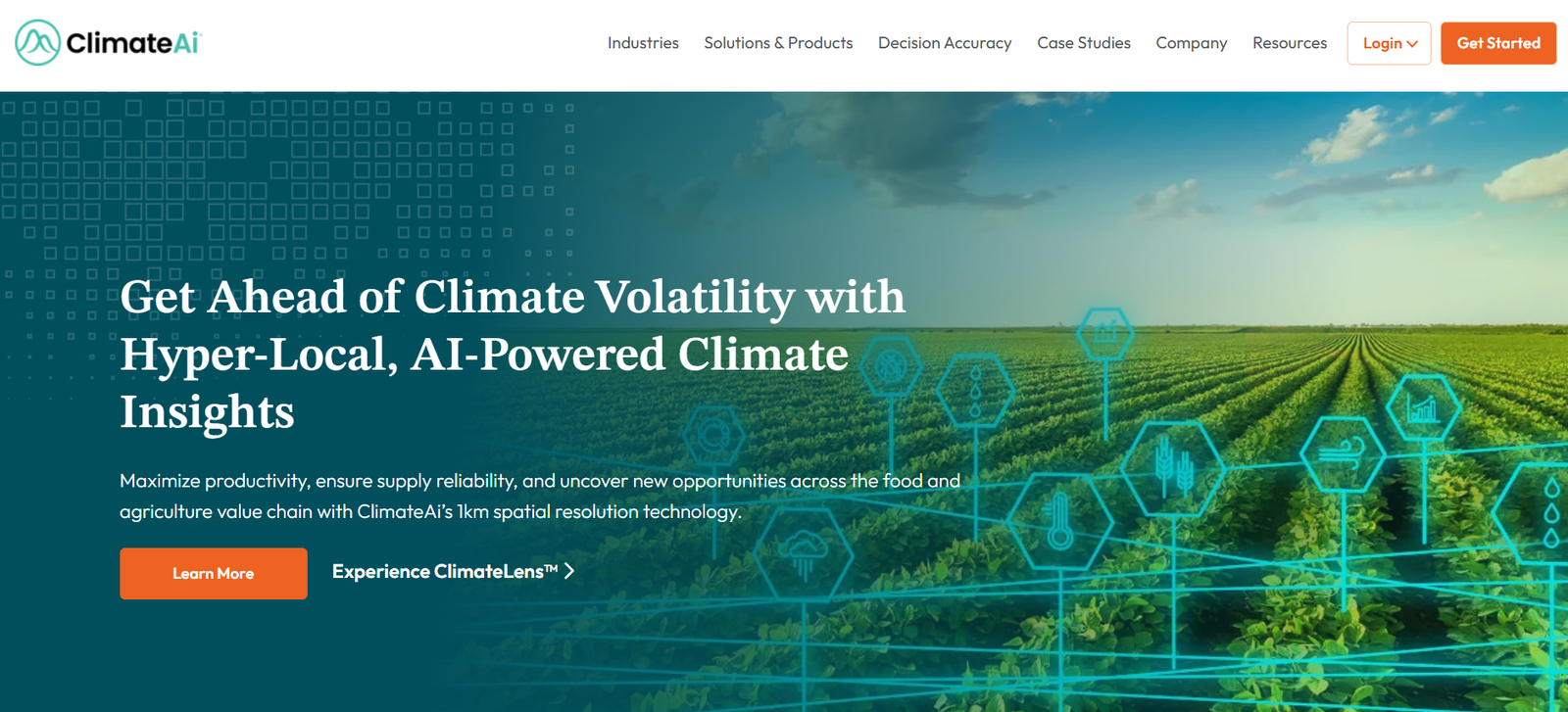
ClimateAI is an enterprise-grade climate intelligence platform that leverages artificial intelligence to provide long-range climate risk forecasting for businesses. Designed to help organizations adapt to climate volatility, the platform uses AI-powered models to deliver actionable predictions that support supply chain resilience, agricultural planning, financial risk mitigation, and infrastructure decision-making.
At the core of ClimateAI is a proprietary suite of climate analytics tools that translate climate data into business insights. These insights help companies forecast climate-related risks at hyperlocal scales, months to years in advance, across multiple sectors. By connecting the dots between weather variability and business operations, ClimateAI empowers companies to future-proof their decision-making against extreme weather, drought, floods, and other environmental risks.
Founded by climate scientists, technologists, and entrepreneurs from Stanford University, ClimateAI is pioneering the use of artificial intelligence in climate adaptation. It provides not just historical and current data, but probabilistic, forward-looking forecasts that are critical for operational and strategic planning in an era of accelerating climate change.
Features
ClimateAI delivers a comprehensive suite of features focused on climate risk management, business forecasting, and adaptive planning:
AI-Powered Climate Forecasting: Uses proprietary machine learning models and climate simulations to provide long-term climate forecasts for temperature, precipitation, drought, and extreme weather events.
Hyperlocal Resolution: Offers granular climate insights at farm, facility, or city-level scales, enabling localized decision-making.
Sector-Specific Solutions: Custom modules designed for agriculture, food supply chains, financial services, infrastructure, and logistics.
Custom Climate Risk Scoring: Generates risk scores for specific regions, crops, facilities, or supply routes based on current and projected climate exposure.
Adaptation Planning Tools: Helps users model future scenarios and develop action plans to mitigate risk and ensure resilience.
Historical Weather Analysis: Access to past climate and weather data to contextualize trends and establish baseline risk profiles.
API and Data Integration: Supports integration with enterprise systems, GIS tools, and custom dashboards via robust API infrastructure.
Climate Resilience Metrics: Quantifies exposure, sensitivity, and adaptive capacity for assets, facilities, and agricultural regions.
Interactive Visualization Dashboard: A user-friendly interface for exploring climate forecasts, risk scores, and scenario analysis in real time.
Scientific Transparency: Backed by peer-reviewed methodologies and developed in collaboration with global climate institutions.
How It Works
ClimateAI combines multiple data sources, including global climate models, satellite imagery, and localized weather station inputs, with proprietary AI algorithms to produce climate forecasts tailored to business use cases. The platform uses ensemble modeling, where multiple models are aggregated to improve accuracy and reduce uncertainty.
Once a company inputs its geographic locations, assets, or supply routes into the system, ClimateAI processes the data and returns forecasts that are aligned with business needs. These can include early warnings for droughts, heatwaves, rainfall variability, or severe weather events.
For agriculture, ClimateAI provides planting and harvesting date recommendations, yield projections, and disease risk forecasts based on seasonal and long-term weather patterns. For supply chains, it helps identify climate-vulnerable nodes and propose alternative sourcing or logistics options.
The platform’s outputs are delivered through interactive dashboards, APIs, or reports, depending on the organization’s workflow. Businesses can customize alert thresholds, risk tolerance levels, and time horizons to align climate risk monitoring with strategic objectives.
Use Cases
ClimateAI serves a broad spectrum of industries where climate variability poses a strategic or operational risk:
Agriculture and Agribusiness: Farmers, food processors, and agribusinesses use ClimateAI to plan planting schedules, mitigate yield loss, and ensure food security in the face of droughts and heatwaves.
Supply Chain and Logistics: Companies map climate risks across sourcing regions and transportation networks to preempt disruptions and enhance supply chain resilience.
Financial Services: Banks, insurers, and investors use the platform to assess climate-related financial risks and opportunities across portfolios, lending practices, and underwriting strategies.
Infrastructure Planning: Developers and utilities assess long-term climate exposure for construction sites, energy grids, and water systems to optimize design and capital investment.
Consumer Goods and Retail: Businesses that rely on agricultural inputs or global distribution networks use ClimateAI to align procurement, inventory, and operational strategy with climate risk profiles.
Government and NGOs: Policy planners and development agencies apply ClimateAI for regional adaptation strategies, disaster preparedness, and resource allocation.
ESG and Reporting: Organizations use ClimateAI’s data to meet sustainability disclosure requirements and align with frameworks like TCFD (Task Force on Climate-related Financial Disclosures).
Pricing
ClimateAI follows a customized enterprise pricing model. Pricing is tailored based on several factors:
Number of geographies or assets being monitored
Industry sector and module requirements (e.g., agriculture, supply chain, finance)
Level of integration (API access, dashboard-only, or white-label solutions)
Volume and frequency of data usage
Customization of risk metrics and forecasts
Due to the nature of enterprise implementations, ClimateAI does not publish public pricing on its website. Prospective clients are encouraged to request a personalized demo and proposal directly from the company’s sales team.
To get a quote or explore partnership opportunities, visit the official ClimateAI website and schedule a consultation.
Strengths
ClimateAI’s most significant strength is its ability to deliver predictive climate intelligence that is actionable and business-focused. Unlike many climate tools that stop at analysis, ClimateAI translates data into specific insights for agriculture, logistics, finance, and infrastructure planning.
Its hyperlocal and long-range forecasting capability offers strategic value that goes beyond short-term weather updates. The platform’s ability to forecast months or even years in advance helps businesses proactively plan for risks rather than react to disasters.
Another core advantage is its scientific credibility. ClimateAI’s models are grounded in peer-reviewed methodologies and benefit from a team that combines AI expertise with deep climate science knowledge.
The platform’s flexibility—ranging from dashboard visualizations to API-based data delivery—also makes it suitable for integration into existing enterprise workflows. Its multilingual and cross-industry adaptability adds further utility for global companies and regional players alike.
Drawbacks
While ClimateAI offers a robust platform, there are a few considerations to note. As an enterprise-grade solution, it may be less accessible for small businesses or individual users due to the customized pricing and implementation complexity.
Another limitation is that the accuracy of long-range climate forecasts, while increasingly reliable, still carries uncertainty. ClimateAI does account for probabilistic modeling, but some businesses may require guidance on interpreting this data effectively.
Due to the technical nature of the platform, teams without in-house expertise in climate science or risk management may face a learning curve during implementation. ClimateAI mitigates this by offering onboarding and support, but the process may still require time and internal alignment.
Finally, since pricing is not publicly available, potential users must go through a sales process before determining whether the platform aligns with their budget.
Comparison with Other Tools
ClimateAI stands out from traditional weather forecasting tools like AccuWeather or The Weather Company by focusing on long-term, business-specific climate intelligence rather than short-term forecasts.
Compared to broader climate analytics firms like Jupiter Intelligence or Cervest, ClimateAI is notable for its specialized focus on agriculture and supply chain resilience. Its use of AI to simulate climate scenarios for planting dates, crop selection, and logistics optimization is more actionable for operational teams.
Other ESG platforms like Plan A or Watershed focus primarily on emissions tracking and sustainability reporting. In contrast, ClimateAI is adaptation-focused, helping companies not just reduce their footprint, but also prepare for climate impacts.
Customer Reviews and Testimonials
ClimateAI has been recognized by leading institutions and featured in media outlets such as Forbes, Bloomberg, and TechCrunch. While formal reviews on G2 or Capterra are limited due to the B2B nature of the platform, customer testimonials published by ClimateAI indicate a strong satisfaction rate.
Companies in agribusiness and consumer goods have credited ClimateAI with helping avoid crop failures, reroute logistics proactively, and meet ESG goals. Many clients appreciate the clarity of the platform’s dashboard and the business relevance of its insights.
User testimonials often highlight the responsive support team, the platform’s ability to localize forecasts, and the return on investment achieved through risk reduction and improved planning.
Conclusion
ClimateAI is a cutting-edge solution for businesses seeking to manage climate risk and build resilience into their operations. With its AI-driven forecasting, hyperlocal insights, and customizable tools, it offers a transformative way to prepare for an unpredictable climate future.
Its sector-specific modules and enterprise-grade infrastructure make it suitable for organizations with complex supply chains, agricultural operations, or infrastructure investments. While it requires a tailored onboarding process, the long-term strategic value it provides far outweighs the initial learning curve.
For companies looking to stay ahead in a world shaped by climate change, ClimateAI offers not just data, but a roadmap to adaptive success. Visit the official ClimateAI website to request a demo and see how predictive climate intelligence can empower your business.


